
A trade signal is a condition-based trigger generated by technical, fundamental, or algorithmic analysis that identifies a high-probability opportunity to buy or sell a financial instrument. Every complete signal includes five core elements: the instrument, direction, entry price, stop-loss, and take-profit target. Missing any one of those elements reduces reliability and increases your risk. For active retail options traders, understanding the definition of trade signals is the foundation of every disciplined trading decision you will make.
What is a trade signal and how does it work?
A trade signal is a specific, actionable alert that tells you when a defined set of conditions has been met in the market. It is not a tip, an opinion, or a gut feeling. It is a structured output from an analysis process, and it answers four questions: what to trade, which direction, where to enter, and where to exit.
The anatomy of a quality signal matters. A signal that says "SPY looks bullish" is useless. A signal that says "Buy SPY 520 call, entry at $3.20, stop at $1.60, target at $6.40" gives you everything you need to size the trade, manage risk, and execute without hesitation. The stop-loss inclusion is critical because it defines your reward-to-risk ratio before you commit a single dollar.

Signals are probabilistic, not deterministic. No signal guarantees a winning trade. The edge comes from applying signals consistently, within a defined risk framework, over a large enough sample of trades.
What are the main types of trade signals?
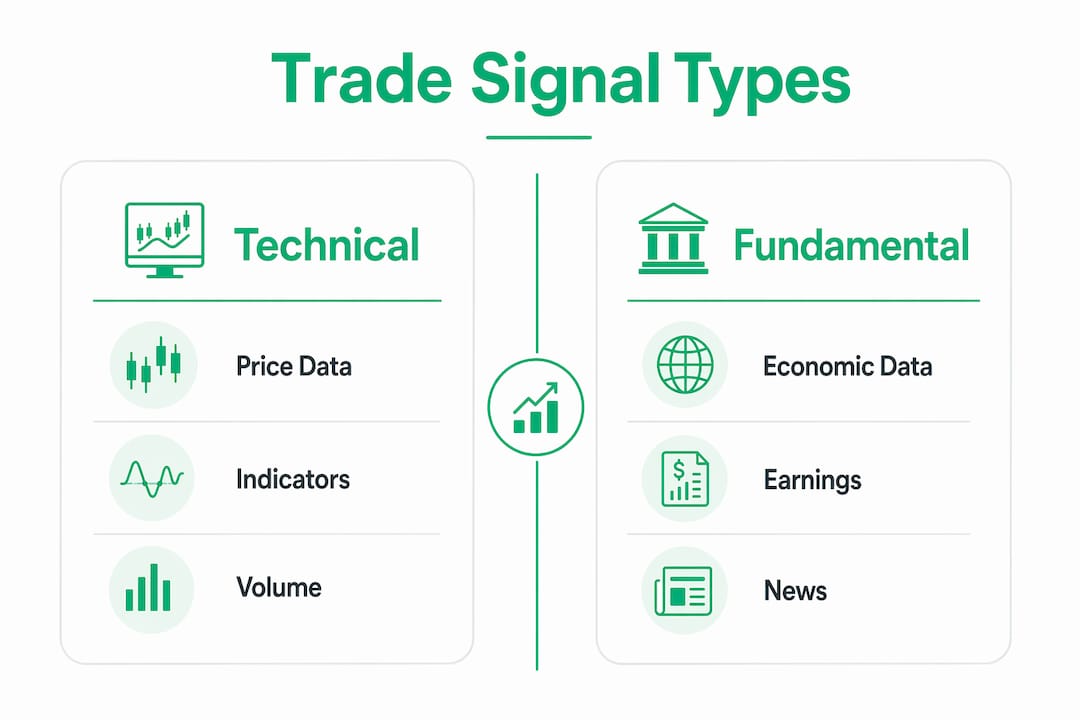
Trade signals fall into three categories: technical, fundamental, and algorithmic. Each draws from a different data source and suits different trading styles.
Technical signals
Technical signals use historical price data, volume, and indicators such as RSI, moving averages, MACD, and Bollinger Bands. They are the most common signal type for retail options traders because they work on any timeframe and any liquid instrument. The trade-off is that technical indicators are lagging by nature. They confirm what has already happened in price, which makes them less effective during sudden reversals or news-driven moves.
Fundamental signals
Fundamental signals derive from economic data releases, earnings reports, interest rate decisions, and sector news. A trader who buys calls ahead of an earnings beat based on revenue growth trends is acting on a fundamental signal. These signals carry more predictive weight in theory, but they require more research time and are harder to quantify into a clean entry and exit.
Algorithmic signals
Algorithmic signals use automated mathematical models to scan thousands of instruments simultaneously and generate alerts in real time. They remove human bias from the detection process. The downside is that most retail traders cannot build or audit these models themselves, which means trusting the output without fully understanding the logic.
| Signal type | Data source | Best for | Key limitation |
|---|---|---|---|
| Technical | Price, volume, indicators | Short-term options setups | Lagging in fast markets |
| Fundamental | Earnings, economic data | Directional plays around events | Time-intensive research |
| Algorithmic | Mathematical models | High-frequency scanning | Logic is often opaque |
How do active retail traders use trade signals effectively?
Receiving a signal is step one. Executing it well requires a five-step process that separates disciplined traders from reactive ones.
- Receive the alert. Note the instrument, direction, entry, stop-loss, and target. Confirm all five elements are present before proceeding.
- Verify with market context. Check the broader trend on a higher timeframe. Professional traders use confluence with higher-timeframe trends and support/resistance levels to significantly increase their probability of success.
- Size the position. Risk management suggests risking 1%–3% of capital per signal-based trade. Calculate your position size from the stop-loss distance, not from a dollar amount you feel comfortable losing.
- Execute with the correct order type. Use limit orders at the signal's entry price. Market orders on options can result in wide slippage, especially in low-volume contracts.
- Monitor or set and forget. Pre-set your stop-loss and take-profit in the platform. Once the trade is live, your job is to let the setup play out.
Pro Tip: Never adjust your stop-loss to avoid a loss. Moving a stop wider after entry is not risk management. It is emotional interference dressed up as strategy.
The verification step is where most retail traders skip ahead. A signal generated in isolation, without checking whether the broader market supports the direction, has a lower probability of success. Confluence is not optional. It is the filter that separates high-quality setups from noise.
What are common misconceptions about trade signals?
The most damaging misconception is that a signal is a command. Signals are probabilistic tools best integrated into broader strategies, not substitutes for trader judgment. A 70% win-rate signal still loses 30% of the time. Treating every alert as a guaranteed outcome leads to oversizing, emotional reactions, and account damage.
A second misconception is that more signals equal more profit. Frequency is not an edge. Traders who chase every alert, regardless of setup quality or personal risk tolerance, accumulate losses faster than traders who wait for high-conviction setups.
Here are the most common pitfalls to avoid:
- Ignoring your own risk tolerance. A signal sized for a $100,000 account is not appropriate for a $10,000 account. Understanding the trade setup rationale and adjusting for your account size is non-negotiable.
- Skipping the "why." If you cannot explain why a signal was generated, you cannot evaluate whether it applies to current conditions. Breakout signals fail in range-bound markets. Reversal signals fail in strong trends.
- Emotional interference after entry. A disciplined set-and-forget approach with pre-set exit points prevents the reactionary mistakes that destroy otherwise solid setups.
- No tracking system. Traders who do not log their signal-based trades cannot identify patterns in what works and what does not.
Pro Tip: Keep a trading journal with at least four fields per trade: signal type, entry reason, outcome, and what you would do differently. Review it weekly.
Tracking signal performance by category allows you to filter out consistently underperforming signal types and concentrate on the setups that fit your style. A breakout trader who keeps taking reversal signals because they look attractive is working against their own edge.
How do you evaluate and select high-quality trade signals?
Signal quality is not about how confident the alert sounds. It is about completeness, logic, and track record.
A complete signal contains all five elements: instrument, direction, entry, stop-loss, and take-profit. Any signal missing a stop-loss is incomplete by definition. Without a stop-loss, you cannot calculate a reward-to-risk ratio, and without that ratio, you cannot size the trade correctly.
Reward-to-risk ratio is the single most useful metric for evaluating a signal before you take it. A signal with a 1:1 ratio requires a win rate above 50% just to break even after commissions. A signal with a 2:1 ratio is profitable at a 40% win rate. Prioritize signals with ratios of 2:1 or better.
Backtesting and track records matter. A signal provider with a documented history of setups, including losses, is more credible than one showing only winners. Consistency over 50 or more trades is a meaningful sample. Anything less is noise.
Morningoptions uses a five-AI pipeline to vet, score, and rank daily options trade ideas. Each briefing delivers specific contract ideas with entry levels before the market opens, not vague directional commentary. That specificity is what makes a signal usable rather than decorative.
What tools support effective trade signal use?
Signal delivery and execution infrastructure matter as much as signal quality. A great signal received 20 minutes after the entry window has closed is worthless.
Signals can be delivered via SMS, email, push notifications, or apps, with automated execution available for traders who use bots and manual execution for those who prefer discretion. Most active retail options traders use manual execution because options contracts require judgment on strike selection and expiration that automated systems handle poorly without customization.
The tools that complement signal use most effectively include:
- A platform with fast order entry. Slippage on options is real. A platform that requires five clicks to enter a trade costs you edge on every fill.
- Preset stop-loss and take-profit functionality. This is the infrastructure that makes set-and-forget execution possible.
- A signal aggregator or scanner. Rather than monitoring dozens of tickers manually, a scanner surfaces setups that meet your criteria. Morningoptions delivers AI-powered daily trade ideas ranked by quality before the open, giving you a prioritized list rather than a raw data dump.
- A trading journal app or spreadsheet. Performance tracking is not optional if you want to improve.
The combination of a quality signal source, a fast execution platform, and a consistent logging system creates the infrastructure for disciplined trading. Any one of those three elements missing creates a gap that costs money over time.
Key Takeaways
A trade signal is only as useful as the risk management framework around it. Signals without stop-losses, position sizing rules, and performance tracking are just noise with a timestamp.
| Point | Details |
|---|---|
| Signal anatomy | Every quality signal includes instrument, direction, entry, stop-loss, and take-profit. |
| Three signal types | Technical, fundamental, and algorithmic signals each suit different trading styles and timeframes. |
| Risk per trade | Limit each signal-based trade to 1%–3% of total capital to protect against losing streaks. |
| Confluence matters | Verify signals against higher-timeframe trends and support/resistance before executing. |
| Track performance | Log every signal trade by category to identify which setups consistently work for your style. |
Why I stopped chasing "perfect" signals
Most retail traders spend too much time searching for the signal with the highest win rate. I spent years doing the same thing. The uncomfortable truth is that win rate is the least important metric in signal trading. Consistency in risk management outweighs it every time.
The traders I have seen blow accounts were not using bad signals. They were using decent signals with no position sizing discipline and no set-and-forget execution. They moved stops, doubled down on losers, and skipped the journal because logging losses felt discouraging. That combination is lethal regardless of signal quality.
What actually works is simpler than most traders want to admit. Pick a signal type that fits your schedule and risk tolerance. Verify every alert with at least one confluence factor. Risk the same percentage per trade, every trade. Log the results. Review weekly. Adjust quarterly.
The signals are not the hard part. The discipline is.
— Customer
Morningoptions delivers signals built for active options traders
Active retail options traders need specific contract ideas with entry levels before the open, not directional opinions they have to translate into a trade themselves.
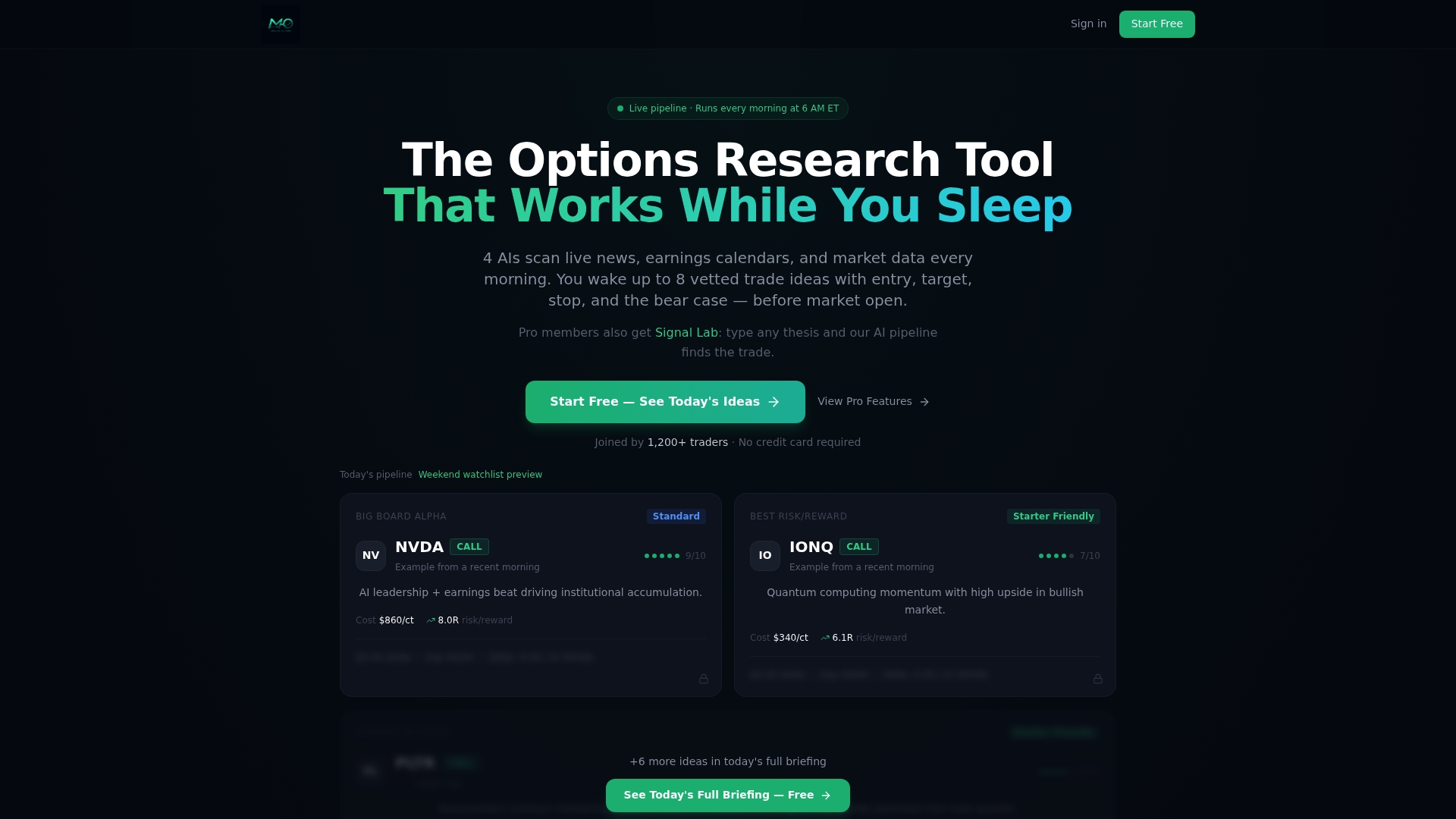
Morningoptions runs every market morning through a five-AI pipeline that vets, scores, and ranks options trade ideas by quality. The free daily briefing gives you ranked setups with entry levels before the bell. The Pro tier at $89/mo adds a lunchtime scanner and an on-demand AI chat scanner for researching any ticker you want. Every idea comes with the specificity a real trade requires. Visit Morningoptions to get your first briefing before tomorrow's open.
FAQ
What is a trade signal in simple terms?
A trade signal is a specific alert that tells you when to enter or exit a trade, based on defined conditions from technical, fundamental, or algorithmic analysis. It includes the instrument, direction, entry price, stop-loss, and take-profit target.
Are trade signals guaranteed to be profitable?
No. Trade signals are probabilistic tools, not guarantees. Even high-quality signals lose a percentage of the time, which is why consistent risk management matters more than win rate.
How much should I risk per trade signal?
Standard risk management practice suggests risking 1%–3% of your total trading capital per signal-based trade. This protects your account during losing streaks while keeping you in the game long enough to benefit from your edge.
What makes a trade signal high quality?
A high-quality signal includes all five core elements: instrument, direction, entry, stop-loss, and take-profit. It also carries a reward-to-risk ratio of 2:1 or better and comes from a source with a documented, consistent track record.
How do I know which type of trade signal suits my style?
Track your results by signal category over at least 50 trades. Filtering signals based on historical success in your own trading journal reveals which types, such as breakout versus reversal, consistently perform well for your specific approach and schedule.