
An options contract is a legal right to buy or sell 100 shares of an asset at a fixed price before a set expiration date. Executing your first options trade step by step requires more than picking a stock. It demands account setup, approval levels, strategy selection, and a defined exit plan before you place a single order. This guide walks you through every stage, from opening a brokerage account to closing your position, using 2026 industry standards and risk management norms that give beginners the clearest path to a confident, low-risk start.
What preparatory steps do you need before your first options trade?
Your brokerage account is the foundation of every trade you will ever place. Opening one takes 10–15 minutes online, but the options approval process requires more thought. Brokers use a tiered approval system with levels 1–5, where each level unlocks progressively riskier strategies. Be honest about your experience and goals on the application. Understating your knowledge to gain higher access backfires because you end up in strategies you cannot manage.
Once approved, fund your account with capital you can afford to lose. A common starting point is $3,000–$5,000, which gives you enough room to practice position sizing without risking financial damage. Before touching real money, learn to read an options chain. An options chain lists every available contract for a stock, organized by expiration date, strike price, bid price, ask price, and open interest. These five columns are the raw data behind every trade decision you will make.
You also need to understand three order types before going live: limit orders, market orders, and stop orders. Limit orders are the only type you should use as a beginner. They let you set the exact price you are willing to pay, which protects you from the wide bid-ask spreads that are common in options markets.
- Brokerage account: Choose a broker that offers options trading with a clear approval process and educational tools.
- Options approval level: Apply for Level 1 or Level 2 to access covered calls and cash-secured puts.
- Options chain literacy: Practice reading strike prices, expiration dates, bid/ask columns, and open interest.
- Risk calculator: Use your broker's built-in tools to calculate maximum loss before entering any trade.
- Paper trading: Simulate trades without real money to build decision-making habits.
Paper trading for 4–6 weeks is the standard recommendation before going live. That window is not just about mechanics. It trains your emotional responses to winning and losing positions, which is the real skill gap for most beginners.
Pro Tip: Set up your paper trading account to mirror your real account size exactly. If you plan to trade with $5,000, simulate with $5,000. Practicing with fake millions creates habits that do not transfer to real trading.
How do you select the right contract for your first trade?
Choosing the right underlying asset is the first real decision in any options trade tutorial. Beginners should start with large-cap stocks or broad ETFs like SPY or QQQ. These assets have high liquidity, tight bid-ask spreads, and predictable behavior compared to small-cap stocks or sector-specific names. Liquid markets mean you can enter and exit positions without paying a large penalty on the spread.

Call vs. put: which one fits your outlook?
A call option gives you the right to buy shares at the strike price. You buy a call when you expect the stock to rise. A put option gives you the right to sell shares at the strike price. You buy a put when you expect the stock to fall. As a beginner, stick to one direction at a time. Do not buy both simultaneously until you understand how each behaves independently.
Choosing the right strike price and expiration
Strike price selection determines your cost and probability of profit. At-the-money (ATM) options, where the strike price is close to the current stock price, offer the best balance of cost and sensitivity for beginners. In-the-money (ITM) options cost more but behave more like owning the stock, which makes them easier to understand. Avoid deep out-of-the-money options. They are cheap for a reason: they expire worthless most of the time.
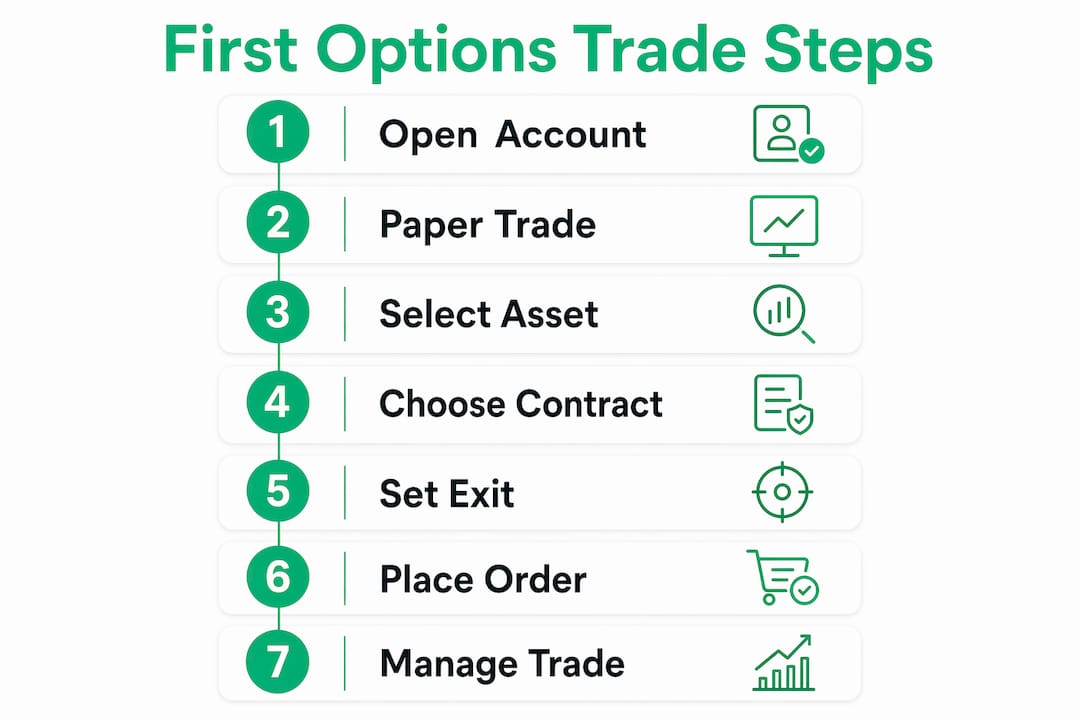
Options with 30–60 days to expiration are the standard recommendation for beginners. That window gives you enough time for your thesis to play out without paying excessive premium. It also reduces the damage from theta decay, which is the daily erosion of an option's value as expiration approaches.
| Contract feature | Beginner-friendly choice | Why it matters |
|---|---|---|
| Underlying asset | Large-cap stocks or SPY/QQQ | High liquidity, tight spreads |
| Option type | Call (bullish) or put (bearish) | Matches your market outlook |
| Strike price | At-the-money or in-the-money | Better probability of profit |
| Expiration | 30–60 days out | Reduces theta decay risk |
| Weekly options | Avoid | High gamma and theta risk |
Pro Tip: Before selecting any contract, check the open interest column in the options chain. Open interest above 500 contracts signals a liquid market where you can exit without getting stuck.
How do you place your first options order and manage execution?
Placing your first live order is where theory meets reality. Follow these steps in order to avoid the most common execution mistakes.
- Select the contract. Pull up the options chain for your chosen stock. Find the expiration date in the 30–60 day range and click on the strike price you selected.
- Choose a limit order. Use a limit order rather than a market order. Set your limit price at the midpoint between the bid and ask. For example, if the bid is $2.00 and the ask is $2.40, enter a limit of $2.20.
- Set quantity to one contract. One contract controls 100 shares. A $2.20 premium means your total cost is $220 plus any broker fees. Each contract controls 100 shares, so always multiply the premium by 100 to get your real dollar exposure.
- Calculate total cost and fees. Round-trip execution costs including bid-ask spread and broker commissions reduce your net profit. Factor these in before you decide the trade is worth placing.
- Set your exit targets before submitting. Decide your profit target (commonly 50% gain on the premium) and your maximum loss (commonly 50% of premium paid) before you click submit. Write them down.
- Submit and confirm. Review the order ticket one final time. Confirm the expiration date, strike, quantity, and limit price. Then submit.
- Monitor and close. Check the position daily. If the trade hits your profit target or loss limit, close it immediately. Do not wait for expiration.
Defining your exit plan before entry is the single habit that separates profitable traders from emotional ones. Most successful traders close positions early rather than riding them to expiration.
Pro Tip: If your limit order does not fill within 15 minutes, adjust the price slightly toward the ask. Options markets move fast, and a stale order can miss the trade entirely.
What are the best beginner-friendly options strategies?
The two strategies with the strongest track record for beginners are covered calls and cash-secured puts. Covered calls and cash-secured puts carry historical win rates of 65–70%, which is significantly higher than buying outright calls or puts. Both strategies involve selling options rather than buying them, which means you collect premium upfront and profit when the stock stays within a range.
A covered call works like this: you own 100 shares of a stock and sell a call option against them. You collect the premium immediately. If the stock stays below the strike price at expiration, the option expires worthless and you keep the premium as income. A cash-secured put works similarly: you sell a put option and hold enough cash to buy the shares if assigned. You collect premium and only buy the stock if it drops to your strike price, which is a price you were already willing to pay.
Buying outright calls or puts (long options) is simpler to understand but harder to profit from. You need the stock to move in the right direction, by enough, and fast enough to overcome theta decay. That is three conditions instead of one.
- Covered call: Best for stocks you already own or are willing to hold long term.
- Cash-secured put: Best for stocks you want to buy at a lower price.
- Long call or put: Simpler to understand but requires precise timing and direction.
- Naked options and spreads: Avoid these until you have at least 6 months of live trading experience.
The defining principle of starting options trading best practices is this: trade defined-risk strategies first. Know your maximum loss before you enter. That single rule eliminates the worst outcomes for beginners.
What common pitfalls should you watch for in early options trades?
About 75% of new options traders lose money on their first trades. The most common cause is not bad luck. It is over-leveraging. Because each contract controls 100 shares, a $500 options position gives you exposure to $50,000 worth of stock movement. Beginners who do not account for this multiplier take on far more risk than they realize.
The second most common mistake is trading short-dated weekly options. Weekly options have high gamma risk, meaning their price swings wildly with small stock moves. They also decay rapidly in the final days before expiration. That combination creates emotional, reactive trading that almost always leads to losses.
"Professional options traders conduct pressure tests with paper trading, ensuring consistent exit decisions under various market pressures before engaging real capital."
A trade journal is one of the most underused tools in options trading basics. After every trade, record the entry price, exit price, your original thesis, what actually happened, and what you would do differently. Reviewing 20–30 trades reveals patterns in your decision-making that no course or book can teach you.
- Over-leveraging: Always multiply the premium by 100 to understand your real dollar exposure.
- Weekly options: Avoid contracts with fewer than 21 days to expiration until you are experienced.
- No exit plan: Set profit and loss targets before entering every trade, without exception.
- Emotional exits: Follow your predetermined plan. Do not change your exit target mid-trade because of fear or greed.
- Ignoring costs: Execution costs beyond the premium, including spread and fees, directly reduce your net return.
Beginners should limit risk to 2–5% of account value per trade. On a $3,000 account, that means a maximum of $60–$150 at risk per position. That constraint feels restrictive at first. It is the constraint that keeps you in the game long enough to get good.
Key takeaways
Executing your first options trade successfully requires preparation, defined risk limits, and a predetermined exit plan before a single order is placed.
| Point | Details |
|---|---|
| Preparation before trading | Open a brokerage account, gain options approval, and paper trade for 4–6 weeks before going live. |
| Contract selection | Choose liquid large-cap stocks or ETFs with 30–60 day expirations and at-the-money strikes. |
| Order execution | Always use limit orders and calculate total cost by multiplying the premium by 100. |
| Risk management | Limit each trade to 2–5% of your account and set profit and loss targets before entry. |
| Beginner strategies | Covered calls and cash-secured puts carry 65–70% historical win rates and suit beginners best. |
What I have learned about starting options trading the right way
Most beginners treat options as a shortcut to fast profits. That framing is the root cause of most early losses. Options are probability tools. Every trade you place is a bet on a range of outcomes, not a prediction of a single price. The moment you internalize that, your decision-making changes completely.
The traders I have seen succeed early share one trait: they treat the first 3–6 months as a tuition period. They size small, track every trade, and focus on process over outcome. A losing trade with a sound process is more valuable than a winning trade based on luck. Luck does not repeat. Process does.
The biggest mistake I see is skipping paper trading because it "feels fake." Paper trading is not about simulating profits. It is about building the muscle memory to close a losing position without hesitation. That skill is worth more than any strategy.
Realistic expectations matter more than any single technique. Options trading is not passive income from day one. It is a skill that compounds over time, and the beginners who treat it that way are the ones still trading two years later.
— Customer
How Morningoptions helps beginners execute better trades
Getting your first options trade right is hard when you are building your process from scratch. Morningoptions runs a five-AI pipeline that vets, scores, and delivers daily trade ideas before the market opens, so you start each session with pre-filtered opportunities rather than a blank screen.
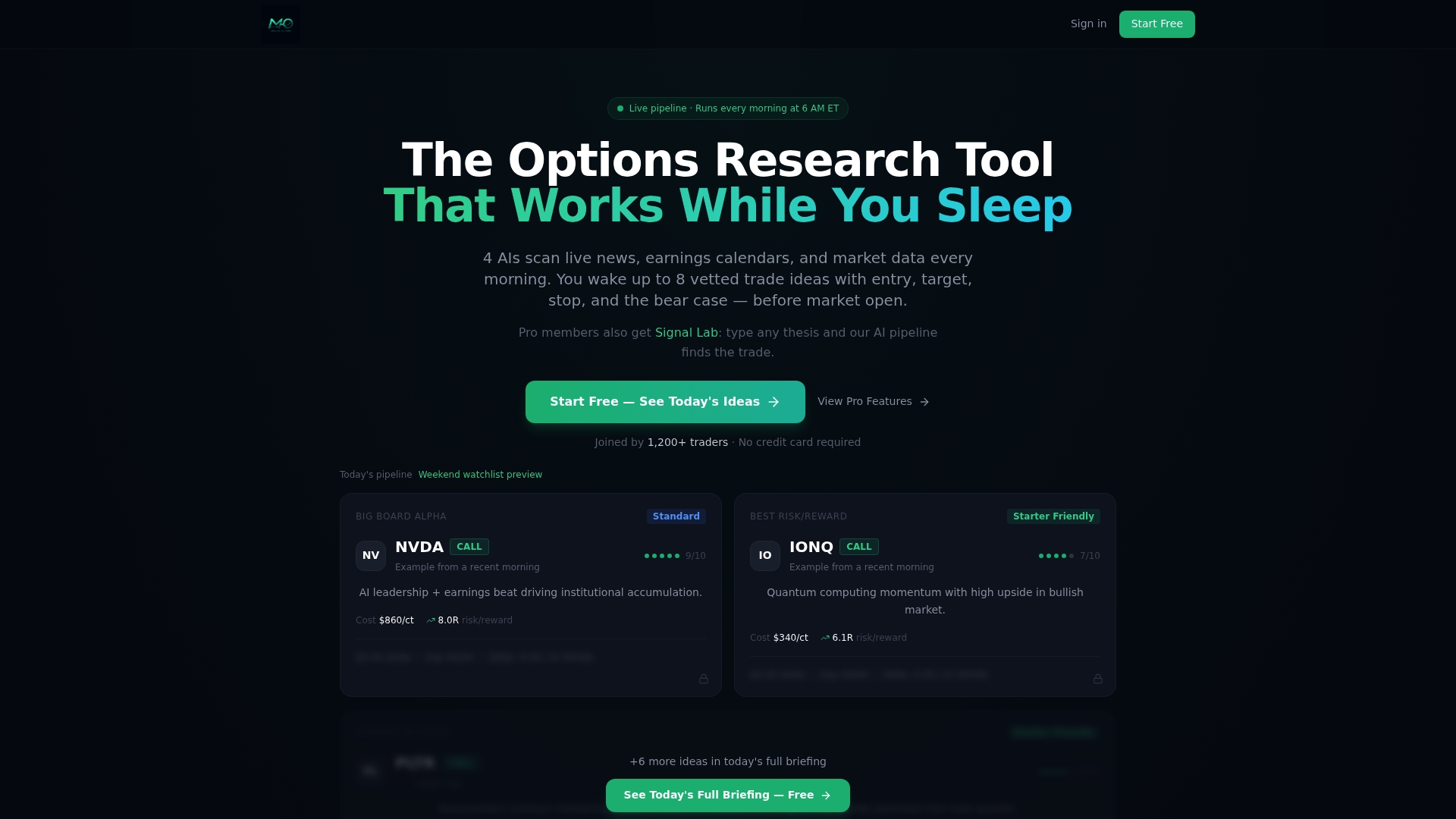
Each idea from Morningoptions includes risk controls, sizing guidance, and strategy context aligned with the best practices covered in this guide. That means you are not just getting a ticker. You are getting the reasoning behind the trade, which is exactly what beginners need to build real understanding. Visit Morningoptions to see how daily vetted trade ideas can sharpen your decision-making from your very first live trade.
FAQ
What is an options contract for beginners?
An options contract gives you the right to buy or sell 100 shares of a stock at a fixed price before a set expiration date. You pay a premium for that right, and your maximum loss is limited to the premium paid.
How much money do I need to start options trading?
A starting account of $3,000–$5,000 gives you enough room to practice proper position sizing. Limit each trade to 2–5% of your account to avoid early losses.
What expiration date should I choose for my first trade?
Options with 30–60 days to expiration are the standard recommendation for beginners. That range balances cost, time for your thesis to develop, and manageable theta decay.
Why should I use a limit order instead of a market order?
Options markets have wide bid-ask spreads. A market order fills at the ask price, which can cost significantly more than the midpoint. A limit order lets you set the exact price you pay.
What is the safest options strategy for a first trade?
Covered calls and cash-secured puts are the safest starting points, with historical win rates of 65–70%. Both strategies collect premium upfront and profit when the stock stays within a predictable range.