
The most reliable 0DTE options strategy is defined-risk premium selling, vertical credit spreads and iron condors, sized to your maximum loss rather than your collected credit, with debit trades reserved for high-conviction, event-driven moves. The non-negotiable guardrails: cap risk per trade at a fixed dollar amount, never hold naked short options into the final 30 minutes without a hard exit, and assume your broker may liquidate before you do. The setups, sizing math, and a full walkthrough follow below.
TL;DR:
- Vertical credit spreads are the most reliable 0DTE strategy, with risk capped at your maximum loss and best suited for mild directional views.
- Manage risk carefully by sizing positions to your max dollar loss, using intraday stop-losses, and avoiding large naked shorts near market close or in the first 15 minutes.
- Expect gamma spikes and liquidity thinness to cause sharp moves and slippage, requiring real-time tools and disciplined order execution.
- Avoid buying options when implied volatility is already high relative to expected moves; instead, focus on premium collection in range-bound conditions.
- Use defined-risk spreads and strict exit rules, logging trades and avoiding emotional decisions to prevent big losses in fast-moving, complex markets.
Table of Contents
- What Is the Best 0DTE Options Strategy for Same-Day Expiration?
- How Do You Actually Build and Manage Each 0DTE Setup?
- What Are the Biggest Risks in 0DTE Trading and How Do You Manage Them?
- Why Do Gamma, Theta, and Vega Behave Differently on Expiration Day?
- When Should You Use Each 0DTE Strategy Based on Market Conditions?
- What Does a Complete 0DTE Trade Walkthrough Look Like?
- What Tools and Order Tactics Do You Need for 0DTE Trading?
- What's the 60-Second Checklist Before Placing a 0DTE Trade?
- A Trader's Honest Take on Trading Same-Day Expirations
- How Morningoptions Helps You Trade 0DTE With a Repeatable Process
- Where to Verify 0DTE Rules and Data Yourself
- Sources
What Is the Best 0DTE Options Strategy for Same-Day Expiration?
Same-day options trading now represents a large portion of daily volume, which changes how you should think about strategy selection. In 2023, roughly 43% of average daily SPX volume was same-day expiration, according to Cboe. That scale isn't a curiosity. It means the bid/ask spreads on SPX 0DTE contracts are tight enough to make defined-risk selling genuinely repeatable, not just theoretically sound.
Here's the shortlist of strategies that actually get used, ranked roughly by how often professional-leaning retail traders deploy them:
- Vertical credit spreads (sell one strike, buy a further OTM strike): the workhorse for a mild directional lean with capped risk. Best when you have a view but want defined downside.
- Iron condors (credit spread on both sides): the go-to for range-bound days with moderate implied volatility. Cboe's data on same-day spread volume shows credit spreads and condors make up a large share of same-day spread activity, for good reason.
- Short strangles or straddles (naked short calls and puts, no protective wing): higher theta collection, but unlimited-ish risk on one side. Experienced traders only, and never oversized.
- Long calls or puts (debit): reserved for high-conviction, event-driven moves, like a Fed decision or an earnings gap in a liquid underlying. You're paying for gamma and betting on magnitude.
- Debit verticals: a reduced-cost way to express the same directional view as a long call or put, with a capped max loss and a capped max gain.
- Gamma or delta hedging with the underlying, and naked short single options: expert-only territory. These require constant attention and a real feel for how fast delta moves near the money on expiration day.
Zero days to expiration options, per Investopedia's definition, exist specifically to let traders capture rapid premium decay or hedge intraday exposure. That framing matters. Everything below assumes you're trading the decay, not gambling on a coin flip.
How Do You Actually Build and Manage Each 0DTE Setup?
Strategy selection is the easy part. Execution is where most 0DTE traders lose money even when they picked the right setup.
1. Vertical credit spreads. Sell a strike around 15 to 20 delta, buy the next strike out (often 5 to 10 points wide on SPX, tighter on SPY). Target a credit that's a moderate portion of the width between strikes. On a 10-point-wide SPX spread, that means collecting a few dollars per spread. Max loss is the width minus the credit received, multiplied by 100. A 10-point spread collecting $3.00 risks $7.00, or $700 per contract. Size to that $700, not to the $300 you're hoping to keep.
2. Iron condors. Build two credit spreads, one on the call side and one on the put side, both around 10 to 15 delta on the short strikes. On a calm SPX day with a modest expected move, condors let you collect premium from both directions while capping total risk to the wider of the two spread widths. Enter both sides as a single four-leg order when your broker's platform supports it. Filling legs separately on a fast-moving morning is how you end up accidentally net-long or net-short without meaning to.
3. Short strangles and straddles. These carry no defined ceiling on loss, so sizing is entirely about margin buffer and hard stops, not credit collected. A common professional rule, echoed in FINRA's guidance on 0DTE risk, is to size positions to your maximum tolerable loss for the day, not to what you've collected in premium. If you're not comfortable defining that number before you enter, you're not ready for this trade type.
4. Long calls and puts (debit). Buy at or slightly out of the money, 40 to 55 delta, when you have a specific catalyst and the implied move priced into the option looks smaller than what you expect to happen. Because theta burns fast on expiration day, plan your exit before entry, not after.
5. Debit verticals. Same directional idea as a long call or put, but you sell a further OTM strike against it to reduce cost and cap the position at a known maximum gain. This trims your breakeven and reduces the drag from a sudden implied volatility drop after the catalyst hits.
6. Gamma and delta hedging. If you're running a naked short position and it moves against you, buying a small amount of the underlying (or an offsetting option) to flatten delta is a legitimate adjustment, not a panic move, as long as you've planned the hedge ratio in advance. This is advanced work and it assumes you already understand assignment mechanics cold.
On order execution: always try to leg in with limit orders first, even on multi-leg spreads. Paired spread orders (entering both legs as one ticket) reduce the risk of a partial fill leaving you exposed on just one side. If you get a partial fill on a two-leg spread, don't chase the second leg at market. Either cancel and reprice, or accept the single-leg exposure and manage it as its own position with its own stop.
Common adjustments during the session: rolling a tested short strike further out for a small additional credit, buying a few shares or a cheap option to offset delta on a spread that's gone against you, or simply closing early when the setup has clearly failed rather than waiting for expiration to prove you wrong. None of these are exotic. They're routine maintenance, and skipping them is how a manageable loss becomes an account-threatening one. For sizing frameworks that scale with account size, this guide on small-account options strategies breaks down position limits by capital tier.
What Are the Biggest Risks in 0DTE Trading and How Do You Manage Them?
The risks in same-day options trading aren't abstract. They show up fast, and they compound if you're not sized correctly.
Gamma spikes. Near-the-money options on expiration day carry gamma that can double or triple in the final hours as time value evaporates. A position that looked comfortably out of the money at 10 AM can be at-the-money and swinging hard by 2 PM. Size every position so a single large intraday move against you, the kind that happens a handful of times a month, doesn't threaten your account. That means sizing to max defined loss, a rule FINRA effectively echoes when it warns that 0DTE contracts can produce total loss within a single session.

Execution and liquidity risk. Wide bid/ask spreads on less-liquid strikes eat into your edge before you even get filled. Budget for slippage the way you'd budget for a commission, not as an afterthought. A spread that looks like it collects $3.00 on the mid-price might only fill at $2.70 in practice.
Broker behavior. This is the one retail traders underestimate most. Brokers can and do liquidate positions ahead of the close to avoid assignment risk, particularly on physically settled equity options versus cash-settled index products like SPX. FINRA notes this pre-close liquidation risk directly, and the OCC's Options Disclosure Document lays out the assignment framework that makes this possible. Know your broker's specific cutoff time for 0DTE positions before you ever place a trade.
Concrete rules that keep you in the game: For practical risk management and position-sizing rules that complement these guidelines, see Risk Management and Position Sizing in Practice.
- Cap max dollar risk per contract before entry, based on the spread width, never the credit.
- Set a max open-dollar exposure across all 0DTE positions combined, not per trade.
- Use intraday stop-losses tied to the underlying's price level, not just the option's price, since option pricing can lag in fast markets.
- Build in a time-based exit, such as closing anything unresolved by 3:30 PM ET regardless of P&L, to avoid the final-30-minute gamma scramble.
Pro Tip: Check your margin account terms for 0DTE-specific rules before you trade. The SEC's margin account bulletin explains how brokers can adjust requirements intraday, and some firms apply stricter buying power reductions to same-day expirations than to standard monthly contracts.
Why Do Gamma, Theta, and Vega Behave Differently on Expiration Day?
The Greeks don't just describe risk on 0DTE contracts. They dictate strike selection.
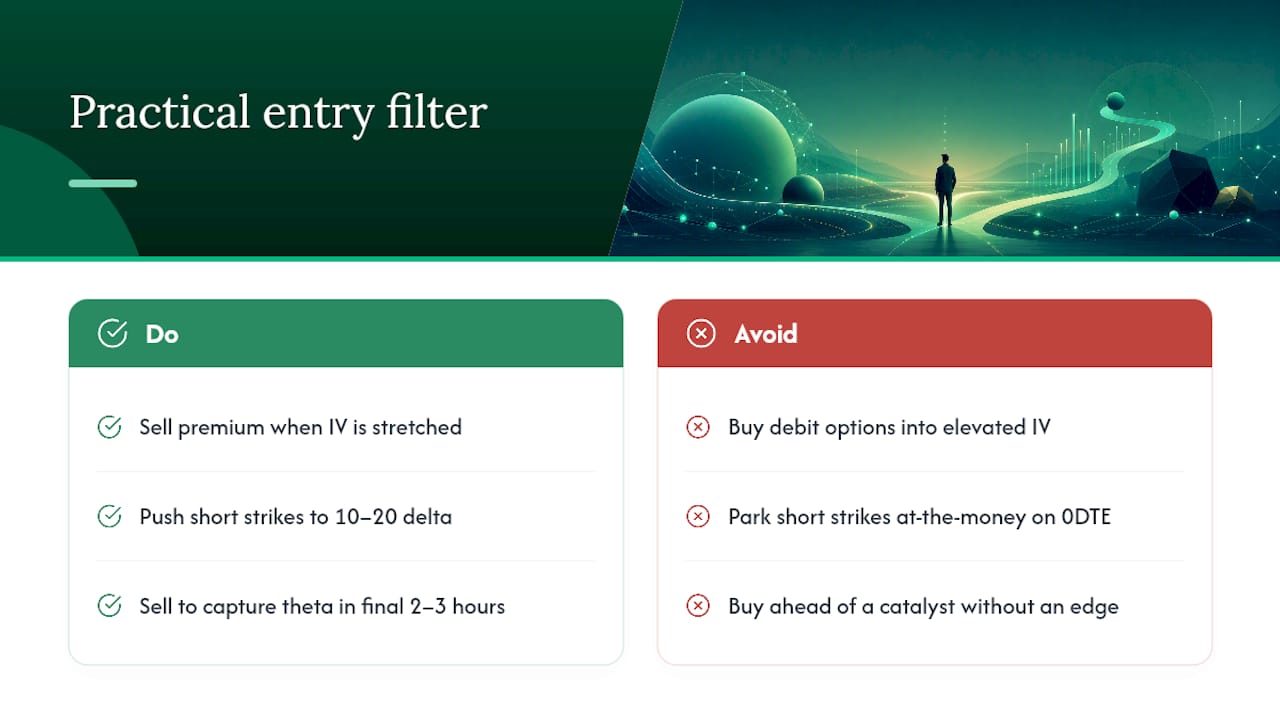
Gamma accelerates as expiration nears, and it's sharpest for strikes sitting close to the underlying's current price. That's exactly why premium sellers push their short strikes out to 10 to 20 delta rather than parking them at the money: you want to sell where gamma risk is lower, even if the credit is smaller. A strike that's comfortably 15 delta at 10 AM can gamma its way to 40 delta by 1 PM on a trending day.
Theta decays on a curve, not a straight line, and that curve steepens dramatically in the final two to three hours before close. This is the core mechanical edge behind premium selling on 0DTE contracts: sellers capture that accelerating decay, while debit buyers fight against it every single minute they hold.
Vega and implied volatility matter most before scheduled events. Elevated IV going into a Fed announcement or a big earnings report inflates option premiums, which is exactly when debit buyers get hurt by IV crush once the news hits and volatility collapses. If you're buying a debit call or put ahead of a catalyst, check whether the implied move already prices in more than you expect. Buying into elevated IV without a real edge on direction and magnitude is a losing habit dressed up as conviction.
Combine all three and you get a simple entry filter: avoid buying debit options when IV is already stretched relative to the expected move, and favor selling premium in that same environment instead.
When Should You Use Each 0DTE Strategy Based on Market Conditions?
Match the setup to what the tape is actually doing, not what you wish it would do.
- Range-bound day (moderate IV, small expected move, no major catalyst): favor iron condors or symmetric credit spreads. This is the bread-and-butter environment for premium sellers.
- Directional day (clear momentum, a scheduled event, or a breaking news catalyst): favor debit spreads or, for high conviction only, a single long call or put.
- Event day (earnings, Fed decisions, CPI prints): avoid naked short selling entirely. Either hedge a debit position or stick to defined-risk spreads sized smaller than usual, since the expected move often undershoots the actual move.
- First 15 minutes and final 30 minutes of the session: never open large naked short exposure in either window without a hard, pre-set exit rule already in place. Both windows see the fastest gamma and the thinnest liquidity of the day.
What Does a Complete 0DTE Trade Walkthrough Look Like?
Here's how a same-day setup might move from signal to close using a MorningOptions-style workflow.
- Morning scan. A [brand_signal] pre-market briefing flags SPX showing a moderate expected move with IV rank sitting in the middle of its recent range, no major catalyst on the calendar. The scanner tags this as a range-bound setup.
- Trade selection. Based on that signal, you build an iron condor: short strikes near 15 delta on both sides, roughly 30 points wide on each spread, targeting a $4.50 combined credit.
- Sizing. Max loss per contract is $25.50 (30 minus 4.50, times 100). At a $500 max risk rule for this trade, that caps you at roughly 19 contracts, rounded down for buffer.
- Entry. Place both spreads as separate limit orders slightly better than mid-price, watching for fills within a few cents of target.
- Management. If the underlying tests either short strike, that side gets adjusted or closed at a predefined loss trigger, around 2x the credit collected on that side.
- Exit. Take profit at 50% of max credit if it hits early, or close everything unresolved by 3:30 PM ET regardless of remaining premium.
Pro Tip: Write your exit rules down before you place the trade, not after you're already watching the position move. A rule you invent mid-trade is really just an excuse.
What Tools and Order Tactics Do You Need for 0DTE Trading?
You can't manage a fast-moving 0DTE position on a delayed quote feed. The minimum setup:
- A real-time options chain with live Greeks, not a 15-minute-delayed view.
- An implied move calculator so you can compare priced-in expectations against your own read on the day.
- Time & sales and a Level II or aggregated tape view to gauge whether liquidity is thinning before you need to exit.
- Limit orders first, always, with paired spread tickets for multi-leg trades to avoid partial fills.
- OCO or bracket orders where your broker supports them, so profit targets and stop levels execute without you babysitting every tick.
- A pre-market scan for the day's expected move and IV rank, plus a midday re-scan around lunch, since conditions on a 0DTE contract can shift meaningfully in four hours.
What's the 60-Second Checklist Before Placing a 0DTE Trade?
- Pre-trade: confirm account margin buffer, set your max-dollar risk for this trade, check IV rank and today's expected move, and glance at the bid/ask width for liquidity.
- Intraday: confirm order type (limit, paired spread), set your stop and profit triggers, and decide your maximum acceptable slippage before you click submit.
- Post-trade: log the trade, credit or debit, size, outcome, and write one sentence on what you'd do differently.
A Trader's Honest Take on Trading Same-Day Expirations
. The lesson that stuck: the trades that hurt most weren't the ones where the market moved against a good setup. They were the ones where discipline slipped, sizing too big after a winning streak, skipping the exit rule because "it'll probably come back."
Emotion is the real risk in 0DTE trading, more than gamma or IV crush combined. Running a consistent daily scan before the open, instead of scrambling to find a trade after seeing the market move, is what changed that. A repeatable process leaves less room for the account to talk you into something the setup never supported.
— Customer
How Morningoptions Helps You Trade 0DTE With a Repeatable Process
Morningoptions gives you a ranked, specific list of contract ideas before the open, entry levels included, instead of vague market commentary you have to translate into a trade yourself. That's the real gap for most 0DTE traders: not a lack of information, but too much of it with no filter.

Every free morning briefing runs the day's setups through an AI pipeline that scores and vets trade ideas before you ever see them, so you're starting from a shortlist instead of an open options chain. The Pro tier at $89 a month adds the lunchtime scanner, which re-checks conditions as the session develops, plus an AI chat scanner for researching any ticker on demand when something outside the briefing catches your eye. If you're trading 0DTE setups the way this article describes, sized to defined risk and matched to the day's actual conditions, Morningoptions gives you the daily input that decision-making runs on. Check the morning briefing before your next session and see how it compares to your current pre-market routine.
Where to Verify 0DTE Rules and Data Yourself
- Cboe: same-day volume statistics and market structure.
- FINRA: risk warnings and broker liquidation behavior.
- Investopedia: plain-language definitions and strategy basics.
- OCC: assignment and settlement disclosures.
Sources
- The Evolution of Same Day Options Trading | Cboe
- Zeroing In on an Options Trading Strategy: 0DTE | FINRA
- Zero days to expiration (0DTE) options: What they are and how they work | Investopedia