
Options assignment is the process by which a seller of an options contract is legally obligated to fulfill the contract terms when the buyer chooses to exercise. This is not optional. The Options Clearing Corporation (OCC) enforces assignment, and once it is triggered, you cannot refuse it. Understanding the options assignment process is the difference between a managed position and a surprise margin call. This guide covers the mechanics, the risks, and the strategies retail traders use to stay in control when assignment happens.
What is options assignment explained step by step?
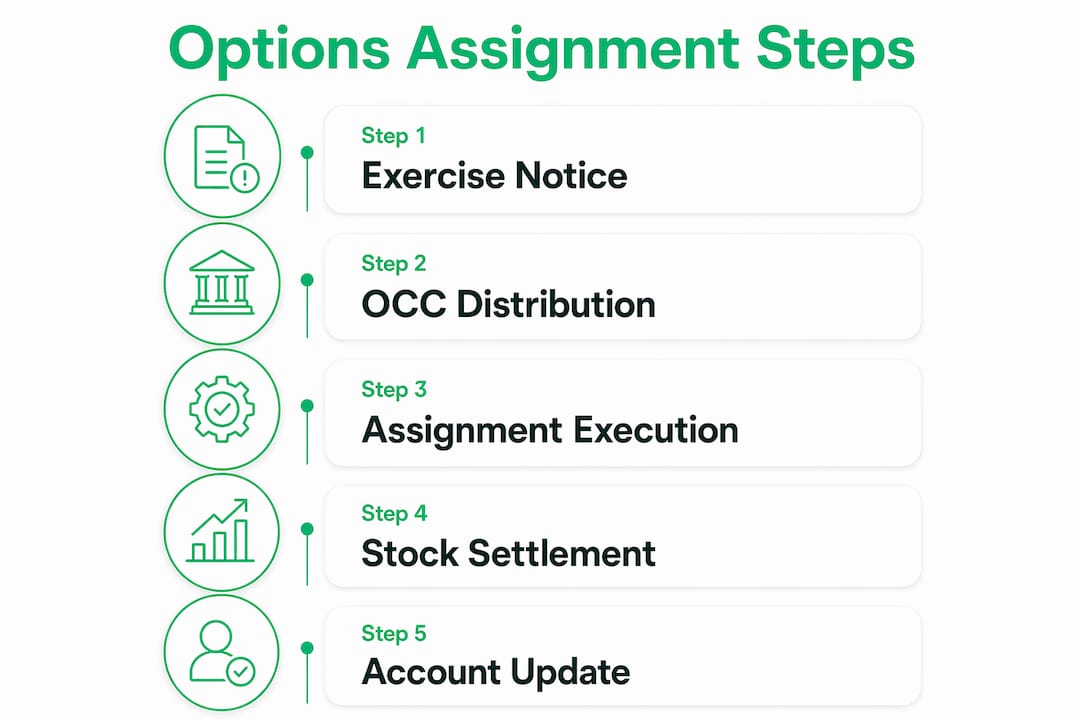
Assignment begins the moment a buyer exercises their option. The OCC receives the exercise notice and distributes it to the relevant clearing firm using a random lottery system. That clearing firm then assigns the notice to one of its clients who holds a matching short position. The selection is random, which means you can be assigned at any time, not just at expiration.
The OCC automatically exercises options that are in the money by $0.01 or more at expiration, with the cutoff at 5:30 PM ET on expiry day. That $0.01 threshold is lower than most traders expect. A position you thought was safe can flip in-the-money in the final minutes of trading and trigger automatic exercise.
Settlement follows a T+1 timeline for the underlying shares. That means the stock transaction appears in your account the next business day. The cash or shares move before you have time to react, which is why planning ahead matters more than reacting after the fact.
Call assignment vs. put assignment
The stock transaction that results from assignment depends on whether you sold a call or a put. A short call assignment forces you to sell 100 shares at the strike price. A short put assignment forces you to buy 100 shares at the strike price. If you hold the underlying stock in a covered call, the shares simply transfer out of your account. If you sold a naked call, you are forced into a short stock position, which requires capital and margin to support.

What are the common risks of options assignment?
Assignment risk is highest for traders who sell options without a hedge or without the capital to cover the resulting stock position. A naked call seller faces theoretically unlimited loss if the stock has moved far above the strike. A naked put seller must buy shares at the strike price regardless of how far the stock has fallen. These are not edge cases. They are the defining financial risk of selling uncovered options.
Early assignment adds another layer of complexity. Call options can be exercised early before a dividend ex-date, because the buyer wants to capture the dividend payment. Deep in-the-money puts may also be exercised early when the time value has eroded and the buyer prefers cash now. Both scenarios can catch traders off guard if they are not watching the calendar.
Key early assignment triggers to monitor:
- Dividend ex-dates: Short call holders are most vulnerable the day before the ex-date.
- Deep in-the-money puts: Low extrinsic value signals high early assignment probability.
- Earnings announcements: Volatility spikes can push options deep in-the-money quickly.
- Low liquidity options: Thin markets make it harder to close positions before assignment occurs.
Pin risk is a specific danger on expiration day. If the stock closes right at or near your strike price, you cannot know for certain whether you will be assigned until after the market closes. After-hours price movements can push the stock through your strike, triggering assignment on a position you thought expired worthless. Holding short options into expiration without margin headroom is a common and costly mistake.
Pro Tip: If your short option is within $0.50 of the strike price on expiration day, treat it as a live assignment risk and plan your margin accordingly. Do not wait for the close to decide.
How do you manage and reduce options assignment risk?
The most direct way to avoid unwanted assignment is to close or roll your short option before expiration. Buying back the short leg eliminates your obligation entirely. Rolling means closing the current position and opening a new one at a later expiration or different strike, which extends your time and gives the trade more room to work.
Covered calls and cash-secured puts are the two structures that make assignment manageable by design. With a covered call, assignment simply means your shares are called away at a profit. With a cash-secured put, assignment means you buy shares at a price you already agreed was acceptable. Assignment is often the intended outcome for traders using these structures. The premium collected is the reward for accepting that obligation.
Practical steps to reduce assignment risk:
- Close short options early: Buy back positions when they reach 80–90% of maximum profit. There is little reward left and meaningful risk remains.
- Monitor dividend calendars: Check ex-dates for any stock where you hold a short call. Roll or close the position at least two days before the ex-date.
- Maintain margin buffers: Keep enough cash or margin capacity to absorb a stock position if assignment occurs unexpectedly.
- Avoid holding through earnings: Implied volatility collapses after earnings, but the stock can move far enough to trigger assignment before that happens.
Understanding high probability trade selection also reduces assignment risk. Trades structured with favorable probability of expiring out of the money are less likely to result in assignment in the first place.
Pro Tip: Rolling a short option is not always the right move. If the trade thesis has changed, closing the position outright and accepting the loss is cleaner than extending a bad trade into a worse one.
The decision to accept versus avoid assignment comes down to your position structure and capital. Covered sellers should often accept assignment as the natural conclusion of a successful trade. Naked sellers should almost always act to avoid it, because the capital requirements and risk exposure are not worth the premium collected.
What happens to your account after options assignment?
Assignment is processed overnight, and the changes appear in your brokerage account the next morning. You cannot choose to refuse assignment once the OCC has notified your broker. The transaction is final before you log in.
Here is what changes in your account immediately after assignment:
- Stock position: 100 shares are either added (put assignment) or removed (call assignment) per contract assigned.
- Cash balance: Your account is debited for the purchase price on a put assignment or credited for the sale on a call assignment.
- Margin impact: If the resulting stock position exceeds your margin capacity, your broker may issue a margin call the same morning.
- Options position: The assigned short option is removed from your account. The obligation is fulfilled.
Tax treatment of assignment is a detail many retail traders overlook. The premium you collected when selling the option adjusts your cost basis on the resulting stock position. For a put assignment, the premium reduces your effective purchase price. For a call assignment, the premium adds to your effective sale proceeds. Consult a tax professional for your specific situation, as the rules can vary based on holding periods and position structure.
Post-assignment, you have several choices. You can hold the stock if you believe in the underlying. You can sell the shares immediately to close the position. You can also sell a new covered call against the assigned shares to generate additional premium while you hold. Options strategies for managing assigned capital are covered in depth in surplus capital management approaches that apply directly to post-assignment scenarios.
Key Takeaways
Options assignment turns a theoretical obligation into a real stock transaction, and the OCC enforces it with no room for refusal once triggered.
| Point | Details |
|---|---|
| OCC automatic exercise | Options in the money by $0.01 or more are automatically exercised at 5:30 PM ET on expiry day. |
| Random lottery assignment | The OCC assigns exercise notices randomly to clearing firms, which then assign randomly to clients. |
| Early assignment triggers | Dividend ex-dates and deep in-the-money puts are the two most common causes of early assignment. |
| Overnight processing | Assignment finalizes overnight and appears in your account the next morning with no option to refuse. |
| Covered vs. naked risk | Covered call and cash-secured put sellers face manageable assignment outcomes; naked sellers face capital and margin risk. |
Assignment is not the enemy. Surprise is.
Every trader I have spoken with who feared assignment was actually fearing the unknown. Once you understand the mechanics, assignment stops being a threat and starts being a variable you plan around. The traders who get hurt are the ones who sell options without thinking through what happens if they are assigned. They collect the premium and forget the obligation.
The mindset shift that matters most is this: assignment is the moment an abstract obligation becomes a real market transaction. That moment is not a disaster. It is a decision point. Do you hold the stock? Do you sell it? Do you write a new option against it? All of those are valid answers, but you need to have thought through them before the assignment hits your account at 8:00 AM.
I have seen traders panic-sell assigned shares at the open, only to watch the stock recover by noon. I have also seen traders hold assigned shares through a further decline because they had no exit plan. Neither outcome is inevitable. Both are avoidable with preparation. The options hedging principles that apply to managing risk before a trade also apply to managing an assigned position after the fact.
The practical advice I keep coming back to is simple: never sell an option you would not be comfortable being assigned on. If the thought of owning 100 shares of that stock at that price makes you uncomfortable, do not sell the put. If the thought of selling your shares at that strike bothers you, do not sell the call. Assignment is not a bug in the system. It is the system working exactly as designed.
— Customer
Morningoptions gives you the edge before the open
Assignment risk starts with trade selection. The better your entry, the less likely you are to find yourself on the wrong side of an exercise notice.
Morningoptions delivers AI-powered trade ideas every market morning before the open. Each idea is vetted through a five-model AI pipeline that scores probability, risk, and entry levels. You get ranked contract ideas with specific strikes and expirations, not vague market commentary. The Pro tier at $89/month adds a lunchtime scanner and an on-demand AI chat scanner for researching any ticker before you place a trade. Free daily briefings are available with no commitment. Start your morning with a clearer picture of the day's setups at Morningoptions.
FAQ
What is options assignment in simple terms?
Options assignment is the process where a seller of an options contract is required to fulfill the contract terms because the buyer chose to exercise. The OCC enforces this obligation, and it cannot be refused once triggered.
Can you be assigned before expiration?
Yes. American-style options can be exercised at any time before expiration. Early assignment most often occurs before dividend ex-dates on short calls or when a put is deep in the money with little time value remaining.
How do you avoid options assignment?
Close or roll your short option before expiration to eliminate the obligation. Monitoring dividend calendars, maintaining margin buffers, and avoiding holding short options through expiration are the most effective ways to reduce assignment risk.
What happens to your account when you are assigned?
The stock transaction appears in your account the next morning after overnight processing. Shares are added or removed, your cash balance adjusts, and the short option position is closed. You cannot reverse or refuse the assignment once it is processed.
Is assignment bad for covered call sellers?
Assignment is generally the intended outcome for covered call sellers. The shares are called away at the strike price, and the premium collected adds to the effective sale price. The position closes profitably in most cases.