
An iron condor is a four-leg, defined-risk credit spread built from a bear call spread and a bull put spread on the same underlying and expiration, and it makes money when price stays inside your two short strikes through expiration. The goal is collecting premium and letting theta work in your favor, which is why the setup fits best in range-bound conditions with IV Rank reasonably elevated rather than crushed near zero or spiking during panic. Traders at Morningoptions scan for exactly this kind of setup daily, using IV Rank and VIX behavior as entry filters rather than gut feel.
TL;DR:
- Setting short strikes around 16 delta and maintaining a wing width of about 5 dollars on a $100 index ETF offers a balance between premium collection and manageable max loss.
- Entering trades when IV Rank is 50 or above and within 30 to 45 DTE maximizes premium capture while limiting gamma risk.
- Managing positions at 50% of max profit and setting clear stop-loss levels (1.5 to 2 times credit) significantly improves long-term success rates.
- Diversifying across uncorrelated underlyings and risking only 1% to 3% of account equity per condor reduces overall exposure.
- Automation tools like Morningoptions can streamline the screening and entry process, reinforcing disciplined trade execution.
Table of Contents
- How to Build an Iron Condor: The Four Legs and Payoff
- Why Iron Condors Work: Theta, Volatility, and the Greeks
- Strike Selection: Delta Rules, Wing Width, and Position Sizing
- Picking Expiration and Volatility: DTE, IV Rank, and VIX Ranges
- A Worked Iron Condor Example With Real Numbers
- Managing an Iron Condor: Adjustment Rules That Actually Work
- Your Iron Condor Pre-Trade and Exit Checklist
- Common Iron Condor Mistakes and Habits That Fix Them
- How Morningoptions Turns These Rules Into a Daily Routine
- Where to Learn More and Verify the Rules
- The Editorial Take: Rules Beat Instinct Every Time
- Sources
How to Build an Iron Condor: The Four Legs and Payoff
An iron condor is really two credit spreads stapled together, and once you see the structure, the strikes make sense on their own.
On the call side, you sell an out-of-the-money call and buy a further out-of-the-money call. That's the bear call spread, and it profits if the underlying stays below your short call strike. On the put side, you sell an out-of-the-money put and buy a further out-of-the-money put, forming a bull put spread that profits if price stays above your short put strike. Combine both and you've built the classic structure described on the Iron condor Wikipedia entry: four legs, one expiration, a defined range where you win.
The long options, the ones further out-of-the-money, aren't there to make money. They cap your risk. Without them, you'd be running naked strangles with unlimited exposure on both sides. With them, your maximum loss is fixed the moment you open the trade.
Here's how the math breaks down:
- Max profit equals the net credit received when you open the trade, realized in full if the underlying closes between your two short strikes at expiration.
- Max loss equals the width of either wing minus the credit collected, whichever wing gets tested.
- Upper breakeven equals the short call strike plus the total credit received.
- Lower breakeven equals the short put strike minus the total credit received.
Picture the payoff diagram as a flat plateau in the middle (your profit zone) that slopes downward on both edges until it hits a flat floor (your max loss), which stays flat no matter how far price runs beyond the wings. That flat floor is the entire point of paying for the long options. The ApexVol iron condor cheat sheet recommends collecting a credit equal to at least a third of your wing width, since anything thinner rarely justifies the risk you're taking on.
Why Iron Condors Work: Theta, Volatility, and the Greeks
Time decay is the engine. Every day that passes without the underlying breaking out of your range, both short options lose a little extrinsic value, and that decay accelerates as expiration approaches, which is exactly why condors get opened 30 to 45 days out rather than at 5 DTE.
The second edge is subtler and often overlooked: implied volatility tends to overstate how much the underlying will actually move. Options are priced on implied volatility, a forecast, while your profit depends on realized volatility, what actually happens. When implied volatility sits meaningfully above what the stock or index later delivers, premium sellers capture that spread as pure edge. This is why entry timing built around IV Rank matters more than most traders assume, since a high IV Rank tells you options are relatively expensive versus their own recent history, not just expensive in absolute terms.
Watch these Greeks while the trade is live:
- Theta should be positive and growing as a share of your total position value, confirming decay is working for you.
- Delta on the whole position should stay close to zero when price is centered, and it drifts toward whichever side gets tested.
- Gamma starts small but grows sharply in the final one to two weeks before expiration, which is why late-stage price swings hurt disproportionately more than early ones.
- Vega works against you if implied volatility rises after entry, even if price hasn't moved yet.
Backtests on roughly 4,872 SPY iron condors from 2005 to 2019 found that managing positions at 50% of max profit produced meaningfully higher win rates than holding to expiration, largely because closing early sidesteps the exact gamma risk window described above.
Strike Selection: Delta Rules, Wing Width, and Position Sizing
Strike selection is where most new condor traders either build a durable edge or quietly stack the odds against themselves.
- Anchor short strikes around 10 to 20 delta, with 16 delta as a widely used guideline. A 16 delta strike roughly corresponds to a one standard deviation move, giving you a statistical basis for where the market is unlikely to reach rather than a strike picked because "it looked far enough away."
- Treat wing width as a direct tradeoff between credit and max loss. A $5-wide wing on a $100 stock collects more premium than a $2-wide wing but risks more capital if tested; narrower wings suit smaller accounts, wider wings suit traders comfortable holding more risk per contract.
- Check return on risk before committing capital. A condor collecting $1.00 of credit on $4.00 of width offers 25% return on risk if held to max profit, which sits close to healthy for a 30 to 45 day trade; anything well below that usually isn't worth the commissions and pin risk.
- Size each position at a small, fixed percentage of account equity, commonly 1% to 3% of net liquidity per condor. A $50,000 account risking 2% per trade caps loss at $1,000 on any single position, which keeps one bad month from becoming a bad year.
- Diversify strikes across uncorrelated underlyings rather than stacking five condors on the same index. Five SPY condors and five QQQ condors aren't really ten independent bets; they move together more often than traders expect.
The delta-and-width combination isn't cosmetic. It's the single biggest lever you control before the trade is even live, more influential than almost any adjustment you'll make afterward.
Picking Expiration and Volatility: DTE, IV Rank, and VIX Ranges
Timing an iron condor comes down to two questions: how much time is left, and how expensive are options right now.
Most systematic condor traders enter around 30 to 45 days to expiration. That window gives theta enough runway to work while keeping gamma risk manageable, according to the framework laid out in the complete guide to profiting in range-bound markets. Go shorter than that and gamma risk dominates too early; go longer and you're tying up capital for decay that hasn't started accelerating yet.
IV Rank filters when to pull the trigger within that window:
- IV Rank at 50 or above is a common minimum threshold, since it means current implied volatility sits in the top half of its own recent range, giving sellers richer premium relative to actual risk.
- A VIX roughly between 15 and 25 is often cited as the sweet spot for SPX-style premium selling, volatility high enough to pay well, low enough that it's not signaling active panic.
- IV Rank near zero usually means premium is too thin to justify the risk, even if the underlying looks range-bound on a chart.
Before entering anything, screen the calendar. Earnings reports, FDA decisions, Fed announcements, and other binary catalysts inside your expiration window can blow through both short strikes in a single session, and no amount of delta discipline protects you from a gap that skips your entire wing.
A Worked Iron Condor Example With Real Numbers
Assume a liquid index-tracking ETF trading at $450, with 40 days to expiration and IV Rank sitting at 55, comfortably inside the preferred entry zone.
You sell the 435 put and buy the 430 put for protection. On the call side, you sell the 465 call and buy the 470 call. Both wings are $5 wide, and the combined credit received is $1.75 per share, or $175 per contract.
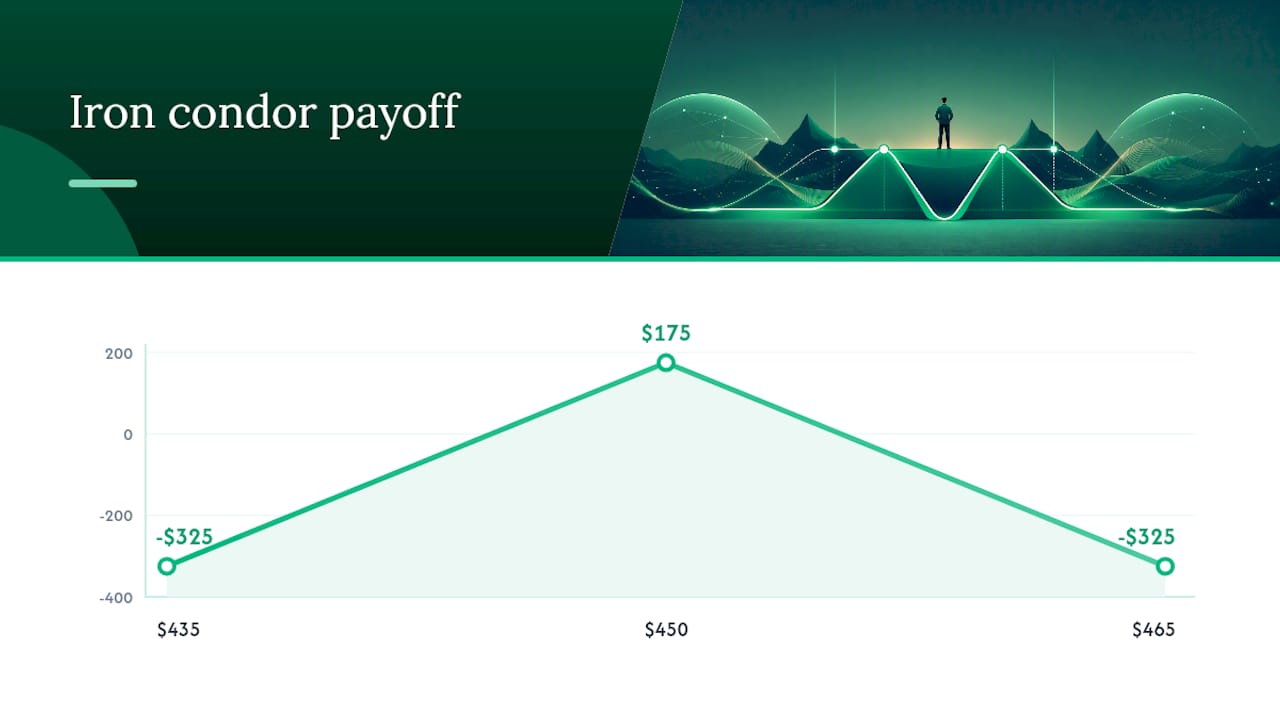
Three outcomes at expiration illustrate the payoff:
If the underlying closes at $435 (right at the short put), the put spread is nearly at max loss territory while the call spread expires worthless, so you're deep into losses on that side and need to have already acted well before this point.
If it closes at $450 (dead center), both spreads expire worthless and you keep the full $175 credit, the best-case scenario.
If it closes at $465 (right at the short call), you're in the mirror-image situation to the first scenario, approaching max loss on the call side.
That's usually the point mechanical traders start watching for their profit-take trigger.
Managing an Iron Condor: Adjustment Rules That Actually Work
The single biggest difference between traders who survive iron condors long term and those who blow up on one bad trade isn't strike selection. It's whether they manage with rules or with hope.
Run through these checks in order, every time you look at an open position:
- Has price closed one short strike, or is the tested-side delta approaching 30 to 35? That's your first adjustment trigger, well before the option is deep in the money.
- Has the position hit 50% of max profit? If yes, that usually overrides everything else, close it.
- Has the loss reached 1.5 to 2 times the credit received? That's your stop-loss line, and it should be set before you ever enter the trade, not decided emotionally while watching it happen.
- Are you inside 21 DTE with an untested side still open? Gamma risk is climbing fast here even if nothing looks wrong yet.
When a side gets tested but hasn't blown through your stop-loss level, rolling the untested side closer for a net credit is usually the first move, since it improves your breakevens immediately without requiring new capital. If the tested side itself needs relief, rolling it out in time (and sometimes up or down in strike) can buy room for the underlying to settle back into range, though this resets your clock and often reduces total credit efficiency versus starting a fresh position.
Some traders convert a struggling condor into an iron butterfly by tightening one side, concentrating risk into a narrower, higher-probability zone. Others simply take a partial exit, closing the losing spread while letting the still-profitable side ride to capture whatever's left.
Pro Tip: Closing at 50% of max profit isn't about being conservative, it's about the math. You're not leaving money on the table; you're trading unrealized theta for lower gamma exposure during the exact window where things go wrong fastest.
Mechanical beats emotional almost every time here, and the ApexVol cheat sheet built its entire framework around exactly this kind of predefined rule set.
Your Iron Condor Pre-Trade and Exit Checklist
Copy this into your trading journal and run through it before every entry and every check-in.
- Confirm IV Rank is 50 or higher and the underlying shows no clear directional trend on the daily chart.
- Verify you're entering between 30 and 45 DTE, not chasing a shorter-dated trade for a bigger annualized return.
- Check the earnings calendar and any scheduled binary events through your expiration date; skip the trade if one falls inside the window.
- Confirm the underlying has tight bid-ask spreads and reasonable open interest at your target strikes; wide spreads eat into edge fast.
- Set short strikes near 16 delta on each side and choose wing width based on account size and comfort with max loss.
- Cap risk per condor at 1% to 3% of account equity, and cap total open condor risk at a level you could survive being wrong on all at once.
- Write down your three exit triggers before entering: 50% profit target, 1.5 to 2 times credit stop-loss, and a DTE time stop around 21 days.
- Check delta on both short strikes daily once the position is live, and treat 30 to 35 delta on either side as your adjustment signal.
Common Iron Condor Mistakes and Habits That Fix Them
One bad gap wipes out months of gains. A close second is holding through earnings or Fed announcements out of curiosity rather than discipline, then watching a clean setup get skipped by a gap that clears both wings.
Adjusting emotionally, widening a spread or doubling down after already being wrong, tends to compound losses rather than fix them. And trading without a written plan means every decision gets made under stress, which is when traders make their worst calls.
Four habits fix most of this:
- Write your entry and exit rules down before opening the trade, not while it's moving against you.
- Keep a trade journal logging entry IV Rank, DTE, strikes, and outcome so patterns become visible over time.
- Cap position size as a fixed percentage of equity, every time, no exceptions for "this one looks safer."
- Apply the same 50%/stop-loss/DTE rules to every condor rather than improvising fresh logic each trade.
A trader who follows a boring, consistent rule set will almost always outperform one running the "perfect" strategy inconsistently.
How Morningoptions Turns These Rules Into a Daily Routine
Running this checklist by hand every morning across a watchlist of tickers is exactly the kind of repetitive work that benefits from automation. Morningoptions delivers daily briefings that screen for range-bound setups, surface IV Rank context, and rank specific contract ideas with entry levels before the market opens, so the filtering in the checklist above happens before you ever open your broker.
- Some free daily briefings offer trade ideas with entry levels and bear-case analysis built in.
- Paid plans unlock additional scanners and AI chat features for researching specific tickers on demand.
- These offerings are based on the premise that mechanical filters beat gut feel, especially for premium-selling strategies where entry timing around IV Rank and DTE matters as much as strike selection.
Traders can layer the checklist's sizing and exit rules on top of Morningoptions' daily scans rather than building an entire screening process from scratch.
Where to Learn More and Verify the Rules
Before trading options on margin or with a new broker, verify your account protections through SIPC, which covers the specifics of what's protected and what isn't. Run any broker or registered representative through FINRA's BrokerCheck before funding an account, a five-minute check that's saved plenty of traders from unpleasant surprises. For a beginner-friendly refresher on the structure itself, Robinhood Learn's iron condor explainer covers the basics cleanly, and if you're opening a new account specifically to trade spreads, PsyFi's guide to opening a brokerage account walks through the verification steps most platforms require.
The Editorial Take: Rules Beat Instinct Every Time
Most iron condor content oversells the setup part and undersells management, which is backwards. Anyone can pick 16 delta strikes off an option chain. That instinct is wrong, and the SPY backtest data backs it up: managed exits beat holding to expiration on both win rate and time efficiency.
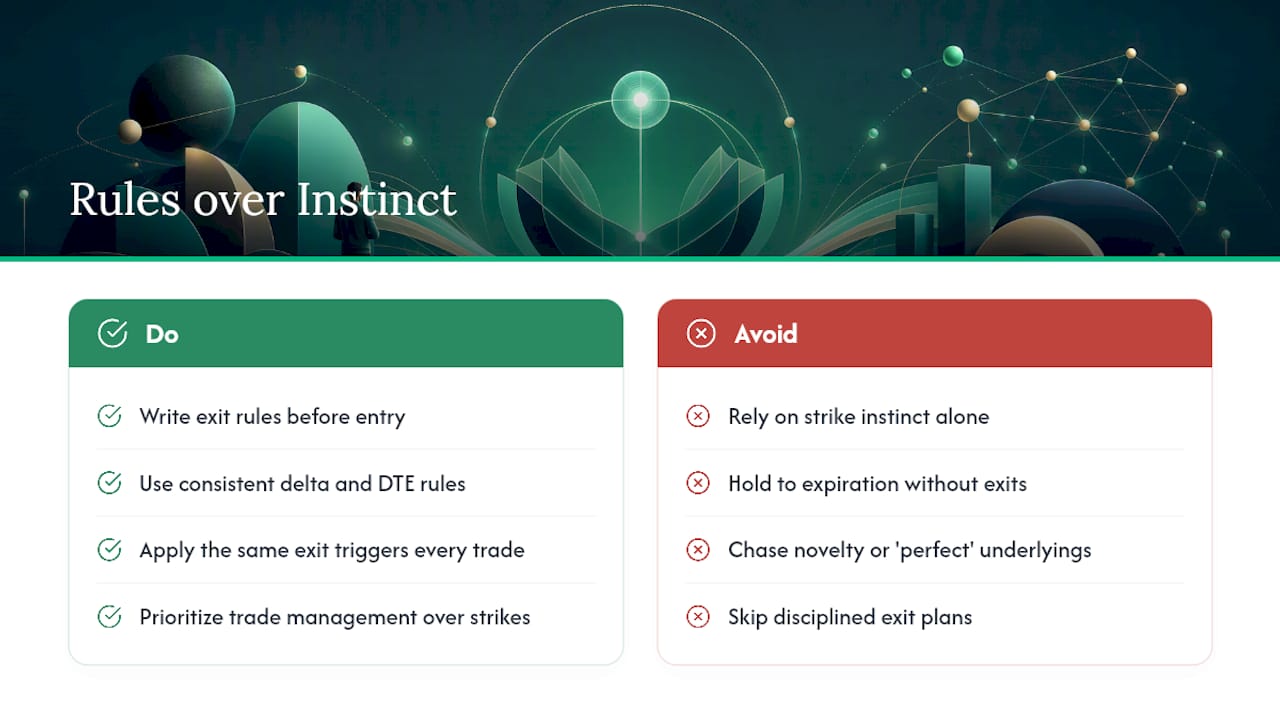
The conventional advice fixates on finding the "right" strikes or the "best" underlying. The real edge lives in consistency, running the same delta rules, the same DTE window, and the same exit triggers on every single trade until the process is boring. Boring is the goal. Novelty is where accounts get hurt.
If you take one thing from this, prioritize writing your exit rules before you enter, not after. A trader with mediocre strike selection and disciplined exits will beat a trader with perfect strikes and no plan, almost every time the market gets tested.
— Customer
This article is general information, not a substitute for advice from a qualified financial advisor. Consult a qualified financial professional about your own circumstances before acting on anything here.
Sources
- Iron Condor Cheat Sheet: Setup, Adjustments & Exit Rules - ApexVol
- The Iron Condor Strategy: A Complete Guide to Profiting in Range-Bound Markets
- Iron condor - Wikipedia
- SIPC