
Choosing the right options strategy starts with four questions: What direction do you expect the market to move? How much can you afford to lose? Are you after income or capital growth? And how much time are you giving the trade? Get those answers locked in before you look at a single strategy name, and the list of candidates shrinks from twenty-plus down to three or four. That is the core of any solid simple options strategy selection guide, and everything else builds from there.
Before picking a strategy, make sure you understand the basic mechanics. A call option gives you the right to buy shares at a set price (the strike) before a specific date (expiration). A put option gives you the right to sell. Buying options costs a premium upfront. Selling options collects that premium but creates an obligation. Time decay, known as theta, erodes the value of options you own every single day.
Use these filters to narrow your choice:
- Market outlook: Bullish, bearish, or neutral/range-bound
- Risk tolerance: Defined risk (capped loss) or undefined risk (open-ended exposure)
- Objective: Income generation (collect premium) or capital appreciation (buy and profit from a move)
- Time horizon: Days, weeks, or months, and how theta affects each
- Account size and broker approval level: Some strategies require margin or higher approval tiers
1. Long call: the straightforward bullish bet
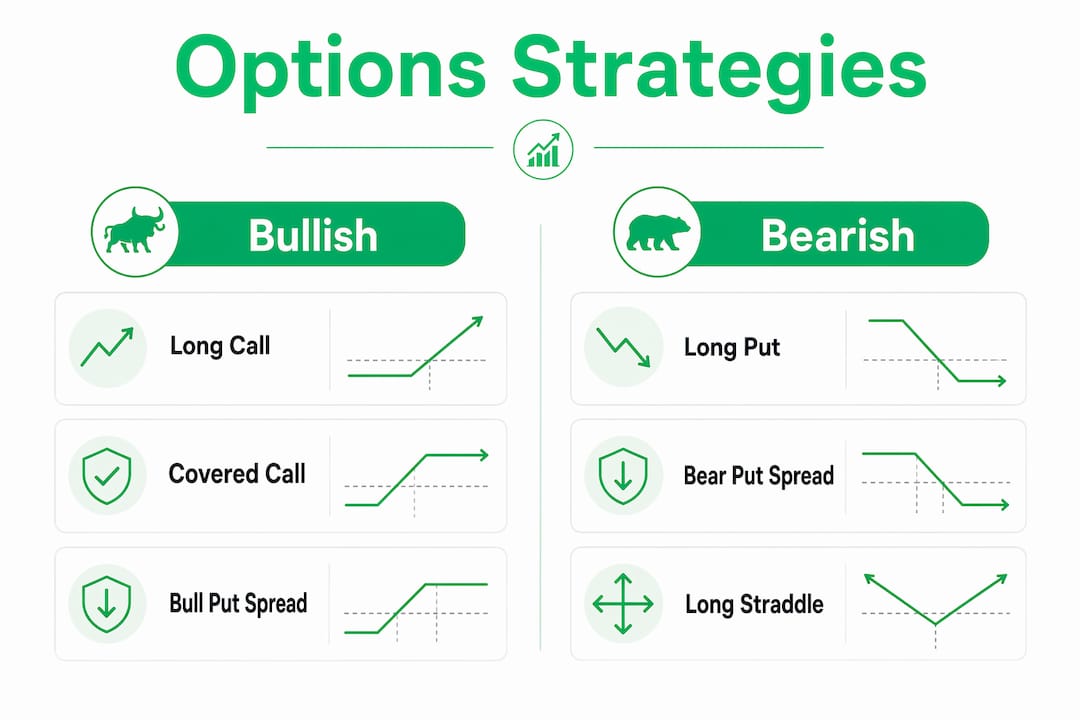
A long call is the simplest bullish play. You pay a premium for the right to buy shares at the strike price before expiration. If the stock climbs above your strike by more than the premium you paid, you profit. If it doesn't, you lose only what you paid for the option.

The appeal for beginners is that maximum loss is capped at the premium, while the upside is theoretically unlimited. The catch is timing. The stock has to move enough, fast enough, to overcome both the premium cost and daily time decay. A stock that drifts slowly higher can still leave a long call worthless at expiration.
Best for: Strongly bullish outlook, low-to-moderate implied volatility, and a clear catalyst in view.
Pros: Simple mechanics, defined risk, leverage with less capital than buying shares outright.
Cons: Time decay works against you constantly; requires a meaningful move before expiration.
2. Long put: the clean bearish trade
A long put profits when the underlying stock falls below the strike price by more than the premium paid. It is the mirror image of a long call, and it works as both a speculative bearish trade and a hedge against shares you already own.

Like long calls, long puts carry defined risk limited to the premium. The same time decay problem applies. Short-dated puts lose value rapidly, so buying puts with a longer time until expiration gives the trade room to develop.
Best for: Bearish outlook or hedging an existing stock position.
Pros: Defined risk, no need to short shares, can protect a portfolio during downturns.
Cons: Premium loss if the stock holds steady or rises; theta erodes value daily.
3. Covered call: the beginner's income strategy
A covered call is widely considered the gateway strategy for beginners moving from stock investing to options. You own at least 100 shares of a stock and sell a call option against them, collecting premium immediately. If the stock stays below the strike at expiration, you keep the premium and your shares. If it rises above the strike, your shares get called away at that price.
The strategy feels intuitive because it starts with something you already own. The income it generates lowers your effective cost basis over time. The trade-off is that you cap your upside at the strike price, so it doesn't fit a position where you expect a big rally.
Best for: Neutral to mildly bullish outlook on shares you already hold.
Pros: Immediate income, reduces cost basis, lower risk than pure stock ownership.
Cons: Caps upside; stock downside risk remains fully intact.
| Strategy | Outlook | Risk Type | Objective |
|---|---|---|---|
| Long call | Bullish | Defined | Capital growth |
| Long put | Bearish | Defined | Capital growth / hedge |
| Covered call | Neutral/mildly bullish | Undefined (stock risk) | Income |
| Bull put spread | Bullish/neutral | Defined | Income |
| Bear put spread | Bearish | Defined | Capital growth |
| Long straddle | Volatile/big move | Defined | Capital growth |
| Iron condor | Neutral/range-bound | Defined | Income |
4. Bull put spread: defined-risk income for bullish traders
A bull put spread sells a put at or near the current stock price and buys a lower-strike put for protection. You collect a net credit upfront. The maximum profit is that credit; the maximum loss is the difference between the strikes minus the credit received. Defined-risk strategies like this cap losses from the start, which is exactly what beginners need.
This strategy works well when you expect a stock to hold steady or drift higher, and implied volatility is elevated enough to make the premium worth collecting. It fits smaller accounts because the loss is capped and predictable.
Best for: Bullish to neutral outlook, high implied volatility, income focus.
Pros: Defined risk, collects premium, profits even if the stock barely moves.
Cons: Capped profit; requires broker approval for spreads.
5. Bear put spread: bearish with a cost limit
A bear put spread buys a higher-strike put and sells a lower-strike put, reducing the net cost of the trade. You profit if the stock falls below the long put strike by expiration. The maximum loss is the net debit paid; the maximum gain is the spread width minus that debit.
This is cleaner than buying a naked long put when you have a moderate bearish view and want to reduce premium outlay. The trade-off is that profit is capped at the lower strike.
Best for: Moderate bearish outlook, low-to-moderate implied volatility.
Pros: Lower cost than a long put, defined risk on both sides.
Cons: Profit is capped; needs a meaningful move to pay off.
6. Long straddle: betting on a big move in either direction
A long straddle buys a call and a put at the same strike price and expiration. You profit if the stock moves sharply in either direction, enough to exceed the combined premium paid. It doesn't matter which way the stock goes; it just has to move big.
High implied volatility favors selling premium; low implied volatility favors buying it. Straddles are most effective when IV is relatively low and a catalyst like earnings is approaching. If IV is already elevated, the premium cost of a straddle can be punishing.
Best for: Expecting a large move in either direction, neutral on direction, low-to-moderate IV.
Pros: Profits from volatility in either direction, defined risk.
Cons: Expensive; requires a large move to overcome the combined premium.
7. Iron condor: profiting from a quiet market
An iron condor sells an out-of-the-money call spread and an out-of-the-money put spread simultaneously. You collect a combined credit and profit if the stock stays within the range defined by the short strikes at expiration. Maximum loss is the wing width minus the credit received.
This is a neutral, income-focused strategy that works best when implied volatility is high and you expect the stock to stay range-bound. It is one of the most popular defined-risk strategies for beginners because losses are capped and the math is transparent.
Best for: Neutral outlook, high implied volatility, income focus.
Pros: Collects premium from two sides, defined risk, profits in quiet markets.
Cons: Complex to manage; loss can be larger than the credit collected if the stock breaks out.
How to choose the right simple options strategy for your portfolio
Picking a strategy is a four-step process, not a gut call. Work through each variable before you commit capital.
- Define your directional bias. Bullish, bearish, or neutral? Be specific about magnitude too. Slightly bullish is different from strongly bullish, and the strategy that fits each is different.
- Check implied volatility. High IV favors selling premium; low IV favors buying it. Selling a covered call when IV is low means collecting thin premium for real stock risk.
- Set your maximum acceptable loss. If you can only stomach losing the premium paid, stick to debit strategies. If you can handle a defined spread loss, credit spreads and condors open up.
- Confirm your broker approval level. Many brokers require Level 2 or Level 3 approval for spreads. New traders often overlook this and find their strategy choices restricted at the worst moment.
Pro Tip: Start with defined-risk strategies exclusively. Selling naked options carries theoretically unlimited loss potential and can wipe out a small account on a single bad trade. Spreads and long options keep your worst case visible from the moment you enter.
Common beginner mistakes to avoid:
- Buying short-dated options and watching time decay destroy value before the stock moves
- Chasing high-premium undefined-risk trades without understanding the downside
- Forcing trades when no clear setup exists. Expert traders wait for setups that match their forecast and the volatility environment
- Ignoring account-level risk management principles and sizing positions too large relative to total capital
Understanding market conditions for options is just as important as knowing the strategy mechanics. A great strategy in the wrong environment will still lose money.
How AI-powered insights sharpen your strategy selection
Morningoptions runs a five-step AI pipeline that vets, scores, and ranks trade ideas every market morning before the open. Instead of scanning dozens of tickers manually, you get a ranked list of specific contract ideas with entry levels, already filtered by market conditions and risk profile.
The free daily briefing covers the top-ranked ideas each morning. The Pro tier at $89/month adds a lunchtime scanner and an AI chat tool for researching individual tickers on demand. That second scanner is particularly useful for checking whether implied volatility on a specific stock supports buying or selling premium before you commit. For beginners building their options trading basics checklist, having pre-vetted ideas removes a significant layer of decision fatigue.
Key Takeaways
Matching your market outlook and risk tolerance to the right strategy is the single most important step in options trading for beginners.
| Point | Details |
|---|---|
| Start with four filters | Evaluate market direction, implied volatility, risk tolerance, and investment objective before selecting any strategy. |
| Defined risk first | Beginners should use spreads and long options to keep maximum loss visible and controlled from entry. |
| Time decay is a real cost | Buying short-dated options accelerates premium loss; aim for 45–90 days to expiration when buying. |
| IV drives buy vs. sell | High implied volatility favors selling premium strategies; low implied volatility favors buying options. |
| Morningoptions ranks setups daily | The AI pipeline surfaces pre-vetted trade ideas with entry levels, reducing guesswork for beginner and intermediate traders. |
From stocks to options: what actually changes
The biggest mental shift when moving from stocks to options isn't the complexity of the strategies. It's accepting that being right about direction isn't enough. You can correctly predict that a stock will rise and still lose your entire premium if the move is too slow, too small, or arrives after expiration.
That realization is humbling at first. But it also clarifies what options are actually good for. Options work best as risk management tools, not lottery tickets. Covered calls generate income on shares you already believe in. Defined-risk spreads let you take a directional view without catastrophic downside. Long puts hedge a portfolio during uncertain periods without forcing you to sell your holdings.
The traders who struggle longest are the ones who treat options as a faster path to big gains. The ones who progress quickly treat them as a way to express a view with a known, limited cost. Patience matters more than prediction. Waiting for a setup where direction, volatility, and timing all align is not passive; it is the discipline that separates consistent traders from ones who blow up their accounts on a few aggressive trades.
Morningoptions gives you ranked trade ideas before the market opens
Every morning before the open, Morningoptions delivers a ranked briefing of specific options trade ideas, not vague market commentary. Each idea comes with a contract, an entry level, and a risk profile already scored by the AI pipeline, so you spend your pre-market time evaluating setups rather than hunting for them.
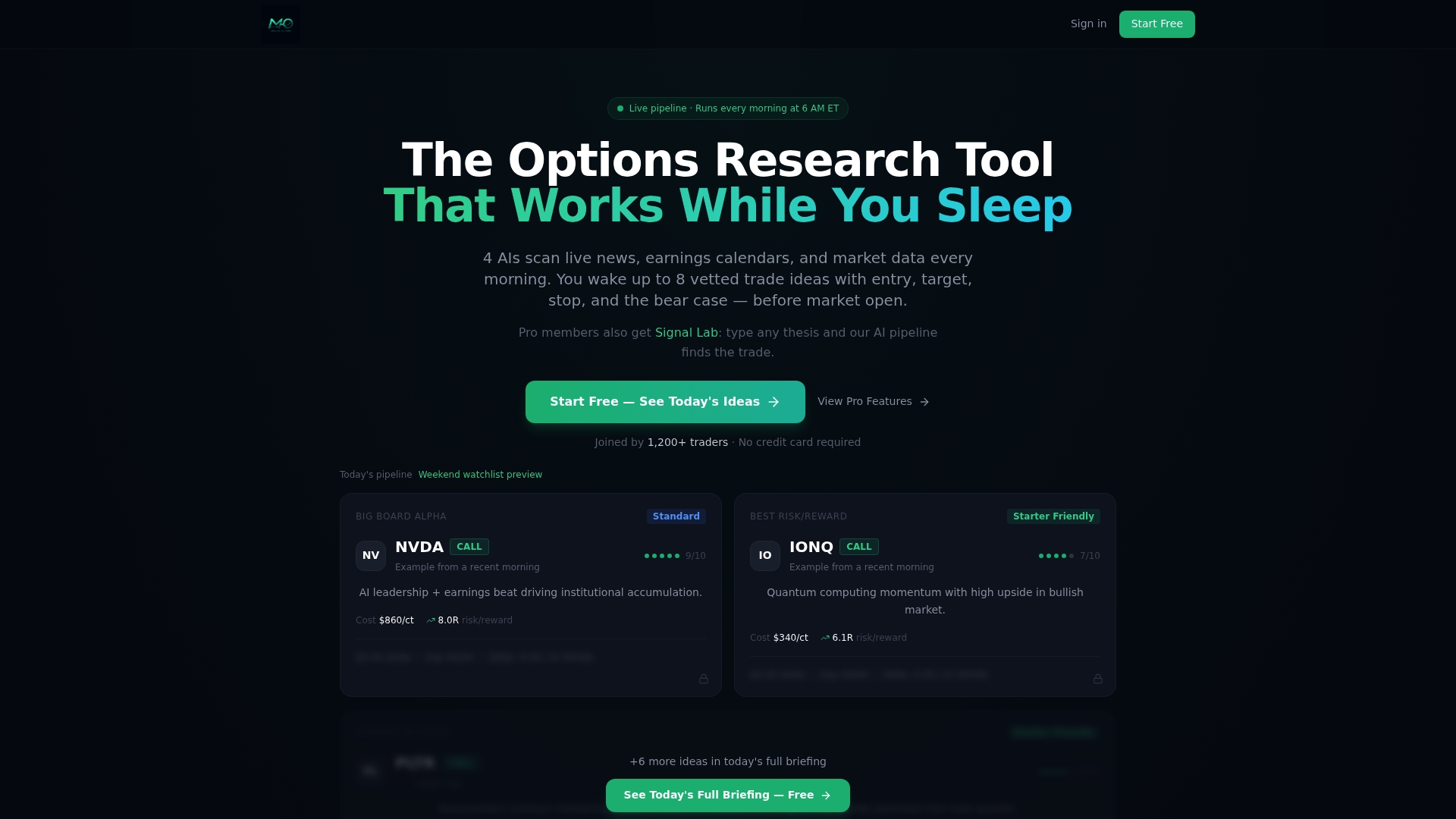
The free tier gives you daily briefings with the top-ranked ideas. Upgrading to Pro at $89/month adds the lunchtime scanner and an AI chat tool for researching any ticker on demand, useful when you want to check whether a stock's implied volatility supports a spread or a long option before you enter. For beginners building confidence with simple options strategies, having pre-vetted, ranked ideas with clear entry levels removes the hardest part of the learning curve. Visit Morningoptions to explore the free daily briefing and see what the Pro tier includes.