
Use four filters before you touch a chain: minimum open interest in the hundreds, minimum daily volume that matches your strategy speed, a maximum bid-ask spread under 5% to 10% of the mid for income trades, and enough displayed size to fill your order. Then place limit orders at or near the mid-price, never a market order. Everything below shows the exact numbers and the setup steps.
TL;DR:
- Use filters with minimum open interest of 1,000 contracts, daily volume of 200 contracts, and spreads under 5% for conservative income trading.
- Match liquidity thresholds to your trading frequency, allowing wider spreads for quick scalping and tighter spreads for longer-term strategies.
- Prioritize near-dated, at-the-money options and verify recent actual trading activity before placing limit orders to reduce slippage.
- Always check spread as a percentage of mid-price rather than bid-price alone, especially for low-priced options, to avoid underestimating trading costs.
- Rely on real-time, detailed chain data that includes spread percentage, displayed size, delta, and expiration controls for effective screening.
Table of Contents
- What Liquidity Metrics Actually Tell You on the Chain
- Which Filter Presets Should You Actually Use?
- How Do You Set Up a Liquidity Filter Step by Step?
- How Do You Limit Slippage When You Trade?
- What Should a Good Options Screener Expose?
- How Morningoptions Applies These Filters for You
- What Traders Get Wrong About Liquidity
- Try Morningoptions for Pre-Filtered, Ranked Trade Ideas
- Sources
- FAQ
What Liquidity Metrics Actually Tell You on the Chain
Options liquidity comes down to four numbers on the chain, and most traders only look at one of them. Bid-ask spread, displayed size, open interest, and intraday volume together describe how tradable a contract really is, not just how popular the underlying stock is.
The bid-ask spread options traders should watch is the gap between the buy and sell price. A $0.10 spread sounds tiny until you check it against a $1.00 mid-price. That's a 10% haircut before the trade even moves. Spread as a percentage of mid matters far more than the raw cents, because a $0.05 spread on a $10 option is nothing, but the same $0.05 on a $0.50 option is brutal.
Displayed size is the second piece people skip. The National Best Bid and Offer (NBBO) only guarantees you that price for the size shown, often just 1 to 10 contracts on thinner names. Trade beyond that size and you start eating into worse prices further down the book.
- Open interest measures how many contracts are currently outstanding. It tells you about structural depth over time.
- Volume measures how many contracts traded today. It tells you whether anyone's actually active right now.
A contract can have huge open interest from a position built months ago and still trade almost nothing today. Spread under roughly 5 to 10% of mid is generally healthy for income selling; once it climbs past 15 to 20%, the cost usually outweighs the trade idea itself. That gap between quoted price and what you actually pay to get filled is market impact, and it's why liquidity in options never boils down to a single stat.
Which Filter Presets Should You Actually Use?
Your strategy speed should set your thresholds, not a generic rule you read once. Slow, monthly income trades can tolerate different liquidity than a same-day scalp, so match the preset to what you're actually doing.
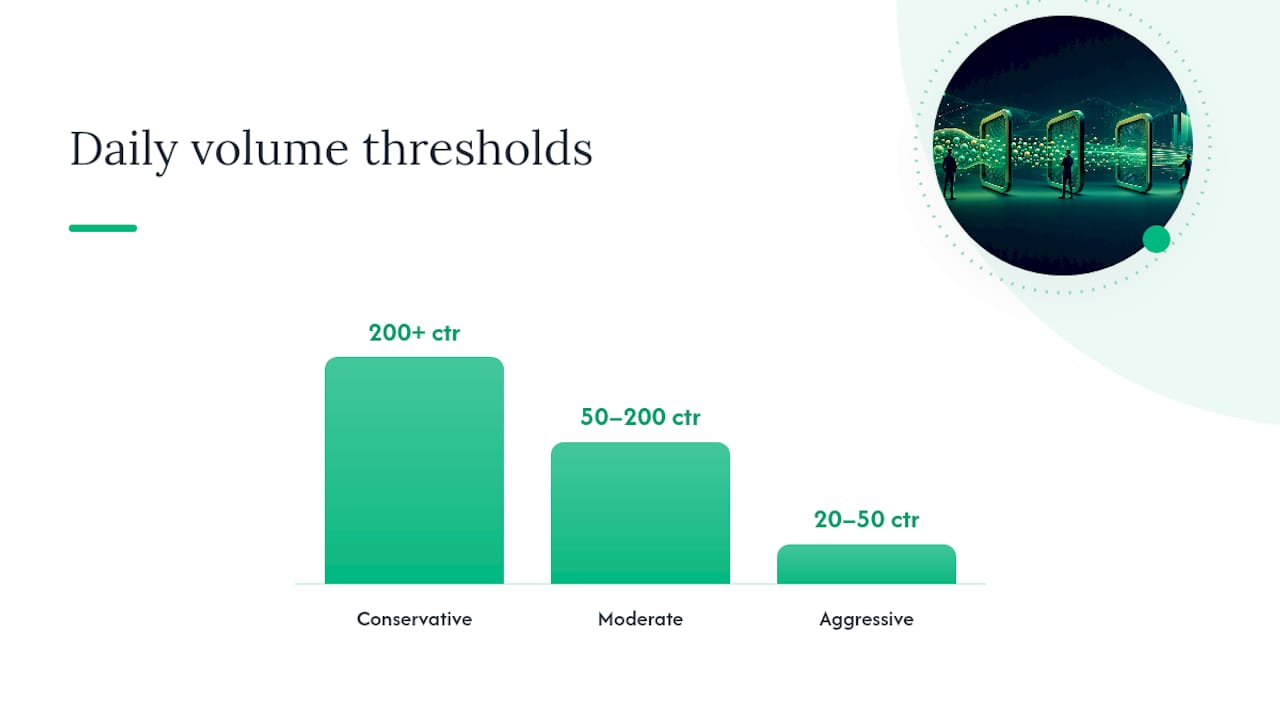
Conservative preset, built for income sellers:
- Minimum open interest: 1,000 or more contracts
- Minimum daily volume: 200 or more contracts
- Maximum spread: under 5% of mid, or under $0.05 flat on cheaper options
Moderate preset, built for active swing traders:
- Minimum open interest: 300 to 1,000 contracts
- Minimum daily volume: 50 to 200 contracts
- Maximum spread: 5 to 10% of mid
Aggressive preset, built for scalpers and short-term momentum plays:
- Minimum open interest: 100 to 300 contracts
- Minimum daily volume: 20 to 50 contracts
- Maximum spread: 10 to 15%
Notice the tradeoff. Looser volume and open interest requirements often mean accepting wider spreads, as less liquid names rarely have tight spreads regardless of desire.
Two practical notes matter more than the numbers themselves. First, use relative spread percentage on higher priced options, but switch to an absolute cents floor on cheap contracts, since a percentage on a $0.20 option barely means anything. Second, liquidity concentrates heavily at near-dated, at-the-money strikes and decays fast as you move into far-dated tenors or deep out-of-the-money wings. Stay close to the money and close to the front month whenever your strategy allows it.
Pro Tip: Check spread against the option's mid price, not its bid. A $0.10 wide spread on a $0.60 bid can actually be a $1.10 mid, which changes your percentage math completely.
How Do You Set Up a Liquidity Filter Step by Step?
Running the filter isn't complicated once you know the order of operations. Here's the sequence that keeps you from wasting time on strikes that look good but trade nothing.
- Pick your underlying and expiration window. Stick to the front month or roughly a 30 day window unless your strategy explicitly calls for something longer.
- Apply your preset. Set minimum open interest, minimum daily volume, and maximum spread percentage based on whether you're running the conservative, moderate, or aggressive filter from above.
- Open the actual chain. A screener result is a starting point, not a verdict. Check displayed size at the strike you're eyeing.
- Check time and sales. Look at recent prints to confirm trades are actually clearing near the quoted mid, not just sitting there unfilled.
- Shortlist two or three strikes. Rank them by spread tightness and size relative to what you plan to trade.
- Size your order to displayed size. If NBBO shows 5 contracts and you want 20, plan to work the order in pieces rather than firing all at once.
- Place a limit order at or near mid. This is where most of your execution cost either gets saved or gets wasted.
Names like SPY and QQQ make this whole process almost trivial, since their options chains carry deep size at nearly every strike and expiration. Try the same steps on a thinly traded small cap option and you'll see the difference in about ten seconds.
How Do You Limit Slippage When You Trade?
Slippage in options trading almost always traces back to one habit: sending a market order on a wide-spread contract. A market order guarantees you cross the entire spread instantly, no matter how ugly it is. There's no upside to that trade for you, only for whoever's on the other side.
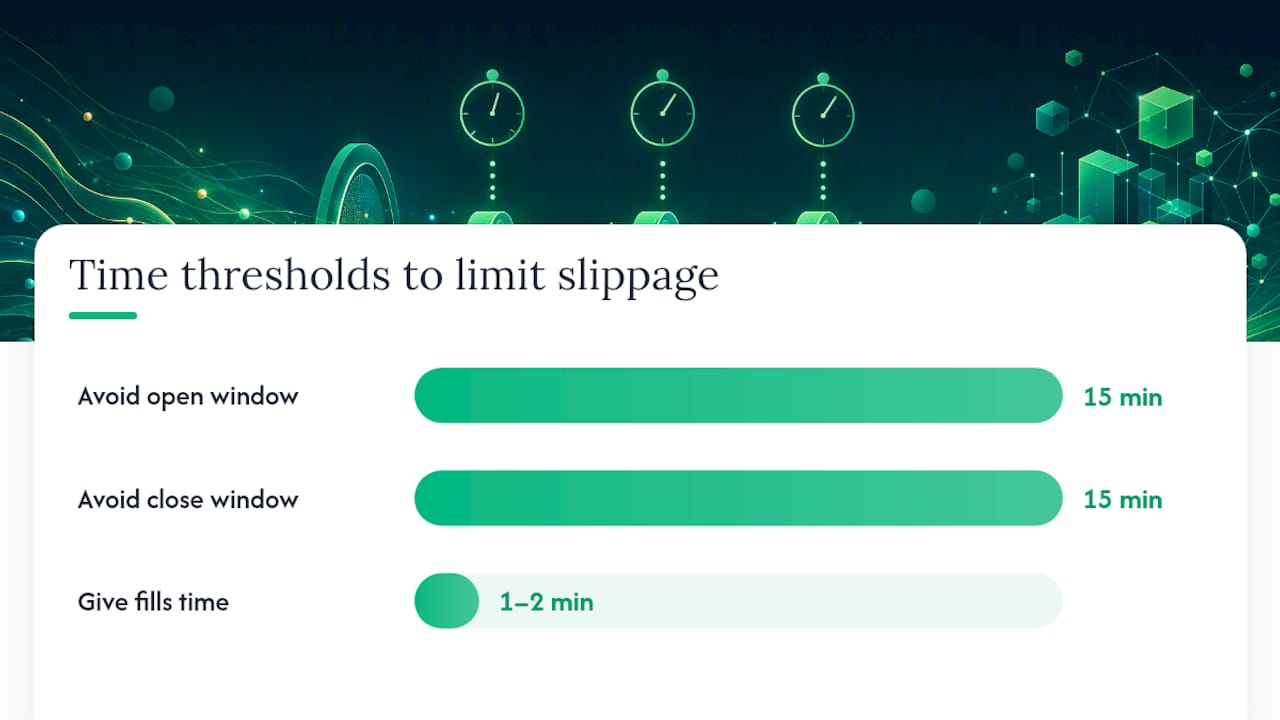
Midpoint limit orders flip that script. Placing your limit at or near the mid-price forces the market maker to either meet you there or let the order sit, and plenty of fills happen at or near mid on liquid names within seconds. If it doesn't fill, nudge a cent or two toward the ask or bid rather than jumping straight to the worse price.
- Avoid the first and last 15 minutes of the trading day, when spreads widen from opening volatility and closing imbalances.
- Midday tends to run calmer on names with real liquidity in options, which is exactly when you want to be working an order.
- Never send an order larger than displayed NBBO size in one shot. Split it and work the pieces.
Pro Tip: If a fill isn't happening within a minute or two on a liquid underlying, that's usually a sign your limit is priced wrong, not a sign to switch to a market order.
What Should a Good Options Screener Expose?
A screener is only as useful as the fields it lets you filter on. If it hides spread percentage or displayed size behind a paywall or just doesn't calculate them, you're back to doing math by hand on every strike.
Look for these fields specifically:
- Minimum open interest and minimum daily volume, set independently
- Maximum bid-ask spread as a percentage of mid, not just raw cents
- Displayed size at the NBBO
- Delta, so you can filter by moneyness alongside liquidity
- Expiration window controls, ideally locked to a front month or custom day range
Some platforms bundle all of this into a single toggle. A liquidity-cleanup filter combines minimum volume, minimum open interest, and maximum spread into one switch, which is a fast first pass before you tighten anything by hand. Beyond the filters themselves, check that the screener runs on real-time quotes, shows full chain depth rather than a summary, and lets you export your shortlist. A scanner that models fills at the midpoint rather than assuming instant execution at the quoted price will also save you from backtest numbers that look better on paper than they'll ever perform live.
How Morningoptions Applies These Filters for You
Morningoptions runs this exact filtering logic before a trade idea ever reaches its daily briefing. The scanner checks spread, open interest, and volume automatically, then ranks the surviving candidates and hands you specific contracts with entry levels rather than a raw list of tickers to research yourself.
The free daily briefing covers the morning's top ideas. The Pro tier adds a lunchtime scanner and an AI chat tool for pulling a liquidity read on any ticker mid-session, which matters most on days when volume shifts fast after the open.
Building your own scans still makes sense if you trade a narrow watchlist and know exactly which strikes you want checked. If you'd rather start from a pre-filtered, ranked shortlist and spend your time on the trade decision instead of the spreadsheet, an automated feed does that job for you.
What Traders Get Wrong About Liquidity
The most common mistake is checking the underlying's total volume and assuming every strike inherits it. It doesn't. Liquidity concentrates at the money and near-dated, and a single far-dated or deep out-of-the-money strike on a heavily traded stock can still be a ghost town.
The second mistake is treating market orders as harmless on "big name" tickers. Spread cost adds up trade after trade, quietly, and it belongs in your expected return math from the start, not as an afterthought when a strategy underperforms.
Quick checklist before any trade: spread percentage, minimum open interest, minimum volume, displayed size, and a mid-price limit order. Skip more than one of those and you're trading blind.
— Customer
Try Morningoptions for Pre-Filtered, Ranked Trade Ideas
Morningoptions is the shortcut for traders who don't want to build spread and open-interest filters by hand every morning before the bell. The scanner runs those checks automatically and delivers ranked, specific contract ideas with entry levels, so you skip straight to the decision.

The free daily briefing covers the morning's top setups at no cost. The paid plan unlocks the lunchtime scanner and an on-demand AI chat tool for checking liquidity and setups on any ticker during the session. If you're tired of manually cross-checking spread percentages before every trade, start with a free briefing tomorrow morning and see how the ranked list compares to your own shortlist.
Sources
- What Is Options Liquidity? Bid-Ask, Depth, and Market Impact | OAS
- How to Tell If an Option Is Liquid (Spread, OI, Volume) | TheOptionsBench
FAQ
How Do You Check the Liquidity of Options?
Look at four things together: bid-ask spread as a percentage of mid, open interest, today's volume, and displayed size at the NBBO. If two of the three core metrics look weak, treat the strike as untradeable regardless of how popular the underlying is.
What Is the 3-5-7 Rule in Options Trading?
The 3-5-7 rule refers to a specific spread-based trading strategy structure rather than a liquidity metric, and it isn't part of the filter framework covered here. If you're researching liquidity specifically, focus on spread percentage, open interest, and volume instead.
What Is Warren Buffett's Favorite Option Strategy?
Buffett has publicly discussed selling cash-secured puts as a way to acquire stock at a discount or collect premium if it isn't assigned. That strategy still depends heavily on picking liquid strikes, since a wide spread on a cash-secured put erodes the premium you're trying to collect.
What Options Have the Most Liquidity?
Options on heavily traded index-tracking names like SPY and QQQ consistently carry the tightest spreads and deepest size at nearly every strike and expiration. Individual stock options can rival that only on the largest, most actively traded names, and usually only near the money in the front month.