
The best time to trade options is the mid-morning window between 10:00 and 11:00 AM ET, when the opening chaos settles but volume stays healthy. Plus, the final hour from 3:00 to 4:00 PM ET, when liquidity returns for closing positions. The open (9:30 to 10:00 AM ET) offers the biggest moves but suits only prepared traders with tight risk rules. Midday, roughly 11:30 AM to 2:00 PM ET, is usually the weakest window for new entries.
TL;DR:
- The optimal time to trade options is between 10:00 and 11:00 AM ET due to improved liquidity and tighter spreads after the open chaos.
- Liquidity rebuilds during the final hour from 3:00 to 4:00 PM ET, making it favorable for closing positions and managing day-end gamma risk.
- Midday from 11:30 AM to 2:00 PM ET generally presents the weakest window for new entries due to low volume and wide spreads.
- Strategies should match session timings: breakout traders favor post-open and power hour, while premium sellers prefer the calm midday environment.
- Proper execution practices, such as using limit orders and sizing down during wide spreads, are essential to reduce slippage and improve trade outcomes.
Table of Contents
- Your Daily Trading Options Timing Checklist
- How Liquidity and Volatility Shift Through the Trading Day
- Which Options Strategy Fits Which Trading Window?
- Why Day of the Week and Days to Expiration Change Your Timing
- Building an Execution Checklist That Actually Reduces Slippage
- What a Disciplined Trading Day Actually Looks Like
- What the Data Actually Tells Active Traders
- Let Morning Options Do the Scanning So You Can Focus on Timing
- Sources
Your Daily Trading Options Timing Checklist
The trading day moves in a U shape. Volume and volatility peak at the open, sag through the middle hours, then climb again into the close. That pattern shows up consistently in session-volume studies, and it's the single most useful thing to internalize if you only remember one fact from this article.
Three rules follow from that shape:
- Trade the first and last hours when you want liquidity and movement; treat midday as a management window, not a hunting window.
- Widen your patience at the open. The first prints are often noisy and don't reflect where the market wants to settle.
- Shrink your size when spreads are wide, and never assume the fill you'd get at 10:15 AM is the fill you'll get at 9:31 AM.
Pro Tip: Set a personal rule that you won't place a new options order in the first five minutes after the bell, no matter how good the setup looks. That single habit prevents more bad fills than any indicator will.
How Liquidity and Volatility Shift Through the Trading Day
Every session has its own personality, and knowing which one you're in changes how you should behave.
-
Pre-market. Thin volume, wide spreads, and prices that can gap on a single headline. Use this window to scan for premarket catalysts and set your alert levels, but avoid executing anything except in the most liquid index-linked names.
-
The open (9:30 to 10:30 AM ET). This is where the day's biggest ranges usually happen, and also where the ugliest fills happen. A common practitioner rule is to wait five to thirty minutes before committing capital, unless you're running a defined opening-range breakout system with hard entry and exit rules already written down.
-
Mid-morning (10:00 to 11:00 or 11:30 AM ET). Spreads tighten, the initial overreaction fades, and price action starts reflecting actual supply and demand rather than order-imbalance noise. Most retail traders get their cleanest entries here.
-
Midday lull (11:30 AM to 2:00 PM ET). Volume drops off a cliff. Many professional traders stop opening new positions by 11:30 ET specifically because the risk-to-reward during this stretch rarely justifies it. It's not a dead zone for everyone, though. Traders managing existing credit spreads or rolling positions often prefer the calm.
-
Afternoon ramp and power hour (3:00 to 4:00 PM ET). Liquidity rebuilds as institutions rebalance and day traders close positions before the bell. If you're holding options expiring that day or the next, this hour also carries the sharpest gamma risk of the entire session, since small stock moves can swing option value disproportionately.
Which Options Strategy Fits Which Trading Window?
Not every strategy wants the same clock. Matching your approach to the session you're actually trading in is often the difference between a good fill and a frustrating one.
- Directional and momentum buyers do best in the post-open cleanup window and again during power hour, when continuation rates on breakout setups run noticeably higher than during midday. Chasing a morning gap at 9:32 AM is a different bet than buying the same breakout at 10:20 AM once it's confirmed.
- Premium sellers and credit spread traders often prefer midday precisely because the market's calm. Selling into elevated implied volatility during a quiet stretch, especially around the widely used 45 days-to-expiration mark favored by many systematic sellers, gives you time decay working in your favor without needing the stock to move at all. This lines up with the idea that midday rewards management over aggression rather than punishing you for showing up.
- Scalpers and high-frequency intraday traders need liquidity above almost everything else, which pushes them toward the open and the close, where order flow is thickest and spreads are tightest relative to the moves available.
- Spread and multi-leg traders generally get the best combined pricing on both legs during mid-morning, once bid-ask spreads have normalized from the opening scramble. Trying to leg into an iron condor at 9:35 AM is asking for slippage on both sides.
Why Day of the Week and Days to Expiration Change Your Timing
Tuesday through Thursday tend to draw steadier volume than Monday, which often carries weekend news risk, or Friday, which can get choppy near the close as weekly options expire.
Days to expiration matter just as much as time of day:
- Many premium sellers open new positions around 45 DTE, giving the trade room to work before time decay accelerates.
- Gamma risk climbs sharply as positions approach 21 and especially 7 days to expiration, which is exactly why late-day entries in short-dated contracts deserve smaller size.
- Earnings, Fed announcements, and other scheduled catalysts override the normal clock entirely. A stock that behaves predictably at 10:15 AM on a quiet Tuesday can gap through every level you mapped out the moment an FOMC statement hits the wire.
Building an Execution Checklist That Actually Reduces Slippage
Timing gets you into the right window. Execution mechanics determine whether that window actually pays off.
- Use limit or marketable-limit orders during thin periods. A blind market order at 9:31 AM on a stock with a wide options spread can cost you far more than a few seconds of patience would.
- Check volume, open interest, and bid-ask width before you click buy, not after.
- Watch your broker's cutoff for opening same-day-expiring contracts. Many brokers restrict new same-day expiration positions after roughly 3:30 PM ET, and getting caught by that rule mid-trade is an unforced error.
- Size down when spreads are wide and lean on defined-risk structures, like spreads instead of naked options, whenever gamma risk is elevated. Execution-cost research using time-stamped trade data backs this up directly: market impact genuinely varies by time of day, and the broader guidance on execution quality points the same direction.
Pro Tip: Before entering any trade outside the mid-morning or power-hour windows, ask yourself if you'd take the same trade if the spread were twice as wide. If the answer is no, wait.
What a Disciplined Trading Day Actually Looks Like
A realistic schedule for an active options trader rarely means staring at charts for six and a half hours. It looks more like three concentrated blocks: fifteen to twenty minutes before the open reviewing overnight news and setting alert levels, a focused window from roughly 9:45 to 11:00 AM ET for entries, then a quick midday check to manage or adjust existing positions before returning for the final hour.
Traders who use strategies built around limited screen time tend to lean on pre-market briefings to shortcut the scanning work, and a midday scan to catch anything that's shifted since the open, which cuts total watch-time without cutting quality of decisions.
What the Data Actually Tells Active Traders
The conventional advice, "trade the open, avoid lunch, trade the close," is directionally right but incomplete. It treats every trader like a scalper, when the actual research shows timing preferences split hard by strategy. A premium seller ignoring midday because "everyone says avoid it" is walking away from some of the calmest, most favorable conditions for that specific trade.
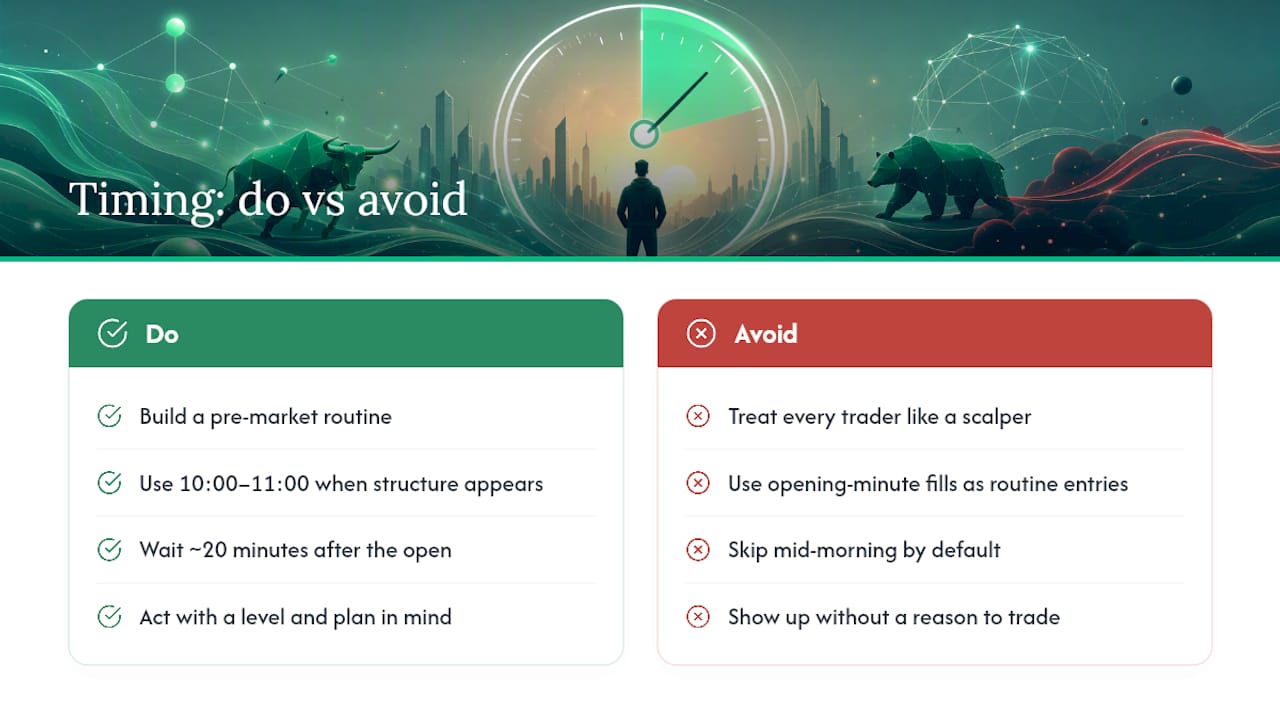
What the research does support without much ambiguity: opening-minute execution is genuinely riskier than most new traders assume, and the mid-morning window gets underrated because it isn't dramatic. No one brags about a clean 10:20 AM fill. But that's exactly why it works. The gap between what feels exciting (trading the open) and what actually performs (waiting twenty minutes, then acting with a plan) is where most retail losses happen.
Prioritize this first: build a pre-market routine before you build a timing rule. Knowing that 10:00 to 11:00 AM tends to offer clean structure doesn't help if you show up without a level in mind or a reason for the trade.
— Customer
Let Morning Options Do the Scanning So You Can Focus on Timing
Knowing the best windows to trade is only half the job. Showing up to them with a specific, vetted idea instead of a vague hunch is the other half, and that's the gap Morningoptions closes. Every market morning, its AI pipeline scores and ranks options trade ideas with entry levels before the bell rings, so your 9:45 AM prep window starts with a shortlist instead of a blank screen.

The daily briefing covers pre-market catalysts and earnings context so you're not scrambling to figure out why a stock gapped. A paid Pro tier adds a lunchtime scanner built specifically for that low-liquidity midday stretch, when a fresh set of eyes matters most, plus an AI chat tool for researching any ticker on demand. Three realistic ways traders use it: reviewing ranked ideas before the open, running a quick midday check between meetings, and capturing setups worth revisiting the next morning. Start with the free daily briefing and see how it fits into your own trading window.
Sources
- The Best Time of Day to Trade Options (Data-Backed 2026)
- Best Time of Day to Day Trade: Why Most Pros Stop by 11:30 ET - TradeOlogy Academy
- Best Time of Day to Day Trade: Market Session Analysis and Optimal Trading Windows | TradeAlgo
- Options trading hours