
The single best setup for options news is a wire service for speed, an options-flow feed for positioning, a pre-market briefing for context, and a customizable alert scanner to tie it all together. No single source does all four jobs well, which is exactly why traders who rely on one outlet get blindsided by moves everyone else saw coming.
If you only have thirty seconds, here's the roster:
- For raw speed: Reuters or MarketWatch headlines
- For options flow and unusual activity: Barchart's options commentary or a dedicated flow scanner
- For depth and structure: Bloomberg or Risk
- For a fast, free morning read: MorningOptions' daily briefing
By role, the one-line picks look like this: the active retail scalper needs a wire plus a scanner; the event-driven earnings trader needs options-specific coverage like CNBC's Options Action and an implied volatility (IV) tracker; the institutional-minded directional trader wants Bloomberg-grade Greeks and skew data; the volatility trader needs a VIX feed alongside macro wires. Each role points to a different combination, not a single winner.
Key Takeaways
A reliable options-news workflow combines a fast wire, an options-flow feed, a depth source, and a filtered briefing, because no single outlet covers speed, positioning, and analysis at once.
| Point | Details |
|---|---|
| Match source to job | Use wires for speed, flow feeds for positioning, and outlets like Bloomberg or Risk.net for structural depth. |
| Check IV before the headline | IV rank and recent IV change matter more than the news item itself when sizing a trade. |
| Build a three-alert stack | Combine an earnings calendar alert, an IV-rank filter, and an unusual-volume trigger. |
| Verify before you trade | Confirm claims against exchange timestamps and a second source before acting on breaking headlines. |
| Use MorningOptions for the morning filter | Its free briefing ranks daily contract ideas, and the $89/month Pro tier adds Signal Lab and midday scans for traders who need more than the open. |
This article is general information, not a substitute for advice from a qualified financial advisor. Consult a qualified financial professional about your own circumstances before acting on anything here.
Table of Contents
- Which Options News Sources Should You Use, and When?
- How Do You Build an Intraday News Workflow?
- How Does News Actually Move Option Prices?
- Why MorningOptions Fits This Workflow
- What Actually Matters vs. What Traders Waste Time On
- Get a Ranked Options Briefing Before the Market Opens
- Sources
Which Options News Sources Should You Use, and When?
Not every source does the same job, and treating a slow-moving analysis site like a breaking-news feed is how traders miss the open. The table below breaks down the five source categories by what they're actually built for.
| Category | Speed | Options-specificity | Analytical depth | Alerts/customization | Cost |
|---|---|---|---|---|---|
| Newswires (Reuters, MarketWatch) | Very fast | Low | Low | Moderate | Free to low-cost |
| Financial media (CNBC, WSJ) | Fast | Moderate | Moderate | Limited | Free/subscription |
| Options-specific outlets (Options Insider, Options Action) | Moderate | High | Moderate to high | Limited | Mostly free |
| Options-flow services (Barchart, flow scanners) | Fast | High | High | High | Free tier + paid |
| Exchange data (Cboe) | Real-time | High | High (raw) | Low (raw feed) | Often paid/delayed free |
A few practical notes on the trade-offs:
- Newswires win on speed but say nothing about implied volatility or positioning.
- Options-flow services are the only category built to show you where money is actually going, not just what happened.
- Exchange data from Cboe is the ground truth for pricing and volume, but it's raw. You still need a filter to make it usable.
For an earnings play, pair breaking news with a flow service. You want the headline and the confirmation that real contracts are trading on it, not just chatter.
How Do You Build an Intraday News Workflow?
Reading five tabs at once isn't a strategy, it's a way to miss the one headline that mattered. Here's a workflow that keeps you moving without drowning you in noise.
- Pre-market (6:00 to 9:15 AM ET): Scan overnight wires, check the economic calendar for scheduled catalysts, and review your morning briefing for ranked setups.
- First 30 minutes after the open: Watch for confirmation. Does the flow feed show real volume behind the morning's top ideas, or is price moving on thin liquidity?
- Midday (11:30 AM to 1:30 PM ET): Run a second scan for anything that developed after the open, earnings surprises, guidance changes, or a sudden IV spike on a name you're watching.
- Close and overnight: Note what moved and why, and flag any pending catalysts (earnings, Fed speakers, economic data) for the next session.
A useful alert stack looks like this: an earnings calendar alert set two days ahead, an IV-rank filter that flags contracts trading above their 30-day average, and a volume filter that fires when options volume crosses a multiple of average daily volume on a specific ticker.
Timing matters as much as the sources themselves. Prioritize speed during the first fifteen minutes after any major macro release. Fed minutes and CPI prints move option premiums within seconds, and you don't have time to read a think piece before adjusting a position. Depth sources matter more in the hour before earnings, when you're deciding on strike selection rather than reacting to a headline. A trading scanner that filters headlines against your open positions saves the manual cross-checking that eats up the most time.

Pro Tip: Route your highest-priority alerts (earnings on positions you hold, and any ticker with unusual options volume) to a phone push notification, not email. Email is where speed goes to die.
How Does News Actually Move Option Prices?
Every options trader has felt it: a stock barely moves on a headline, but the option price does something strange anyway. That's implied volatility doing its job, and understanding the mechanism turns a confusing headline into a specific, tradeable adjustment.
Earnings are the cleanest example. IV climbs into the report as uncertainty builds, then collapses immediately after, a pattern known as the IV crush. A stock can beat earnings and still see its calls lose value if the move was smaller than what the crushed IV had priced in.
Macro surprises (CPI, jobs reports, Fed decisions) hit the whole market's volatility at once, which is why the VIX tends to spike on data days even for stocks with no direct exposure to the number. Fed commentary works through expectations. A single unscripted phrase from a Fed official can reprice rate-sensitive sectors within minutes, well before any official statement changes. M&A rumors spike IV asymmetrically, usually skewed toward calls on the target and puts on the acquirer, since deal risk cuts both ways.
Before trading any headline, run through this checklist:
- Where does IV rank sit relative to the past year, not just the past week?
- Has IV already moved, or is the move still ahead of you?
- How wide is the bid-ask spread right now versus its normal range?
- Is there enough time to expiration left to give the trade room to work?
Pro Tip: When bid-ask spreads widen sharply after a headline, that's the market telling you liquidity just dried up. Favor defined-risk spreads over single-leg positions until spreads normalize.
Fast Trust Checks Before You Trade a Headline
Not every "breaking" post is real, and trading on a fake block trade claim is an expensive lesson. Run a quick check before you act: does the source tie back to a real-time exchange feed, does it quote a primary source by name, and does the outlet disclose its own vetting process rather than just aggregating social posts?
Red flags worth ignoring outright: anonymous account claims about a "massive" options trade with no confirmable print, headlines recycled across five sites with no original link back to a wire or exchange, and any tip that can't survive a check against a second source.
Pro Tip: Cross-check the timestamp on a breaking headline against the exchange tape. If Cboe's volume data doesn't show unusual activity within a few minutes of the claim, the "signal" is probably just noise.
Why MorningOptions Fits This Workflow
MorningOptions was built for the exact gap this workflow exposes: traders have plenty of raw news but not enough time to turn it into a ranked, tradeable idea before the open. Its AI pipeline scans overnight catalysts and earnings, then delivers a briefing with specific contract ideas, entry levels, and a bear case, not vague commentary.
- Pre-market briefings rank the day's setups so you're not starting from a blank screen at 6 AM.
- Signal Lab (Pro tier) lets you run on-demand scans on any ticker instead of waiting for the next scheduled update.
- Midday scans (Pro tier) catch what develops after the open, filling the gap most morning-only tools leave open.
- Free tier gives you limited daily ideas; the Pro tier at $89/month unlocks the full briefing set, Signal Lab, and expanded scans.
Traders who want speed and depth from primary sources should still keep Reuters and Bloomberg open for confirmation. MorningOptions isn't meant to replace exchange-level data. It's meant to be the filter that turns everything else into a decision you can act on before the bell.
What Actually Matters vs. What Traders Waste Time On
Most advice about options news treats every source as interchangeable, as if bookmarking ten sites is a strategy. It isn't. The traders who consistently make good intraday decisions read fewer sources, not more, and they've matched each one to a specific job instead of scanning everything and hoping something useful surfaces.
The overrated habit is chasing every headline that mentions a ticker you hold. Most of that noise never touches implied volatility in a way that matters. What's underrated is checking IV rank before checking the headline itself. A stock can drop three percent on bad news and its options can still get cheaper if the move undershot what was already priced in.
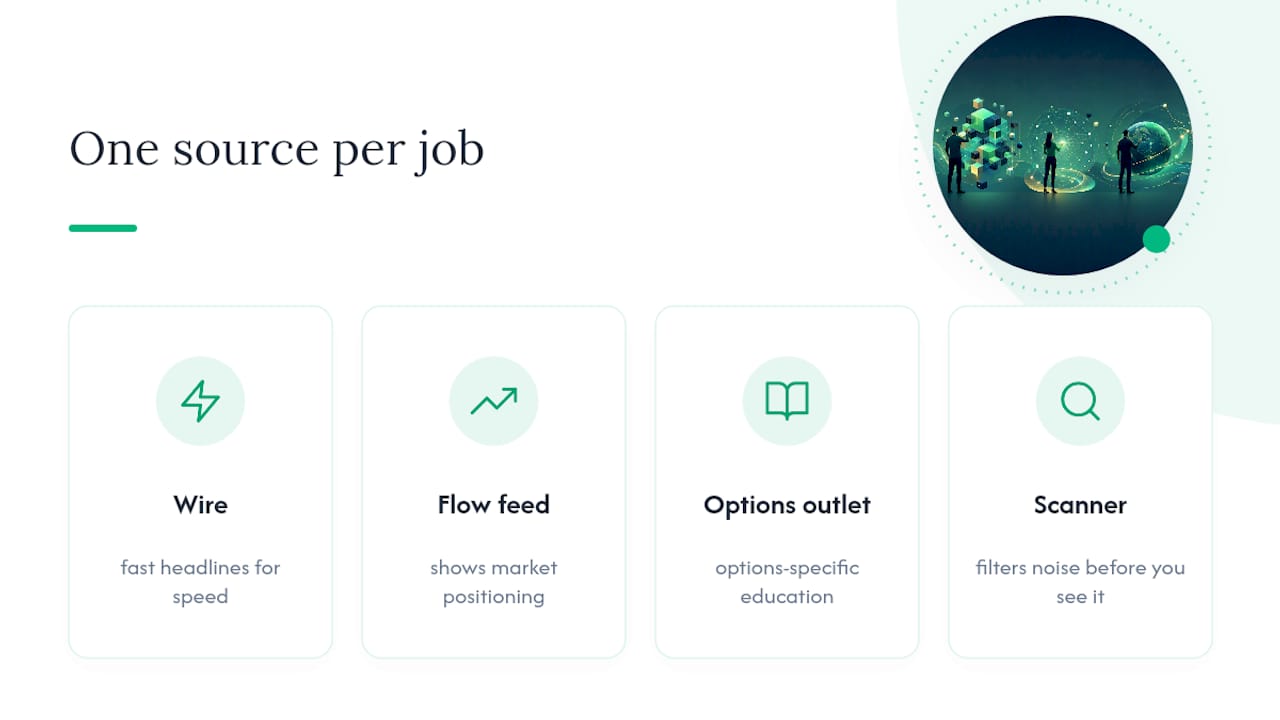
Here's what I'd tell any trader building this stack from scratch: pick one source per job, not five sources doing the same job badly. A wire for speed, a flow feed for positioning, one options-specific outlet for education, and a scanner that filters the noise before it reaches you. Anything beyond that four-source stack is usually procrastination dressed up as research.
Get a Ranked Options Briefing Before the Market Opens
Building the workflow above from scratch, wires, a flow feed, a scanner, and time to check all three before 9:30 AM, is a lot to ask of anyone who also has a job outside of trading. That's the gap MorningOptions closes: instead of assembling raw feeds yourself, you get a ranked briefing with specific contract ideas, entry levels, and a bear case already built in, every trading morning.
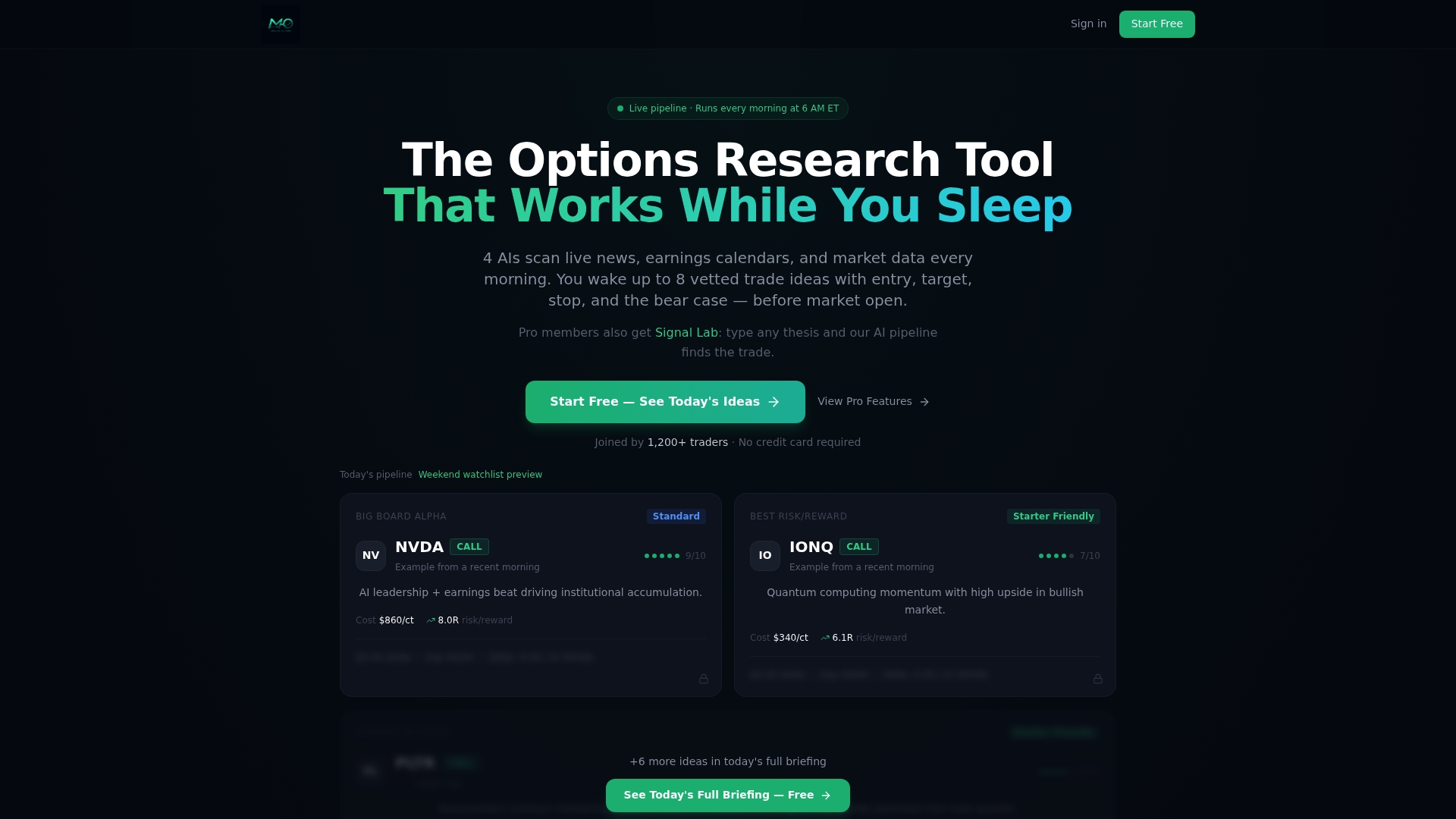
If you're the earnings-driven or event-driven trader this article describes, the free daily briefing gives you a fast read on the day's setups without another subscription commitment. If you want the lunchtime scanner and Signal Lab to catch what develops after the open, the Pro tier at $89/month adds that layer without asking you to abandon your existing news sources; it's built to sit alongside them. Start with the free daily briefing at MorningOptions tomorrow morning and see how it compares to your current pre-market routine.
Sources
Generic finance news won't tell you whether a stock's implied volatility is cheap or expensive going into earnings. You need sources built for that specific question, organized by what job they do.
For speed, the wires still win. Reuters provides fast wire coverage that reaches professional desks first, and it remains the default first-check during breaking events. MarketWatch runs a close second for retail traders who want free, easy-to-scan headlines rather than a professional terminal.
For options-specific flow and unusual activity, Barchart's options news and commentary publishes write-ups on unusual volume and specific contract activity, useful for spotting where large positions are building before a move. Watch for spikes in volume relative to open interest. A contract trading ten times its average daily volume two days before an earnings date is the kind of signal worth an alert.
For deep analysis and institutional-grade data, Bloomberg offers real-time reporting plus Terminal tools like volatility surfaces and skew charts that most retail traders never see. Risk.net covers structural topics like 0DTE contract growth and product innovation, useful when you need to understand why IV behaves the way it does across an entire asset class, not just one ticker.
For options-focused commentary that blends education with trade ideas, CNBC's Options Action combines live TV segments with strategy breakdowns tied to specific tickers, and experts there tend to frame the conversation around managing volatility rather than just calling direction. The Wall Street Journal fills a similar niche for macro and earnings context with more institutional weight than retail-focused outlets. Options Insider runs a continuously updated feed with sections dedicated to most-active options and earnings reports, which makes it a solid standing tab during market hours.
For exchange-level ground truth, Cboe publishes the raw volume, open interest, and settlement data that every downstream analysis eventually traces back to. It's not built for casual reading, but it's the source that resolves any dispute about what actually traded.
For a fast morning read that's already been filtered, MorningOptions delivers a daily pre-market briefing with ranked, specific contract ideas rather than general commentary, which matters if your time before the open is measured in minutes, not hours.
Pricing shapes vary widely. Wires and CNBC are free. Bloomberg Terminal access runs into the thousands per month and is really an institutional tool. Options Insider and Barchart's news are largely free, while flow-specific scanners and AI-driven briefings tend to sit behind a modest monthly subscription once you want the full feature set.
- Global Market Headlines | Breaking Stock Market News | Reuters
- Bloomberg - Business News, Stock Markets, Finance, Breaking & World News
- Options Action: Options Trading Strategies & Market Trades
- Risk