
A trading scanner is a real-time software tool that continuously monitors thousands of stocks and options contracts, delivering instant alerts the moment a setup matches your criteria. For active options traders, this speed advantage is the difference between catching a move at the open and chasing it an hour later. Manual chart review simply cannot compete with automated, rule-based screening across an entire market. This article explains why use trading scanners matters in 2026, how they work, what benefits they deliver, and how to avoid the mistakes that sink most traders who use them wrong.
Why use trading scanners instead of manual screening?
A trading scanner monitors market data instantaneously and alerts traders the moment conditions form, enabling entry before momentum peaks. A static screener, by contrast, delivers a snapshot. It shows you where the market was, not where it is. For intraday options trades, that distinction is everything.
Manual chart review forces you to cycle through tickers one at a time. A scanner runs thousands of filters simultaneously, in the background, while you focus on execution. The time savings alone justify the tool. But the deeper benefit is consistency. Every alert fires on the same objective criteria, not on whatever catches your eye after your third cup of coffee.

Real-time scanners also separate discovery from decision-making. You are not deciding which stocks to look at. The scanner decides that for you, based on rules you set in advance. Your job shifts from searching to evaluating. That is a fundamentally better use of your attention.
The industry distinguishes three scanner types: discovery scanners that flag movement, setup engines that define entry, stop, and target zones, and bots that automate execution. Successful traders use a layered approach rather than relying on alerts alone. Understanding which layer you are working with prevents the most common misuse pattern.
How scanners filter the market
Scanners apply technical filters across price action, volume, implied volatility, options flow, and momentum indicators simultaneously. You define the criteria. The scanner watches every tick. When a stock crosses your volume threshold, breaks a key level, or shows unusual options activity, the alert fires. Tick-by-tick data with sub-second refresh rates is the standard for professional scanners. Delayed data produces reactive trades, and reactive trades lose money.
Common filter criteria for options traders include:
- Unusual options volume relative to open interest
- Implied volatility rank above a set threshold
- Price breaking above or below a defined range
- Relative volume spikes on the underlying stock
- Specific candlestick patterns on intraday timeframes
Pro Tip: Set your volume filter to at least 1.5x the 20-day average before adding any other criteria. This single filter cuts noise by more than half before you touch anything else.
What are the key benefits of trading scanners for options traders?
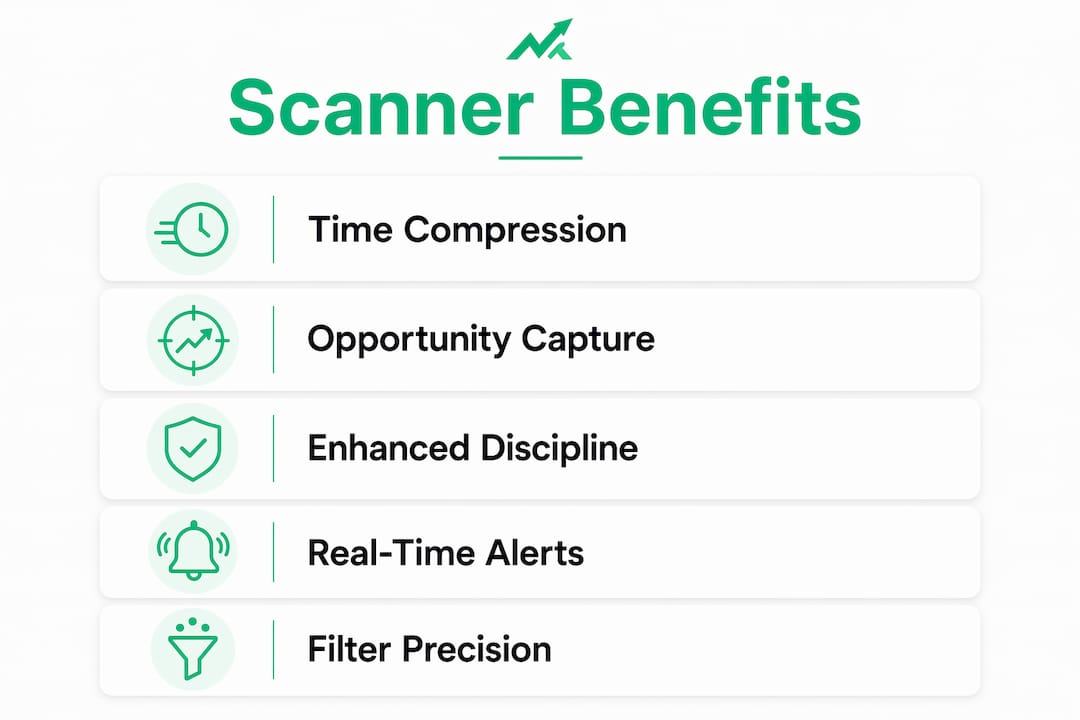
The primary benefit of market scanners is time compression. Screening thousands of tickers manually takes hours. A scanner does it in seconds. That recovered time goes toward trade evaluation, risk sizing, and execution quality, all of which directly affect your P&L.
Scanners also improve opportunity capture. Options setups are time-sensitive. A breakout that sets up at 9:45 AM maybe fully extended by 10:15 AM. Without a scanner watching for that breakout in real time, you miss it entirely. With one, you get the alert at 9:45 AM and can evaluate it before the move matures.
Market scanners improve trader discipline by automating search with pre-defined rules, which reduces emotional trading mistakes like FOMO. When your scanner only alerts on setups that meet your criteria, you stop chasing stocks that "look interesting." The filter enforces your strategy. That enforcement is worth more than any individual trade signal.
Scanners with integrated backtest data let traders see historical win rates and expected returns before risking capital. This feature supports confident position sizing. Instead of guessing whether a setup has an edge, you can see its historical performance across hundreds of occurrences. That data changes how you size positions and set targets.
The benefits stack:
- Time savings: Automated screening replaces hours of manual chart work
- Broader coverage: Monitor thousands of stocks and options simultaneously
- Reduced emotional trading: Pre-set rules replace gut-feel decisions
- Data-backed sizing: Backtest results inform position size and risk allocation
- Multi-timeframe monitoring: Watch setups across daily, hourly, and 5-minute charts at once
What pitfalls should traders avoid when using scanners?
Approximately 80% of day traders fail partly because they misuse scanners as random trade signals rather than integrating alerts into a disciplined risk management framework. An alert is not a trade. It is a candidate. The distinction matters enormously.
The most common mistake is acting on every alert without confirmation. A scanner tells you something happened. It does not tell you whether the setup is valid, whether liquidity supports your position size, or whether the broader market context favors the trade. You still need to evaluate the chart, check the options chain, and confirm the setup before entering.
Over-optimizing scanner filters on past data without considering current liquidity leads to poor trade outcomes. A filter that worked perfectly on last year's data may generate useless alerts in a different volatility regime. Filters need periodic review against live market conditions, not just historical backtests.
Alert fatigue is the other major trap. Too many alerts destroy focus. A scanner generating 50 alerts per hour forces you to make rapid, low-quality decisions on each one. A few curated alerts per day are more valuable than a flood of random signals. Quality filtering and alert ranking solve this problem.
Pro Tip: Cap your active scanner alerts at 5–10 per session. If your scanner fires more than that, tighten your filters. More alerts do not mean more opportunities. They mean more noise.
Pitfalls to avoid:
- Treating every alert as a confirmed trade signal
- Ignoring volume and liquidity requirements in filter design
- Over-optimizing filters on historical data without live validation
- Failing to integrate scanner output with a written trade plan
- Letting alert volume overwhelm your decision-making capacity
How to integrate trading scanners into your daily options workflow
Start with strategy alignment. Your scanner filters must match your actual trading criteria. If you trade iron condors on high implied volatility stocks, your scanner should filter for IV rank above 50, liquid options chains, and underlying stocks in defined ranges. Filters built around someone else's strategy produce alerts that do not fit your plan.
Use scanners to build and update your watchlist dynamically each morning. Run a pre-market scan before 9:30 AM to identify candidates with unusual overnight options activity, earnings catalysts, or technical setups near key levels. That watchlist becomes your focus list for the session. You are not reacting to random movement. You are monitoring a curated set of candidates you already evaluated.
A practical daily workflow looks like this:
- Run a pre-market scan at 8:00 AM using your core criteria
- Review each alert manually and confirm the setup on the chart
- Check the options chain for liquidity, spread width, and open interest
- Evaluate the trade setup against your risk rules before sizing
- Set price alerts on your confirmed candidates so you catch entries without watching every tick
- After the session, log which scanner alerts led to valid setups and which did not
That last step is critical. Tracking which alerts convert to quality setups tells you whether your filters are working. Tracking options trades systematically over time reveals which scanner criteria produce the best results, which lets you refine your filters with real data instead of guesswork.
Combine scanner alerts with manual chart confirmation every time. A scanner alert opens the door. Your chart analysis decides whether you walk through it.
What features matter most in a modern options trading scanner?
Not all scanners deliver equal value. The features that separate professional-grade tools from basic screeners are specific and measurable.
| Feature | Why it matters |
|---|---|
| Sub-second data refresh | Stale data produces late entries and losing trades |
| AI-powered pattern recognition | Identifies complex setups faster than manual rule sets |
| Customizable alert delivery | Push, email, and desktop alerts keep you informed without screen-watching |
| Backtest integration | Historical win rates support confident position sizing |
| Multi-window workspaces | Monitor different strategies and timeframes simultaneously |
Free scanners are generally limited by delayed data and fewer features. Premium scanners provide the speed and advanced filtering that professional trading requires. The cost of a professional scanner is small compared to the cost of a single bad trade entered on stale data.
Modern scanners also rank alerts by technical strength and freshness. Alert ranking lets you focus on the best opportunities first rather than reviewing every alert in chronological order. That ranking function alone saves meaningful time during fast market sessions.
For options traders specifically, look for scanners that filter on options-specific data: implied volatility rank, unusual options flow, put/call ratios, and open interest changes. A scanner built only for equity traders will miss the signals that matter most to your strategy.
Key Takeaways
Trading scanners deliver their full value only when paired with disciplined filters, manual confirmation, and a written trade plan that governs every entry.
| Point | Details |
|---|---|
| Scanners replace manual screening | Real-time alerts cover thousands of tickers simultaneously, saving hours of chart work each session. |
| Alerts are candidates, not signals | Every scanner alert requires manual chart confirmation and risk assessment before entry. |
| Filter quality beats alert volume | A few curated, strategy-specific alerts per session outperform a high volume of generic signals. |
| Backtest data improves sizing | Historical win rates from integrated backtest tools support confident, data-backed position sizing. |
| Discipline is the real edge | Pre-set scanner rules reduce emotional trading and enforce consistent strategy execution. |
Scanners are co-pilots, not autopilots
Every trader I have watched blow up a scanner-based approach made the same mistake: they outsourced their judgment to the tool. A scanner is a co-pilot. It handles the search. You handle the decision. The moment you start treating alerts as instructions rather than candidates, you have handed control of your capital to an algorithm that knows nothing about your risk tolerance, your account size, or the broader market context that day.
The traders who use scanners well spend less time watching screens, not more. They run tight filters, review a short list of candidates before the open, and spend the session executing a plan they already built. They are not reacting. They are selecting from a pre-qualified list.
The other thing worth saying plainly: scanner discipline compounds. When you evaluate options trade ideas with the same criteria every session, you build a data set. You learn which setups work in trending markets and which work in choppy ones. That knowledge is not available to traders who scan randomly and act on instinct. It only comes from systematic, consistent use of a well-configured tool.
The confidence that comes from data-backed decisions is not a soft benefit. It changes how you size positions, how you manage losing trades, and how you recover from drawdowns. That is the real long-term value of using a scanner correctly.
— Customer
Morningoptions delivers ranked trade ideas before the open
Active options traders need more than raw alerts. They need context, scoring, and specific contract ideas they can act on immediately.
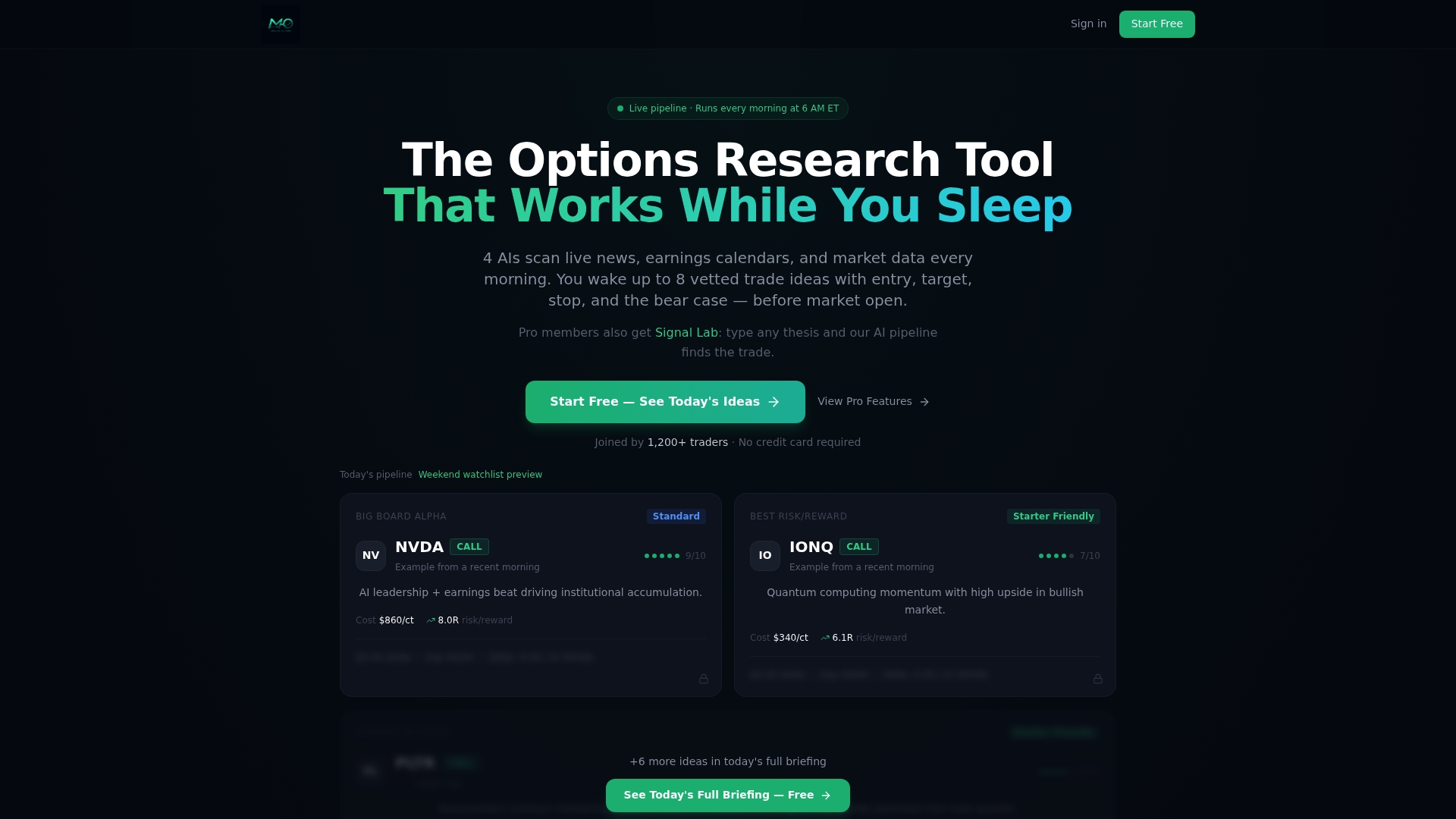
Morningoptions runs a five-stage AI pipeline every market morning, vetting and scoring options setups before the open. Each briefing delivers ranked trade ideas with specific contracts and entry levels, not vague directional commentary. The free daily briefing gives you a clear read on the day's setups in minutes. The Pro tier at $89/mo adds a lunchtime scanner and an AI chat scanner for researching any ticker on demand. If you want a scanner that does the filtering and the analysis, Morningoptions is built for exactly that.
FAQ
What is a trading scanner?
A trading scanner is software that monitors market data in real time and sends alerts when a stock or options contract meets your pre-defined criteria. Unlike static screeners, scanners update continuously and alert you the moment conditions form.
Why use trading scanners instead of a stock screener?
Scanners deliver real-time alerts on live market conditions, while screeners provide static snapshots. For intraday options trading, the speed difference determines whether you enter a setup at the right price or miss it entirely.
How many scanner alerts should I act on per day?
Experienced traders limit active alerts to 5–10 per session. More alerts than that create decision fatigue and lower the quality of each trade evaluation. Tight, strategy-specific filters produce fewer but higher-quality candidates.
Can a scanner replace manual chart analysis?
A scanner identifies candidates. It cannot replace the manual chart review, options chain check, and risk assessment required before entering a trade. Scanner alerts are discovery tools, not complete trade plans.
Do free trading scanners work for options traders?
Free scanners typically use delayed data and offer limited filter options. For options trading, where timing and liquidity data are critical, a professional-grade scanner with real-time data is the standard that produces reliable results.