
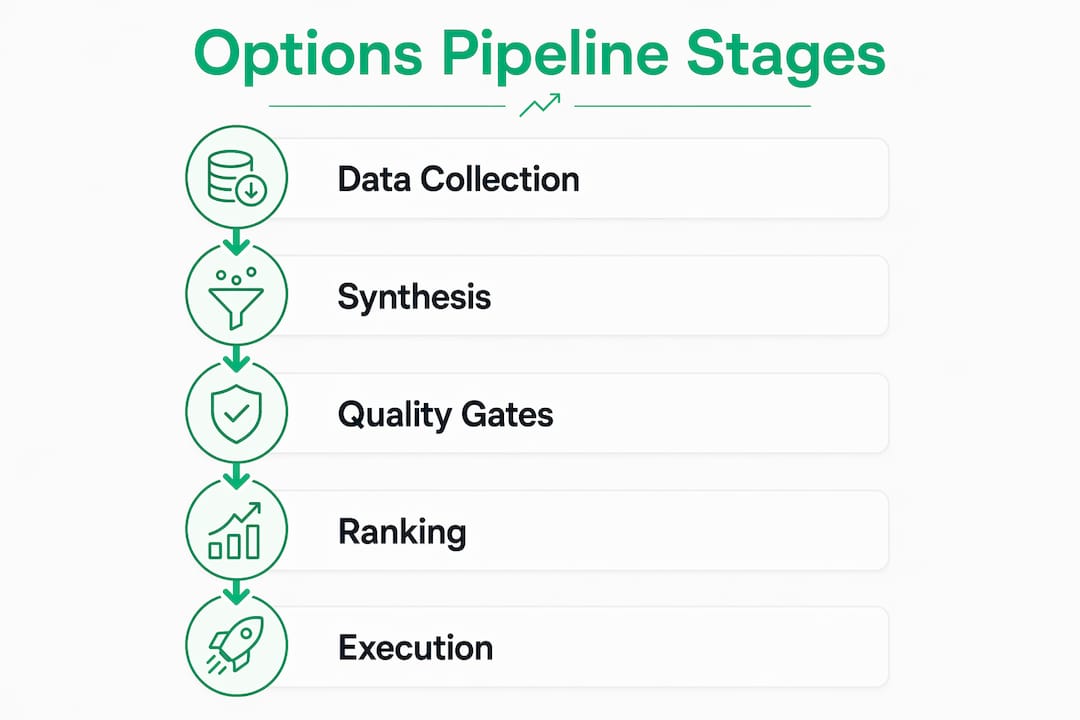
Options pipeline research is the structured process of filtering, analyzing, and synthesizing raw options market data into reliable trade signals that retail traders can act on with confidence. Most traders drown in noise because they skip this process entirely. The pipeline solves that by converting thousands of daily contracts into a focused set of high-quality setups. Institutional flow data, Gamma Exposure (GEX), and AI-driven quality gates are the three pillars that make this work. Morningoptions applies a five-stage AI pipeline to vet, score, and rank each trade idea before the market opens, setting a clear benchmark for what actionable signal quality actually looks like.
What are the main stages of an options research pipeline?
The options pipeline research explained in its simplest form is a sequence of quality gates, each one removing noise before passing data to the next stage. Pipeline stages include vendor-specific preprocessing, contract filtering, integrity checks, contextual enrichment, and contract-to-daily aggregation. Each gate exists to prevent unreliable signals from reaching the output layer where traders make decisions.
Here is how the stages break down in practice:
- Data ingestion. Raw options chains arrive from market data vendors. Timestamp alignment and quote freshness checks run immediately to confirm the data is valid at decision time.
- Contract filtering. Contracts are screened by open interest, bid/ask spread, and volume thresholds. Illiquid or stale contracts are removed before any analysis begins.
- Benchmark alignment. Remaining contracts are mapped against index benchmarks and sector context to confirm they carry economic relevance, not just statistical noise.
- Enrichment. Surviving contracts receive contextual layers: implied volatility rank, GEX contribution, and flow classification (bullish, bearish, or neutral).
- Aggregation and transformation. Individual contract signals are rolled up into daily research matrices. The pipeline converts contract-level data into session-level trade ideas with defined entry levels.
Pro Tip: Focus on the Vol/OI ratio as your first quality screen. Grade A flow prints carry Vol/OI ratios exceeding 5x, which confirms genuine institutional conviction rather than routine hedging activity.
AI agents accelerate every stage. Specialized agents fill four roles: Researcher (data collection), Analyst (synthesis), Critic (quality review), and Scribe (output formatting). This division of labor reduces manual research costs to as low as $0.05–$0.15 per run. That cost efficiency means the pipeline can run multiple validation passes on each signal before it reaches a trader's screen.

Quality gates are the most underrated part of the process. Effective pipelines require at least three credible sources per research question and iterative review cycles to prevent shallow conclusions. A signal that clears only one source is not a signal. It is a rumor.
How does Gamma Exposure influence pipeline research interpretation?
Gamma Exposure is a regime indicator, not a directional predictor. GEX analysis defines the session range and support/resistance levels created by forced dealer hedging. Understanding which regime you are in changes how you interpret every other signal the pipeline produces.
The two GEX regimes work like this:
- Positive GEX. Dealers are long gamma. They buy dips and sell rallies to stay delta-neutral. The market becomes range-bound, and mean-reversion strategies outperform.
- Negative GEX. Dealers are short gamma. They must chase price moves to hedge, which amplifies volatility. Trending and breakout strategies work better in this environment.
This distinction matters because the same flow signal reads differently depending on the regime. A large call sweep in positive GEX is likely a short-term position against a known resistance level. The same call sweep in negative GEX could be the opening leg of a sustained directional move.
Divergences between GEX regime signals and aggressive directional order flow often signal imminent market shifts and contain some of the most actionable institutional signals available to retail traders.
Real-world pipelines combine GEX with volatility state variables and flow classification to build multi-layered ensemble models. A single indicator never tells the full story. The pipeline's job is to show you when multiple signals agree, and flag clearly when they do not. Disagreement between GEX and flow is itself a signal worth tracking.
What role does DTE selection play in signal quality?
Days to Expiration is a fundamental variable in pipeline research, not a cosmetic setting. DTE affects liquidity, gamma exposure, spread behavior, and overall execution quality. Choosing the wrong DTE bucket forces you into contracts that look good on paper but trade poorly in practice.
| DTE Bucket | Liquidity Profile | Gamma Behavior | Best Use Case |
|---|---|---|---|
| 0–7 DTE | Thin, spread-sensitive | Extremely high | Day trades, defined-risk scalps |
| 8–21 DTE | Moderate, improving | High | Swing trades, earnings plays |
| 22–45 DTE | Strong, most liquid | Moderate | Core directional positions |
| 46+ DTE | Deep, low gamma | Low | Longer-term thesis trades |
Professionals query actual listed expirations first before selecting a DTE bucket. A pipeline that assumes weekly expirations exist on every ticker will generate signals for contracts that do not trade. That is a structural flaw, not a data problem.
Pro Tip: Always run a bid/ask spread check on your target contract before entering. High-quality research pipelines maintain consistent spread checks to verify contracts are tradable at decision time, not just at data-pull time.
Execution policy also shifts by DTE. Contracts under 7 DTE require tighter entry discipline because gamma acceleration can move the position against you within minutes. Contracts in the 22–45 DTE range give you more time to be right, which is why most institutional flow concentrates there. When a pipeline surfaces a signal in a thin DTE bucket, treat it with extra skepticism unless the Vol/OI ratio is exceptionally high.
How do retail traders apply pipeline research in practice?
The practical application of options pipeline research starts with one rule: ignore everything that does not clear Grade A status. Retail traders benefit most from focusing on Grade A flow prints and using AI-enhanced pipelines to cut manual workload while keeping signal quality high. A typical session produces 30–80 Grade A prints. That is your working universe for the day.
Here is how to build a repeatable process around pipeline output:
- Start with GEX regime. Identify whether the market is in positive or negative GEX before reading any flow signals. This sets the interpretive frame for everything else.
- Filter by Vol/OI ratio. Only consider prints where volume exceeds open interest by at least 5x. Lower ratios suggest routine activity, not conviction.
- Watch for GEX/flow divergences. When aggressive directional flow conflicts with the current GEX regime, pay close attention. These divergences often precede significant price moves.
- Match DTE to your strategy. A swing trade thesis needs a different expiration than a same-day scalp. Mismatching DTE to strategy is one of the most common execution errors retail traders make.
- Use AI output as a starting point, not a final answer. Pipeline research reduces the research burden, but you still need to confirm the setup fits your risk tolerance and position sizing rules.
Pro Tip: Treat the pipeline as a filter, not a signal generator. The pipeline tells you where to look. Your high-probability trade criteria tell you whether to act.
The most common pitfall is chasing signals that cleared the pipeline but conflict with the broader market regime. A bullish call sweep in a negative GEX environment with deteriorating breadth is not a buy signal. It is a warning that someone is positioning for a move that has not happened yet. Pipeline research gives you the data to recognize that distinction before you commit capital.
Integrating pipeline research with options hedging concepts also improves overall portfolio management. Understanding how your pipeline-sourced positions interact with existing hedges prevents you from accidentally doubling exposure in a single direction.
Key Takeaways
Options pipeline research transforms raw market data into ranked, tradable signals by applying structured quality gates, regime analysis, and AI-driven validation at every stage.
| Point | Details |
|---|---|
| Grade A flow is your filter | Focus only on prints with Vol/OI ratios exceeding 5x to confirm institutional conviction. |
| GEX sets the interpretive frame | Identify positive or negative GEX regime before reading any flow signal to avoid misreading direction. |
| DTE is a fundamental variable | Match expiration bucket to your strategy type; wrong DTE produces poor liquidity and execution slippage. |
| AI agents cut research cost | Multi-agent pipelines reduce per-run research costs to as low as $0.05–$0.15 while improving validation depth. |
| Divergences are signals too | When GEX regime and directional flow conflict, that tension often precedes the most significant market moves. |
What I have learned from watching pipelines evolve
I have watched retail traders go from reading raw options flow on a spreadsheet to running five-stage AI pipelines in under three years. The speed of that shift is real, but the underlying discipline has not changed. The traders who get consistent results are the ones who treat the pipeline as a quality control system, not a signal vending machine.
The biggest reliability gain I have seen comes from multi-agent validation. When a Critic agent reviews the Analyst's output before it reaches the Scribe, shallow conclusions get caught before they become bad trades. That layer of internal review is what separates a research pipeline from a data feed. Transparency matters here too. Pipelines that show intermediate outputs, like evidence cards and synthesis steps, produce decisions that are traceable. You can audit why a signal was generated, which means you can also learn from the ones that failed.
My advice for retail traders is to start with the regime, not the flow. GEX tells you the rules of the game for that session. Flow tells you where players are betting. Reading flow without knowing the regime is like reading a box score without knowing the sport. The AI tools available now, including Morningoptions' five-stage pipeline, lower the entry barrier significantly. But the conceptual framework still requires your attention. The pipeline handles the data work. You handle the judgment.
— Customer
Morningoptions: AI-powered pipeline research before the open
Morningoptions runs a five-stage AI pipeline every market morning to vet, score, and rank options trade ideas before the opening bell. Each briefing delivers specific contract ideas with entry levels, not vague market commentary.
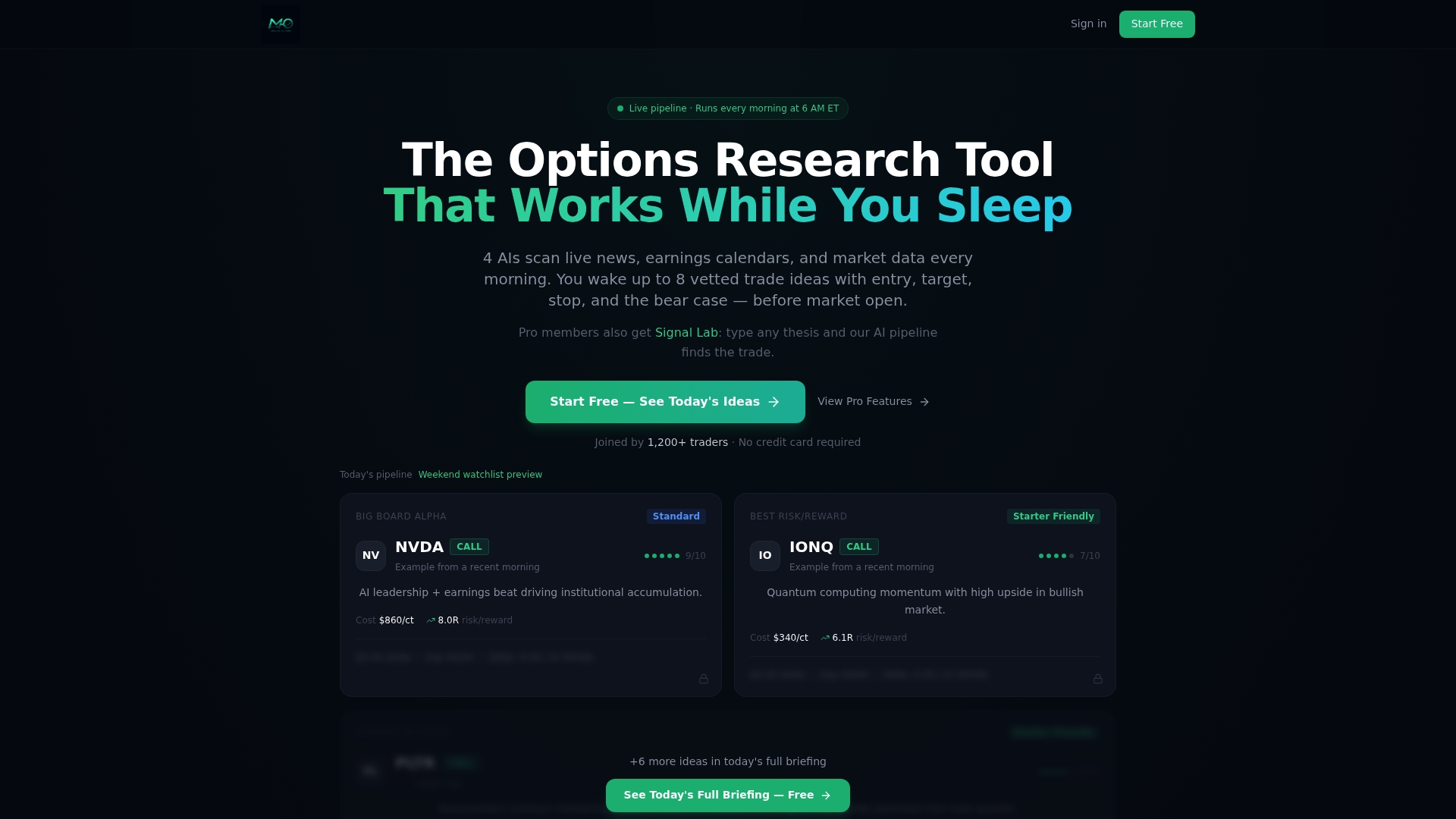
The free daily briefing gives you ranked setups based on Grade A flow, GEX regime alignment, and DTE-matched execution quality. The Pro tier at $89/mo adds a lunchtime scanner and an on-demand AI chat scanner for researching any ticker in real time. If you want pipeline research working for you before 9:30 AM, Morningoptions delivers exactly that.
FAQ
What is options pipeline research?
Options pipeline research is the structured process of filtering raw options market data through quality gates to produce reliable, ranked trade signals. It converts thousands of daily contracts into a focused set of high-conviction setups using flow analysis, GEX regime data, and AI validation.
How many Grade A flow signals appear in a typical session?
A typical session produces 30–80 Grade A prints, identified by Vol/OI ratios exceeding 5x. These are the signals worth analyzing; everything below that threshold is background noise.
Why does Gamma Exposure matter for signal interpretation?
GEX determines whether the market is in a range-bound or trending regime. Reading a flow signal without knowing the GEX regime produces the wrong interpretation roughly half the time.
What DTE bucket works best for swing trades?
The 22–45 DTE bucket offers the strongest liquidity and moderate gamma behavior, making it the most practical range for swing trade setups sourced from pipeline research.
How does AI reduce manual research effort in options pipelines?
AI agents handle data collection, synthesis, quality review, and output formatting automatically. This cuts per-run research costs to as low as $0.05–$0.15 and removes the manual bottleneck from signal validation.