
Evaluating options trade ideas quickly is defined as the process of narrowing down high-potential setups using data-driven tools and structured testing before committing capital. Active retail traders face a hard constraint every morning: the window between pre-market scanning and the opening bell is short. Traders who rely on gut instinct or unstructured research consistently underperform those who apply a repeatable, fast evaluation framework. Morningoptions addresses this gap directly by delivering AI-ranked, specific contract ideas with entry levels every market morning, not vague commentary. The difference between a profitable session and a blown trade often comes down to how well you assess ideas in those first critical minutes.
What tools enable fast and reliable evaluation of options trade ideas?
The right tools cut evaluation time from hours to minutes. Automated backtesting platforms let traders assess a strategy in under 20 minutes, compared to the 8–40 hours required by traditional manual or coding-based methods. That time difference is the gap between acting on a morning idea and missing the setup entirely.
Three categories of tools form the foundation of any fast evaluation workflow:
- Automated backtesting platforms: These run historical simulations with transaction costs included, producing pass/fail signals without manual coding.
- Options strategy builders: Professional-grade builders let traders define multi-leg strategies in under two minutes using live premium data, including Greeks and payoff graphs.
- Pre-market scanners: AI-powered scanners filter the universe of available contracts by criteria like implied volatility rank, open interest, and delta, before you ever open a chart.
Beyond software, two prerequisites matter. First, brokerage integration with live data feeds eliminates the lag that kills fast decisions. Second, a stable internet connection is non-negotiable. A frozen screen during pre-market evaluation is not just annoying. It is a capital risk.
| Tool Category | Primary Benefit | Time Saved |
|---|---|---|
| Automated backtester | Historical validation with costs | Hours to minutes |
| Strategy builder | Greeks and payoff in real time | 30+ minutes to under 2 |
| Pre-market AI scanner | Filtered, ranked trade ideas | Eliminates manual screening |

Pro Tip: Set your scanner filters the night before. Pre-configured screens for IV rank, delta range, and days to expiration mean you open to a short list, not a wall of tickers.
How to execute a rapid evaluation workflow before market open
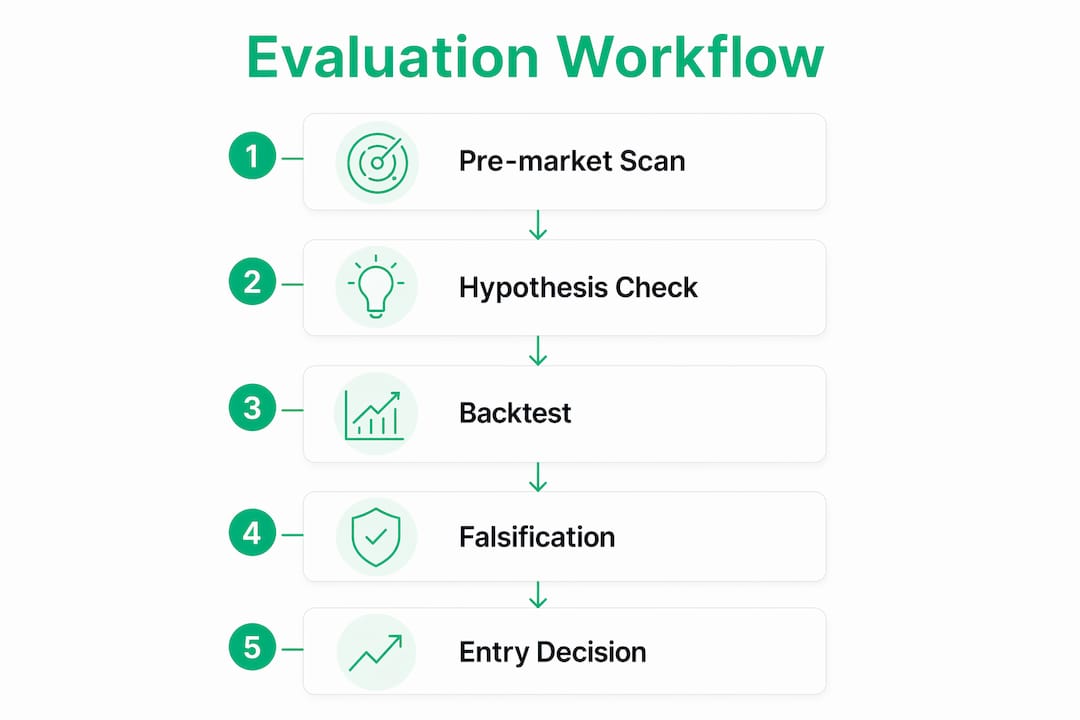
A repeatable workflow is what separates traders who act with confidence from those who freeze. The industry term for this process is "trade idea validation," and it runs in six steps when done correctly.
-
Run the pre-market scan. Pull your filtered list of high-probability trade ideas ranked by your scanner. Aim for a list of five to ten candidates, not fifty.
-
Write a plain-English hypothesis. Before touching a chart, state the trade thesis in one sentence. "I expect SPY to stay below 520 through Friday, so I will sell a call spread." This forces clarity and prevents post-hoc rationalization.
-
Run a fast backtest. Use an automated platform to test the strategy structure against historical data. Out-of-sample testing and inclusion of transaction costs are non-negotiable here. A backtest that ignores commissions and slippage will always look better than reality.
-
Apply a statistical guardrail. Check whether the strategy's edge survives a null model test. If the same returns appear on randomly shuffled dates, the edge is noise, not signal.
-
Review Greeks and payoff diagram. Confirm that delta, theta, and vega exposure match your market view. A payoff graph that looks great at expiration can still destroy capital if the position moves against you in the first two days.
-
Set risk parameters before entry. Define your maximum loss, target profit, and adjustment trigger before placing the order. Defined-risk structures are the standard for professional options traders because they cap the downside before the trade opens.
| Workflow Step | Time Target | Key Output |
|---|---|---|
| Pre-market scan | 5 minutes | Ranked candidate list |
| Plain-English hypothesis | 2 minutes | One-sentence trade thesis |
| Fast backtest | 10–15 minutes | Pass/fail signal with costs |
| Statistical guardrail | 3 minutes | Edge confirmation or discard |
| Greeks and payoff review | 5 minutes | Exposure alignment check |
| Risk parameter setting | 2 minutes | Max loss and target defined |
Pro Tip: If a trade idea cannot survive step two, the plain-English hypothesis, skip the backtest entirely. Vague ideas produce vague results, and vague results waste your most limited resource: pre-market time.
What are common mistakes to avoid when assessing options trade ideas fast?
Speed creates specific failure modes. The most common is overfitting, which means building a strategy that fits historical data perfectly but fails in live markets. Overfitting is common in fast testing environments because traders skip cross-validation and walk-forward analysis to save time. Skipping those steps does not save time. It transfers losses to your account.
A second major mistake is ignoring transaction costs. Commissions, bid-ask spreads, and slippage can turn a theoretically profitable strategy into a losing one. Every backtest must include realistic cost assumptions before you treat the result as meaningful.
Relying blindly on AI outputs without manual review is one of the most expensive habits in retail options trading. AI-generated backtests require human oversight to catch edge-case bugs and errors before capital is allocated. The tool surfaces candidates. You make the call.
Three additional pitfalls deserve attention:
- Misreading payoff graphs without market context. A graph showing profit at expiration ignores path dependency. A position can hit your stop loss before reaching expiration, even if the final price lands in your profit zone.
- Ignoring open interest and gamma positioning. Entering a trade without knowing where large gamma exposure sits means you are trading blind against institutional flow.
- Failing to align strikes with current market structure. A strike that looked clean yesterday may sit directly on a key support level today. Always check the current chart before confirming a strike selection.
Pro Tip: Run a "pre-mortem" on every trade idea before entry. Ask: what would have to be true for this trade to fail immediately? If you cannot answer that in thirty seconds, you do not understand the trade well enough to place it.
How do falsification testing and market context sharpen rapid strategy evaluation?
Falsification testing is the practice of trying to prove a strategy wrong before trying to prove it right. Most traders do the opposite. They find a setup that worked in backtesting and then search for reasons to confirm it. Falsification using shuffled timing null models discards obviously flawed strategies before you invest time in deeper optimization. It is a cheap, fast gate that protects your workflow from weak ideas.
The null gate test works like this: take your strategy's trade signals and randomize the entry dates. If the randomized version produces similar returns to the original, the strategy has no real edge. It is capturing market drift, not a repeatable pattern. Discard it and move to the next candidate.
Understanding gamma flips, open interest clusters, and implied volatility term structure before trade entry prevents the most common form of being "stopped out" by institutional positioning. These are not advanced concepts reserved for hedge funds. They are publicly available data points that retail traders can read in under three minutes with the right tools.
| Advanced Concept | What It Tells You | Time to Check |
|---|---|---|
| Null gate (shuffled timing) | Whether edge is real or random | Under 3 minutes |
| Gamma flip levels | Where dealer hedging accelerates moves | 2 minutes |
| IV term structure | Whether vol is cheap or rich at your expiry | 2 minutes |
| OI clusters | Where large positions sit near your strikes | 2 minutes |
Pro Tip: Treat falsification as your first filter, not your last. If a strategy cannot beat a random entry model, no amount of parameter tuning will fix it. Move on.
Key Takeaways
Fast, reliable options trade evaluation requires a structured workflow, not just fast tools. The combination of automated backtesting, falsification testing, and market context checks produces better decisions in less time than any single method alone.
| Point | Details |
|---|---|
| Speed requires structure | A repeatable six-step workflow cuts evaluation time without cutting accuracy. |
| Automated tools save hours | Backtesting platforms reduce validation from 40 hours to under 20 minutes. |
| Falsification beats confirmation | Testing ideas against null models discards weak setups before they cost capital. |
| Market context is non-negotiable | Gamma flips, OI clusters, and IV term structure must be checked before every entry. |
| AI assists, humans decide | AI-ranked ideas require manual review to catch errors before capital is allocated. |
Why speed without discipline is the fastest way to lose money
Active traders often treat speed as the goal. It is not. Speed is the constraint. The goal is accurate decisions made within that constraint. I have watched traders burn through accounts not because they were slow, but because they confused activity with analysis. Clicking fast and thinking fast are not the same thing.
The traders who consistently perform well share one habit: they fail fast on weak ideas and spend their real attention on the two or three setups that survive every filter. High-throughput evaluation with fast rejection builds a statistical edge over time. Perfecting one unvalidated trade does not.
AI tools like the five-pipeline system behind Morningoptions change the calculus significantly. They surface ranked, specific ideas with entry levels before the open. But the traders who get the most from those tools are the ones who still apply their own falsification check and Greeks review before entering. Technology raises the floor. Discipline raises the ceiling.
The "fail fast" philosophy is not pessimism. It is math. If you evaluate ten ideas and discard eight, you enter two trades with genuine conviction. That is a better outcome than entering five trades with moderate confidence in each. Conviction, backed by a fast but rigorous process, is where edge lives.
— Customer
Morningoptions delivers ranked trade ideas before the open
Active retail traders need more than a list of tickers. They need ranked, specific contract ideas with entry levels, context on the setup, and enough background to apply their own judgment fast. Morningoptions runs a five-AI pipeline every market morning to vet, score, and explain each trade idea before the open.
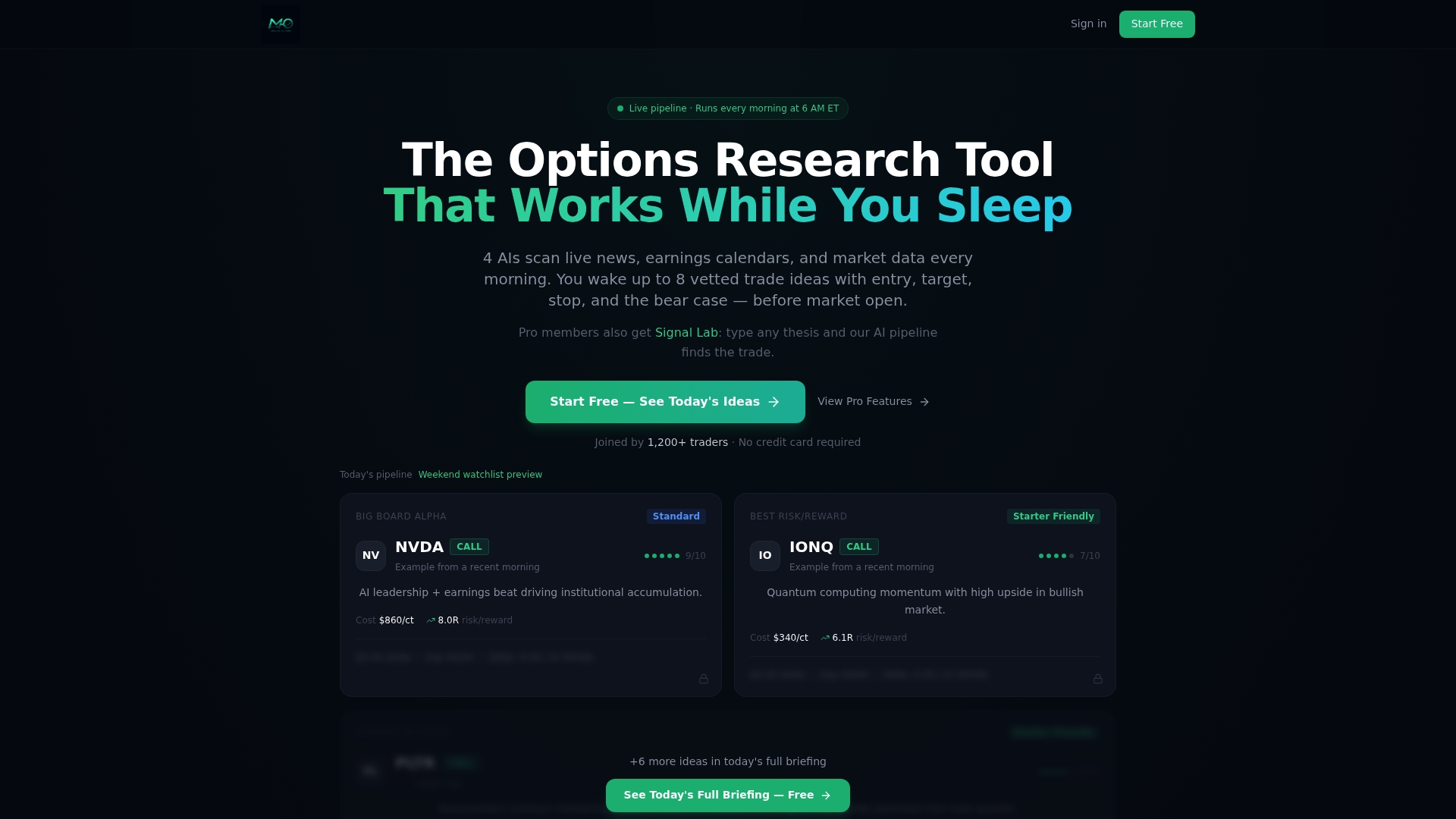
The free daily briefing gives you a clear read on the day's setups without requiring a subscription. The Pro tier at $89/mo adds the lunchtime scanner and an AI chat scanner for researching tickers on demand, so your rapid evaluation workflow has live support throughout the trading day. If you want pre-market trade ideas that are already filtered, ranked, and explained, Morningoptions is built for exactly that.
FAQ
How quickly can I evaluate an options trade idea?
A structured workflow using automated backtesting and a pre-market scanner can complete a full evaluation in under 30 minutes. Automated platforms alone cut backtesting from 8–40 hours to under 20 minutes.
What is falsification testing in options trading?
Falsification testing means trying to prove a strategy wrong before optimizing it. Shuffled timing null models reveal whether a strategy's edge is real or just capturing random market drift.
Why do transaction costs matter in fast backtesting?
Ignoring commissions, bid-ask spreads, and slippage produces backtest results that overstate real profitability. Including transaction costs is the minimum standard for any backtest used to make live trading decisions.
What are the most important Greeks to check before entering an options trade?
Delta, theta, and vega are the three Greeks that most directly affect a position's behavior before expiration. Reviewing all three against your market view takes under five minutes with a live options strategy builder.
How does AI help with rapid options trade evaluation?
AI-powered scanners filter and rank trade ideas by criteria like IV rank and open interest before the market opens. AI outputs require human review to catch errors, but they dramatically reduce the time spent on initial screening.