
Options strategies for volatile markets are defined as structured trades that profit from price swings, elevated premiums, or both, rather than relying on a single directional bet. Volatile conditions create two distinct edges: inflated implied volatility (IV) that makes option selling attractive, and sudden price moves that reward well-timed long volatility positions. The VIX index and IV percentile rank are the two metrics every active trader must monitor before selecting a structure. Morningoptions delivers ranked, contract-specific trade ideas every morning, built specifically for traders who need to act on volatility before the open, not after it.
What are the best options strategies for volatile markets?
The single most important decision in volatile conditions is whether IV is expensive or cheap relative to its recent history. That one read determines whether you sell premium or buy it.
Selling premium through iron condors, credit spreads, and short strangles produces positive expected returns when IV percentile sits above 50. Elevated IV means the market is pricing in more movement than it typically delivers, so you collect rich premiums and profit when realized volatility falls short of implied. Defined-risk structures like iron condors cap your maximum loss, which matters enormously when a gap event hits overnight.
Buying long straddles or strangles is the correct approach when IV percentile drops below 30. Low IV means options are cheap relative to history, and any volatility spike or large directional move pays off asymmetrically. The ideal setup is a known catalyst, such as an earnings release or a Federal Reserve announcement, where realized volatility is likely to exceed the implied move priced into the options.

Calendar and diagonal spreads exploit the term structure of volatility. When the VIX futures curve is in contango, front-month options decay faster than back-month options. Selling the near-term expiration and buying the further-dated one captures that differential without requiring a large directional move.
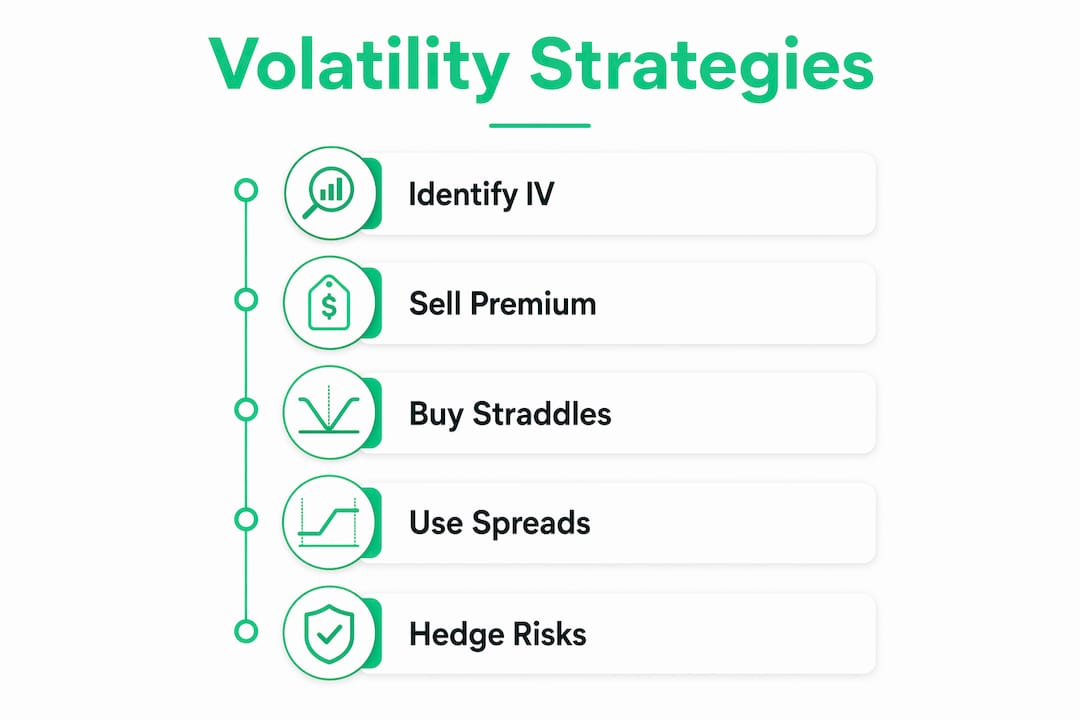
Protective puts and VIX call spreads serve as tail hedges. A protective put on a long equity position defines your downside to a fixed dollar amount. A VIX call spread profits when the fear index spikes, often at the exact moment your other positions are under pressure. Treat these as portfolio insurance tools, not speculative bets.
Pro Tip: Never run a naked short strangle into a binary event. Convert it to an iron condor by buying wings at least 10 deltas further out. The cost is small; the protection against a gap move is substantial.
How should traders size positions and manage risk during high volatility?
Position sizing is the single variable that separates traders who survive volatility from those who blow up. Most retail traders size by gut feel or by notional dollar amount. Both methods fail in volatile markets.
Vega-based sizing is the correct framework. A 3-point VIX spike can cause outsized losses on a short vega position even when delta is perfectly neutral. Sizing by vega exposure tells you exactly how much your position gains or loses per one-point move in implied volatility, which is the risk that actually matters in a volatile regime.
Experts recommend the following limits:
- Long volatility trades: limit to 1%–3% of total portfolio capital per position
- Short volatility trades: limit to 0.5%–2% of total portfolio capital, given the asymmetric downside
- Tail hedges: size to cover 20%–30% of portfolio delta exposure, not to generate profit on their own
- Spread width: keep defined-risk spreads narrow enough that the maximum loss stays within your per-trade risk budget
Margin and liquidity management are equally critical. In a fast sell-off, brokers can issue margin calls within hours. Keeping a cash buffer of at least 20% of your options buying power prevents forced liquidations at the worst possible prices. Reduce position size before a known volatility event, not during it.
Pro Tip: Run a quick vega stress test before every new position. Ask: if the VIX jumps 5 points overnight, what does my P&L look like? If the answer makes you uncomfortable, cut the size in half before you enter.
How do volatility metrics guide strategy selection?
The VIX index measures the 30-day implied volatility of S&P 500 options. It is the market's real-time fear gauge, but the raw number alone is not enough to make a trade decision.
IV percentile and IV rank tell you where current IV sits relative to its own history. IV percentile answers: "What percentage of the past year had IV lower than today?" A reading above 50 signals expensive options; below 30 signals cheap ones. This single metric determines whether you are a net seller or a net buyer of premium.
The VIX term structure reveals the market's expectation for future volatility. Contango, where near-term VIX futures trade below longer-dated futures, is the normal state. It benefits calendar spread sellers and punishes holders of long volatility ETFs through roll costs. Backwardation, where near-term futures spike above longer-dated ones, signals acute fear and typically accompanies the best entry points for short volatility trades after the spike peaks.
Implied volatility versus realized volatility is the core edge in options trading. When implied volatility consistently exceeds realized volatility, selling premium has a structural advantage. When realized volatility exceeds implied, long volatility strategies win. Tracking a 20-day realized volatility figure alongside the current IV rank gives you a quick read on which regime you are in.
Skew and bid-ask spreads round out the picture. Steep put skew signals that the market is paying up for downside protection, which makes put spreads expensive to buy but lucrative to sell. Wide bid-ask spreads during volatility bursts destroy edge on both sides. Always check the spread before sizing up.
What execution tactics improve results in volatile markets?
Execution quality degrades fast when volatility spikes. Wide bid-ask spreads during stressed markets can cut expected returns by a meaningful amount before the trade even starts. The following tactics protect your edge at the point of execution.
- Use limit orders exclusively. Market orders in a fast tape fill at the worst possible price. Place your limit at the midpoint of the bid-ask spread and work it toward the ask only if the market is moving away from you.
- Scale into positions in two or three tranches. Entering a full position at once in a volatile tape is a timing gamble. Splitting into smaller entries averages your cost and reduces the impact of a bad fill on any single tranche.
- Stress test before you enter. Model the position's P&L across a range of VIX moves, not just the expected move. A position that looks fine at current IV may be catastrophic if IV doubles.
- Set profit targets and exit rules before entry. Long volatility trades decay every day through theta. Without a pre-set exit, traders hold too long and watch profits evaporate. A target of 50%–100% of max profit for long vol, and 50% of max profit for short vol, is a widely used benchmark.
- Do not average down on short volatility positions. Adding to a losing short premium trade during a volatility spike is the fastest path to a margin call. Treat the original stop as final.
Protecting margin and using hedges pragmatically prevents forced liquidations. In volatile sell-offs, timing control and margin protection matter more than directional accuracy.
Long volatility ETFs like VXX suffer from contango drag in stable markets, which represents the majority of trading days. Use them as short-term tactical tools during acute volatility events, never as long-term holds. The roll costs compound against you every day the market stays calm.
Pro Tip: Track your options trades systematically in a journal that records IV rank at entry, vega exposure, and exit reason. After 50 trades, patterns in your execution mistakes become obvious and fixable.
Key Takeaways
The most effective options strategies for volatile markets combine IV-based structure selection, vega-aware position sizing, and disciplined execution to protect capital while capturing premium or directional moves.
| Point | Details |
|---|---|
| IV percentile drives structure choice | Sell premium above 50th percentile; buy volatility below 30th percentile. |
| Size by vega, not notional | Limit short vol trades to 0.5%–2% of portfolio; long vol to 1%–3%. |
| Defined-risk spreads protect capital | Iron condors and credit spreads cap max loss and survive gap events better than naked positions. |
| Execution quality is edge | Use limit orders and scale entries to avoid slippage during wide bid-ask conditions. |
| Volatility ETFs are tactical only | Contango drag makes long VIX products destructive as long-term holds. |
What I've learned trading options through volatile markets
Most retail traders approach volatility as a problem to solve. I treat it as the product. When IV spikes, options premiums inflate, and that inflation is where the real edge lives, provided you have a plan ready before the spike hits.
The biggest mistake I see is traders who build a volatility playbook during calm markets and then abandon it the moment things get chaotic. Discipline in execution, particularly around position sizing based on vega exposure, is what separates a profitable volatility trader from one who blows up on a single bad week. A 3-point VIX move should never threaten your account. If it does, your size is wrong.
I also warn traders about the seductive simplicity of long volatility ETFs. They feel like an easy hedge, but contango roll costs erode value relentlessly in quiet markets. Use them for a specific event window, then exit. Holding them through calm periods is a slow bleed.
The traders I respect most carry a written volatility playbook: specific structures for high IV regimes, specific structures for low IV regimes, and pre-set position limits for each. They do not improvise under pressure. They execute the plan they built when they were thinking clearly.
— Customer
How Morningoptions supports active volatility traders
Volatile markets reward preparation, and Morningoptions is built for exactly that moment before the open when you need a clear read on the day's setups.

Every morning, Morningoptions delivers AI-powered briefings with ranked, contract-specific trade ideas, including entry levels and strategy context, not vague market commentary. The daily trade ideas are vetted through a five-model AI pipeline that scores each setup for quality and fit. Pro members ($89/mo) also get the lunchtime scanner and an on-demand AI chat scanner for researching specific tickers as conditions shift through the session. For traders who want systematic support for high-probability setups in volatile conditions, Morningoptions removes the guesswork from morning preparation.
FAQ
What is IV percentile and why does it matter?
IV percentile measures where current implied volatility sits relative to the past year of readings. Traders use it to decide whether options are expensive enough to sell or cheap enough to buy.
When should I use a long straddle versus an iron condor?
Use a long straddle when IV percentile is below 30 and a large move is expected. Use an iron condor when IV percentile is above 50 and you expect the underlying to stay within a defined range.
How does vega-based sizing protect against volatility spikes?
Vega measures how much a position gains or loses per one-point move in implied volatility. Sizing by vega exposure caps your loss from a sudden IV spike, even when your delta is neutral.
Why do long volatility ETFs lose value over time?
Long VIX products like VXX suffer from contango drag, where rolling expiring futures into the next month at a higher price creates a constant cost. This decay makes them unsuitable for long-term holds.
What is the safest way to hedge a portfolio during a sell-off?
Protective puts on individual positions and VIX call spreads at the portfolio level are the two most direct hedging tools. Treat them as defined-cost insurance, and do not close them prematurely when they start working.