
A trade setup is a predefined, rule-based configuration of market conditions that signals a potential trading opportunity with defined entry, stop-loss, and profit-target levels. In professional trading circles, the formal term is "trading setup" or "setup criteria," and understanding it is the foundation of consistent, disciplined options trading. Without a clearly defined setup, every trade becomes a judgment call, and judgment calls are where emotion takes over. This guide breaks down what a trade setup is, how to build one, which types work best for options traders, and how to apply them without second-guessing yourself at the open.
What is a trade setup? Core definition and components
A trade setup is a predefined rule-based configuration that includes specific price levels, indicators, or chart patterns, along with defined entry, stop-loss, and take-profit levels. Think of it as a checklist your trade must pass before you commit capital. If the checklist is not complete, you do not trade.
Every setup has three non-negotiable components:
- Entry trigger: A clear, repeatable, rule-based signal that initiates the trade. A clearly explained entry trigger is one that any two traders can identify independently and reach the same conclusion. Without this, setups become subjective and results become inconsistent.
- Stop-loss: A predefined exit point that limits your loss if the trade moves against you. Stop-losses anchored to logical market structures like support zones or swing lows produce better risk management than arbitrary dollar amounts.
- Take-profit target: A logical exit level to lock in gains, also anchored to price structure rather than a round number or gut feeling.
The risk-reward ratio ties all three together. Disciplined traders require a minimum 2:1 risk-reward ratio for any setup. That means for every $1 you risk, you target at least $2 in return. If a setup does not meet that threshold, you skip it, regardless of how compelling it looks.
Pro Tip: Write your entry trigger in one sentence. If you cannot explain it clearly and simply, the trigger is not objective enough to trade.

How do you create and evaluate an effective trade setup?
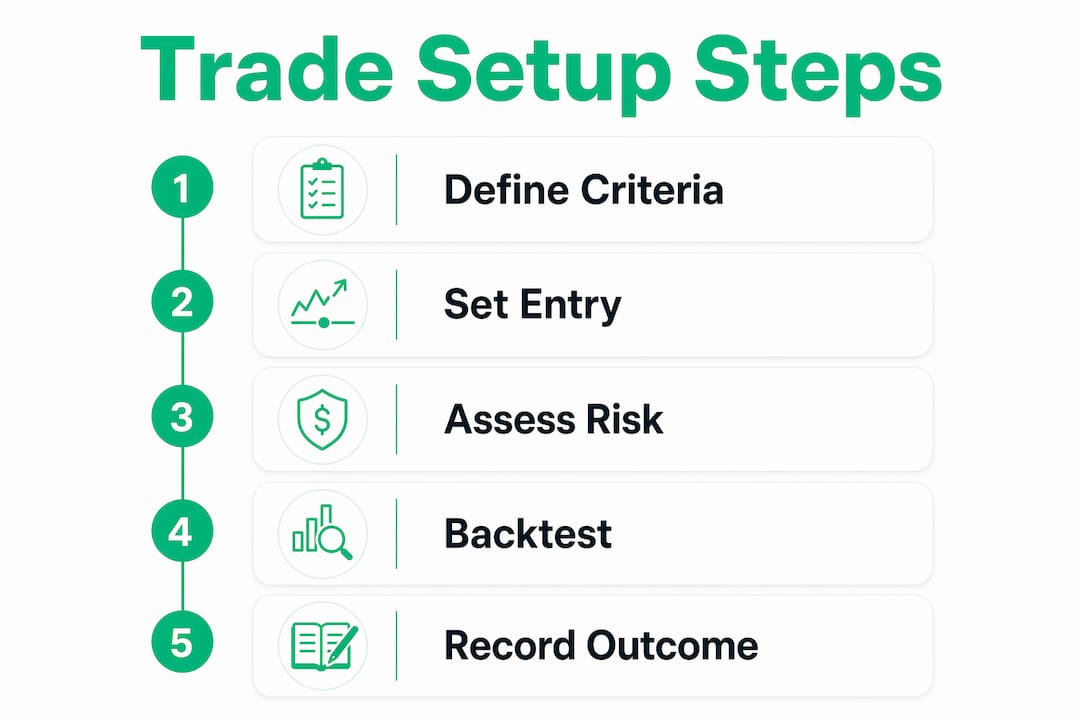
Building a trade setup is a process, not a one-time decision. Traders who skip the development phase often end up with setups that work in backtests but fall apart in live markets.
-
Define your trading goal. Are you targeting directional moves, volatility expansion, or premium decay? Your goal shapes every other decision. An options trader selling premium needs different setup criteria than one buying calls on a breakout.
-
Select your indicators or conditions. Choose tools that match your style. Trend traders often use moving average crossovers or relative strength. Volatility traders rely on Average True Range (ATR) or Bollinger Bands. The key is that each indicator must produce a binary signal: the condition is either met or it is not.
-
Write objective entry and exit rules. Vague rules like "buy when the stock looks strong" are not rules. Objective rules sound like: "Enter a call debit spread when the 10-day moving average crosses above the 50-day moving average on above-average volume, with the stock above a key resistance level."
-
Backtest and paper trade before going live. Backtesting and paper trading reduce emotional bias and let you adjust the setup before risking real capital. Run at least 30 historical examples to get a meaningful sample.
-
Add no-trade rules. No-trade rules like avoiding the first two minutes after the open, skipping mid-day choppy conditions, and taking a ten-minute pause after a loss protect your capital and your mindset. These rules are as important as your entry criteria.
-
Score each setup before entry. Professional traders grade setups on criteria like market structure, volume confirmation, and trend alignment. A five-point scoring system works well. If a setup scores below four out of five, classify it as a no-trade and move on.
-
Define position sizing. Know your maximum loss per trade before you enter. Position sizing is not optional. It determines whether a losing streak wipes you out or leaves you with capital to trade another day.
Pro Tip: Keep a setup journal. After each trade, record whether all criteria were met, what the outcome was, and what you would change. Patterns in your journal reveal which setups actually work for you.
What are the common types of trade setups for options traders?
Common trade setup types include trend continuation patterns, reversal candlestick signals, breakouts from key levels, and volatility-based configurations. Each type suits a different market environment, and options traders need to match the setup type to the current conditions.
Trend continuation setups
These setups enter in the direction of an established trend after a brief pullback or consolidation. Moving average crossovers are the classic example. A 10-day moving average crossing above a 50-day moving average on rising volume signals that buyers are in control. For options traders, this environment favors buying calls or call debit spreads with 30–60 days to expiration.
Reversal setups
Reversal setups identify exhaustion points where a trend is likely to change direction. Pin bars and hammer candlesticks at key support or resistance levels are the most recognized reversal signals. A hammer at a major support zone after a sustained downtrend tells you sellers are losing momentum. Options traders can use this for buying puts on a failed rally or calls on a support bounce.
Breakout setups
Breakout setups trigger when price moves decisively through a defined support or resistance level on above-average volume. The volume confirmation separates genuine breakouts from false ones. Options traders often buy calls or puts depending on the breakout direction, targeting the next major price level as the profit target.
Volatility-based setups
ATR and Bollinger Bands measure how much a stock is moving relative to its recent history. When Bollinger Bands contract sharply, a volatility expansion is often coming. Options traders use this to buy straddles or strangles before the move, capturing the directional swing regardless of which way it breaks.
The table below summarizes how each setup type maps to options strategies:
| Setup type | Market condition | Options approach |
|---|---|---|
| Trend continuation | Established uptrend or downtrend | Call or put debit spreads |
| Reversal | Exhaustion at key level | Long calls or puts at turning points |
| Breakout | Consolidation near resistance | Long calls or puts on volume surge |
| Volatility expansion | Low volatility, tight range | Straddles or strangles before the move |
How do disciplined traders apply setups consistently?
Consistency is the gap between traders who profit over time and those who do not. A setup only works if you follow it every time, not just when it feels comfortable.
- Wait for all criteria before entering. Entering early because a setup "looks like it's setting up" is not trading a setup. It is guessing. The most successful traders wait for the market to meet every criterion before committing capital.
- Avoid revenge trading. After a losing trade, the instinct is to immediately find another trade to recover the loss. This is how traders abandon their setups and compound losses. The ten-minute pause rule after a loss exists for this exact reason.
- Anchor targets to market structure. Exit points tied to market structure rather than arbitrary dollar amounts produce mathematically sound risk-reward and better trade quality. Your profit target should sit at the next resistance level, not at a round number you picked for comfort.
- Use setup filters during unusual conditions. Volatility spikes around earnings, Federal Reserve announcements, or geopolitical events can invalidate your setup's historical edge. Filtering out these periods is not weakness. It is sound risk management.
- Track every trade against your setup criteria. A repeatable checklist with defined risk and reward parameters removes emotion from the decision. Reviewing your trade log weekly shows you which setups are performing and which need adjustment.
Pro Tip: Before the market opens, write down the exact price level or indicator reading that would trigger your setup. If the market does not reach that level, you do not trade. This single habit eliminates most impulsive entries.
Key Takeaways
A trade setup is the foundation of consistent options trading because it replaces subjective judgment with objective, repeatable criteria that define entry, risk, and reward before any capital is committed.
| Point | Details |
|---|---|
| Core definition | A trade setup is a predefined checklist of market conditions with entry, stop-loss, and take-profit levels. |
| Minimum risk-reward | Require at least a 2:1 risk-reward ratio on every setup or skip the trade entirely. |
| Score before entry | Grade each setup on objective criteria; skip any setup that scores below your threshold. |
| No-trade rules matter | Rules that keep you out of bad trades protect capital as much as rules that get you in. |
| Setups need a strategy | A setup is the "what" to trade. Risk management and position sizing determine how much and when. |
Why setups are tools, not guarantees
The most common mistake traders make is treating a setup as a profit guarantee. A setup is a tactical tool. It improves your odds by filtering out low-quality trades and keeping you consistent, but it does not eliminate losing trades. Every professional trader I have observed accepts losses as part of the process. What separates them is that their losses are controlled and their wins are sized correctly.
The distinction between a setup and a strategy is one that most retail traders miss entirely. A setup is the "what" to trade, while a strategy governs when and how, including risk management and position sizing. Treating a setup as a complete strategy is like knowing which door to open without knowing what to do once you walk through it.
Patience is the hardest part. The best setups appear less often than traders want them to. Forcing a trade because you have not traded in two days is not discipline. It is boredom masquerading as analysis. The traders who build real consistency are the ones who sit on their hands until the market delivers exactly what their criteria require. For high-probability trade criteria, the standard is always the same: every box checked, every time.
Test every setup thoroughly before risking real money. Backtesting gives you confidence. Paper trading gives you the emotional experience of following rules under pressure. Both are necessary. Skipping them is the reason most traders abandon setups after a few losing trades instead of refining them.
— Customer
How Morningoptions helps you find quality setups daily
Active options traders know that finding setups is only half the work. Evaluating them quickly before the open is the other half.

Morningoptions delivers AI-powered options briefings every market morning, ranked and specific, with contract ideas and entry levels, not vague market commentary. A five-stage AI pipeline vets, scores, and analyzes each trade idea so you get a clear read on the day's setups before the bell rings. The free daily briefing covers the top-ranked ideas. The Pro tier at $89/mo adds a lunchtime scanner and an on-demand AI chat scanner for researching any ticker in real time. If you want rule-based setup ideas delivered to you every morning, Morningoptions is built for exactly that.
FAQ
What is a trade setup in simple terms?
A trade setup is a predefined checklist of market conditions that must be met before you enter a trade. It includes an entry trigger, a stop-loss, and a profit target.
How is a trade setup different from a trading strategy?
A setup defines what conditions signal a trade. A strategy is the broader plan that includes when to trade, how much to risk, and how to manage positions over time.
What risk-reward ratio should a trade setup require?
Disciplined traders require a minimum 2:1 risk-reward ratio. If a setup does not meet that threshold, the trade is skipped regardless of how attractive it appears.
How do you validate a trade setup before using it live?
Backtest the setup against at least 30 historical examples, then paper trade it in real-time conditions. Both steps reduce emotional bias and confirm the setup's edge before real capital is at risk.
Can a trade setup guarantee profits?
No. A trade setup improves consistency and filters out low-quality trades, but it does not eliminate losses. Its value is in providing repeatable, objective criteria that keep emotion out of the decision.