
An AI options scanner is an automated system that continuously analyzes options market data across thousands of strike and expiry combinations, identifying mispriced strategies, unusual institutional activity, and volatility anomalies faster than any manual process. If you've been scanning chains by hand, you already know the problem: the opportunity closes before you finish checking the third ticker.
Here's what a well-built AI scanner actually does:
- Scans thousands of options chains simultaneously in real time
- Detects IV Rank and IV Percentile extremes across all underlyings
- Flags block trades, sweep orders, and abnormal volume or open interest shifts
- Identifies term structure dislocations for calendar spread opportunities
- Generates ranked, specific strategy recommendations with entry rationale
U.S. options volume has reached record levels in recent years, making systematic scanning essential. At that scale, manual scanning isn't just slow. It's structurally inadequate.
How AI scans and analyzes options market data in practice
The scanning process starts with raw data inputs: full options chains, volatility surfaces, volume and open interest patterns, and every strike/expiry combination across hundreds of underlyings. The AI ingests this multidimensional feed continuously, not in periodic snapshots.
From there, the system runs anomaly detection. It compares current implied volatility to historical ranges, flagging IV Rank extremes where premium is either unusually expensive or cheap. It also maps the volatility term structure, spotting dislocations between near-term and longer-dated expirations that signal calendar spread opportunities.
Unusual activity detection runs in parallel. The scanner watches for block trades, sweep orders moving through multiple exchanges, and sudden volume spikes relative to open interest. These patterns often precede directional moves or signal institutional positioning before it becomes obvious on a price chart.
Once anomalies are identified, a weighted scoring model ranks each opportunity. Factors like edge percentage, probability of profit, risk/reward ratio, and liquidity all feed into the final score. The output isn't a raw data dump. It's a prioritized list of specific contracts with entry levels and strategy rationale.
Pro Tip: When reviewing scanner output, sort by liquidity first. A high-scoring opportunity in a thinly traded contract is harder to fill cleanly and can cost you the edge the model identified.
Key benefits of using AI in options trading
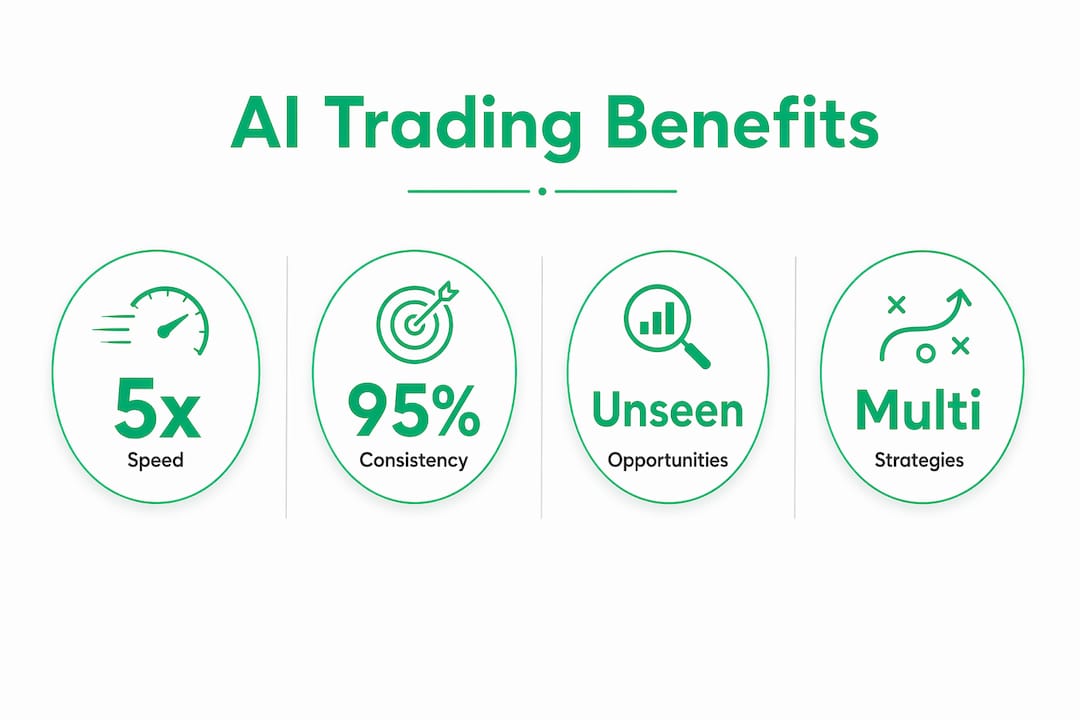
Speed and scale are the most obvious advantages. An AI scanner processes what would take a trader hours of manual chain-checking in seconds, covering far more underlyings than any individual could track. That coverage gap is where most retail traders leave money on the table.

Consistency matters just as much. Manual scanning is mood-dependent. You check more carefully when you're focused, less carefully when you're tired or distracted. AI applies the same scoring criteria to every contract, every time. That systematic approach reduces manual error rates significantly when scanning thousands of options chains.
AI scanners also surface opportunities that human eyes miss entirely. Volatility skew anomalies, subtle term structure dislocations, and unusual activity patterns across less-followed tickers rarely appear on a trader's radar without automated detection. The scanner doesn't get bored and skip the 47th ticker.
For strategy diversity, AI scanners support filters across multiple strategy types, from iron condors and credit spreads to debit spreads ranked by expected value. You can configure the scanner to match your specific approach rather than accepting a generic output.
Morningoptions runs a five-AI pipeline that vets, scores, and delivers ranked contract ideas with entry levels every market morning, built specifically for active retail traders who need a fast, clear read before the open.
Common challenges and limitations of AI options scanners
The biggest pitfall isn't the technology. It's traders running default scoring presets without adjusting them to their actual strategy. A yield-focused wheel trader and a directional spread trader need completely different ranking weights. Using the same preset for both produces a list that's optimized for neither.
Data latency is a real constraint. Most retail-facing scanners work with data that carries some delay, and in fast-moving markets, a stale volatility reading can make a mediocre trade look attractive. Always confirm live quotes and chain liquidity in your broker before acting on any scanner output.
AI systems also lack market context awareness. A scanner might flag elevated IV on a ticker without knowing that an FDA decision drops tomorrow, making the setup far riskier than the volatility surface alone suggests. Regulatory changes, earnings revisions, and macro events require human judgment that no scoring model currently replicates reliably.
False positives are inevitable. Any system scanning thousands of contracts will surface some setups that look good on paper but fail basic qualitative checks. Treating every high-ranked result as a trade-ready signal, rather than a starting point for further review, is where traders get hurt.
Pro Tip: Start with the balanced scoring preset, then run the same scan with a customized weight set that reflects your actual priorities. Compare the two ranked lists. The differences reveal exactly where the default assumptions don't match your strategy.
How active traders can effectively use AI options scanners
Build a pre-market routine around the scanner output rather than treating it as an on-demand lookup tool. Reviewing ranked results before the open, when you're not reacting to live price action, produces better decisions than scanning mid-session under pressure.
Set filters that match your risk profile before you run a single search. Delta range, days to expiration, minimum open interest, and IV range should all reflect your actual playbook. Setting these criteria once and applying them consistently cuts the time you spend on contracts that were never going to fit your strategy.
Use unusual activity flags as a starting point, not a conclusion. When the scanner surfaces a sweep order or block trade, cross-reference it with the underlying's technical setup and any known catalysts. Institutional positioning is informative, not prescriptive.
Revisit your scoring weights whenever the market regime shifts. Parameters that worked well in a low-volatility environment often underperform when realized volatility spikes. Quarterly recalibration is a reasonable minimum.
Confirm every scanner-generated idea against live broker data before placing an order. Spreads widen, liquidity thins, and prices move between the scan and your order entry. The scanner finds the opportunity. You confirm it's still there.
Pro Tip: Keep a log of scanner-generated trades you passed on and why. After 30 days, review which ones would have worked. This feedback loop is how you refine your filters and weights with real evidence rather than intuition.
How do popular AI options scanners compare on features?
Scanner capabilities vary more than their marketing suggests. Entry-level tools typically offer basic filtering by delta, DTE, and IV, with static ranking presets and no customization. Mid-tier platforms add weighted scoring models, multiple strategy types, and real-time data feeds. The gap between those tiers is substantial for active traders.
The most capable platforms combine volatility surface analysis, unusual activity detection, and strategy-specific ranking in a single workflow. Morningoptions adds a lunchtime scanner and an on-demand AI chat scanner at the Pro tier ($89/mo), letting traders research specific tickers between the morning briefing and market close. For traders who want to backtest scanner-generated strategies before committing capital, StrategyArchive provides a dedicated backtesting environment built for the derivatives niche.
The practical differentiator is how the output is presented. A ranked list of specific contracts with entry levels beats a raw data table that requires you to do the interpretation yourself.
How AI scanners integrate with your existing trading platform
Most AI scanners operate as standalone web applications that feed into your broker separately. You review the ranked output, then manually enter the trade in your broker platform. That workflow adds a step but also adds a natural checkpoint where you confirm live conditions before committing.
Some platforms offer direct broker integrations or API connections that push scanner-generated ideas into your order entry screen. This reduces friction but also reduces the pause between signal and execution, which is where many traders skip their own due diligence.
The AI Market Analyzer approach, combining screenshot-based chart analysis with AI interpretation, represents a different integration model: bringing AI analysis to whatever chart or platform you're already using rather than requiring a platform switch.
Data privacy and security when using AI scanners
AI scanner platforms handle your trading preferences, filter settings, and sometimes brokerage account data. Before connecting any scanner to a live account, review what data the platform stores, how long it retains it, and whether it shares aggregated data with third parties.
Reputable platforms use encrypted connections and don't store your broker credentials directly. OAuth-based broker integrations, where the scanner requests read-only access through your broker's own authentication system, are the safer standard. Avoid platforms that ask for your full brokerage login credentials.
What AI scanner output actually looks like in practice
A retail trader running a credit spread scan before the open might see a ranked list of 12 opportunities across 40 tickers, sorted by edge percentage and probability of profit. The top result shows a specific ticker, strike, expiration, premium, delta, and a brief rationale noting elevated IV Rank and favorable skew. That's the difference between a scanner and a screener: the scanner tells you what to consider trading, not just what to look at.
Morningoptions delivers exactly this format every market morning, with ranked contract ideas and entry levels before the open, so traders arrive with a shortlist rather than a blank slate.
Regulatory considerations for AI tools in US options trading
The SEC and FINRA don't currently regulate AI scanner tools as investment advisors when they provide general market analysis rather than personalized investment advice. The distinction matters. A scanner that ranks opportunities based on your configured filters is a decision-support tool. A platform that tells you specifically to buy a contract based on your financial situation may cross into regulated advisory territory.
Traders should treat scanner output as research, not recommendations. The responsibility for trade decisions, position sizing, and risk management stays with you. No AI scanner output changes your obligations under pattern day trader rules, margin requirements, or options approval levels set by your broker.
Key Takeaways
AI options scanners give active retail traders the speed and coverage that manual chain analysis cannot match, but their value depends entirely on how well you configure and use them.
| Point | Details |
|---|---|
| Scale advantage | AI scans thousands of strike/expiry combinations simultaneously, covering far more ground than manual methods. |
| Customization is critical | Default scoring presets rarely match individual strategies; adjust weights to reflect your actual priorities. |
| Human oversight required | Confirm live quotes and check for catalysts before acting on any scanner-generated idea. |
| Record-volume context | U.S. options volume reached 15.2 billion contracts in 2025, making systematic scanning essential. |
| Pre-market routine | Reviewing ranked output before the open produces better decisions than scanning during live price action. |
The future of AI in options trading is already here
The traders who treat AI scanners as a replacement for judgment will keep getting burned by false positives and missed context. The traders who treat them as infrastructure, the same way they treat a reliable data feed or a good charting platform, will pull a consistent edge from them.
What's changing fast is the depth of integration. Scanners are moving from standalone tools toward embedded workflows where AI analysis, order entry, and position management share the same interface. The gap between institutional-grade opportunity detection and what retail traders can access has narrowed considerably, and Morningoptions is built around exactly that premise: give active retail traders the same quality of pre-market intelligence that used to require a full research desk.
The skill that won't be automated is knowing when not to trade. AI finds the setups. You decide which ones fit your risk tolerance, your current positions, and what you actually know about the underlying. That judgment layer is where the edge lives.