
What are options scoring models and why do they matter?
Options scoring models are systematic frameworks that convert raw Greek data and trade metrics into a single ranked number, letting you compare contracts that would otherwise be impossible to evaluate side by side. Without normalization, Delta is a probability ratio, Gamma is acceleration, Theta is daily decay, and Vega is volatility sensitivity. Each operates on a completely different scale, so stacking them directly tells you nothing useful.
The core value these models deliver:
- Normalization: Raw Greeks are converted to a common scale (typically 0–100) before any ranking occurs
- Efficiency ratios: Metrics like the GammaTheta Ratio measure directional acceleration per unit of daily decay
- Composite scoring: Liquidity, implied volatility, yield, and cushion combine with Greek scores into one sortable number
- Sentiment overlays: The Option Q-Score from MenthorQ ranges from 0 to 5, reflecting bullish or bearish positioning based on call/put volume, open interest shifts, and dealer gamma
- Ranked trade ideas: Morningoptions applies a five-pipeline AI approach to surface ranked contract ideas with entry levels every morning before the open
Scoring models don't predict winners. They rank which contracts are worth your attention given your thesis.
Table of Contents
- How scoring models normalize Greeks and apply efficiency ratios
- How traders use scoring models to rank and filter options contracts
- How Morningoptions scores and ranks trade ideas every morning
- Limitations and cautions when relying on options scoring models
- Popular options scoring models in practice
- How to build a custom options scoring model
- Comparing scoring models by use case
- Risk management considerations when using scoring models
- Key Takeaways
How scoring models normalize Greeks and apply efficiency ratios
Raw Greek comparison fails because the numbers mean nothing in isolation. A Gamma of 0.08 on one contract versus 0.12 on another tells you which accelerates faster, but not which is worth the decay cost. Normalization solves this by scoring each Greek relative to the chain's range, then combining them through efficiency ratios.
The Oyamori Contract Score (OCS) illustrates the method clearly. Every Greek gets normalized to a 0–100 scale first. Delta scoring centers on the 0.40–0.70 range for long directional trades, with a Delta of 0.55 earning the maximum score. Gamma scores relative to the highest Gamma on the same chain. Theta is inverted, so lower daily decay earns a higher score. Vega is normalized against the chain maximum but carries less weight for short-hold trades.
"High Gamma is not the OCS goal. High Gamma per unit of Theta is. A contract that moves fast and decays slowly beats a contract that moves fast and decays aggressively." — Oyamori Contract Score documentation
The GammaTheta Ratio (GTR) is the engine behind this logic. A contract with 40% less raw Gamma can still win if it delivers three times the acceleration per unit of daily decay. OCS also computes Delta Gamma Efficiency (DGE) as a secondary tiebreaker, adding Delta into the GTR calculation to reward contracts that move directionally, accelerate, and decay slowly together.
Key normalization principles:
- Normalize first, then rank — raw values only become meaningful against a reference
- Liquidity and bid-ask spread scores cap any contract that looks good on paper but is untradeable in practice
- Liquidity scoring weights same-day volume three times above open interest, because current participation matters more than stale positioning
How traders use scoring models to rank and filter options contracts
A composite score gives you a sortable list, not a buy signal. The practical workflow is filtering thousands of contracts down to a workable shortlist, then applying your own directional thesis and risk tolerance to the top candidates.

Income-focused traders using wheel-style strategies score contracts across five dimensions: yield (35% weight), cushion (30%), probability of profit (15%), liquidity (15%), and implied volatility (5%). The contract score is then adjusted by a days-to-expiration multiplier, with the 14–45 DTE window receiving full weight and very short or very long expirations penalized. A score means the contract ranks well on composite criteria, not that it has a specific chance of profit.
Directional traders weight the model differently. Scanner presets for cash-secured puts and covered calls weight factors like premium yield, delta, liquidity, DTE, and implied volatility, with liquidity acting as a hard gate rather than just another input. Tight spreads and solid volume come before yield-chasing.
Practical filtering steps most traders follow:
- Sort contracts high to low on composite score within your DTE and moneyness filters
- Confirm liquidity independently before entry, especially on thinly traded underlyings
- Cross-check the score against your directional thesis — a top-ranked contract on the wrong side of a move is still a loss
- Use sentiment overlays like the Option Q-Score to confirm conviction before committing capital
Pro Tip: Compare scores among contracts with similar DTE, moneyness, and underlying liquidity. An 85 on a liquid large-cap put is not directly comparable to an 85 on a thin micro-cap call.
How Morningoptions scores and ranks trade ideas every morning
Morningoptions runs a five-pipeline AI process that vets, scores, and ranks options trade ideas before the market opens. The output isn't a list of tickers with vague commentary. You get specific contracts, entry levels, and strategy context, all filtered through quantitative scoring combined with market regime analysis covering momentum, seasonality, and volatility Q-Scores.
The AI evaluates trade ideas with ranked contract scores alongside entry levels and strategy education, giving active retail traders a fast read on the day's setups. The Pro tier ($89/mo) adds a lunchtime scanner and an on-demand AI chat scanner for researching tickers in real time.
| Scoring dimension | What Morningoptions evaluates |
|---|---|
| Greek efficiency | Normalized Delta, Gamma, Theta, Vega scores |
| Market regime | Momentum, seasonality, and volatility Q-Scores |
| Liquidity | Volume, open interest, and bid-ask spread |
| Trade structure | Entry level, strategy type, and DTE window |
| Composite rank | Final scored ranking for each contract idea |
The combination of quantitative scoring with regime context is what separates a ranked list from a useful briefing. A contract that scores well on Greek efficiency but sits inside an earnings window or a deteriorating volatility regime needs that context before you act on it. Morningoptions surfaces both layers together, which is why the pipeline research approach matters for traders who want more than a raw screener output.
Limitations and cautions when relying on options scoring models
Scores rank contracts. They do not predict outcomes. Every serious scoring framework states this explicitly, and ignoring it is where traders get into trouble.
Short premium strategies face a specific penalty structure. Contracts outside the 14–45 DTE window or with low premium-to-strike ratios score poorly because the economics are genuinely unfavorable, not because the model is being conservative. Very short expirations behave like lottery tickets; LEAPS behave like stock proxies. Neither fits the standard wheel cadence that income-focused scoring models are built around.
Key cautions to keep in mind:
- Scores are relative rankings, not profit forecasts — always apply your own risk tolerance and trade thesis
- High implied volatility can reflect event risk or deteriorating underlying quality, not just attractive premium
- Liquidity scores can shift intraday as volume and open interest change, so refresh data before entry
- Scoring models don't incorporate earnings dates, dividend risk, or assignment history unless you filter for those separately
- Market regime shifts can make a well-scored contract irrelevant fast — pair scores with broader strategy context
Popular options scoring models in practice
Three frameworks show how different scoring priorities produce different outputs.
Oyamori Contract Score (OCS) targets long directional trades. It weights GTR most heavily in scalping mode (30% GTR, 25% Gamma, 20% Delta, 15% Liquidity, 10% Spread), producing a score optimized for fast acceleration at low decay cost. An OCS of 80–100 means top-tier Greek efficiency on today's chain.
MenthorQ Option Q-Score focuses on sentiment, not Greek efficiency. The score runs 0–5, where 5 signals strong bullish conviction from concentrated call buying and out-of-the-money call open interest buildup. Large shifts in the Q-Score can precede volatility expansion or short gamma dynamics around expiry, making it useful for anticipating market structure changes rather than selecting specific contracts.
Wheel Strategy Contract Score is built for income sellers. Yield carries 35% of the weight, cushion 30%, with probability of profit, liquidity, and IV splitting the remainder. The DTE multiplier penalizes anything outside 14–45 days, and a minimum premium quality check prevents low-bid contracts from scoring artificially high on cushion alone.
How to build a custom options scoring model
Building your own model follows the same logic as the frameworks above, applied to your specific strategy.
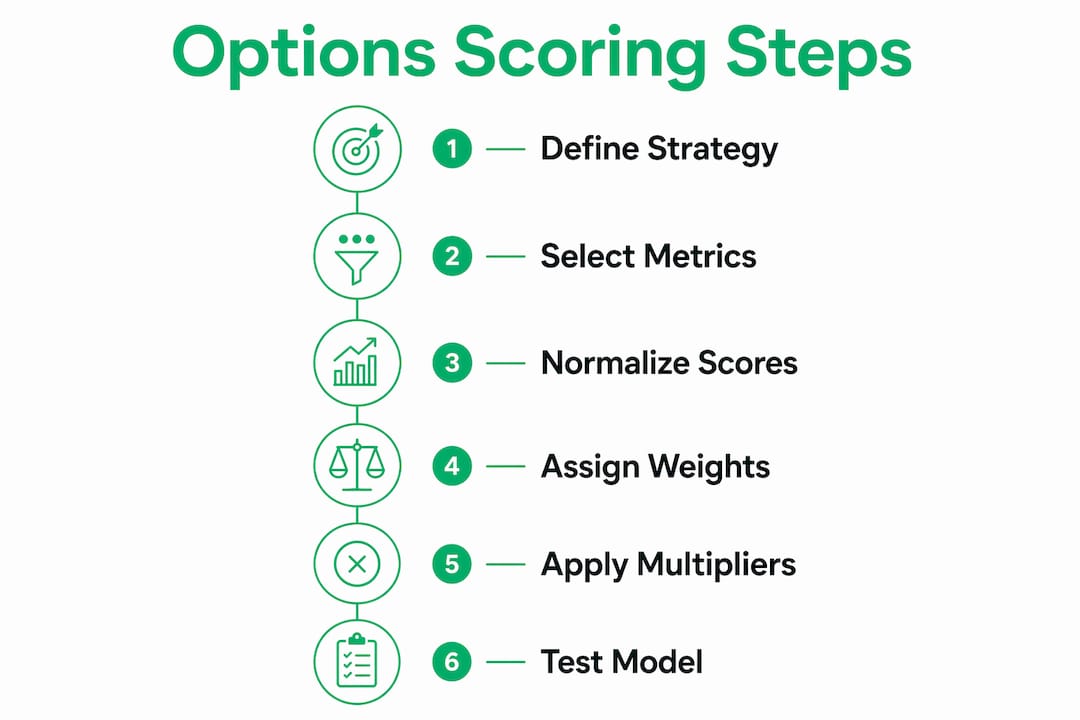
Step 1: Define your strategy type. Long directional, short premium, or sentiment-driven trades each need different weighting profiles. Greek efficiency matters most for long calls and puts; yield and cushion matter most for cash-secured puts and covered calls.
Step 2: Select your scoring dimensions. At minimum, include Delta (strike selection), a decay efficiency metric (Theta or GTR), liquidity (volume and open interest), and DTE. Add implied volatility rank if you sell premium.
Step 3: Normalize each dimension to a common scale. Score each metric from 0–100 relative to the current chain or your screener universe. Invert Theta so lower decay earns a higher score.
Step 4: Assign weights based on your priorities. Liquidity should act as a gate, not just a weighted input. If a contract fails a minimum volume or open interest threshold, score it zero regardless of Greek efficiency.
Step 5: Apply multipliers for DTE and premium quality. Penalize contracts outside your target DTE window. For premium strategies, require a minimum bid relative to the strike price before awarding full credit.
Step 6: Test the output against your trade history. A model that consistently surfaces contracts you would have traded anyway is calibrated correctly. One that keeps ranking contracts you'd reject on inspection needs reweighting.
Comparing scoring models by use case
No single model fits every strategy. The right framework depends on what you're optimizing for.
| Model type | Best for | Primary weight | Key limitation |
|---|---|---|---|
| Greek efficiency (OCS-style) | Long directional trades | GammaTheta Ratio | Ignores sentiment and regime |
| Sentiment scoring (Q-Score style) | Regime and conviction reads | Call/put flow, skew | Not a contract selector |
| Income composite (Wheel-style) | Cash-secured puts, covered calls | Yield and cushion | Penalizes short and long DTE |
| Multi-regime AI (Morningoptions) | Active retail traders, daily setups | Composite + regime context | Requires daily engagement |
Greek efficiency models and sentiment models answer different questions and work best together. OCS tells you which contract to buy if you're going long. The Q-Score tells you whether the options market agrees with your directional thesis. Using both before entry adds a layer of confirmation that neither provides alone. Traders who want both layers pre-packaged can evaluate trade ideas quickly through a service that integrates scoring with regime context.
Risk management considerations when using scoring models
Scoring models surface opportunity. Risk management determines whether you survive long enough to benefit from it.
Position sizing doesn't come from the score. A contract scoring 90 on Greek efficiency still warrants the same position-size discipline as any other trade. The score tells you the contract is efficient relative to its chain; it says nothing about how much capital to risk. Treat high scores as a reason to look closer, not a reason to size up.
Correlation risk is easy to miss when you're filtering by score. A screener returning ten high-scoring contracts on the same underlying, or across highly correlated sectors, creates concentrated exposure that no composite score captures. Review your overall portfolio delta and sector exposure before adding a new position, regardless of its rank.
Volatility regime shifts can invalidate a model's assumptions quickly. A scoring model calibrated for normal implied volatility conditions may surface misleading rankings during earnings season or macro events. Scoring models built for short premium strategies explicitly penalize high-event-risk contracts through IV filters, but only if you've set those filters correctly before running the scan.
Key Takeaways
Options scoring models rank contracts by normalizing Greeks and applying efficiency ratios, giving traders a sortable list rather than a profit guarantee.
| Point | Details |
|---|---|
| Normalize before ranking | Raw Greeks operate on different scales; convert each to 0–100 before combining them. |
| GammaTheta Ratio is the core metric | It measures directional acceleration per unit of daily decay, not raw Gamma alone. |
| 14–45 DTE is the sweet spot | Income-focused models apply full weight in this window and penalize shorter or longer expirations. |
| Scores are relative, not predictive | A score means top-tier ranking on today's chain, not a specific percent chance of profit. |
| Pair scores with regime context | Greek efficiency plus sentiment and momentum signals together produce more reliable trade selection. |
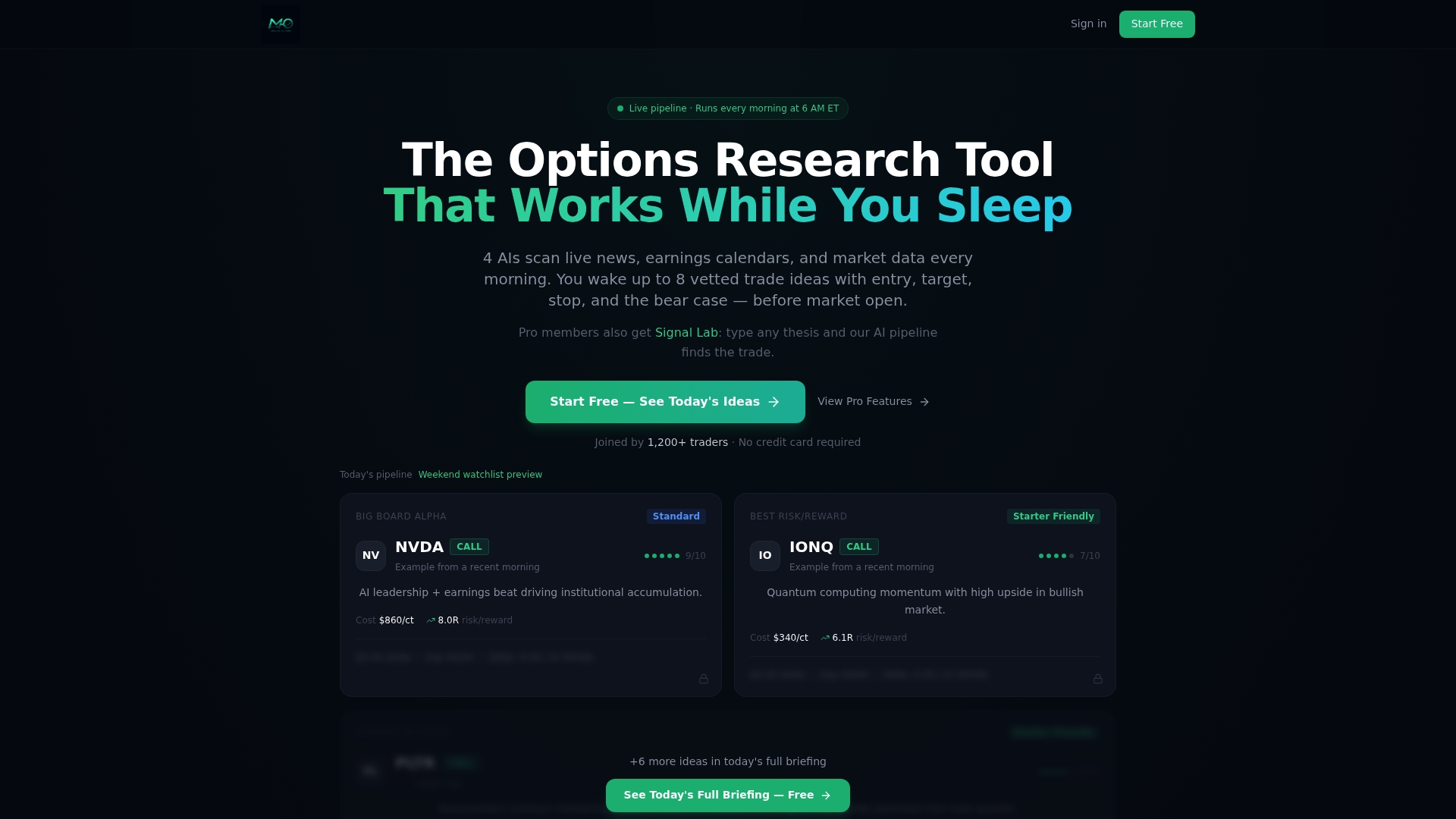
Morningoptions runs this entire scoring process every morning before the open, delivering ranked contract ideas with entry levels and strategy context through a five-pipeline AI system. The free daily briefing covers the top setups; the Pro tier at $89/mo adds the lunchtime scanner and an on-demand AI chat scanner. If you want scored, ranked trade ideas without building the model yourself, start with Morningoptions.