
Run a structured pre market routine of about 10 to 45 minutes before every session, built around three moves: scan futures and news, map your gap and key levels against VWAP, and write down your trade plan with hard risk limits. That gets you to the opening bell with three prioritized setups, a written plan for each, and a daily loss limit already set. Whether you trade ES/NQ futures or single stocks, the sequence stays the same. A tool like a specialized AI-powered options scanner can shortcut the idea-generation half of that work.
TL;DR:
- A structured pre-market routine helps traders make informed decisions before the opening bell, focusing on market tone, gap analysis, volume, and key levels.
- The full preparation takes 45 to 90 minutes, while a condensed version can be completed in 10 to 15 minutes for part-time traders.
- Prioritize a small, well-understood watchlist and set alerts at critical levels to avoid impulsive trading during volatile sessions.
- Pre-setting risk limits and no-trade conditions prevents reactionary errors, especially after unexpected gaps or macro events.
- Using AI-powered tools like Morningoptions can streamline idea-generation, saving time on research and enabling faster final trade planning.
Table of Contents
- Why a Pre Market Routine Beats Winging It
- The Core Pre Market Checklist With Time Budgets
- Building a Watchlist That Actually Holds Up
- Setting Risk Limits and No-Trade Conditions in Advance
- The 10 Minute Routine for Part-Time Traders
- Tech and Platform Checks That Prevent Costly Mistakes
- How Morningoptions Fits Into Your Morning Workflow
- Adjusting Your Routine for Volatile Versus Typical Days
- What My Morning Actually Looks Like
- Try Morningoptions Before Your Next Open
- Sources
- FAQ
Why a Pre Market Routine Beats Winging It
Trading is decision management, not prediction. The traders who hold up over a full year are the ones who make their hardest calls before 9:30 AM: how much to risk, which setups qualify, and when to walk away. Waiting until the bell to figure that out means making decisions under adrenaline, which is exactly when judgment gets worse.
Most wasted pre-market time goes to two things: scrolling social media for opinions and watching video recaps of yesterday's action. Neither produces a tradable level. A short, repeatable pre-market checklist that takes about 10 minutes consistently beats an unstructured hour of "research" because it forces output, not just input.
Keep your watchlist to a small list of well-understood names. Depth on a handful of tickers, where you actually know the float, the catalyst, and the levels, wins over shallow familiarity with twenty.
The Core Pre Market Checklist With Time Budgets
This is the backbone of any pre market preparation session. Run it in order. Total time: 45 to 90 minutes for a full professional routine, detailed further here.
- Futures and news scan (5 to 10 minutes). Check ES/NQ futures direction, scan overnight headlines, and note any scheduled catalysts (earnings, Fed speakers, CPI). Output: one line on overall market tone.
- Gap analysis (10 to 20 minutes). Compare current price to the previous close, mark the gap size as a percentage, and note whether it's a continuation or reversal setup against yesterday's range.
- Volume and float checks (10 to 20 minutes). Confirm premarket volume against average daily volume for each candidate. Thin premarket volume on a small float can mean a false signal.
- Level identification and markups (10 to 20 minutes). Mark premarket high/low, previous day high/low, and VWAP on your chart. These four levels do most of the work for entries and stops.
- Scanner and alert setup (5 to 10 minutes). Set price alerts at your marked levels so you're not staring at a screen waiting for a break.
- Trade plan writing and mental rehearsal (5 to 10 minutes). Write a one-line thesis, entry trigger, stop, and target for each of your three to five names. Run through the if/then scenario in your head once.
- Tech check and quiet five minutes. Confirm your platform is connected, hotkeys work, and you're in the right account. Then stop. Give yourself five silent minutes before the bell.
For each ticker, your written output should look like: thesis, level, stop, target, alert condition. That's the whole point of the pre-market template approach, a written plan you can execute against instead of improvising.
The compressed version of this same sequence runs 10 to 15 minutes and is covered in its own section below.
Building a Watchlist That Actually Holds Up
Start with a scanner set to premarket gappers, unusual volume, and (if you trade options) unusual options flow. Run each candidate through a quick catalyst check: earnings, guidance change, FDA news, an upgrade or downgrade, or a sector-wide move.
Premarket volume matters more in context than in isolation. A stock trading 500,000 shares premarket on a normal 2 million share average day is meaningfully different from the same volume on a stock that trades 20 million shares daily. Smaller floats need a lower absolute volume threshold to signal real interest, so normalize by float size rather than comparing raw numbers across tickers.
For each name that survives the filter, write a one-sentence thesis:
- "Gapping up 8% on earnings beat, holding above premarket high, watching for VWAP reclaim."
- "Down 12% on guidance cut, no bounce yet, avoiding until it holds a level for 15 minutes."
- "Unusual call volume ahead of FDA date, thin float, treating as high-risk lottery position only."
Cap the list at three to five names. If you can't write that one-liner cleanly, the ticker doesn't belong on your list yet. The MindTradr template backs this up directly: a short watchlist with explicit rules prevents impulsive trades better than a long one you never fully vet.
Setting Risk Limits and No-Trade Conditions in Advance
Decide your per-trade risk and daily loss limit before reviewing charts. Front-loading these decisions, defining exactly how much you'll risk per trade and the number that ends your day, turns you into someone executing a plan instead of someone reacting to a losing streak.
No-trade conditions belong in your checklist just like any level or alert. Common ones worth encoding:
- You slept less than five or six hours.
- The stock gapped more than 15% against your expected direction on no clear catalyst.
- A major scheduled macro event (FOMC, CPI, jobs report) hits within the first 30 minutes of the session.
- You've already hit your daily loss limit.
When a limit gets hit, the protocol is simple: stop trading, close open positions, and log what happened immediately. Trying to win it back in the same session is how a bad morning turns into a bad week.
Pro Tip: Write your daily loss limit on a sticky note next to your monitor. The physical reminder works better than a mental one when you're three trades deep and tempted to break your own rule.
The 10 Minute Routine for Part-Time Traders
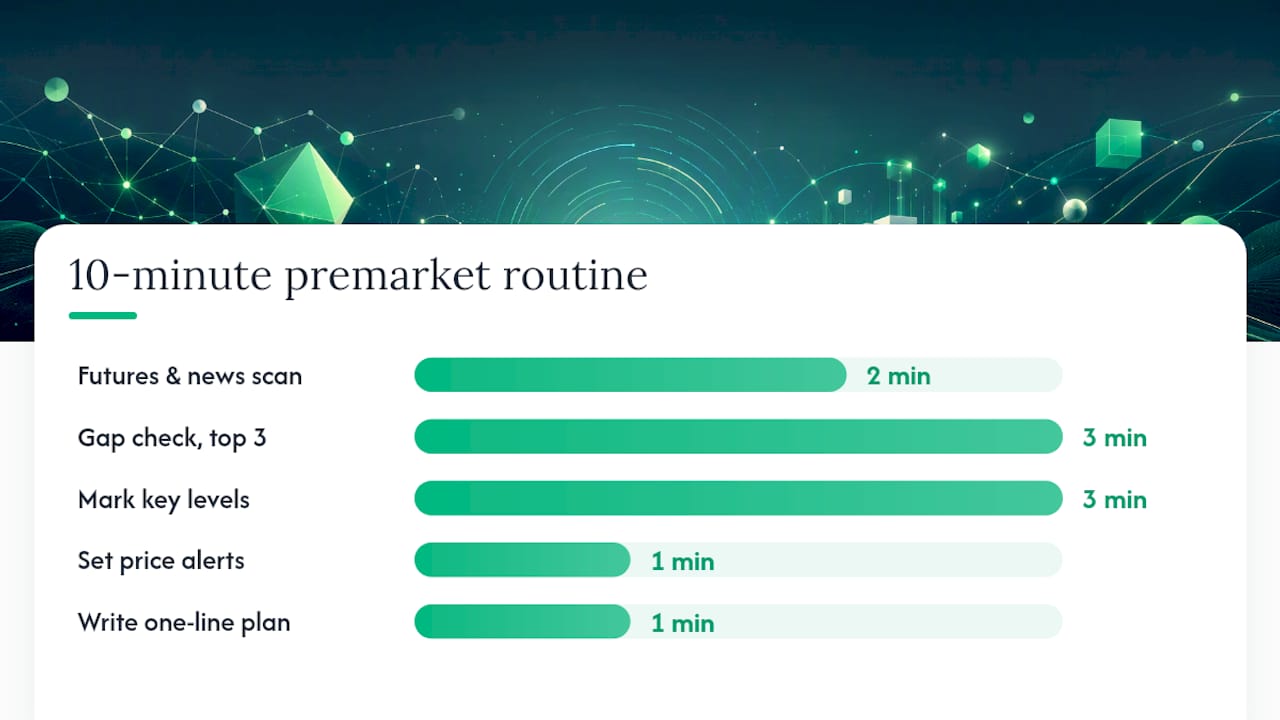
Not everyone has 90 minutes before the open. If you're trading around a day job, run this sequence instead, built on the same time-budgeted logic as the 10-minute checklist model:
- Futures and news scan, two minutes.
- Quick gap check on your top three watchlist names, three minutes.
- Mark one or two key levels per ticker (premarket high/low or VWAP), three minutes.
- Set price alerts at those levels, one minute.
- Write a one-line trade plan for each name, one minute.
The trick to making this work is moving prep to the night before. Mark static levels (previous day high/low, any known support or resistance) after the close, and note any scheduled events for the next morning while they're fresh. That cuts your live morning work almost in half.
Choose the full routine on days with clear catalysts or higher volatility. Default to the compressed version on quiet, range-bound days when the market isn't offering much anyway.
Tech and Platform Checks That Prevent Costly Mistakes
Before you touch a single order, confirm you're in the right account. Paper versus live is the single most expensive mix-up in retail trading, and it happens more than anyone likes to admit. Check your default order type (limit, not market, in most cases), verify your hotkeys fire correctly, and confirm your data feed and broker connection are both live.
Set alerts with intention: a break above the premarket high, a VWAP cross, or unusual options flow on a name you're tracking. Three or four sharp alerts beat fifteen that all fire in the same five-minute window and drown each other out.
Automation helps with repetitive scanning and alert triggers. It creates blind spots when you let it replace your own read on context, a scanner doesn't know that today's gap is happening into a Fed decision. Use it to save time on the mechanical steps, not to skip the judgment calls.
How Morningoptions Fits Into Your Morning Workflow
An AI-driven trade briefing service can deliver ranked options trade ideas with entry and exit levels before the market opens, built through a multi-step AI pipeline that vets and scores each idea against live data and catalyst analysis. That slots directly into the watchlist and trade-plan steps above: after your futures and news scan, a briefing gives you pre-vetted candidates with levels already mapped, so you spend your remaining prep time on final confirmation and risk sizing rather than starting your ticker search from zero.
Adjusting Your Routine for Volatile Versus Typical Days
A quiet, range-bound Tuesday and a CPI release morning are not the same session, and your routine shouldn't treat them that way. On typical days, the standard 45 to 90 minute flow or the 10 to 15 minute compressed version works fine because gaps are smaller and levels hold longer.
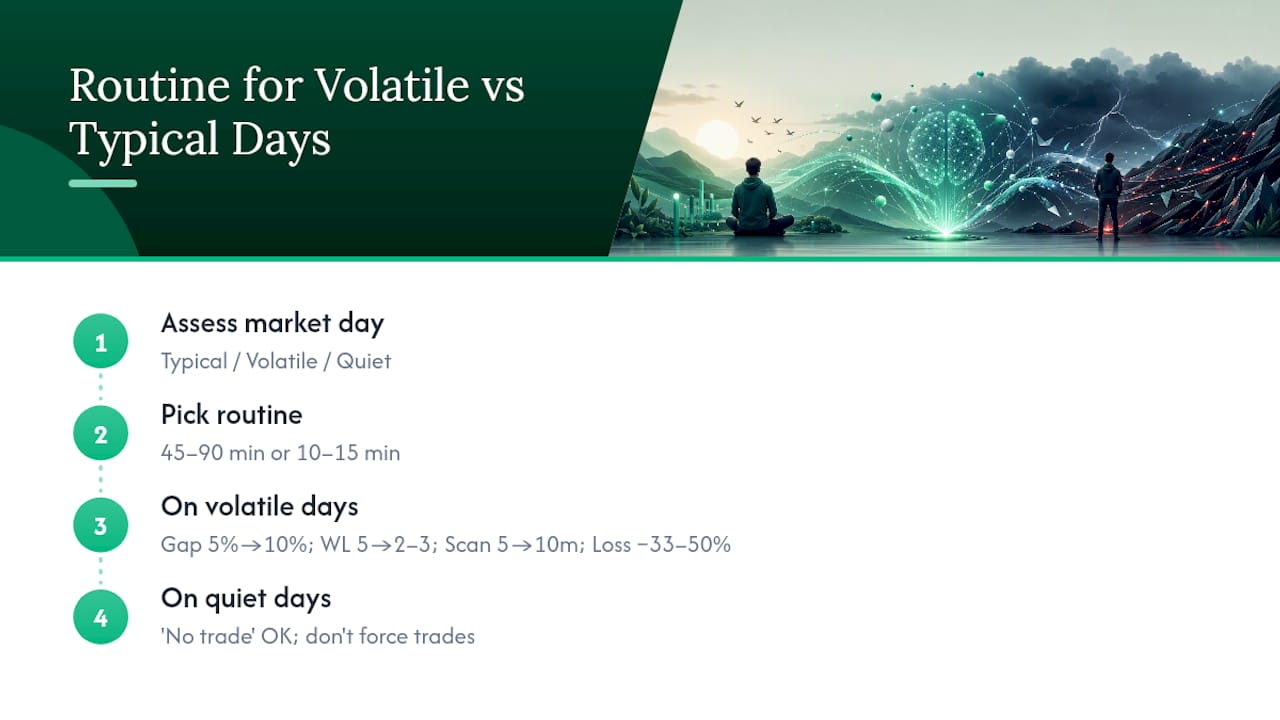
High volatility days change the math. Widen your no-trade filters: a gap that would normally qualify as tradable at 5% might need a 10% threshold on a day when the VIX is elevated and everything is moving harder than usual. Cut your watchlist further, to two or three names instead of five, because volatile sessions punish split attention more than calm ones do.
Spend extra time on the futures and news scan specifically. On a Fed day or a major earnings morning for a bellwether stock, the first five minutes of that scan should expand to ten, since correlated moves across sectors become more likely and more violent. Tighten your daily loss limit too. Some traders cut it by a third to a half on known high-event days, reasoning that wider swings mean a stop-out happens faster and a string of them compounds quicker.
On unusually quiet days, the opposite adjustment applies. Low volume and tight ranges mean fewer valid setups will appear, so resist the urge to force a trade just because you ran the checklist. A completed routine that ends in "no trade today" is still a successful routine. The checklist's job is to filter for quality, not to guarantee action every single morning.
What My Morning Actually Looks Like
Some mornings run long, most don't need to. On a typical day I'm at my desk by 8:45, futures and headlines by 8:50, three names marked with levels by 9:05, alerts set and plans written by 9:15. The output is always the same: a one-line thesis per ticker and a number I won't trade past.
The habit that makes it stick isn't discipline, it's timing. Pick a fixed clock time and treat the routine as non-negotiable, not optional prep you'll do "if there's time."
— Customer
Try Morningoptions Before Your Next Open
Certain platforms provide a head start on the idea-generation step that eats the most pre-market time: a few ranked options setups with entry and exit levels, delivered early in the morning. Some services offer a free plan with daily briefings usable in your watchlist step, with paid upgrades that unlock additional scanners and AI chat tools for researching tickers mid-session, useful when a name catches your eye after the open. Start by testing one free morning briefing against your own watchlist tomorrow: pull up three names from the briefing, run them through your own gap and level check, and see how much time it saves versus building your list from scratch. Check today's briefing at Morningoptions and fold it into step two of your checklist.
Sources
For a deeper look at level-mapping and premarket mechanics, see Morningoptions' guide to premarket trading. If you trade around news catalysts, the 15-minute EDGAR and options flow method sharpens your catalyst checks. For valuation context on names before a move, the partner analysis at Lacuna Journal is worth a read.
- The Perfect Pre-Market Routine: What to Do Before 9:30 AM — Ticker Daily
- Pre-Market Routine for Day Traders: A Simple Checklist | Mettle
- The Pre-Market Checklist Every Trader Needs (Template Inside) — MindTradr
- Pre-Market Trading Routine: The 10-Minute Checklist — TradersSecondBrain
FAQ
What Is the 3-5-7 Rule in Trading?
The 3-5-7 rule is a risk management guideline suggesting a trader risk no more than 3% of capital on any single trade, keep total exposure across all open trades under 5%, and cap total portfolio risk at 7%. It's a framework for sizing, not a law, and many traders adjust the specific numbers to their own risk tolerance and account size.
Can You Make $1,000 a Day With Day Trading?
It's possible on a given day, but it depends entirely on account size, position sizing, and volatility, not on any routine alone. A trader risking 1% per trade on a $20,000 account isn't likely to hit $1,000 in a single session without taking outsized risk, so treat any specific daily dollar target as a planning number, not a guarantee.
What Is the Premarket Doing Today?
Premarket price action reflects overnight news, earnings releases, and index futures movement before the 9:30 AM open, and it shifts daily based on catalysts. Checking ES/NQ futures direction alongside your specific watchlist names is the fastest way to read premarket sentiment each morning.
What Is a Good Strategy for Pre Market Trading?
A solid pre market strategy combines gap analysis, volume confirmation, and clear level identification (premarket high/low, previous day high/low, and VWAP) rather than chasing headlines alone. Pairing that with a written trade plan, entry, stop, and target for each name keeps execution disciplined once the bell rings, and a service like Morningoptions can supply pre-vetted setups to build that plan around faster.
How Long Should a Pre Market Routine Take?
A full professional routine runs 45 to 90 minutes, while a compressed version for part-time traders takes 10 to 15 minutes. Choose based on your available time and the day's expected volatility, not a fixed rule.