
Premarket trading is defined as the buying and selling of stocks before the official U.S. market session opens at 9:30 a.m. ET. This session gives traders a window to react to overnight earnings reports, Federal Reserve statements, and economic data releases before the opening bell. Understanding premarket trading mechanics is the difference between entering the day with a plan and chasing price moves you do not understand. The session runs on Electronic Communication Networks (ECNs) rather than the main exchange floor, which creates a structurally different trading environment with its own rules, risks, and opportunities.
What are the hours and platforms for premarket trading?
The standard premarket window runs from 4:00 a.m. to 9:30 a.m. ET. That said, most retail brokers restrict access to 7:00 a.m. onward, aligning their platforms with the time when earnings releases and economic data actually hit the wire.

All premarket activity runs through ECNs. These are electronic systems that match buy and sell orders directly between participants without routing through the New York Stock Exchange or Nasdaq floor. The practical result is a fragmented order book with far fewer participants than the regular session.
That fragmentation has real consequences for how you trade:
- Order types: Most brokers allow only limit orders in premarket. Market orders are typically blocked because wide spreads make them dangerous.
- Liquidity: Volume is a fraction of regular session levels, especially before 7:00 a.m. ET.
- Partial fills: Thin order books mean your limit order may fill partially or not at all.
- Price discovery: Prices form across multiple ECNs simultaneously, so there is no single consolidated quote like you see during regular hours.
- Brokerage differences: Some platforms open premarket access at 4:00 a.m., others at 7:00 a.m. Check your broker's specific rules before placing a trade.
Pro Tip: Set your limit orders at least a few cents inside the bid-ask spread during premarket. Wide spreads are the norm, and chasing the ask in thin markets costs you before the trade even moves.
What are the benefits and risks of trading in the premarket session?
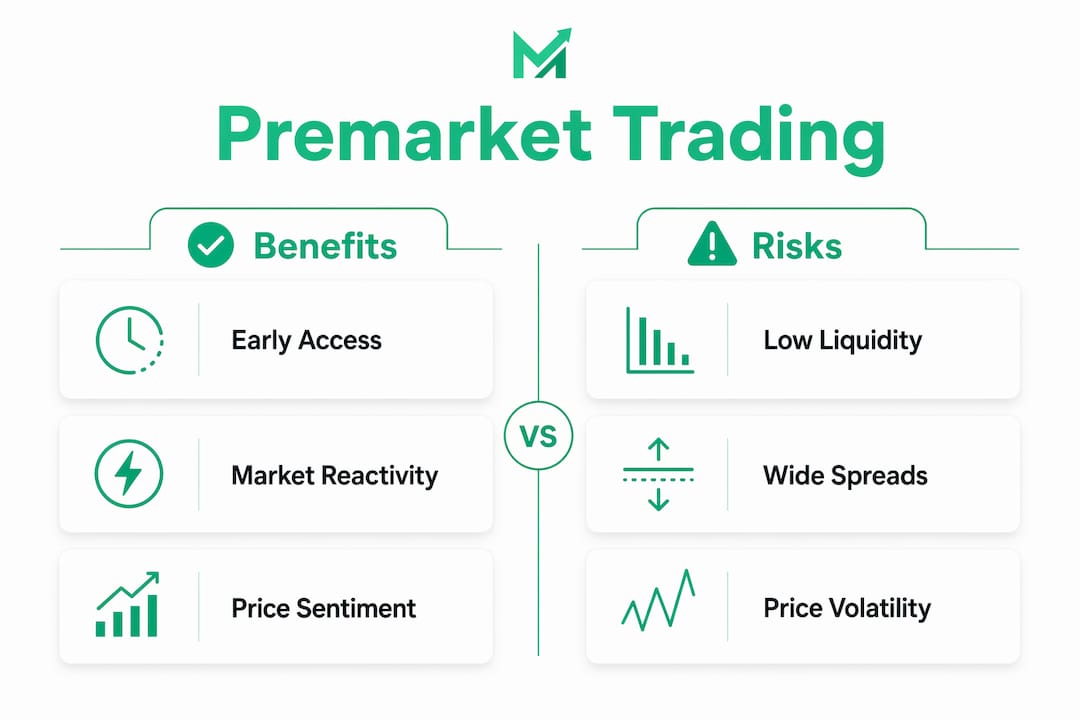
The primary benefit of premarket trading is speed of reaction. Earnings reports, CPI data, and Fed commentary often drop before 9:30 a.m. ET. Traders who understand the premarket session can position themselves before the crowd arrives at the open.
Earnings and economic catalysts released around 8:30 a.m. ET routinely move stock prices several percentage points within minutes. That kind of move is an opportunity for a prepared trader and a trap for an unprepared one.
Benefits of the premarket session:
- React to news before the regular session opens
- Establish positions at prices unavailable once volume floods in at 9:30 a.m.
- Gauge overall market sentiment before committing capital
Risks that every trader must understand:
- Low liquidity: ECN-based trading produces wider bid-ask spreads and thinner order books than regular hours.
- Volatility traps: Thin volume means a single large order can move a stock dramatically. That move often reverses once institutional volume arrives at the open.
- Partial fills: Your limit order may execute in pieces, leaving you with an incomplete position at the wrong moment.
- Restricted order types: Without market orders, you cannot guarantee execution speed.
- False signals: A stock up 5% in premarket may open flat or lower once the opening auction runs.
Pro Tip: Size down in premarket. Use half or less of your normal position size until you see how the stock behaves at the open. Smaller size protects you from volatility traps and partial fill problems.
How does premarket trading differ from regular and after-hours trading?
Regular trading runs from 9:30 a.m. to 4:00 p.m. ET on the NYSE and Nasdaq. After-hours trading typically runs from 4:00 p.m. to 8:00 p.m. ET. Premarket and after-hours sessions share the same structural limitations, but they serve different purposes for traders.
The most important structural difference is the absence of National Best Bid and Offer (NBBO) enforcement. During extended hours, there is no regulatory requirement to route your order to the best available price across all venues. That means you can get a worse fill in premarket than you would for the same stock at 10:00 a.m.
The official opening price is not the last premarket trade price. The opening auction at 9:30 a.m. sets the official open by matching accumulated buy and sell orders. A stock trading at $152 in premarket may open at $148 or $155 depending on that auction result.
| Session | Hours (ET) | Order types | NBBO enforced | Liquidity level |
|---|---|---|---|---|
| Premarket | 4:00 a.m. – 9:30 a.m. | Limit orders only | No | Very low to moderate |
| Regular session | 9:30 a.m. – 4:00 p.m. | All types | Yes | High |
| After-hours | 4:00 p.m. – 8:00 p.m. | Limit orders only | No | Low |
Premarket prices are a sentiment indicator. They tell you where traders expect a stock to open, not where it will open. Treating a premarket price as a guaranteed entry level is one of the most common and costly mistakes retail traders make.
What practical strategies can traders use for premarket trading?
Effective premarket trading is built around catalyst discipline. The session rewards traders who wait for a clear reason to act, not those who trade out of habit or boredom at 4:30 a.m.
- Focus on the 8:30 a.m. ET window. Professional traders react to catalysts at or near 8:30 a.m. ET when economic data drops and liquidity begins to build. Trading before 7:00 a.m. is rarely worth the risk for retail traders.
- Use limit orders exclusively. Set your price before you enter. Never chase a moving stock with a market order in premarket conditions.
- Identify your catalyst first. Is the move driven by an earnings beat, a guidance revision, or a macro data surprise? Moves without a clear catalyst are the most likely to reverse.
- Avoid the first 15 minutes after open. Experienced traders often wait until 9:45 a.m. or 10:00 a.m. to confirm that the premarket trend holds once institutional volume arrives.
- Plan your exit before you enter. Set a stop level and a target before placing the order. Premarket volatility makes emotional decision-making especially expensive.
- Size your position conservatively. Treat premarket trades as higher-risk by default and size accordingly.
Pro Tip: Build a short watchlist the night before using earnings calendars and economic release schedules. Knowing which stocks have catalysts lets you focus your attention rather than scanning in real time at 8:00 a.m.
Understanding high probability trade setups before the open is what separates reactive traders from prepared ones.
How should traders interpret premarket price movements and manage gap risk?
Premarket prices do not set the official open. The opening auction at 9:30 a.m. determines the first official print by aggregating all queued orders. That distinction matters because the gap between the last premarket trade and the official open can be significant.
Gap risk is the price jump that occurs when institutional orders and auction imbalances reset a stock's price at the open. A stock that traded at $80 in premarket may open at $76 because a large seller entered the auction. Cautious traders wait until 9:45 a.m. to see how the stock behaves once real volume confirms or denies the premarket direction.
Key principles for interpreting premarket price action:
- Use premarket as a sentiment gauge. Institutional traders treat it this way. They watch premarket to understand where sentiment sits, not to price their positions.
- Watch volume, not just price. A 4% move on 10,000 shares means far less than a 4% move on 500,000 shares.
- Identify support and resistance levels from the prior regular session. Premarket moves that stall at prior-day levels are more meaningful than moves into open air.
- Avoid impulsive trades at the open. The first minutes of the regular session are the most volatile. Waiting for a clear direction after the opening auction reduces the risk of being caught in a reversal.
Premarket price movements create volatility traps precisely because thin liquidity exaggerates moves. Recognizing that pattern protects you from acting on signals that disappear the moment real volume enters.
Key Takeaways
Premarket trading is a sentiment tool, not a price guarantee. Traders who treat it as a reaction mechanism for confirmed catalysts, use limit orders, and wait for volume confirmation at the open consistently manage risk better than those who chase early moves.
| Point | Details |
|---|---|
| Premarket hours | The session runs 4:00 a.m. to 9:30 a.m. ET, with most retail brokers limiting access to 7:00 a.m. onward. |
| ECN-only execution | All premarket trades route through ECNs, producing wider spreads, thin liquidity, and limit-order-only rules. |
| No NBBO enforcement | Extended hours lack the price protection of regular sessions, increasing the risk of poor fills. |
| Opening auction sets the price | The last premarket trade is not the official open. The 9:30 a.m. auction determines the real opening price. |
| Wait for volume confirmation | Experienced traders hold off until 9:45–10:00 a.m. ET to confirm that premarket trends hold under real volume. |
The premarket edge most traders waste
Most traders I talk to treat premarket like a preview of the regular session. They see a stock up 6% and assume that move is real, confirmed, and tradeable. It is not. Premarket is a negotiation between a small number of participants with incomplete information. The opening auction is where the real price gets set.
The traders who use premarket well are not the ones trading at 4:30 a.m. They are the ones who spend that time building context. They check which stocks have earnings, what the economic calendar looks like, and where key technical levels sit from the prior session. By 8:30 a.m., they have a plan. They are not reacting. They are executing.
The biggest mistake I see is position sizing. Traders use the same size in premarket that they use during regular hours. That is a mistake. Thin liquidity means your stop can get blown through before you can react. Half size, or less, is the right default until you have a read on how the stock is behaving.
Premarket is genuinely useful for options traders too. A stock gapping up 8% on earnings changes the entire options setup for that day. Knowing that before the open lets you plan your strikes, your expiry, and your risk before the chaos of the open hits. That preparation is where the edge lives.
— Customer
Morningoptions delivers premarket trade ideas before the bell
Active traders need more than raw premarket data. They need ranked, specific ideas with entry levels before the open.

Morningoptions runs a five-stage AI pipeline every market morning to vet, score, and explain each trade idea. Free daily briefings give you specific options contract ideas with entry levels, not vague market commentary. The Pro tier at $89/mo adds a lunchtime scanner and an AI chat tool for researching any ticker on demand. If you want a clear read on the day's setups before 9:30 a.m., see today's trade ideas and put premarket analysis to work.
FAQ
What is premarket trading?
Premarket trading is the buying and selling of stocks before the regular U.S. market session opens at 9:30 a.m. ET. It runs on Electronic Communication Networks and gives traders early access to price moves driven by overnight news and economic data.
What hours does premarket trading run?
The premarket session runs from 4:00 a.m. to 9:30 a.m. ET. Most retail brokers restrict access to 7:00 a.m. onward, which aligns with the timing of earnings releases and major economic reports.
Is premarket trading risky?
Premarket trading carries higher risk than regular session trading due to low liquidity, wide bid-ask spreads, and no NBBO enforcement. Volatility traps are common, where thin volume causes sharp moves that reverse once the regular session opens.
Does the premarket price determine the opening price?
No. The official opening price is set by the opening auction at 9:30 a.m. ET. Premarket prices are a sentiment indicator and can differ significantly from the actual open.
What order types are allowed in premarket trading?
Most brokers allow only limit orders during premarket hours. Market orders are typically blocked because wide spreads and thin liquidity make them too risky for reliable execution.