AI can genuinely sharpen how you screen, size, and stress-test options trades, but it should never hold the trigger. The technology is best at scanning thousands of tickers for IV distortion, unusual flow, and earnings setups faster than any human, then modeling the risk before you commit capital. The one non-negotiable rule: a broker-enforced approval step, like the Model Context Protocol, has to sit between any AI suggestion and a live order. Morningoptions builds its entire briefing pipeline around that boundary.
TL;DR:
- Data freshness is critical because delayed quotes can misprice fast-moving implied volatility during the first hour after market open.
- AI tools must be grounded in real-time, verified market data, including live Greeks and IV ranks, to avoid hallucinating or misleading signals.
- An effective workflow involves pre-market screening, detailed trade vetting, cross-checking flow data, staged order drafting, and safety gates before execution.
- Broker integrations like Interactive Brokers' Model Context Protocol ensure AI trading remains safe by separating data read-only access from order submission.
- Beware of tools that lack transparency in data sources or testing methodology, as they increase the risk of acting on unverified or fabricated signals.
Table of Contents
- What AI Can Actually Do for Options Trading
- How Do You Build an AI Options Trading Workflow?
- What Should You Look for in an AI Options Scanner?
- How Do Broker Integrations Keep AI Trading Safe?
- What Kinds of AI Models Power Options Trading Tools?
- Where Does the Data Behind AI Options Analysis Come From?
- Are There Legal Restrictions on Using AI for Options Trading?
- What Do Real AI-Assisted Options Trades Look Like?
- What Mistakes Do Traders Make When Using AI for Options?
- Our Take: AI Amplifies Good Traders, It Doesn't Create Them
- Try MorningOptions Without Changing How You Trade
- Sources
What AI Can Actually Do for Options Trading
Most of the hype around AI options trading oversells autonomous execution and undersells what the technology is genuinely good at: filtering noise and compressing research time. Strip away the marketing and you get a handful of capabilities that hold up under scrutiny.
Screening is where AI earns its keep fastest. A model can rank hundreds of tickers by implied volatility rank, flag unusual options activity, and cross-reference flow data against historical patterns in the time it takes you to pour coffee. Platforms that combine flow data with IV analytics and backtesting produce noticeably more actionable signals than tools relying on chart patterns alone. Pattern recognition without volatility context is guessing with better graphics.
Research depth is the second real advantage. Instead of manually pulling ten quarters of earnings reactions, an AI research assistant can decompose how much of a stock's current implied volatility is attributable to the upcoming earnings event versus baseline noise, then compare that to how the stock actually moved in prior cycles. That single comparison, IV priced in versus realized move historically, often reveals whether an options structure is overpriced before you ever look at a strike.
Trade construction is where things get genuinely useful for time-strapped traders:
- Greeks-aware strategy suggestions that account for your existing portfolio delta and vega exposure, not just the single ticker in isolation.
- Leg construction help for spreads, condors, and calendars that matches your risk tolerance and available buying power.
- Pre-trade simulation showing probable profit and loss zones across a range of underlying price and volatility outcomes before you enter.
- Portfolio-level risk previews that catch when three "independent" positions are actually all long the same sector beta.
- Position monitoring and wheel-tracking, including alerts when a covered call is approaching assignment or when IV has collapsed enough to justify closing early.
None of that works without grounding, though. Research on financial AI systems is consistent on this point: a model without a live, vetted data pipeline behind it will hallucinate numbers that look plausible and are simply wrong. Ask a general-purpose chatbot for a stock's current implied volatility without connecting it to real market data, and it will confidently give you a number pulled from nowhere. That's the single biggest reason "just use ChatGPT" advice for options trading falls apart in practice. The tool has to be wired into an actual data feed, not reasoning from memory.
Data freshness is the other quiet limitation. A scanner running on 15-minute-delayed quotes will misprice fast-moving IV in the first hour after the open, right when options premium decay and gamma effects are most volatile. If you're using an AI scanner for research, know exactly how current its underlying feed is before you trust a strike suggestion.
How Do You Build an AI Options Trading Workflow?
The traders getting real value from AI in options trading aren't the ones asking a chatbot "what should I buy." They've built a repeatable routine that treats AI as a fast, tireless research analyst and keeps every decision point in human hands. Here is the sequence that holds up across market conditions.
1. Start with the pre-market brief. Before the opening bell, read a ranked list of setups generated overnight, ideally one that already filters for IV extremes, earnings proximity, and unusual flow. Check the broad volatility environment (is VIX elevated or compressed?) and flag any names on your watchlist reporting earnings that day or week. This ten-minute read should tell you what's worth digging into further and what to ignore entirely.
2. Screen, then interrogate. Pull the top three or four candidates from the brief and push harder on each one. Ask the tool to decompose how much of the current implied volatility is earnings-driven versus structural, and pull up how the stock actually reacted to its last four or five earnings prints relative to what was priced in. This is the step most retail traders skip, and it's the one that separates a good setup from an overpriced one. A proper trade vetting process exists specifically to catch the difference.
3. Verify against a second source. Cross-check the flow signal against options flow data independently, not just the AI's summary of it. If the unusual activity the model flagged doesn't show up when you look at the raw print, that's a real red flag about the tool's grounding, not just the trade.
4. Draft the trade instructions, don't execute them. Once you've settled on a structure (a call spread, a strangle, whatever fits the thesis), have the AI draft the specific contract, strikes, and sizing based on your account's available buying power and existing exposure. This draft should sit in a staged, reviewable state. It is not an order yet.
5. Run it through your sizing rules and the dual-safety gate. Check the position against your own max-loss-per-trade rule before anything moves toward execution. Well-built broker integrations require two separate confirmations, an explicit environment setting and a runtime confirm flag, before any code path can place a live order. That's exactly how IBKR's AI integration is structured, and it's a design pattern worth demanding from any tool you use.
6. Paper-trade unfamiliar signals before scaling. If a scanner surfaces a signal type you haven't traded before (say, a volatility crush play around a biotech catalyst), run it in a paper account first. Track whether the AI's predicted move and your realized outcome actually line up over five or ten instances before committing real size to that signal category.
7. Use the midday rescan to validate, not chase. Markets shift after the open. A lunchtime rescan that re-checks your morning candidates against updated flow and IV data tells you whether the setup still holds or whether the edge already got arbitraged away by faster money. Treat a midday signal shift as a reason to skip a trade far more often than a reason to jump into a new one.
8. Manage the position with alerts, not autopilot. Set alerts for IV collapse, delta breach thresholds, or approaching expiration, and let AI flag when a roll or close might make sense. The decision to actually adjust still belongs to you. AI is good at noticing "your short strike is now 80% delta," it is not good at knowing your personal risk tolerance for holding through an earnings gap.
Pro Tip: Keep a simple log of every AI-flagged setup you decided to skip, along with why. After a month, you'll see whether your override instincts are actually protecting you or just costing you good trades out of habit.
This routine takes maybe 20 minutes longer than glancing at a stock screener and guessing, and it consistently produces better-sized, better-timed entries. The shift in serious AI trading tools is toward grounded research that challenges your assumptions with evidence, not toward autonomous bots making decisions while you sleep.
What Should You Look for in an AI Options Scanner?
Not every tool marketed as an "AI options scanner" deserves your subscription fee. Before you commit, run any candidate through this checklist.
Data quality first, always. Ask directly whether the platform uses real-time OPRA data or delayed quotes, and whether Greeks are calculated live or estimated from stale prices. This distinction matters more in options than almost anywhere else in trading, because delta and vega shift fast intraday. Some community-built toolkits document real-time feeds and Greeks as separate paid data bundles layered on top of base market data access, which tells you the cost structure isn't trivial for any provider doing this properly.
Model grounding is non-negotiable. Ask the tool a question with a verifiable answer, like a specific stock's current IV rank, and check whether it can show you where that number came from. A model that answers with confidence but no data trail is guessing. This single test will disqualify more tools than any marketing claim will confirm.
Backtesting transparency matters more than backtesting results. Any provider can show you a chart of hypothetical returns. Fewer will show you the methodology: what data window, what slippage assumptions, what happens to the results if you shift the entry criteria by a few percentage points. If a platform won't explain its testing assumptions, treat every performance claim with real skepticism.
Latency and refresh rate. A scanner that refreshes every 15 minutes is fine for swing setups and useless for anything sensitive to same-day IV crush. Know which use case the tool is actually built for before judging it against the wrong standard.
Safety architecture is a feature, not an afterthought. Look specifically for opt-in trading requirements, audit logs of every drafted instruction, and a confirm-before-send step that can't be bypassed accidentally. This is where a lot of flashy tools quietly fail.
Run through the practical basics before you subscribe to anything:
- Does it offer a free tier or trial period long enough to actually test signal quality across a few market days?
- Is paper trading available so you can validate the tool's edge before risking capital?
- What's the actual subscription cost, and does the pricing tier match the features you'd use daily versus occasionally?
- Are historical performance claims backed by a methodology write-up, or just a chart?
The biggest red flag in this space is any provider claiming "proven" returns with a black-box model and zero methodology disclosure. If you can't see how a signal was generated or tested, you can't reasonably trust it with your capital.
How Do Broker Integrations Keep AI Trading Safe?
The single most important technical development making AI options trading viable for retail traders isn't a smarter model. It's the Model Context Protocol, a standard that lets AI assistants read your account positions and market data directly while keeping order submission entirely under the broker's control. That separation of "look" from "act" is what makes the whole category safe enough to use.
Interactive Brokers' implementation is the clearest public example. Assistants like Claude, ChatGPT, and Grok can connect through MCP to pull account summaries, current positions, and market data, then draft trade instructions. Those instructions stay staged. They never auto-execute. You review, adjust, and manually approve before anything touches the market.
Community-built toolkits enforce this same principle at the code level: a script that can place live orders requires two separate, explicit safety gates, an environment variable and a runtime confirm flag, before execution is even possible. Skip either one and the trade never fires.
That dual-gate pattern, documented in projects like the ibkr-options-assistant toolkit, is worth demanding from any AI trading tool you evaluate, not just the well-known platforms.
A few practical points to check before connecting any AI tool to a live brokerage account:
- Confirm the integration is read-only for account data by default, with trading permissions requiring separate, explicit activation.
- Check whether every drafted instruction gets logged for audit, so you have a record of what the AI suggested versus what you actually approved.
- Understand your data subscription costs upfront. Real-time OPRA data and live Greeks calculations are typically separate paid add-ons beyond basic market access, and skipping them means working with materially incomplete information.
- Review the SEC's investor alert on automated trading for the regulatory baseline on what automated systems can and can't promise you.
Configuring these gates correctly takes maybe ten minutes and it's the difference between a research assistant and an unsupervised algorithm with your capital.
What Kinds of AI Models Power Options Trading Tools?
Not all "AI" in this space means the same thing, and the label gets stretched to cover very different technology. Machine learning models, typically trained on historical price, volume, and options chain data, are the workhorse behind most screening and pattern-detection features. They're good at finding statistical relationships across thousands of tickers that a human would never manually check.
Large language models, the kind powering conversational research assistants, aren't predicting prices directly. They're synthesizing data, answering questions in plain language, and drafting trade instructions based on retrieved market data. Their value depends entirely on the quality of the data pipeline feeding them, which is the grounding issue covered earlier.
Reinforcement learning shows up less often in retail-facing tools but gets discussed constantly in trading forums. These models learn strategies by simulating thousands of trade sequences and adjusting based on simulated reward, essentially trial and error at scale. It's powerful for backtesting strategy variations, but retail traders should be wary of any product claiming a reinforcement-learning "trading bot" makes autonomous decisions with real capital. That's a fundamentally different risk profile than a research tool that drafts ideas for your review.
The practical takeaway: ask any provider which category of model is doing the actual work in each feature. Screening probably runs on classical machine learning. Research summaries and chat probably run on an LLM. If anything claims full autonomous decision-making, that's the moment to ask hard questions about oversight.
Where Does the Data Behind AI Options Analysis Come From?
The output of any AI options tool is only as good as what feeds it, and options data has more moving parts than equity data alone. Real-time price feeds cover the underlying stock, but options chains need their own layer: bid, ask, volume, open interest, and implied volatility for every strike and expiration. That's where OPRA (Options Price Reporting Authority) data comes in, and it's typically a separate, paid subscription layered on top of basic market access.
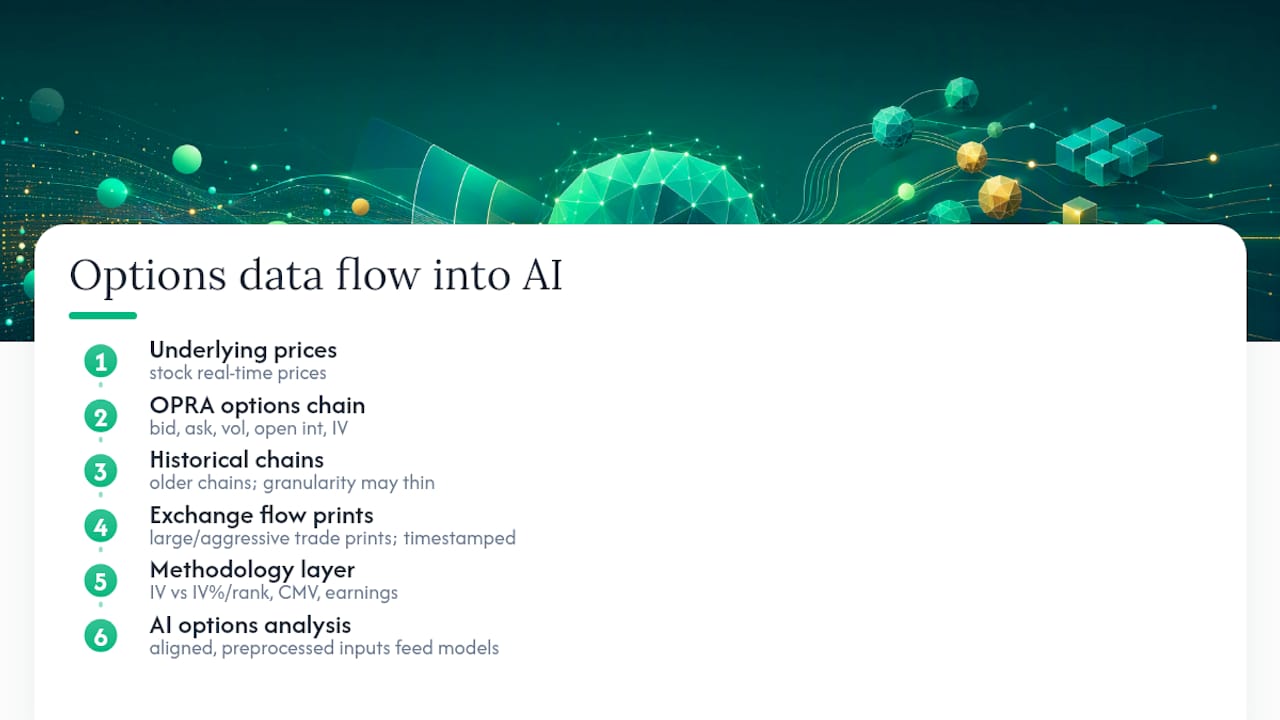
Preprocessing matters just as much as the raw feed. A methodology layer needs clear definitions for things like IV versus IV percentile versus IV rank, constant-maturity volatility summaries that let you compare apples to apples across expiration dates, and earnings-decomposition logic that separates event-driven volatility from baseline noise. Skip that layer and a tool will hand you numbers that are technically accurate but practically misleading.
Historical data for backtesting adds another wrinkle. Options chains from years ago often aren't stored with the same granularity as current data, so a strategy backtest spanning multiple years may be working with thinner historical detail for the earlier periods than the recent ones. A transparent provider will tell you exactly where that data thins out.
Flow data, records of unusually large or aggressive options orders, comes from exchange-level trade prints rather than price feeds. Combining it correctly with IV context requires timestamping trades against the volatility environment at that exact moment, not just flagging "big trade happened."
Are There Legal Restrictions on Using AI for Options Trading?
Nothing in current regulation prohibits a retail trader from using AI tools to research or draft options trades. What the SEC's guidance on automated trading does address is investor protection around systems that place trades without adequate human oversight, and the risks of over-relying on any automated signal without understanding it.
The regulatory line that matters most in practice is execution authority. A tool that drafts a trade idea for your review sits in a fundamentally different category than one that submits orders on your behalf without confirmation. Brokers building AI integrations, including the MCP-based connections IBKR supports, are explicit that final order approval stays with the account holder. That design choice isn't just good engineering. It keeps the product aligned with how regulators think about automated systems and who bears responsibility for a trade.
You're still the one responsible for every trade placed in your account, regardless of what generated the idea. If an AI tool suggests a spread and you approve and submit it, that's your trading decision, with the same suitability and risk obligations as any trade you'd have found manually. No AI disclaimer buried in a tool's terms of service changes that.
Watch for one specific claim: any platform implying it can "guarantee" returns or operate with zero human involvement in order placement is making a claim regulators have repeatedly flagged as a warning sign, not a feature.
What Do Real AI-Assisted Options Trades Look Like?
The clearest documented examples of AI options trading in practice come from workflow demonstrations rather than after-the-fact performance claims, and that distinction matters. One detailed walkthrough of the IBKR AI integration shows an assistant screening a watchlist, decomposing which portion of a stock's implied volatility was tied to an upcoming earnings date, and comparing that priced-in move against how the stock had actually reacted across prior quarters. The output wasn't a buy signal. It was evidence the trader used to decide whether a specific spread was overpriced relative to history.
That's the pattern worth paying attention to: successful AI-assisted setups tend to come from combining a fast screen with a slower verification step, not from trusting the first signal a scanner produces. A trader who sees an IV-rich ticker flagged, then checks whether that richness is explainable by a real catalyst versus just noise, ends up with a meaningfully different (and usually better) trade than one who acts on the flag alone.
The pattern extends to position management too. Wheel-strategy traders using AI-assisted monitoring report catching assignment risk and IV-collapse exit points earlier simply because an alert fired while they were doing something else, not because the model made a prediction no human could have made. The edge isn't prophecy. It's attention at scale, applied consistently across more positions than one person can watch manually.
What Mistakes Do Traders Make When Using AI for Options?
The most expensive mistake is treating a confident-sounding output as a verified fact. Language models are fluent by design, and fluency gets mistaken for accuracy constantly. If a tool states an implied volatility number or a probability of profit without showing where that number came from, verify it against a second source before it influences a real position, because ungrounded models will fabricate plausible-sounding figures when they lack a live data connection.
A second common failure: over-sizing based on an AI-flagged "high conviction" signal. No screening tool, however good its data, should determine your position size. That decision belongs to your own risk rules, applied consistently regardless of how a signal was generated.
Third, traders chase signals from tools with no visible backtesting methodology. A slick interface showing hypothetical historical gains means nothing without knowing the assumptions behind it, slippage, entry timing, survivorship bias in the ticker universe tested.
Fourth, and quietly common: connecting a trading account to an AI assistant without checking the safety configuration first. Skipping the review of whether execution requires explicit confirmation is how a research tool accidentally becomes an unsupervised algorithm.
Last, traders abandon the workflow the first time a signal doesn't pan out, when the fix is usually tightening the verification step, not discarding the tool entirely.
Our Take: AI Amplifies Good Traders, It Doesn't Create Them
The uncomfortable truth about AI options trading is that it makes bad habits faster, not just good ones. A trader who chased hot tips before will now chase AI-flagged signals with the same lack of discipline, just with a shinier justification. The tool didn't create the discipline problem. It just gave it a more convincing narrator.
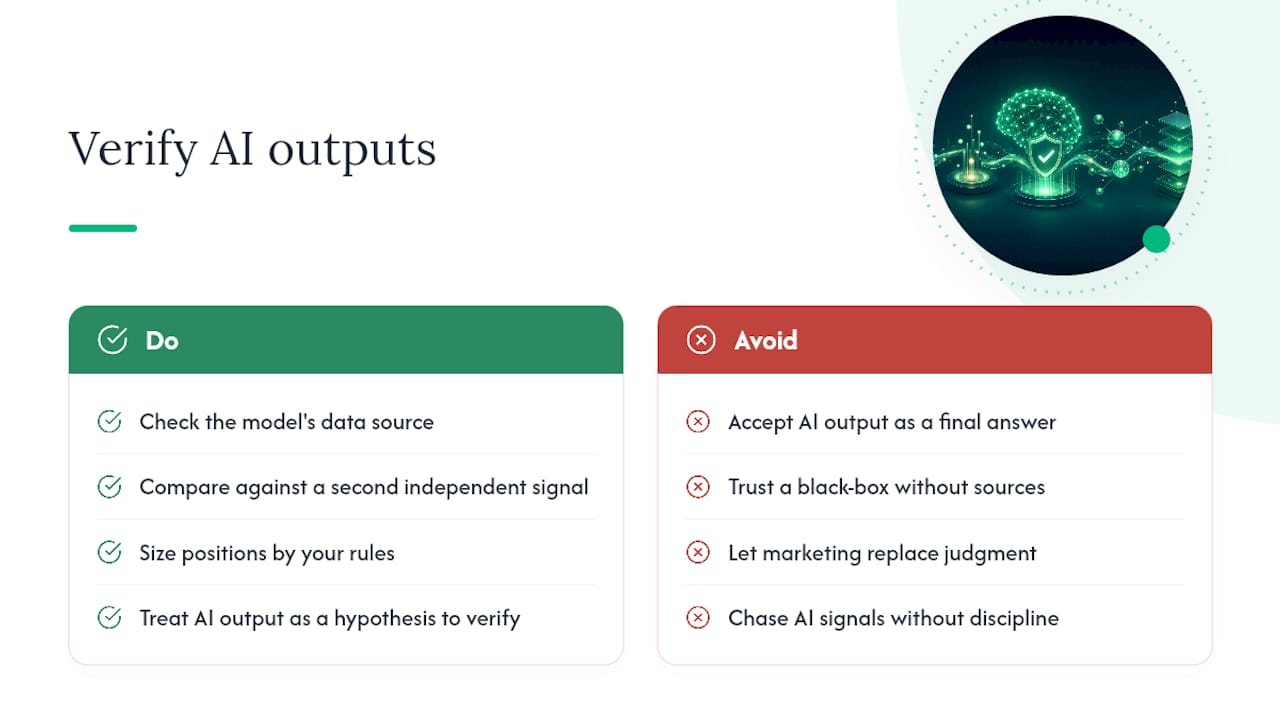
What actually separates traders who benefit from AI in options trading from those who get burned by it isn't the sophistication of the model they're using. It's whether they treat every AI output as a hypothesis to verify rather than an answer to accept. The traders getting real value are running the same skeptical process a good research analyst would: check the data source, compare against a second signal, size according to their own rules, and never let a confident-sounding summary substitute for a number they've actually confirmed.
There's also a real gap between what AI options trading promises in marketing copy and what it delivers in practice. No tool, however well-built, eliminates the need for judgment about position sizing, portfolio concentration, or when to walk away from a setup that looks statistically appealing but doesn't fit your risk tolerance. Morningoptions builds its five-model pipeline specifically to vet and score ideas before a trader ever sees them, precisely because raw AI output without that verification layer produces noise dressed up as signal.
The next few years will separate serious AI options platforms from novelty chatbots on exactly one axis: whether they can show their data sources and testing methodology, or whether they're asking you to trust a black box. Ask that question of every tool, including this one.
— Customer
Try MorningOptions Without Changing How You Trade
Morningoptions gives you the ranked, specific contract ideas this article just walked through, entry levels included, without asking you to build the screening and verification workflow yourself from scratch every morning.
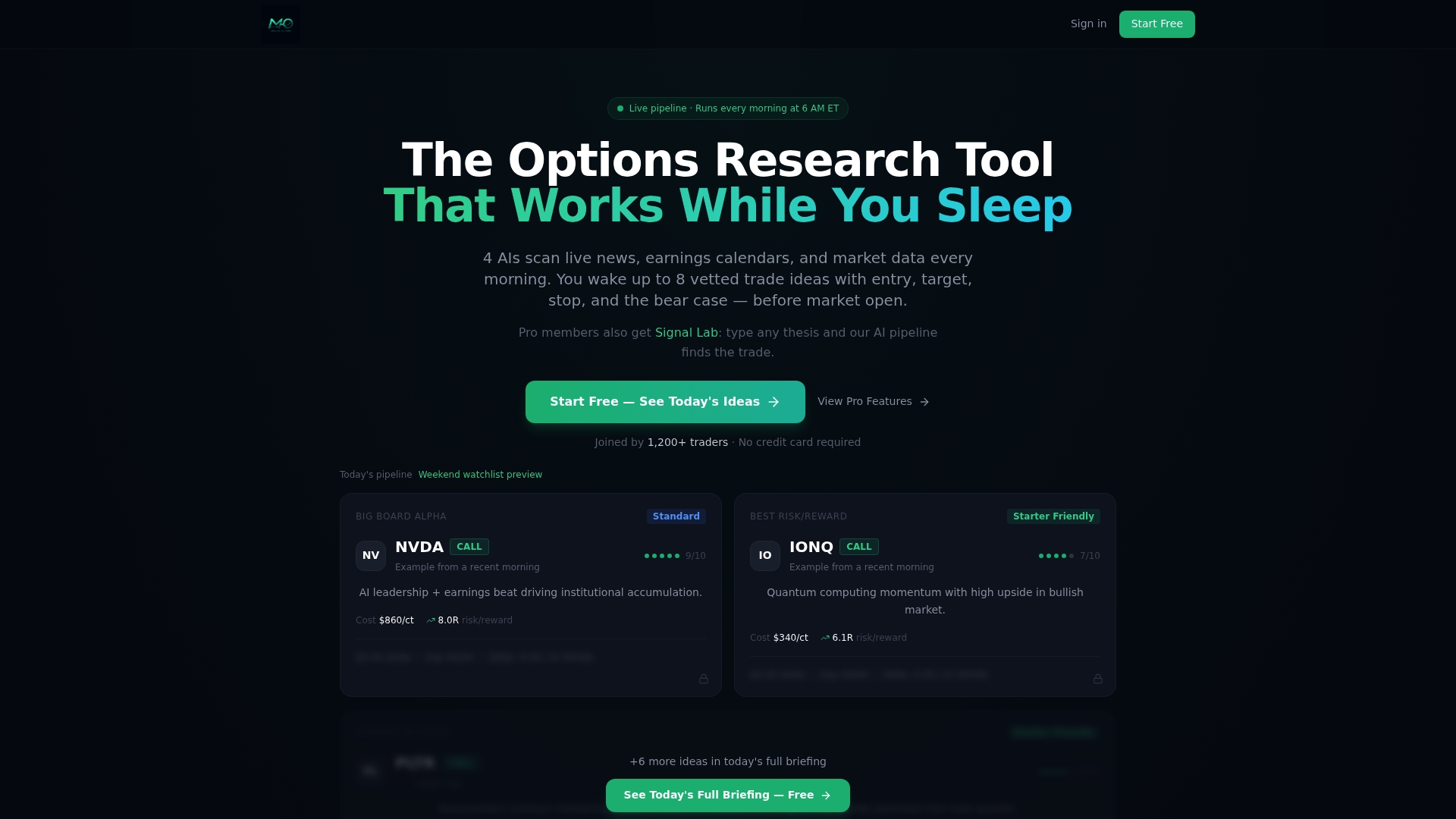
The free daily briefing already covers the pre-market step from the workflow above: a ranked read on the day's setups, IV context, and earnings flags before the bell. If you want additional features like a midday rescan or on-demand AI chat to interrogate a specific ticker, those are available in the Pro tier subscription. Run the free briefing for a week, paper-trade two of the ideas against your own sizing rules, and see whether the signal quality holds up before spending anything. Then try Pro during an earnings-heavy week, when the decomposition tools matter most. Sign up for the daily briefing and see the next morning's ranked ideas before the open.
Sources
The technical and regulatory claims above draw on Interactive Brokers' documentation of its AI integration model and its walkthrough of a real AI-assisted options research workflow, both of which detail how account access and trade drafting work without ceding execution authority. The ibkr-options-assistant toolkit on GitHub shows how dual safety gates get implemented at the code level. Regulatory context on automated trading risk comes from the SEC's investor alert. For readers who want broader portfolio-level context beyond options-specific tools, portfolio analysis tools are worth a look as a complement.
This article is general information, not a substitute for advice from a qualified financial advisor. Consult a qualified financial professional about your own circumstances before acting on anything here.