
An AI options scanner can cut your pre-market research from hours of manual work down to under 10 minutes, and Morningoptions delivers that through a 5-AI pipeline that vets, scores, and ranks specific contract ideas with entry levels before the open every trading day.
Here is what that means in practice:
- Multi-stock, multi-strategy scanning evaluates bull puts, bear calls, and iron condors across dozens of tickers simultaneously, not one at a time
- Live IV Rank and composite scoring replace the manual spreadsheet math most traders still do by hand
- Ranked output means you review the top three ideas, not a raw list of 200 signals
- Free daily briefing is available now at Morningoptions — no credit card required to see what a vetted morning note looks like
Start there. If the briefing saves you an hour tomorrow morning, the rest of this article will show you how to make that repeatable.
Key Takeaways
An AI options scanner cuts pre-market research from 90–120 minutes of manual work to under 10 minutes by automating parallel scanning, composite scoring, and prioritization — while keeping sizing and final approval human.
| Point | Details |
|---|---|
| Time savings are real and documented | A multi-stock, multi-strategy scan completes in under 10 seconds versus 90–120 minutes manually. |
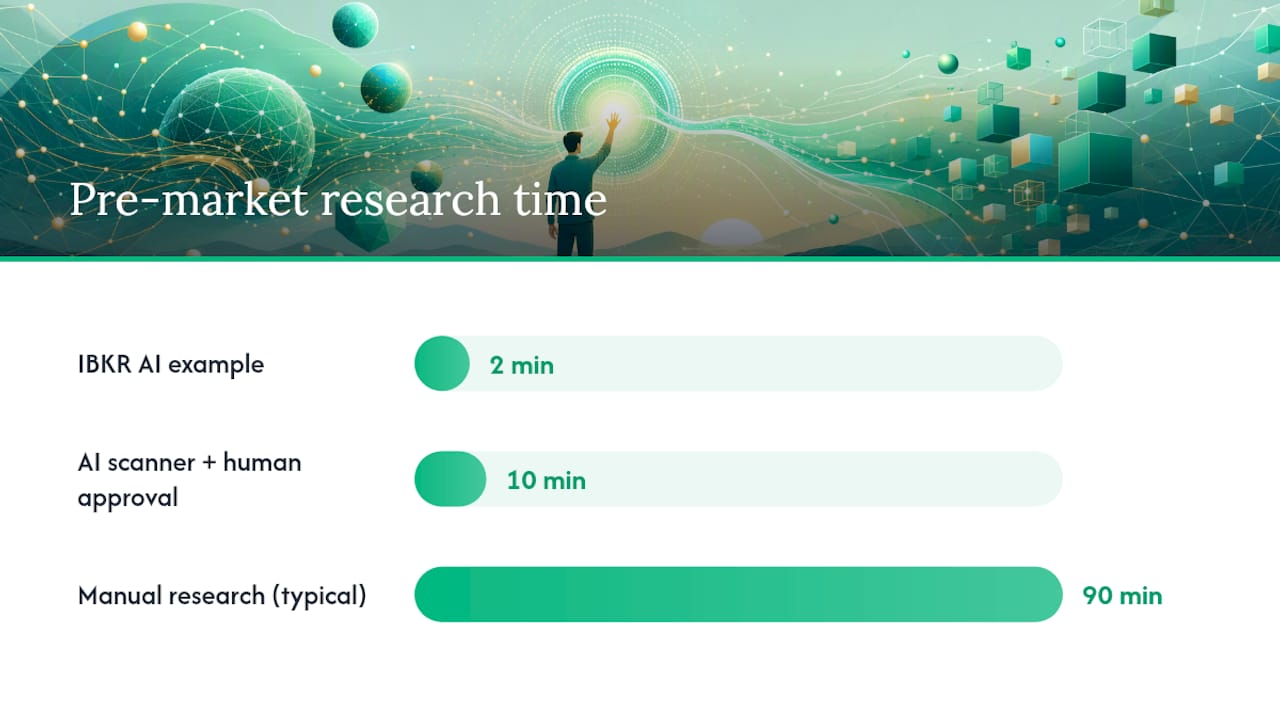
| Pre-market ritual takes under 10 minutes | Run the scan, apply filters, read the top three ranked ideas, vet for earnings and liquidity, then size manually. |
| On-demand scans need structured prompts | Specify ticker, strategy type, POP threshold, and DTE range to get a usable output with entry, exit, and bear case. |
| Human approval is non-negotiable | Sizing, correlation checks, and final trade decisions stay with the trader — AI handles the mechanical screening. |
| Morningoptions free briefing is the starting point | Free daily briefing delivers ranked contract ideas before the open; Pro at $89/mo adds Signal Lab and AI chat scanner. |
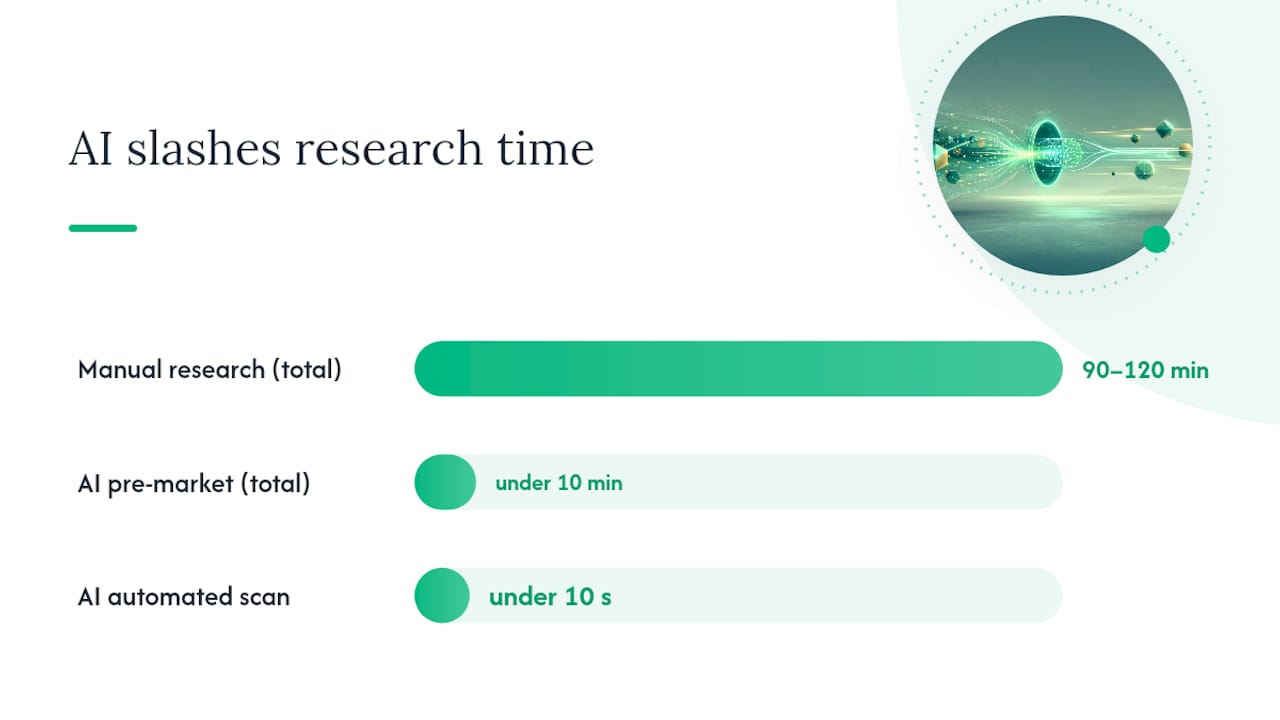
Table of Contents
- How using an AI scanner saves research time
- Your pre-market ritual with an AI scanner
- How to run a fast on-demand ticker scan
- What scanner outputs actually mean
- When AI scanners get it wrong
- What Morningoptions does to speed your research
- Copyable pre-market and on-demand templates
- Free vs Pro: when does $89/month make sense?
- The honest case for AI-assisted trading
- Morningoptions: start with the free briefing
- Sources
How using an AI scanner saves research time
The time savings are not magic. They come from four specific mechanisms that replace the slowest parts of manual options research.
Parallel scanning is the biggest lever. A documented example from TradieCapital showed an AI scanner completing a multi-stock, multi-strategy analysis across five tickers in under 10 seconds. The manual equivalent for an experienced trader runs 90–120 minutes. That gap exists because a human evaluates one ticker, one strategy, one expiration at a time. The scanner runs all of them at once.
Automation of repetitive math removes the second time sink. Probability of profit (POP), delta, theta, IV Rank, and composite scoring all happen automatically. You never open a calculator or pull up a separate volatility surface.
Prioritization is what separates a good scanner from a raw data dump. The best systems, as Jenova's AI agent framework describes, rank ideas by composite score rather than POP alone, so you only read the top candidates. The rest get filtered out before they reach you.
Grounded data prevents the failure mode that makes traders distrust AI output. A well-built scanner calls live pricing and volatility surfaces (ORATS-style analytics, for example) rather than generating plausible-sounding numbers from a language model's training data. Barchart's analysis makes this point directly: combining structured market data with unstructured signals like news and sentiment is what narrows the field to genuinely higher-quality setups.
Pro Tip: Set a minimum POP threshold (many traders use 65–70%), a max DTE range, and a minimum open interest filter before your scan runs. Outputs that clear all three are the only ones worth reading.
Your pre-market ritual with an AI scanner
The full pre-market workflow fits inside 10 minutes when you run it in order.
- Run the scheduled scan at 8:30 AM ET. Let the scanner pull overnight data, pre-market moves, and IV changes before you touch anything. Morningoptions delivers this as a morning briefing automatically.
- Apply your filter presets. Watchlist tickers only, IV Rank above your threshold, minimum liquidity (open interest and bid/ask spread). This cuts the output to a manageable shortlist.
- Read composite scores, not raw signals. The top three ranked ideas are your starting point. Ignore everything below rank five until you have reviewed the top candidates.
- Run a 60-second vet check on each shortlisted idea. Confirm no earnings within the trade's DTE window, check for correlated positions already in your portfolio, and verify the news backdrop is not distorting IV.
- Size and approve manually. The scanner does not know your account size, your existing Greeks exposure, or your risk tolerance for the week. That step stays human.
- Set alerts for intraday triggers. If an idea requires a specific entry price, configure a price alert so the scanner notifies you rather than requiring you to watch the screen.
The IBKR AI workflow example compressed a comparable multi-step research session into roughly two minutes in its documented run. The pre-market ritual above is longer because it includes the human approval steps that protect capital — but it still replaces what most traders spend 90 minutes doing manually.
How to run a fast on-demand ticker scan
The AI chat scanner is where you go when a ticker moves mid-session and you need a fast read. Prompt structure matters more than most traders expect.
Useful prompt patterns:
- Quick idea: "NVDA is up 4% pre-market on earnings beat. What is the current IV Rank, and what is the highest-POP defined-risk strategy for a 30-day hold?"
- IV decomposition: "Break down TSLA's current IV versus its 52-week range. Is IV elevated or compressed relative to historical norms?"
- Earnings-impact check: "META reports in 11 days. What is the expected move implied by the options market, and which strategy captures premium if the move stays inside that range?"
- Strategy generation: "Generate three defined-risk strategies for SPY with POP above 68%, DTE between 21 and 45 days, and max loss under $400."
A well-structured scanner response should return the strategy name, specific strikes and expiration, entry credit or debit, POP, delta, theta, max profit, max loss, and a one-line bear case. If the output is missing any of those fields, the idea is not ready to trade.
Validation checklist before acting on any on-demand output:
- Confirm no earnings announcement falls inside the trade's DTE window
- Verify the quoted price against a live chain (midpoint, not ask)
- Check open interest on both legs — below 500 contracts is a liquidity warning
- Look at the bid/ask spread as a percentage of the credit received
The IBKR workflow recommends saving your watchlist, strategy preferences, and risk constraints in the scanner's memory so you do not re-enter context every session. That alone saves five minutes per session for active traders who run multiple scans per week.
What scanner outputs actually mean
Reading a ranked list correctly is faster than it sounds once you know what each field does.
- POP (probability of profit): The percentage of outcomes at expiration where the trade is profitable, derived from the options chain's implied distribution. A 70% POP means roughly 30% of outcomes result in a loss.
- Composite score: A weighted ranking that combines POP, risk/reward ratio, liquidity, and IV Rank. A high composite score means the idea scores well across all dimensions, not just one.
- IV Rank vs. IV Percentile: IV Rank compares current IV to the 52-week high/low range. IV Percentile compares it to the percentage of days in the past year where IV was lower. Both matter; they can diverge significantly on tickers with one large spike in the lookback window.
- Expected move: The market's implied one-standard-deviation range for a given expiration. Selling premium inside this range is the core logic of most high-POP strategies.
- Greeks snapshot: Delta tells you directional exposure, theta tells you daily time decay, and vega tells you how much the position gains or loses per one-point IV move.
When to accept the top-ranked idea versus moving down the list: if the top idea has a correlated position already open (two short-delta trades in the same sector), take the second-ranked idea in a different sector instead. Evaluating options trade ideas quickly covers this vetting framework in more detail.
When AI scanners get it wrong
Four failure modes account for most scanner errors in live trading.
- Stale data feeds: A scanner quoting prices from 15 minutes ago during a fast-moving pre-market session will generate ideas that are no longer executable at the stated credit. Always verify the live quote before entering.
- Earnings contamination: A scanner that does not filter for upcoming earnings will recommend premium-selling strategies into binary events. That is not a setup — it is a coin flip with defined risk.
- Illiquidity: A high-POP spread on a low-volume ticker looks attractive on paper. In practice, the fill is at the ask, and the exit is worse. Open interest and bid/ask spread checks are non-negotiable.
- False-positive unusual activity: Large block trades are sometimes hedges, not directional bets. An AI that flags every large print as a bullish signal will generate noise.
Concrete controls: Cap any single scanner idea at 2–5% of account value. Set a stop rule at 100–200% of the credit received on short premium trades. Run a correlation check before adding a new position.
Pro Tip: Always pull a live quote from your broker's chain after the scanner outputs a price. The scanner's job is to find the idea. Your broker's chain is the source of truth for what you actually pay.
Practitioner guidance on AI workflow integration is direct on this: AI accelerates pattern detection and research speed, but sizing, risk controls, and final trade decisions stay human. That division of labor is not a limitation — it is the correct architecture.
What Morningoptions does to speed your research
Morningoptions runs a 5-AI pipeline that vets and scores every trade idea before it reaches you. Each stage contributes something specific: one layer screens for liquidity and earnings contamination, another scores IV environment, another evaluates strategy fit, another ranks by composite score, and a final layer generates the bear case and entry/exit guidance. The result is a briefing that reads like a volatility trader's work, not a generic signal list.
Feature breakdown:
- Free daily briefing: Ranked contract ideas with entry levels, strategy type, and a bear case — delivered every market morning before the open
- Signal Lab: On-demand scans you run yourself against specific tickers or setups
- AI chat scanner: Natural-language ticker research, available in the Pro tier
- Lunchtime scanner: A midday scan that catches setups that develop after the open, also Pro-only
Pricing: Free plan includes the daily briefing. Pro tier is $89/month and adds Signal Lab, the AI chat scanner, and lunchtime scans.
For an active trader running several ideas per week, the pre-market briefing alone replaces more than an hour of manual scanning. The options pipeline research framework explains how pipeline-style research integrates with a live trading workflow.
Copyable pre-market and on-demand templates
Pre-market 3-step checklist:
- Open the morning briefing and read composite scores top to bottom — stop at rank three unless the top ideas are correlated
- Run the 60-second vet check: earnings clear, liquidity confirmed, no duplicate sector exposure
- Size the position manually using your account's 2–5% per-idea cap, then enter
On-demand prompt templates:
- IV check: "What is [TICKER]'s current IV Rank and how does it compare to its 6-month average?"
- Strategy generation: "Give me two defined-risk strategies for [TICKER] with POP above 65% and DTE between 21–45 days."
- Unusual activity: "Flag any unusual options activity in [TICKER] in the last 48 hours and explain whether it looks directional or hedging."
- Earnings setup: "What is the expected move for [TICKER] into earnings on [DATE], and what strategy captures premium if price stays inside that range?"
Save your risk constraints (max loss per trade, preferred DTE range, sector limits) in the scanner's session memory so you do not re-enter them every time. The IBKR workflow documentation identifies persistent session memory as one of the highest-value operational features for active traders.
Free vs Pro: when does $89/month make sense?
When to stay free: You trade fewer than two ideas per week and the morning briefing gives you enough to work with.
When to upgrade: You are running five or more ideas per week, you want to research tickers on demand between sessions, or you want the lunchtime scan to catch setups that develop after the open.
Breakeven math: If Pro saves you 60 minutes of manual research per trading day across 20 trading days, that is 20 hours per month. At $89/month, the cost per hour saved is under $4.50. For a trader whose time has any real value, that math resolves quickly. The harder question is whether the ranked ideas improve your trade selection — and that is what the free briefing is for.
The honest case for AI-assisted trading
The traders who get the most from AI scanners are not the ones who trust the output blindly. They are the ones who use it to eliminate the 80% of research that is mechanical and repetitive, then apply judgment to the 20% that actually requires a human decision.
The scanner finds the setup. You decide whether the setup fits your book, your risk budget, and the macro backdrop that day. That division works because the scanner is faster and more consistent at the mechanical part, and you are better at the contextual part.
What I see traders get wrong is treating a high composite score as a trade recommendation rather than a shortlist entry. A 72% POP iron condor on a ticker with earnings in 18 days and a 0.30 bid/ask spread on the short leg is not a good trade — the scanner surfaced it because it cleared the POP filter, not because it cleared every risk filter. The vet checklist is not optional.
The other mistake is abandoning the scanner after one bad signal. Every research tool generates false positives. The question is whether the hit rate on the top-ranked ideas is better than your manual process. For most active retail traders, it is.
Morningoptions: start with the free briefing
Morningoptions gives active retail options traders a concrete alternative to spending the first 90 minutes of every trading day in a spreadsheet. The free daily briefing delivers ranked, vetted contract ideas with entry levels, exit targets, and a bear case — before the open, every market day.
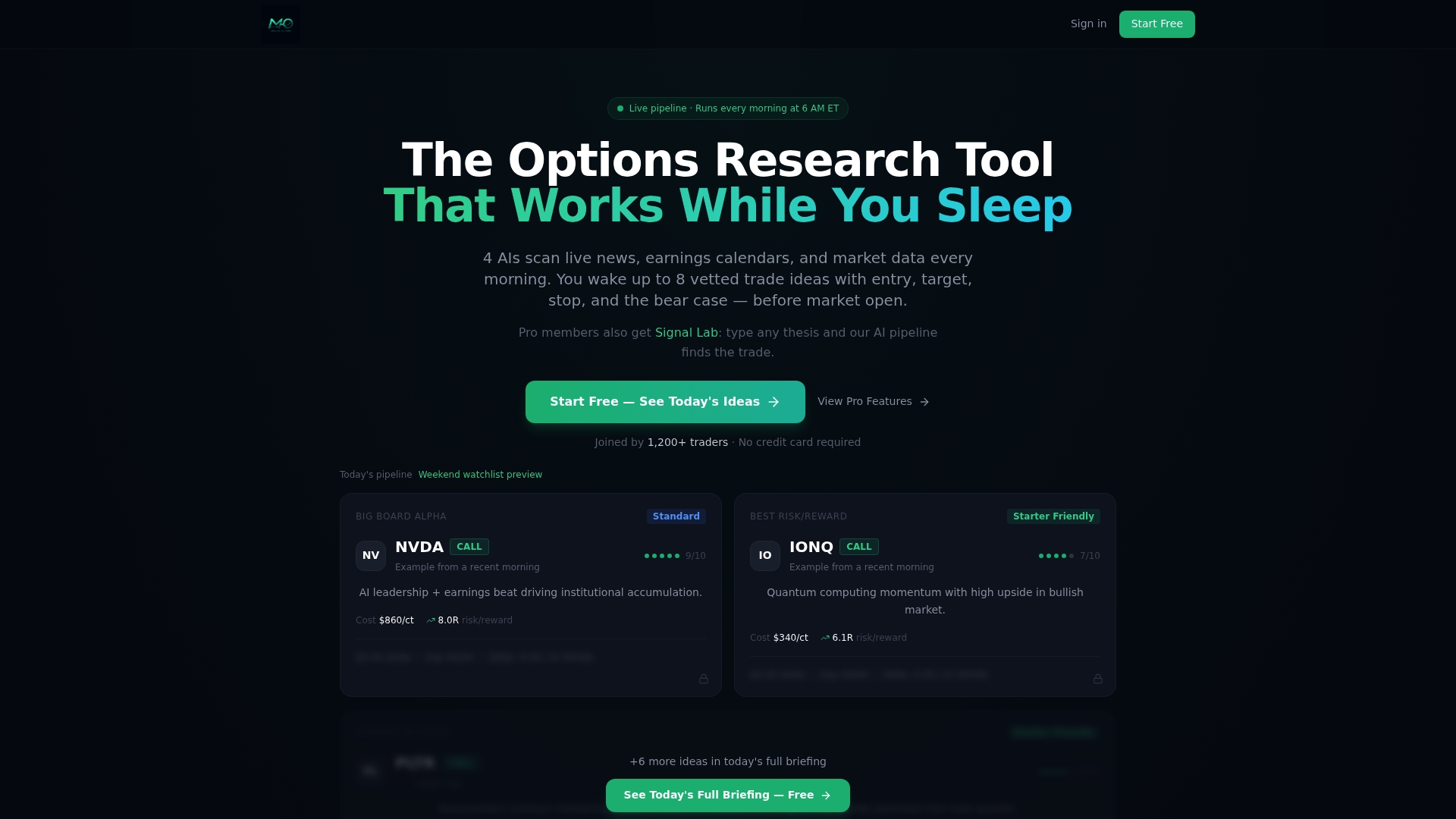
Sign up for the free daily briefing and read tomorrow morning's note before the open. If the ranked ideas and entry levels save you an hour of manual scanning, the Pro tier at $89/month adds Signal Lab for on-demand scans, the AI chat scanner for ticker research between sessions, and the lunchtime scanner for midday setups. No long-term contract — month to month.
Sources
- AI Options Opportunity Detection Agent: The Complete Guide to Intelligent Derivatives Opportunity Discovery in 2026
- How Options Trading AI Is Changing the Way Traders Find Setups
This article is general information, not a substitute for advice from a qualified financial advisor. Consult a qualified financial professional about your own circumstances before acting on anything here.