
Some equity options may qualify for Global Trading Hours, while Cboe notes that SPX and VIX options trade in the limited session. If you want a premarket options strategy, focus on those index contracts, use limit orders and keep size smaller than usual. Exchanges and regulators also require firms to disclose the risks of extended-hours trading.
TL;DR:
- Cboe’s SPX and VIX session runs from 8:15 p.m. ET the prior day to 9:25 a.m. ET; verify contract eligibility and broker support.
- Some equity option classes qualify only if they meet volume, market capitalization, and share volume tests; Cboe reviews eligibility twice yearly, so lists can change.
- Premarket spreads can be 10 to 50 times wider than regular session spreads, so use limit orders, reduce size, and accept partial fills.
- Prefer small trades in one option or spreads with defined risk; confirm your broker supports entering spreads together, since a missed second fill leaves exposure.
Table of Contents
- When do index options trade outside regular hours?
- Which options are eligible, and how do you check yours?
- What are the real risks, and how should you execute?
- Which strategies fit premarket liquidity?
- What should your premarket routine look like?
- What do FINRA and Cboe require you to know?
- Where we land on premarket options
- Get premarket prep done faster with MorningOptions
- FAQ
- Sources
When do index options trade outside regular hours?
Cboe's Global Trading Hours (GTH) session for index options runs from 8:15 p.m. ET the previous day to 9:25 a.m. ET, Monday through Friday, according to SR-CBOE-2025-079 rule text. Cboe also notes that VIX and SPX options trade in that limited session, and that the VIX Index is calculated and disseminated overnight, which lets participants express volatility views outside U.S. cash hours.

Equity options are a narrower story. The same rule text lets some equity option classes qualify for GTH, with a morning window before the regular session opens. A class has to meet criteria such as average daily option volume, underlying market capitalization and share volume.
Two mechanics matter for timing. The rule text describes queuing periods and opening rotations for GTH trading. Submitting an order early does not guarantee a fill at a specific moment. Exchanges also review eligibility twice a year, so the list of qualifying equity classes can change.
Which options are eligible, and how do you check yours?
Cboe notes that SPX and VIX options trade in its limited global trading hours session. Check the exchange's current GTH product list to confirm whether a specific contract is eligible.
Equity options are far more restricted. Some equity option classes may qualify for GTH if they meet the volume and market-cap criteria in the rule text. Do not assume your favorite single stock qualifies just because it is liquid at 10 a.m.
Verify eligibility before you plan a trade:
- Check the exchange's current GTH product list and any recent notices.
- Look for a GTH or extended-hours flag in your broker's option chain.
- Confirm that your broker accepts GTH orders for the specific contract, since some firms support only a subset.
- Pull up bid, ask and open interest on the series itself rather than inferring from the underlying.
What are the real risks, and how should you execute?
Regulators have been consistent on the risks. FINRA Regulatory Notice 14-54 lists lower liquidity, higher volatility, changing prices, unlinked markets, exaggerated news effects and wider spreads. In GTH, reference values may differ from those available during regular hours, so take care when assessing an option's price.
Turn that into rules:
- Use limit orders only, never market orders.
- Cut your size compared with regular hours.
- Expect partial fills and be willing to leave part of an order unfilled.
- Do not anchor on regular-hours prices. Premarket quotes can be far wider.
- Check with your broker whether it supports multi-leg handling in GTH before choosing a spread.
Practitioners warn that premarket spreads can run 10 to 50 times wider than during the regular session, which makes slippage the main cost.
Pro Tip: Set your limit at or near the midpoint, size so that a spread twice what you expect would still be acceptable, and walk the price in small steps instead of chasing the ask.
Which strategies fit premarket liquidity?
Cboe's educational material discusses calendar spreads and directional hedges as possible GTH strategies, while noting that traders should account for different liquidity and shifts in implied volatility. Standard options education references cover the structures involved.
Common ideas, adapted for thin books:
- Directional hedges: a long put or call on an index to offset overnight exposure after news.
- Vertical spreads: defined risk, but only worth it if the broker supports reliable multi-leg fills.
- Calendar spreads: useful when you have a view on how overnight volatility shifts across expirations.
- Index-based hedges: SPX or XSP puts against a stock portfolio, sized to the portfolio's exposure.
Adapt each one. Trade smaller notional, choose wider strike spacing and keep deltas conservative so a wide quote does not erase the edge. Legging into a spread leaves you exposed if the second leg never fills, so prefer structures you can enter as one order or as a single leg.
What should your premarket routine look like?
Keep it focused. Time-boxed routines work better than open-ended scrolling, and our own guide to a time-boxed premarket routine shows how to split the time.
- Check index futures and the overnight range.
- Review headlines and the economic calendar for scheduled releases.
- Filter candidates by liquidity and implied volatility.
- Mark support and resistance on each underlying.
- Confirm contract specs: bid-ask width, open interest, volume and available strikes.
- Decide whether a multi-leg structure is feasible given strike availability.
- Set limit orders or alerts instead of planning to react live.
Treat premarket open interest and gamma readings cautiously, as context rather than signals. For templates, see our premarket watchlist presets, our guide to building an options watchlist with contract checks and our entry and exit rule templates.
What do FINRA and Cboe require you to know?
FINRA guidance says firms should disclose material risks of extended-hours trading and adapt disclosures to product-specific needs. Its 2026 industry snapshot repeats that trading outside regular hours carries lower liquidity, higher volatility and wider spreads.
On the exchange side, the Cboe rule text covers the eligible index list, session times, queuing, opening rotation and the semiannual eligibility review. In practice, read your broker's extended-hours disclosure and check order confirmations to see whether a GTH order was accepted, queued or rejected.
Where we land on premarket options
Our view is that premarket options are a precision tool, not a daily habit. The edge comes from preparation: knowing which contracts qualify, what a fair price looks like and where you will stop. Our briefings rank specific contract ideas with entry levels. Try running that checklist against them for a week.
— Customer
Get premarket prep done faster with MorningOptions
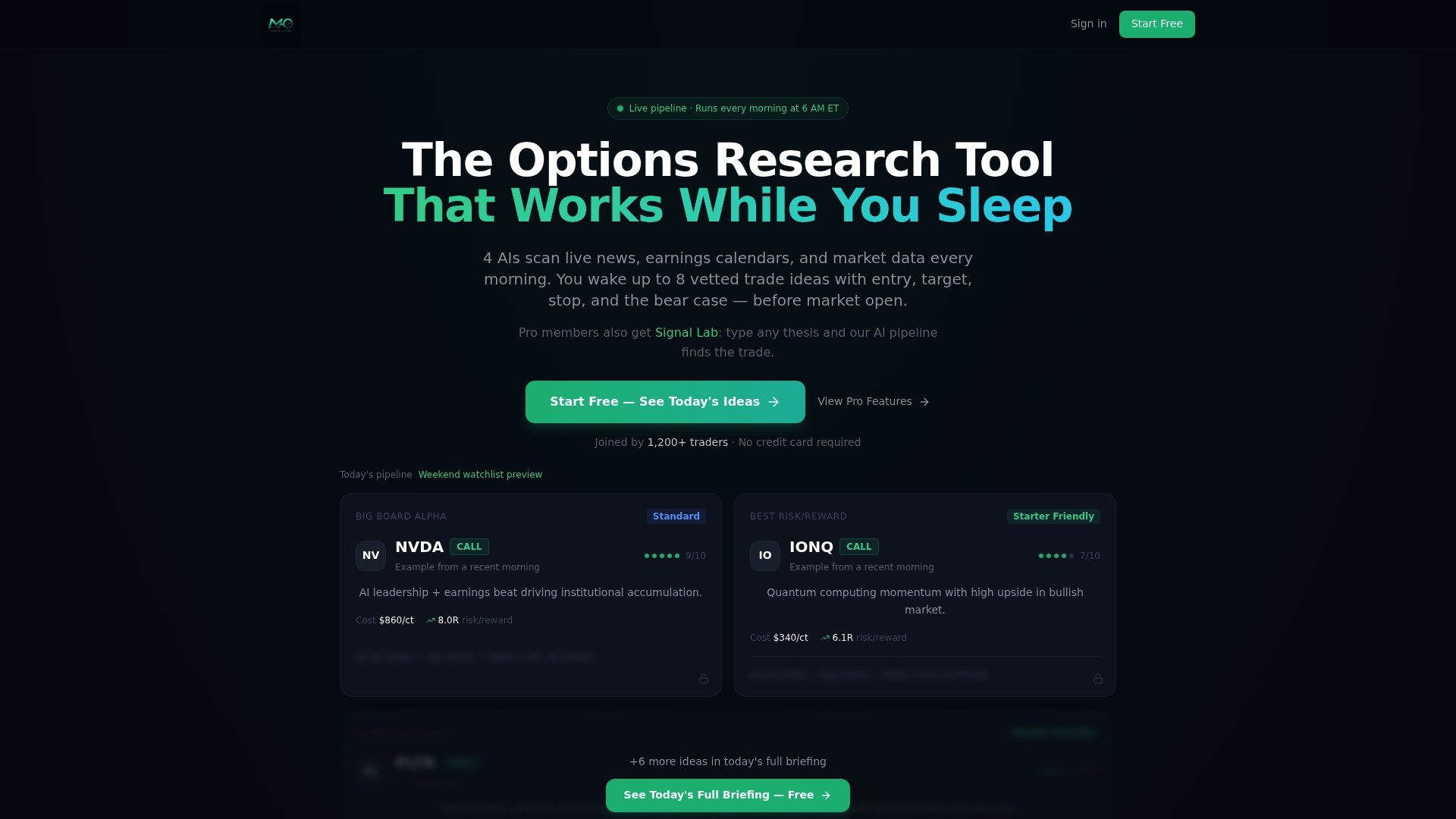
Preparation is where most premarket time goes, and that is the part we shorten. We offer a Free tier and a Pro tier at $89 per month ($742 per year).
- Free: limited daily trade ideas.
- Pro: expanded scans and an AI chat scanner for researching tickers on demand.
- Both: ranked trade ideas.
Start with the Free tier at Morningoptions and build your next premarket plan from it.
This article is general information, not a substitute for advice from a qualified financial advisor. Consult a qualified financial professional about your own circumstances before acting on anything here.
FAQ
Can you trade options in premarket?
Yes, but only for eligible contracts. Index options such as SPX and VIX trade in Global Trading Hours, while most single-stock options wait until 9:30 a.m. ET. Use limit orders because liquidity is thin.
Why do premarket options spreads get so wide?
Fewer participants quote the market, and the underlying may not be updating normally. FINRA's guidance names lower liquidity and wider spreads as core extended-hours risks.
Which premarket options strategies are safest?
Conservative single-leg or defined-risk trades in small size are generally easier to manage than complex multi-leg structures. Legging risk is the main reason, since a missed second fill leaves you exposed.
How long should premarket prep take?
Keep it short and structured. A time-boxed routine with a narrow watchlist and set limit prices avoids decision paralysis at the open.