
The core bullish options strategies are the long call, bull call spread, short put (cash-secured put), bull put spread, covered call, protective put, collar, and advanced multi-leg structures like call backspreads and diagonals. Each fits a different conviction level and market outlook, as the OptionsIndustryCouncil and Wikipedia's options strategy taxonomy both document in detail.
Here is the quick map:
- Strong bullish conviction: Long call, call backspread, risk reversal
- Moderate bullish conviction: Bull call spread, bull put spread, short put / cash-secured put
- Mild bullish or neutral-to-bullish: Covered call, diagonal / Poor Man's Covered Call (PMCC)
- Bullish with downside protection: Protective put, collar
- Volatility-biased bullish: Strap (2 calls + 1 put), broken-wing butterfly
FINRA and the OCC / SIPC are the primary U.S. regulators and investor-protection bodies to consult before trading any of these structures. Morningoptions ranks and scores specific contract ideas across these strategy types every morning before the open.
Key Takeaways
Matching your conviction level and IV rank to the right bullish options structure is the single most important decision before placing any options trade.
| Point | Details |
|---|---|
| Match conviction to structure | Strong bullish favors long calls or backspreads; moderate bullish favors spreads or short puts. |
| Check IV rank first | Buy premium (long calls, debit spreads) when IVR is below 30; sell premium (credit spreads, covered calls) when IVR is above 50. |
| Define max loss before entry | Know your breakeven, max loss, and exit rules before placing any bullish options trade. |
| Mind assignment and dividends | Short options carry early assignment risk near ex-dividend dates; confirm buying power with your broker. |
| Morningoptions daily briefings | Morningoptions ranks and scores specific bullish contract ideas with entry and exit levels every morning before the open. |
Table of Contents
- 1. Long call: the purest bullish directional bet
- 2. Bull call spread: defined cost, defined risk
- 3. Short put / cash-secured put: collect premium or buy stock cheaper
- 4. Bull put spread: defined-risk credit income
- 5. Covered call: generate income on stock you already own
- 6. Protective put and collar: bullish exposure with a safety net
- 7. Advanced multi-leg bullish strategies: butterflies, ladders, backspreads, and more
- 8. How to pick the right bullish options strategy
- 9. Execution, assignment, and risks every options trader must know
- 10. Worked examples and a Morningoptions trade-selection checklist
- 12. Adjustments and exit strategies for bullish positions
- What the data actually tells you about bullish strategy selection
- Morningoptions ranks bullish trade ideas before the market opens
- Sources
1. Long call: the purest bullish directional bet
Buy a call when you have strong bullish conviction, want leveraged exposure to an upside move, and prefer to cap your loss at the premium paid. It is the simplest of all types of bullish options strategies and the right starting point for beginners.
Payoff profile:
- Max profit: Theoretically unlimited (stock can rise indefinitely)
- Max loss: Premium paid
- Breakeven: Strike price + premium paid
Numeric example: Stock XYZ trades at $50. You buy the 55-strike call expiring in 45 days for $2.00 per share ($200 per contract). Breakeven at expiration = $57.00. If XYZ closes at $65, your profit is $65 - $57 = $8.00 per share ($800 per contract). If XYZ closes below $55, you lose the full $200.
Pros:
- Defined, limited loss (the premium)
- Leveraged upside with far less capital than buying shares
- No assignment risk as the buyer
Cons:
- Theta (time decay) works against you every day
- Implied volatility (vega) sensitivity: a drop in IV after entry can hurt the position even if the stock moves in your direction
- Requires a meaningful directional move to profit before expiration
Pro Tip: Buy calls when implied volatility rank (IVR) is below 30. Paying inflated premium in a high-IV environment means IV crush alone can erase gains even when you're right on direction.
2. Bull call spread: defined cost, defined risk
A bull call spread (debit call spread) is the go-to when you're moderately bullish and want to reduce the cost and theta drag of a straight long call. You buy a lower-strike call and sell a higher-strike call in the same expiration, paying a net debit. The OptionsIndustryCouncil treats this as one of the core defined-risk bullish structures for retail traders.
Numeric example: XYZ at $50. Buy the 50-strike call for $3.00, sell the 55-strike call for $1.50. Net debit = $1.50 ($150 per contract).
| Metric | Value |
|---|---|
| Max profit | $1.75 per share ($175) — spread width minus net debit |
| Max loss | $1.50 per share ($150) — net debit paid |
| Breakeven | $46.75 (short strike minus credit) |
| Capital required | $150 per contract (debit paid) |
| Theta sensitivity | Moderate negative (less than a naked long call) |
| Vega sensitivity | Lower than a long call; spread partially offsets IV changes |
When to choose a bull call spread over a long call:
- You want to cut premium cost and reduce IV exposure
- You have a specific price target in mind (the short strike caps your upside, so pick it near your target)
- You're in a moderate-IV environment where the short call sale meaningfully offsets cost
Cons: Upside is capped at the short strike. If the stock rockets past your short strike, you don't participate above it. For defined-risk trade examples that show how to manage these positions, the Morningoptions blog has practical templates.
3. Short put / cash-secured put: collect premium or buy stock cheaper
Use a cash-secured put when you're moderately bullish and genuinely comfortable owning the stock at the strike price. You sell a put, collect premium upfront, and either keep the premium if the stock stays above the strike or get assigned shares at an effective cost basis below the current price.
Numeric example: XYZ at $50. You sell the 47-strike put expiring in 30 days for $1.50 ($150 per contract). To secure the trade, you set aside $4,700 in cash (the full obligation to buy 100 shares at $47).
- Premium collected: $1.50 per share ($150)
- Breakeven at expiration: $47.00 - $1.50 = $45.50 per share
- Max profit: $150 (premium collected, if XYZ stays above $47)
- Max loss: $4,550 (if XYZ goes to zero — $47 strike minus $1.50 premium, times 100)
- Cash required: $4,700 set aside (full cash-secured requirement)
Assignment mechanics: If XYZ closes below $47 at expiration, you are assigned 100 shares at $47. Your effective cost basis is $45.50 after the premium. This is the intended outcome for traders using the strategy to acquire stock at a discount.
Pros:
- High probability of profit in a mild-to-moderate bullish environment
- Premium income with no upside cap (unlike a covered call)
- Effective stock acquisition at a discount if assigned
Cons:
- Full downside exposure if the stock gaps down sharply
- Capital-intensive: the cash set-aside is substantial for high-priced stocks
- Assignment can happen early on American-style options, especially near ex-dividend dates
For traders who want lower-maintenance income tactics, the options strategies for busy professionals guide covers how cash-secured puts fit into a time-efficient approach.
4. Bull put spread: defined-risk credit income
The bull put spread is the limited-risk version of a short put. You sell a higher-strike put and buy a lower-strike put in the same expiration, collecting a net credit. It fits a neutral-to-moderately-bullish view and is the preferred structure when you want income with a hard floor on your loss.
Numeric example: XYZ at $50. Sell the 48-strike put for $2.00, buy the 45-strike put for $0.75. Net credit = $1.25 ($125 per contract).
- Max profit: $1.25 per share ($125) — credit received, if XYZ stays above $48 at expiration
- Max loss: $1.75 per share ($175) — spread width ($3.00) minus credit ($1.25)
- Breakeven: $48.00 - $1.25 = $46.75
Versus a naked short put: The long put at $45 caps your loss at $175 instead of the $4,550 worst case above. You give up some premium for that protection, but margin requirements drop sharply. Brokers typically require only the spread width minus the credit as buying power, not the full cash-secured amount.
Pros:
- Defined max loss — no surprise blowup if the stock gaps down
- Lower capital requirement than a cash-secured put
- Profits from time decay and a stable-to-rising stock
Cons:
- Profit is capped at the credit received
- Still carries assignment risk on the short put leg if the stock moves through it
- Works best in high-IV environments where the credit is worth the trade-off
When IV rank is elevated (above 50), selling premium through a bull put spread tends to be more capital-efficient than buying calls. For a deeper look at how market conditions affect strategy selection, the Morningoptions blog covers IV regimes in detail.
5. Covered call: generate income on stock you already own
The covered call is the right move when you're mildly bullish or neutral on a stock you already own and want to generate income against your position. You sell an out-of-the-money call against 100 shares, collect the premium, and accept that your upside is capped at the short strike.
Numeric example: You own 100 shares of XYZ at $50. You sell the 53-strike call expiring in 30 days for $1.20 ($120 per contract).
- Effective cost basis: $50.00 - $1.20 = $48.80
- Max profit: $3.00 + $1.20 = $4.20 per share ($420) — if assigned at $53
- Breakeven: $48.80 (cost basis minus premium)
- Upside cap: $53 (you sell shares at $53 if assigned, regardless of how high the stock goes)
Assignment and dividend considerations: Early assignment on a covered call is rare but can happen when the call goes deep in-the-money near an ex-dividend date. If the extrinsic value of the call drops below the upcoming dividend, the call buyer may exercise early to capture the dividend. Rolling the call before ex-dividend date is a standard defensive move. A disciplined rolling cadence, such as rolling at around 21 days to expiration, can help manage gamma risk and capture most of the premium.
Pros:
- Immediate income regardless of stock direction
- Reduces effective cost basis over time
- Straightforward to execute; requires only a basic options approval level
Cons:
- Upside is hard-capped at the short strike
- You still hold full downside risk on the stock
- A sharp rally past the short strike means you miss out on gains above it
A covered call is preferable to selling a put when you already own the shares. If you don't own the stock, a cash-secured put achieves a similar income profile with slightly different tax treatment.
6. Protective put and collar: bullish exposure with a safety net
A protective put means buying a put on stock you already own. It acts as insurance: you stay long the stock (bullish exposure) but cap your downside at the put strike. A collar adds a short call on top of that put, using the call premium to offset the put's cost. Both structures suit traders who want to stay bullish but need to limit drawdown.
Protective put example: Own 100 shares of XYZ at $50. Buy the 47-strike put for $1.50. Your downside is now floored at $47 - $1.50 = $45.50 net. Upside remains unlimited.
Collar example: Same position. Buy the 47-strike put for $1.50 and sell the 53-strike call for $1.20. Net cost = $0.30 per share. Downside floor: $46.70. Upside cap: $53.
| Feature | Protective Put | Collar |
|---|---|---|
| Downside protection | Yes — floored at put strike minus premium | Yes — same floor |
| Upside cap | None | Yes — capped at short call strike |
| Net cost | Premium paid for put | Near-zero or small debit (call offsets put cost) |
| Ideal outlook | Bullish, worried about short-term drop | Mildly bullish, want near-zero cost protection |
Tax and dividend notes: Holding a protective put can affect the holding period of your shares for long-term capital gains purposes under U.S. tax rules. Specifically, if the put is "in the money" when purchased, the IRS may suspend the holding period clock on the underlying shares. For tax-efficiency examples relevant to these structures, the options strategies tax efficiency guide is worth reviewing before entering a collar or protective put on a long-term stock position.
7. Advanced multi-leg bullish strategies: butterflies, ladders, backspreads, and more
Once you're past the basics, several higher-complexity structures offer precision, leverage, or volatility plays that standard spreads can't match. These are not beginner trades. Each has a distinct payoff shape and a specific scenario where it outperforms simpler structures.
Call backspread: Sell one call at a lower strike, buy two calls at a higher strike, typically for a small credit or near zero cost. The call backspread profits from an explosive upside move but has two breakevens and is actually hurt by a moderate rally that lands near the short call strike. Use it when you expect a large, fast move, not a slow grind.
Broken-wing butterfly (call): A standard call butterfly with the wings set asymmetrically to collect a small credit. It profits if the stock stays below the short strikes and loses a defined amount if the stock rallies hard. Suited to a mildly bullish or range-bound view in a high-IV environment.
Call ratio spread / ladder: Sell more calls than you buy at higher strikes. Profits from a moderate rally but carries unlimited risk above the short strikes if uncovered. Requires careful position sizing and a clear exit plan.
Diagonal spread / Poor Man's Covered Call (PMCC): Buy a long-dated deep in-the-money call (often a LEAP) and sell a shorter-dated out-of-the-money call against it. As the diagonal spread guide explains, a PMCC behaves like a covered call when the long leg is a LEAP, providing capital-efficient stock replacement with the ability to harvest theta repeatedly by rolling the short call.
Strap (2 calls + 1 put): A volatility play with a bullish bias. Buying two calls and one put profits from a large move in either direction but earns more on an upside breakout. The strap strategy suits traders who expect a catalyst (earnings, FDA decision) and lean bullish on the outcome.
When to avoid advanced multi-leg structures:
- Low-liquidity underlyings with wide bid-ask spreads (slippage kills multi-leg fills)
- Small accounts without the buying power to absorb margin requirements
- Unknown IV regime — entering a complex structure without knowing whether IV is elevated or compressed is guessing, not trading
- Options approval levels below Level 3 or 4 (confirm with your broker before placing)
For a broader look at how volatility regimes affect which structure to use, the options strategies for volatile markets guide covers this in depth.
8. How to pick the right bullish options strategy
Matching conviction to structure is the single most important decision in options trading. Here is the practical checklist before entering any bullish trade:
Pre-trade checklist:
- Conviction strength: Strong (long call, backspread) vs. moderate (spreads, short put) vs. mild (covered call, PMCC)
- IV rank: Low IVR (below 30) favors buying premium; high IVR (above 50) favors selling premium. This practitioner rule is well-documented across bullish strategy decision guides.
- Time horizon: Short-dated (under 21 days) amplifies theta risk on long premium; 30–60 days is the standard sweet spot for most retail trades
- Buying power: Confirm margin and cash requirements with your broker before placing
- Liquidity: Check open interest and bid-ask spread on each leg; avoid illiquid strikes
- Dividend dates: Know the ex-dividend date if you're short calls on dividend-paying stocks
- Exit plan: Define your profit target (often 50% of max profit for credit spreads) and your stop-loss before entry
| Conviction Level | IV Rank | Recommended Strategies |
|---|---|---|
| Strong bullish | Low (below 30) | Long call, call backspread |
| Moderate bullish | Low to moderate | Bull call spread |
| Moderate bullish | High (above 50) | Bull put spread, short put |
| Mild bullish / income | Any | Covered call, PMCC, diagonal |
| Bullish + protection | Any | Protective put, collar |
For a step-by-step decision framework, the simple options strategy selection guide walks through each criterion with examples. If you're still deciding between buying and selling options as a starting point, the buying vs. selling options primer is a useful foundation.
9. Execution, assignment, and risks every options trader must know
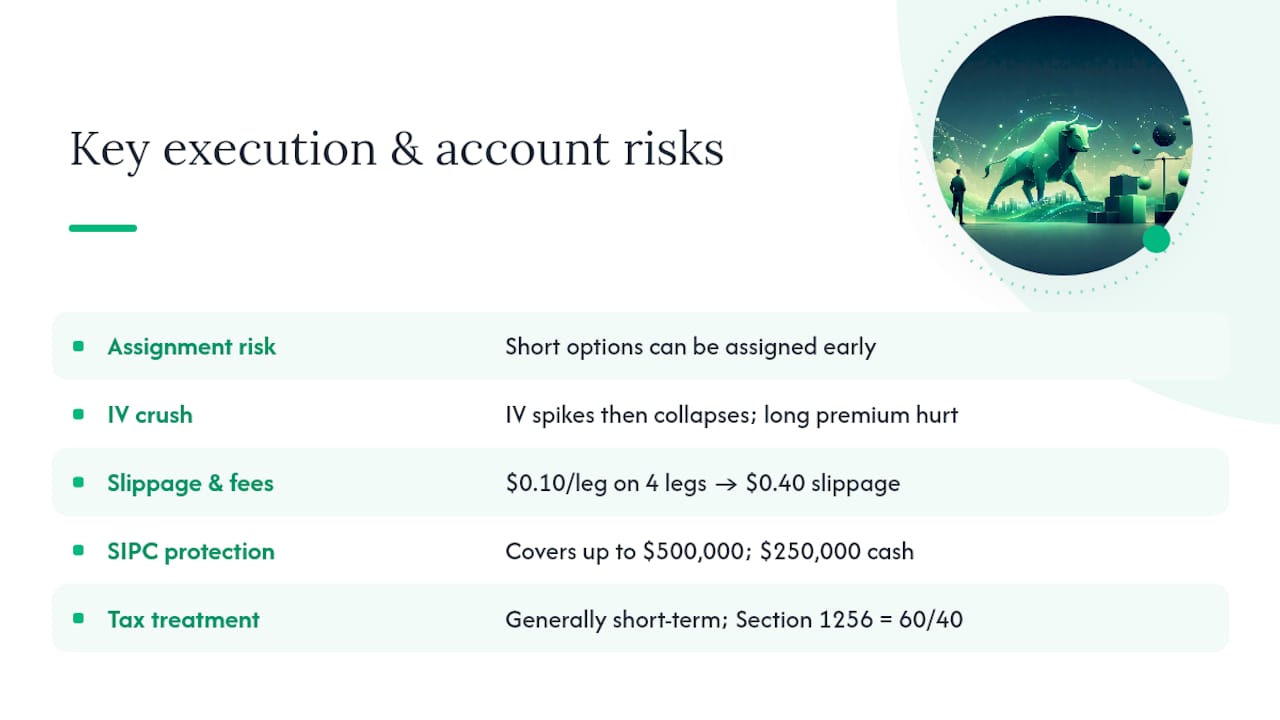
The strategies above can all turn into losses through execution errors, not just wrong directional calls. The three biggest culprits are assignment, IV crush, and slippage on multi-leg fills.
Assignment risk: Any short option can be assigned early on American-style contracts. The most common scenario: you're short a put on a stock that drops sharply, and the put buyer exercises early. Confirm your broker's buying power requirements and approval levels before placing short-leg trades. FINRA's investor guidance covers the disclosure requirements and account approval levels brokers must follow. SIPC protects eligible brokerage account assets up to $500,000 (including $250,000 for cash claims) in the event of broker failure, though it does not protect against market losses.
IV crush: Implied volatility often spikes before earnings or major events, then collapses immediately after. A long call bought into an earnings announcement can lose value even if the stock moves in your favor, because the IV drop deflates the option's extrinsic value faster than the delta gain adds it. Short premium structures (bull put spreads, covered calls) benefit from IV crush; long premium structures (long calls, backspreads) are hurt by it.
Slippage and commissions on multi-leg trades: A four-leg structure with a $0.10 wide bid-ask spread on each leg costs $0.40 in slippage alone before commissions. On a $1.50 credit spread, that is a meaningful drag. Always use limit orders on spreads; never use market orders on multi-leg fills.
Tax treatment: U.S. options are generally taxed as short-term capital gains unless held over a year. Section 1256 contracts (broad-based index options like SPX) receive 60/40 treatment (60% long-term, 40% short-term) regardless of holding period. Wash-sale rules can apply to equity options. Consult a tax professional for your specific situation; this article is general education, not individualized tax advice.
10. Worked examples and a Morningoptions trade-selection checklist
Hypothetical worked example (for illustration only — not a trade recommendation):
Scenario: XYZ stock trades at $52. Morningoptions' AI scanner flags a moderate bullish signal with IVR at 35 and 38 days to expiration. The suggested structure is a bull call spread.
- Buy the 52-strike call for $2.80
- Sell the 57-strike call for $1.10
- Net debit: $1.70 per share ($170 per contract)
- Breakeven: $53.70
- Max profit: $3.30 per share ($330) if XYZ closes at or above $57 at expiration
- Max loss: $1.70 per share ($170) — the debit paid
- Exit rule: Close the spread at 50% of max profit ($165 gain) or if the debit doubles ($340 loss)
This is a hypothetical illustration of the methodology, not a live trade result.
Morningoptions 5-item trade-selection checklist:
- Signal confirmation: Does the AI scanner score the trade above the threshold on both technical and options-flow criteria?
- IV rank check: Is IVR below 40 for a debit trade, or above 40 for a credit trade?
- Liquidity gate: Does each leg have open interest above 500 and a bid-ask spread under $0.15?
- Risk sizing: Is the max loss on this trade under 2% of total account value?
- Exit plan defined: Are the profit target and stop-loss set before order entry?
Pro Tip: Size every bullish options trade so the max loss is a number you can absorb without changing your behavior on the next trade. Morningoptions includes risk-sizing guidance with each daily briefing so you're not doing that math from scratch every morning.
12. Adjustments and exit strategies for bullish positions
No bullish trade runs perfectly from entry to expiration. Knowing when and how to adjust is what separates traders who survive a bad streak from those who don't.
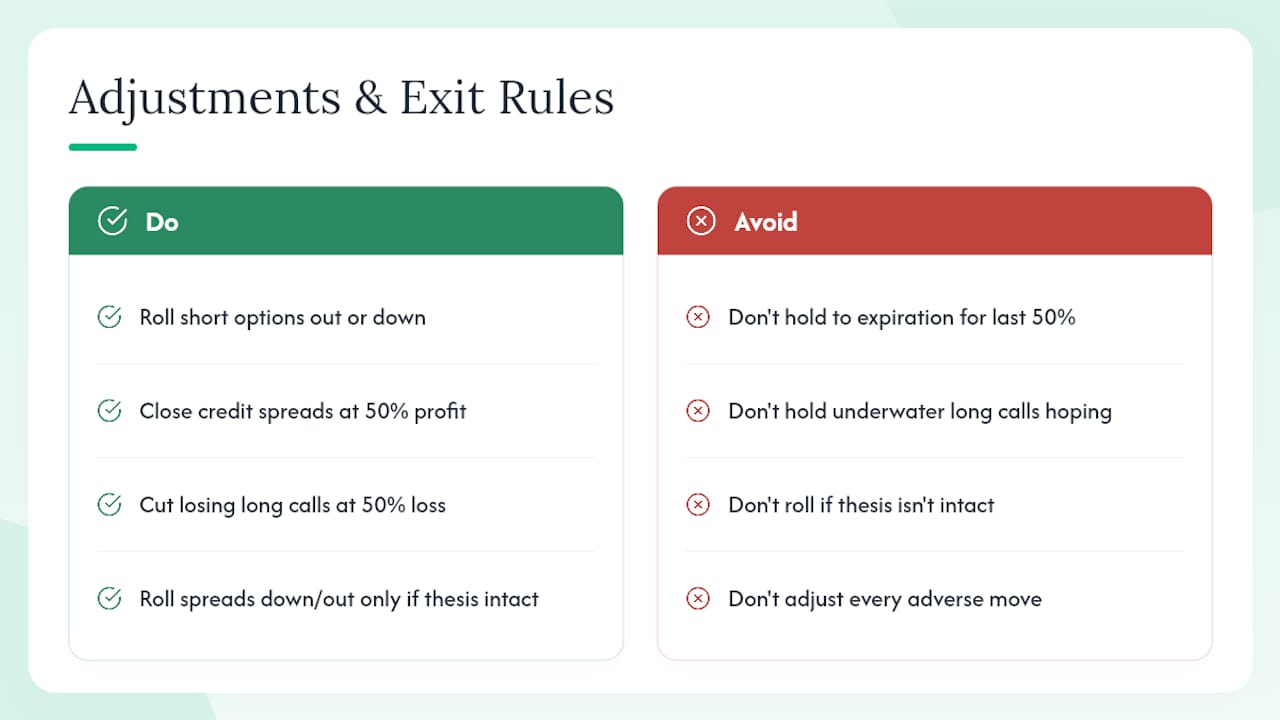
Rolling a short option: If you're short a put or a covered call and the stock moves against you, rolling means buying back the current short option and selling a new one at a different strike or expiration. Rolling out in time (same strike, later expiration) collects additional premium and gives the trade more room. Rolling down (lower strike, same or later expiration) reduces the breakeven but also reduces the credit.
Closing early for a profit: For credit spreads (bull put spread, covered call), the standard exit target is 50% of max profit. Holding to expiration for the last 50% of profit exposes you to gamma risk: the position becomes more sensitive to small moves in the final days. Close early and redeploy the capital.
Cutting a losing long call: A long call that has lost 50% of its value is telling you the thesis was wrong or the timing was off. Holding a deeply underwater long call hoping for a recovery is one of the most common and costly retail mistakes. Set a hard stop at 50% of premium paid and honor it.
Adjusting a bull call spread gone wrong: If the stock drops below your long strike, the spread is near max loss. One option: close the spread and accept the loss. Another: roll the entire spread down and out to a lower strike range and a later expiration, collecting a small additional credit to reduce the net debit. Only roll if your thesis on the stock is still intact.
When to take no action: Not every adverse move requires an adjustment. A short-term pullback in a strong uptrend may not threaten the trade's structure. Check whether the stock is still above key support and whether your breakeven is still reachable before making any change.
What the data actually tells you about bullish strategy selection
Most traders spend too much time picking the "best" bullish strategy and not enough time confirming the one thing that matters most: whether they're buying or selling premium at the right IV level. A long call in a 90th-percentile IV environment is a structurally disadvantaged trade before the stock moves a single point. A bull put spread in that same environment collects premium that is genuinely inflated relative to realized volatility.
The conviction-to-structure match matters, but the IV regime check is what most beginner traders skip. Strong directional conviction does not override a bad entry price on premium. A moderate bullish view with a well-priced credit spread will outperform a strong bullish view expressed through an overpriced long call more often than most traders expect.
The other underrated factor is position sizing. The strategies covered here range from $150 max loss (a tight bull call spread) to thousands of dollars of exposure (a cash-secured put on a $200 stock). Matching the structure to your account size is not a secondary consideration. It is the primary one.
Morningoptions ranks bullish trade ideas before the market opens
Every morning before the open, Morningoptions runs a five-stage AI pipeline that vets, scores, and ranks specific bullish (and bearish) options contract ideas with entry levels, breakevens, and exit guidance. You get ranked trade ideas with the structure already selected, not a list of stocks to research yourself.

The free plan delivers daily briefings with a sample of ranked ideas. The Pro tier ($89/month) unlocks the full briefing, the lunchtime scanner, and Signal Lab, an AI chat interface where you can research any ticker on demand and get a scored trade idea in seconds. Every briefing includes the strategy type, the specific contract, the entry level, the max loss, and the bear case, so you know exactly what you're risking before you place the order.
This is general educational content, not individualized investment advice. Options trading involves substantial risk of loss.
Start with a free daily briefing and see how the AI scanner ranks bullish setups across the strategies covered in this guide.
Sources
- Bullish Outlook — OptionsIndustryCouncil
- Options strategy — Wikipedia
- FINRA
- Call Backspread: Explosive Upside Strategy 2026 — The Option Stack
This article is general information, not a substitute for advice from a qualified financial advisor. Consult a qualified financial professional about your own circumstances before acting on anything here.