
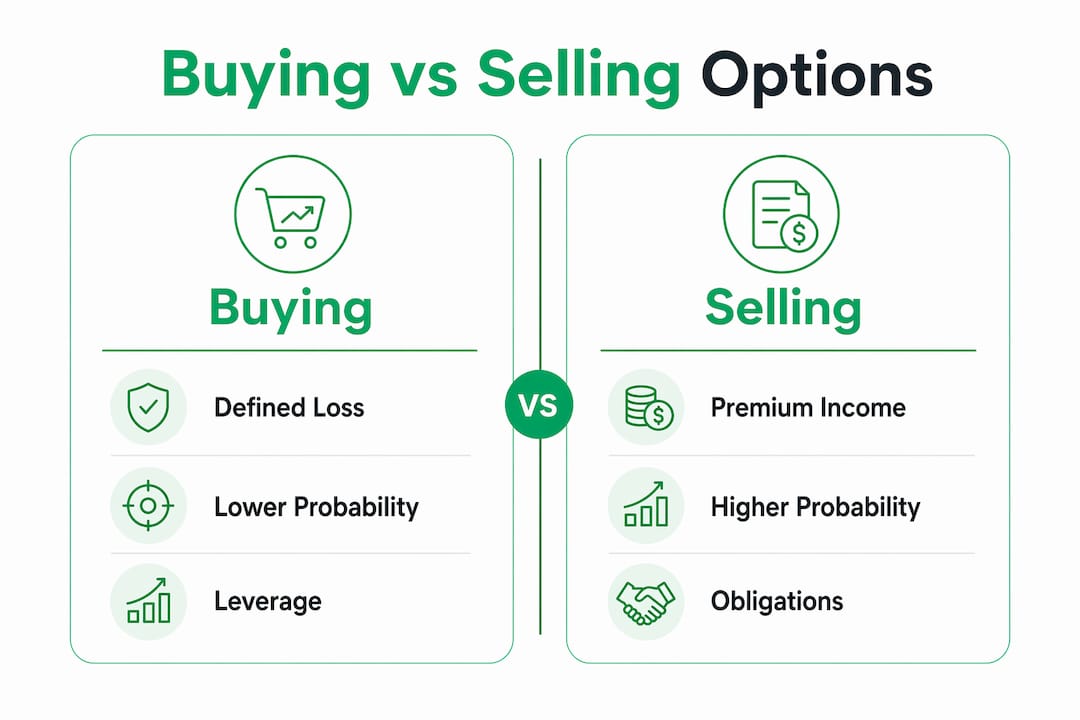
For most new traders seeking steady income, selling options is the higher-probability approach. Buying options makes more sense when you expect a large directional move and can stomach frequent small losses. That's the core of choosing between buying and selling options, and everything else is detail.
Sellers typically collect premium and profit from time decay, achieving probability of profit (POP) in the 70–85% range when selling at 20–30 delta. Buyers flip that math: lower POP (roughly 25–40%) but the potential for outsized gains when the trade works. IV Rank is the single fastest filter. When IV Rank is above 50, premium is rich and selling has an edge. Below 30, options are cheap and buying makes more sense. Morningoptions surfaces IV context and ranked contract ideas every morning so you can apply this filter in under a minute.
| Dimension | Buying Options | Selling Options |
|---|---|---|
| Risk (max loss) | Premium paid (defined) | Potentially large or unlimited (naked) |
| Reward | Unlimited (calls) / large (puts) | Capped at premium collected |
| Probability of profit | lower for buyers | higher for sellers |
| Capital required | Low (premium only) | Higher (margin or cash collateral) |
| Time sensitivity | Theta hurts you | Theta helps you |
| Complexity / monitoring | Lower | Higher |
| Best suited for | Directional thesis, low IV | Income, high IV, range-bound markets |
Quick guidance:
- Buy when you have a strong directional thesis and IV Rank is below 30.
- Sell when you want steady income, IV Rank is above 50, and you have defined-risk controls.
- Red flag: don't sell naked options on a small account without defined risk spreads in place.
Table of Contents
- How buying options actually works: mechanics and payoff math
- How selling options works: premium, obligations, and assignment
- Which approach is actually riskier? A side-by-side comparison
- How delta, theta, vega, and gamma affect buyers and sellers
- Capital, margin, and costs: what each approach actually requires
- Concrete strategy examples: when to buy and when to sell
- A practical checklist for choosing between buying and selling on any trade
- Practitioner rules that remove guesswork from the decision
- Key Takeaways
- How experienced traders actually mix buying and selling
- Morningoptions cuts the decision time down to minutes
- Useful sources and further reading
How buying options actually works: mechanics and payoff math
Buying a call or put gives you a defined maximum loss. The most you can lose is the premium you paid, full stop. In exchange, calls offer theoretically unlimited upside and puts offer gains down to zero on the underlying. The catch is that you need to be right about direction and timing, which is harder than it sounds.

One contract controls 100 shares. If you pay $3.00 for a call option, your total outlay is $300. The breakeven at expiration is the strike price plus the premium paid. Buy a $150 call for $3.00 and you need the stock above $153 to profit at expiry. Below that, you lose some or all of your $300.
A simple example: stock at $150, you buy the $155 call expiring in 45 days for $2.00 ($200 total).
| Stock price at expiry | Option value | P/L |
|---|---|---|
| — | $0 | -$200 |
| $155 | $0 | -$200 |
| — | $2.00 | $0 (breakeven) |
| — | — | +$800 |
Buyers tend to lose money when they buy high-IV options or choose expirations too short for their thesis to play out. Matching DTE to your expected move matters as much as picking the right direction. A 7-day expiry on a thesis that needs three weeks to develop is a near-certain loss.
Strike selection by delta is the practical shortcut. A 0.40–0.50 delta call is near the money and costs more but has a higher POP. A 0.20 delta call is cheaper but wins far less often. Most beginners start around 0.30–0.40 delta for directional trades.
Pro Tip: Treat long options as leverage, not lottery tickets. Size them at 1–3% of your account per trade. The most common beginner mistake is buying five contracts when one would do, then watching the entire position evaporate on a slow week.
How selling options works: premium, obligations, and assignment
Sellers collect premium upfront and profit when time passes without the underlying reaching the strike. That's the appeal. The obligation is the risk: if the option is assigned, you must buy or sell the underlying at the strike price regardless of where the market is.
Selling comes in several forms, each with a different risk profile:
- Naked calls/puts: Maximum premium, maximum risk. Naked calls have theoretically unlimited loss. Naked puts lose down to zero on the underlying. Requires significant margin and is not suitable for most beginners.
- Cash-secured puts: You sell a put and hold enough cash to buy 100 shares if assigned. Risk is real but defined by the stock going to zero. A practical way to get paid while waiting to buy a stock you want anyway.
- Covered calls: You own 100 shares and sell a call against them. Premium collected, but upside is capped at the strike. Low risk, low reward.
- Credit spreads: Sell one option, buy another further out of the money. The long leg caps your maximum loss. This is how most retail traders access selling with defined risk on smaller accounts.
- Iron condors: Combine a call credit spread and a put credit spread. Profit when the underlying stays in a range. Works well in low-volatility, sideways markets.
Margin for naked positions can be substantial. Most brokers require 20% of the underlying's value or more for naked puts. Defined-risk spreads require only the difference between strikes minus premium received. For a $5-wide spread where you collect $1.50, your max loss is $350 and your margin requirement matches that.
Sellers generally prefer 30–45 DTE expirations, closing at 21 DTE or when 35–50% of the premium has been captured. Monitoring daily is not required for most spread positions, but weekly check-ins are the minimum.

Pro Tip: The "wheel" strategy turns assignment into a feature. Sell a cash-secured put on a stock you'd genuinely want to own. If assigned, you buy at your chosen strike (effectively at a discount after the premium). Then sell covered calls against those shares. Repeat. It's not glamorous, but it generates consistent income on stocks you believe in.
Which approach is actually riskier? A side-by-side comparison
The honest answer: it depends on how you define risk. Buyers face a near-certain loss most of the time (low POP) but the loss is always capped at the premium. Sellers win more often but carry the possibility of losses that dwarf the premium collected, especially without defined-risk structures.
Sellers win more trades than they lose, but the losses are larger. A seller running 70–85% win rates at 20–30 delta still needs disciplined loss management to survive the 15–30% of trades that go wrong.
| Dimension | Buying (long options) | Selling (short options) |
|---|---|---|
| Max loss | Premium paid | Unlimited (naked) / spread width (defined) |
| Max gain | Unlimited (calls) / large (puts) | Premium collected |
| POP | 25–40% | 70–85% |
| Capital / margin | Premium only | Margin or cash collateral |
| Theta exposure | Negative (hurts you) | Positive (helps you) |
| Monitoring burden | Lower | Higher (especially naked) |
| Best trader profile | Directional, patient, small account | Income-focused, disciplined, larger account |
Position sizing and diversification across 3–5 underlyings with staggered expirations are the most cited controls for sustaining a selling strategy. Keeping no more than 50% of capital deployed in options at any one time is a widely recommended guardrail.
Psychological failure modes by side:
- Buyers: holding losers too long hoping for a reversal; oversizing because the premium looks cheap.
- Sellers: adding to losing positions to "average down" the credit; ignoring assignment risk on naked positions.
How delta, theta, vega, and gamma affect buyers and sellers
Theta hurts buyers and helps sellers. That single sentence explains why sellers have a structural edge in quiet markets and why buyers need a catalyst to overcome it.
Each Greek tells a different part of the story:
- Delta: Measures how much the option price moves per $1 move in the underlying. Buyers want high delta for maximum directional exposure. Sellers target low delta (0.20–0.30) to stay far enough OTM that the underlying rarely reaches the strike.
- Theta: Time decay. Buyers lose value every day the underlying doesn't move. Sellers collect that decay. An at-the-money option loses roughly one-third of its remaining time value in the final week before expiry.
- Vega: Sensitivity to implied volatility changes. Buyers benefit when IV rises after they enter (their option becomes more valuable). Sellers get hurt by rising IV. This is why buying is best in low-IV environments and selling favors elevated IV.
- Gamma: How fast delta changes as the underlying moves. Gamma is highest near the money and near expiration. Sellers face the most gamma risk inside 21 DTE, which is why most systematic sellers close or roll positions before that window.
Implied volatility tends to overestimate realized volatility. That structural "IV premium" is a consistent edge sellers capture when entering in elevated IV environments. Selling into earnings is a notable exception: IV expansion before the announcement and the subsequent crush can produce unpredictable results, and most systematic sellers skip expirations that cross scheduled earnings dates.
Practical rules:
- IV Rank below 30: options are cheap, favor buying.
- IV Rank above 50: options are expensive, favor selling.
- Inside 21 DTE: gamma risk spikes for sellers; close or roll rather than hold.
Capital, margin, and costs: what each approach actually requires
Buyers need only the premium. A $2.00 option on 100 shares costs $200 in cash, no margin required. That accessibility is one reason buying is the default starting point for most beginners.
Sellers need more. A naked put on a $50 stock might require $1,000 or more in margin depending on broker rules. A cash-secured put requires the full purchase price in cash ($5,000 for a $50 strike). Credit spreads dramatically reduce this: a $5-wide spread requires only the max loss as margin, often $200–$500 per contract.
Cost factors to account for:
- Commissions: Most major U.S. brokers charge $0.50–$0.65 per contract. On a $1.50 credit spread, that's a meaningful percentage of the premium collected.
- Margin interest: Applies only if you're borrowing capital. Defined-risk spreads and cash-secured positions avoid this.
- Capital efficiency: A $250 premium on $400 margin produces a 62.5% annualized ROI on margin, while $500 on $2,000 margin produces only 25%. Raw premium size is a misleading metric.
- Implied vs. realized volatility: Selling when IV is elevated captures the overpricing premium; selling in low IV means collecting less while taking on the same obligation.
Sizing rules matter as much as strategy selection. Risking 1–3% of account per trade keeps any single loss survivable. The "5% Risk Unit" approach allocates no more than 5% of total capital to any single position's maximum risk. For options strategies for busy professionals, defined-risk spreads with low monitoring requirements are the practical default.
Concrete strategy examples: when to buy and when to sell
The one-line rule: buy when you expect a large directional move or IV is low; sell when you expect range-bound action or IV is elevated.
Buyer strategies:
- Long calls: Best for a bullish thesis with a specific catalyst (earnings beat, product launch, breakout). Choose 30–60 DTE, 0.30–0.50 delta. Gives time for the move to develop without paying for excessive time value.
- Long puts: Bearish directional play or portfolio hedge. Same DTE logic applies. Useful when you expect a sharp drop rather than a slow grind.
- Debit spreads (bull call / bear put): Buy one option, sell another further OTM to reduce cost. Lower max gain but also lower breakeven. Good for moderate directional moves when IV is not extremely low.
Seller strategies:
- Covered calls: Own 100 shares, sell a call 1–2 strikes OTM. Generates income on existing holdings. Best in flat to mildly bullish markets. Account size: any, as long as you own the shares.
- Cash-secured puts: Sell a put at a strike where you'd be comfortable owning the stock. Best in neutral to mildly bullish markets with elevated IV. Requires cash equal to 100x the strike price.
- Credit spreads: Sell OTM call or put, buy further OTM for protection. Defined risk, lower margin. POP typically 65–75% at 20–30 delta. Suitable for accounts of any size.
- Iron condors: Combine call and put credit spreads. Profit from range-bound movement. Best when IV Rank is high and you expect the underlying to stay between two levels. Works well on indexes like SPX or SPY.
Pro Tip: Pair a small long position with your selling strategy to manage tail risk. A collar (own shares + sell call + buy put) caps both upside and downside. On a credit spread, buying a further OTM option as a "disaster hedge" costs little and prevents catastrophic loss on a gap move.
A practical checklist for choosing between buying and selling on any trade
The right side of the trade comes down to eight questions. Work through them before entering any position.
Decision checklist:
- Objective: Are you seeking income (sell) or targeting a specific directional move (buy)?
- IV Rank: Is IV Rank above 50 (favor selling) or below 30 (favor buying)?
- DTE alignment: Does your expected move timeline match the expiration? Buyers need enough time; sellers want 30–45 DTE.
- Delta target: Are you selecting strikes at 0.20–0.30 delta for selling, or 0.30–0.50 for buying?
- Capital available: Can you cover margin or cash collateral for selling, or are you limited to premium-only buying?
- Assignment tolerance: Are you comfortable owning the underlying if assigned on a short put?
- Monitoring capacity: Can you check positions weekly (selling) or do you need a set-and-forget structure?
- Tax/timing: Are you near year-end where wash-sale rules or short-term gains matter? See options tax efficiency for U.S.-specific guidance.
Red flags:
- Avoid selling naked options if your account is under $10,000 or if the capital at risk represents emergency funds.
- Avoid buying options with very high IV (IV Rank above 70) unless you have a specific volatility-expansion thesis.
- Avoid buying with less than 14 DTE unless you're trading a same-day catalyst.
Pro Tip: A simple decision rule: if IV Rank is above 50 and you have defined-risk controls or sufficient margin, lean toward selling. If IV Rank is below 30 and you have a clear directional thesis, lean toward buying. When IV Rank sits between 30 and 50, debit spreads often offer the best balance of cost and probability.
Practitioner rules that remove guesswork from the decision
Experienced traders don't decide trade-by-trade from scratch. They run rules-based systems with preset parameters. Here's what those systems look like in practice.
Core rules for sellers:
- 45 DTE sweet spot: The 45 DTE window balances theta decay acceleration with manageable gamma risk. Theta decay is not linear; it accelerates as expiry approaches, and the 45–21 DTE window captures the most efficient portion of that curve.
- Delta 0.20–0.30: Selling at this delta range puts the strike far enough OTM that the underlying rarely reaches it, supporting the 70–85% win rates achievable with disciplined position sizing.
- Profit-taking at 35–50%: Close the position when you've captured 35–50% of the maximum credit. Holding to expiry for the last few dollars of premium introduces disproportionate gamma risk.
- Stop-loss at 2x premium: If the position moves against you and the loss reaches twice the premium collected, close it. This rule prevents a single trade from wiping out several wins.
- 5% Risk Unit: No single position's maximum loss should exceed 5% of total account capital.
Core rules for buyers:
- Match DTE to the expected move timeline. If you think a stock will break out in two weeks, buy at least 30 DTE to give the thesis room.
- Size at 1–3% of account per trade. Long options can go to zero; position size is the only real protection.
- Set a profit target (often 50–100% gain on the premium paid) and a stop (often 50% loss). Holding winners too long and losers too long are equally destructive.
Pro Tip: Stop evaluating selling opportunities by raw premium. A $250 credit on $400 of margin (62.5% annualized ROI) beats a $500 credit on $2,000 of margin (25% ROI) every time you compound it. Capital efficiency is the metric that actually builds accounts. Systematic risk management frameworks make this math automatic.
Morningoptions signals plug directly into this process: each morning briefing includes delta, DTE, and IV context for ranked trade ideas, so you're not calculating these parameters from scratch on every ticker.
Key Takeaways
Sellers win more often but face larger losses when wrong; buyers win less often but can never lose more than the premium paid.
| Point | Details |
|---|---|
| POP trade-off | Sellers achieve 70–85% POP at 20–30 delta; buyers typically see 25–40% POP. |
| IV Rank filter | Favor selling when IV Rank is above 50; favor buying when IV Rank is below 30. |
| DTE and delta rules | Sellers target 30–45 DTE and close at 21 DTE or 35–50% profit; buyers match DTE to their expected move timeline. |
| Capital discipline | Risk 1–3% of account per trade; sellers should keep no more than 50% of capital deployed in options at any time. |
| Morningoptions | Delivers daily ranked trade ideas with delta, DTE, and IV context so you can apply these rules before the market opens. |
How experienced traders actually mix buying and selling
Pros don't pick a side and stay there. They run two sleeves: a selling sleeve for steady income and a smaller buying sleeve for targeted asymmetric bets. The selling side generates consistent cash flow; the buying side is where they take concentrated directional positions when they have high conviction.
A typical structure might look like this: 70–80% of options capital in defined-risk selling positions (credit spreads, iron condors, cash-secured puts) across 3–5 underlyings with staggered expirations. The remaining 20–30% goes into long calls or puts on specific setups where IV is low and a catalyst is imminent. The income from the selling sleeve effectively subsidizes the cost of the buying sleeve over time.
Assignment is treated as an opportunity, not a failure. A short put that gets assigned means you bought stock at your chosen strike, net of premium. If you wanted to own the stock anyway, that's a planned entry at a discount. The covered call then begins immediately.
Behavioral controls matter as much as strategy rules. Tracking options trades systematically reveals patterns that feel invisible in the moment: which setups you overtrade, which market conditions cause you to abandon rules, and whether your actual win rate matches your expected POP. Most traders who blow up accounts don't fail because their strategy was wrong. They fail because they stopped following it.
The practical implication: automate what you can. Use standing rules for profit-taking and stops. Review your trade log weekly. And use pre-market signals to filter ideas rather than scanning the full options chain yourself every morning.
Morningoptions cuts the decision time down to minutes
Every morning before the open, Morningoptions runs a five-model AI pipeline that vets, scores, and ranks specific contract ideas with entry levels, delta, DTE, and IV context already calculated.

Instead of spending an hour scanning tickers and checking IV Rank manually, you get a ranked briefing with the buy-vs-sell decision largely pre-filtered. Each idea includes the specific contract, entry level, bear case analysis, and the strategy rationale. The free plan delivers a daily briefing with limited trade ideas. The Pro tier ($89/mo) unlocks the full briefing, the midday Signal Lab scanner, and an AI chat interface for researching any ticker on demand.
If you're working through the checklist in this article and want the IV Rank, delta, and DTE already surfaced for you, start with the free daily briefing at Morningoptions and see how fast the decision becomes.
Useful sources and further reading
- Systematic Selling Options Strategy: 45 DTE Income | Days to Expiry: The clearest explanation of the 45 DTE rationale, theta decay curves, and profit-taking rules for systematic sellers.
- Options Selling Strategy for Monthly Income | TradeAlgo: Covers win-rate ranges at different delta levels and position sizing rules for sustaining a selling approach.
- Selling vs Buying Options: Which Strategy Delivers Better Returns? | Barchart: Balanced comparison of buyer and seller environments, with IV-based guidance on when each approach has an edge.
- The Option Seller's Playbook | YK Research: Deep dive on capital efficiency metrics and why annualized ROI on margin is the right way to evaluate selling opportunities.
- Options Selling Complete Guide | ProfitVision LAB: Practical execution rules including stop-loss guidelines, the 5% Risk Unit framework, and earnings avoidance strategy.
- Buying vs. Selling Options: Which Is Riskier? | Investopedia: Foundational overview of risk profiles, margin requirements, and strategy suitability for beginners.
- All Strategies | Options Industry Council: Reference library of every major options strategy with payoff diagrams and use-case descriptions.
- Simple Options Strategy Selection Guide | Morningoptions Blog: Framework for matching your market outlook and account size to the right strategy type.
- Types of Market Conditions for Options | Morningoptions Blog: Explains which strategies fit bull, bear, and sideways markets with practical examples.
This article is general educational information, not personalized financial advice. Confirm current rules and suitability with a qualified financial professional before trading.