
Financial literacy for investing is the practical set of skills covering budgeting, credit, saving, debt management, and investing that lets you make smarter decisions about accounts, asset allocation, and costs to reach defined financial goals. According to Fidelity, higher financial literacy directly correlates with better retirement preparedness. Resources like Investor and FINRA exist precisely because most people never receive formal investing education, and that gap costs them real money over time.
Key Takeaways
Financial literacy for investing means mastering budgeting, saving, and debt management before deploying capital, then using tax-advantaged accounts and low-cost diversified funds to build wealth over time.
| Point | Details |
|---|---|
| Build the foundation first | Fund a three-to-six month emergency fund and eliminate high-interest debt before investing. |
| Use tax-advantaged accounts | Prioritize 401(k) employer match, then Roth or Traditional IRA, before taxable brokerage accounts. |
| Keep fees low | Even a 1% annual fee can reduce a $10,000 portfolio's 30-year value by roughly $12,000 versus a 0.03% index fund. |
| Manage behavioral biases | Write down your investment thesis before buying; use a 48-hour rule before selling during downturns. |
| Morningoptions for options traders | Active options traders can use Morningoptions's daily AI briefings and Signal Lab for ranked, vetted trade ideas with defined entry levels. |
Table of Contents
- The five core pillars of financial literacy and where investing fits
- Basic investing principles every financially literate investor should know
- How saving differs from investing, and why speculation is a separate category
- How to start investing in the U.S.: a practical checklist
- Common behavioral biases that hurt investors and habits that help
- How to recognize investment scams and protect yourself
- Authoritative resources to keep building your investing education
- Why options trading demands a higher level of financial literacy
- The learning curve is real, and that is fine
- Morningoptions: daily trade intelligence for active options traders
- Sources
The five core pillars of financial literacy and where investing fits
Capital One identifies five pillars that form the foundation of personal financial stability: budgeting, credit, saving, debt management, and investing. Each one feeds the next.
- Budgeting tells you how much money is actually available after expenses. Without a working budget, you cannot know what you can invest.
- Credit determines your borrowing costs. A strong credit score lowers interest rates on mortgages and car loans, freeing more cash for investments.
- Saving builds the short-term cushion that protects long-term investments. You should not touch invested money to cover a car repair.
- Debt management means eliminating high-interest debt before investing aggressively. Paying off a 20% APR credit card is a guaranteed 20% return.
- Investing is where long-term wealth actually builds, but it is the last pillar to activate, not the first.
The sequencing matters. Most financial educators recommend a three-to-six month emergency fund before committing meaningful capital to the market.
Pro Tip: Build your emergency fund in a high-yield savings account (HYSA) before opening a brokerage account. The FDIC insures deposits up to $250,000, and a HYSA currently pays meaningfully more than a standard checking account while keeping funds liquid.
Basic investing principles every financially literate investor should know
Understanding a few core concepts separates disciplined investors from people who get lucky once and then lose it.
Risk tolerance and time horizon determine everything about asset allocation. A 28-year-old saving for retirement has 35+ years for a portfolio to recover from downturns, so a higher allocation to equities makes sense. A 58-year-old approaching retirement cannot afford a 40% drawdown with no time to recover.

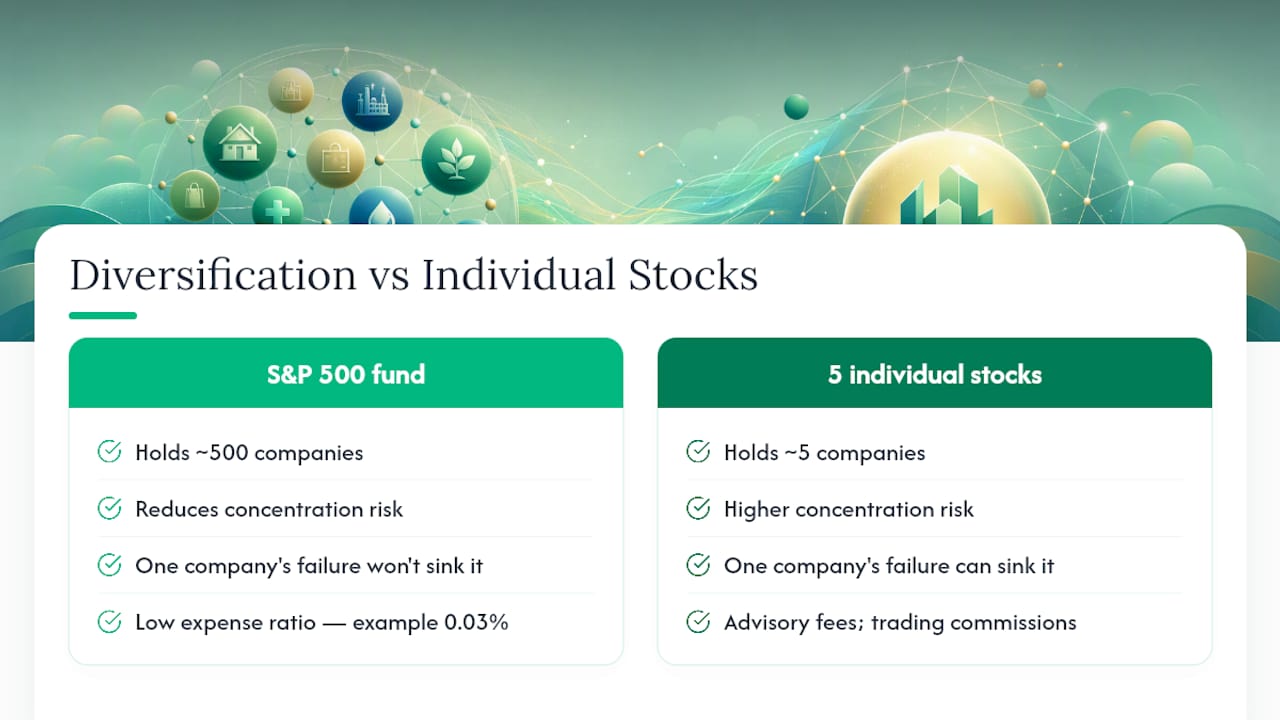
Diversification reduces concentration risk. Owning 500 companies through a single S&P 500 index fund is safer than owning five individual stocks, because one company's failure does not sink the portfolio. FINRA advises learning the mechanics and fee structures of every asset before committing capital.
Fees compound against you just as returns compound for you. This is where most beginners underestimate the damage.
Note: These are illustrative figures based on standard compound-growth math, not guaranteed outcomes.
Fee impact: A 1% annual fee on a $10,000 investment over 30 years at 7% gross return can reduce your ending balance by roughly $12,000 compared to a 0.03% index fund. That is money that never compounds.
Watch for three fee types: expense ratios (the annual cost of owning a fund, expressed as a percentage of assets), advisory fees (charged by human or robo-advisors), and trading commissions (now zero at most major brokerages, but still present in some products).
How saving differs from investing, and why speculation is a separate category
These three activities are often confused, and mixing them up leads to real financial damage.
- Saving is for money you need within one to three years. It belongs in FDIC-insured accounts: savings accounts, money market accounts, or short-term CDs. The goal is capital preservation, not growth.
- Investing is for money you will not need for at least three to five years. SEC guidance stresses aligning investment choices with specific goals, time horizons, and liquidity needs to avoid forced selling during downturns.
- Speculation involves taking on outsized risk for the chance of outsized gain, often with little supporting evidence or a very short time horizon. Day-trading a single stock on a tip is speculation. Buying a diversified index fund and holding it for 20 years is investing.
The practical rule: your emergency fund stays in savings. Money for a house down payment in two years stays in savings. Everything else with a five-plus year horizon can be invested.
How to start investing in the U.S.: a practical checklist
Before opening a brokerage account, confirm three preconditions are met.
- Emergency fund is funded. Three to six months of expenses in a liquid, FDIC-insured account.
- High-interest debt is under control. Any debt above roughly 7–8% APR should be paid down aggressively before investing.
- A working budget exists. You know your monthly surplus and can commit a consistent amount.
Once those are in place, account selection is straightforward. Intuit recommends starting with tax-advantaged retirement accounts before taxable brokerage accounts.
- 401(k): If your employer matches contributions, capture the full match first. That is an immediate 50–100% return on those dollars.
- Roth IRA: Contributions grow tax-free. The annual Roth IRA contribution limit varies by age, with higher limits generally allowed for those 50 or older. Best for investors who expect to be in a higher tax bracket in retirement.
- Traditional IRA: Contributions may be tax-deductible now; withdrawals are taxed in retirement.
- Taxable brokerage account: No contribution limits, no tax advantages, but full flexibility. Use after maxing tax-advantaged options.
For first investments, a single diversified ETF tracking the total U.S. market or the S&P 500 is a reasonable starting point. Target-date funds do the asset allocation automatically based on a retirement year. Dollar-cost averaging (investing a fixed dollar amount on a set schedule regardless of price) removes the pressure of timing the market and reduces the average cost per share over time.
Pro Tip: Set up automatic contributions on payday. Automating the transfer before you see the money in your checking account removes the decision entirely, which is the single most reliable way to stay consistent.
Common behavioral biases that hurt investors and habits that help
The math of investing is simple. The psychology is not. FINRA research identifies emotional reactions and misaligned liquidity as common causes of poor outcomes.
- Loss aversion: Losses feel roughly twice as painful as equivalent gains feel good. This causes investors to sell during downturns and lock in losses.
- Recency bias: Whatever happened recently feels permanent. After a bull market, investors pile in. After a crash, they flee.
- Overconfidence: A few winning trades can make investors believe they have an edge they do not have.
- Herd behavior: Buying what everyone else is buying, usually near the top.
Practical habits that counteract these biases:
- Write down your investment thesis and time horizon before buying anything. Revisit it before selling.
- Set a rebalancing schedule (quarterly or annually) and stick to it regardless of market conditions.
- Use a pre-commitment rule: no selling during a down market without waiting 48 hours and reviewing the original thesis.
- For options and active strategies, defined-risk trade structures cap the maximum loss before entry, removing the worst-case emotional decision.
Pro Tip: Treat your investment policy statement like a contract with your future self. Write down your asset allocation targets, rebalancing triggers, and the conditions under which you will sell. Refer to it every time you feel the urge to react to a headline.
How to recognize investment scams and protect yourself
Investment fraud costs Americans billions of dollars annually. The red flags are consistent across schemes.
- Unsolicited contact promising guaranteed high returns with no risk.
- Pressure to act immediately or "lose the opportunity."
- Requests to move money offshore or to an unregulated platform.
- Vague or evasive answers about how returns are generated.
- Unregistered sellers or unlicensed products.
Protective steps every investor should take:
- Verify any broker or advisor at FINRA BrokerCheck before transferring money.
- Confirm investment products are registered with the SEC at Investor.gov.
- Use only regulated, established brokerages with SIPC protection.
- Keep records of all communications and account statements.
If you suspect fraud, report it to the SEC at Investor.gov, FINRA, or your state securities regulator. Acting quickly limits damage.
Authoritative resources to keep building your investing education
The IOSCO Core Competencies Framework covers seven investor-education content areas: basic investing concepts, product attributes, buying and selling processes, owning holdings, investor rights, behavioral biases, and scams. It is the international standard regulators use to design investor education programs.
- Investor: Free, government-backed guides on every investing topic. Start here for definitions and regulatory context.
- FINRA Investor Education: Practical courses on investing basics, fund types, and fraud prevention.
- Investopedia: Deep explanations of financial terms and concepts with practical how-to guides. Strong for building vocabulary.
- BetterInvesting: Nonprofit focused on long-term stock analysis with courses, a video library, and structured stock-selection methodology for retail investors.
- Fidelity Learning Center: Free courses on retirement planning, ETFs, and portfolio construction. Accessible even without a Fidelity account.
A realistic learning path: start with Investor.gov for foundational concepts, move to FINRA for mechanics and fee education, then use Investopedia to fill vocabulary gaps. BetterInvesting suits investors ready to analyze individual stocks.
Why options trading demands a higher level of financial literacy
Options are not a shortcut. They are a separate category of instrument with mechanics that amplify both gains and losses, and they require mastery of concepts most stock investors never encounter.
Specific literacy requirements for options include:
- Contract mechanics: Each option controls 100 shares. Expiration dates, strike prices, and the difference between calls and puts must be second nature before trading.
- Assignment risk: Selling options creates an obligation. Understanding assignment mechanics is non-optional for anyone writing covered calls or cash-secured puts.
- Implied volatility: Options pricing reflects the market's expectation of future movement. Buying options when implied volatility is elevated means paying a premium that works against you.
- Commission and fee structures: Options trades often carry per-contract fees. On small positions, fees can consume a disproportionate share of potential profit.
Options should only be considered after you have met the core financial literacy pillars, built an emergency fund, and have a clear understanding of your maximum acceptable loss on any single trade. The IOSCO framework explicitly includes behavioral bias awareness and scam recognition as prerequisites for advanced investing — not optional extras.
Tools like Morningoptions help by delivering pre-vetted, ranked trade ideas with defined entry levels and bear-case analysis every morning before the open. That structure supports discipline rather than replacing it. For readers ready to explore options strategies for busy professionals, the key is starting with defined-risk structures and a clear process.
The learning curve is real, and that is fine
Most investors take several months to get comfortable with the basics and years to see meaningful compounding. That timeline is normal, not a failure. The investors who build real wealth are not the ones who found a shortcut. They are the ones who learned the fundamentals, stayed consistent, and did not panic when markets moved against them.
Small wins matter more than they seem. Opening a Roth IRA and making one contribution is a more meaningful step than reading 10 books about investing theory. The Investopedia financial literacy definition frames literacy as applied knowledge, not just absorbed information. Use the IOSCO and SEC frameworks as checkpoints, not finish lines.
Morningoptions: daily trade intelligence for active options traders
Once you have the financial literacy fundamentals in place and you are ready to trade options actively, the challenge shifts from knowing what to do to finding high-quality setups efficiently every morning before the market opens.
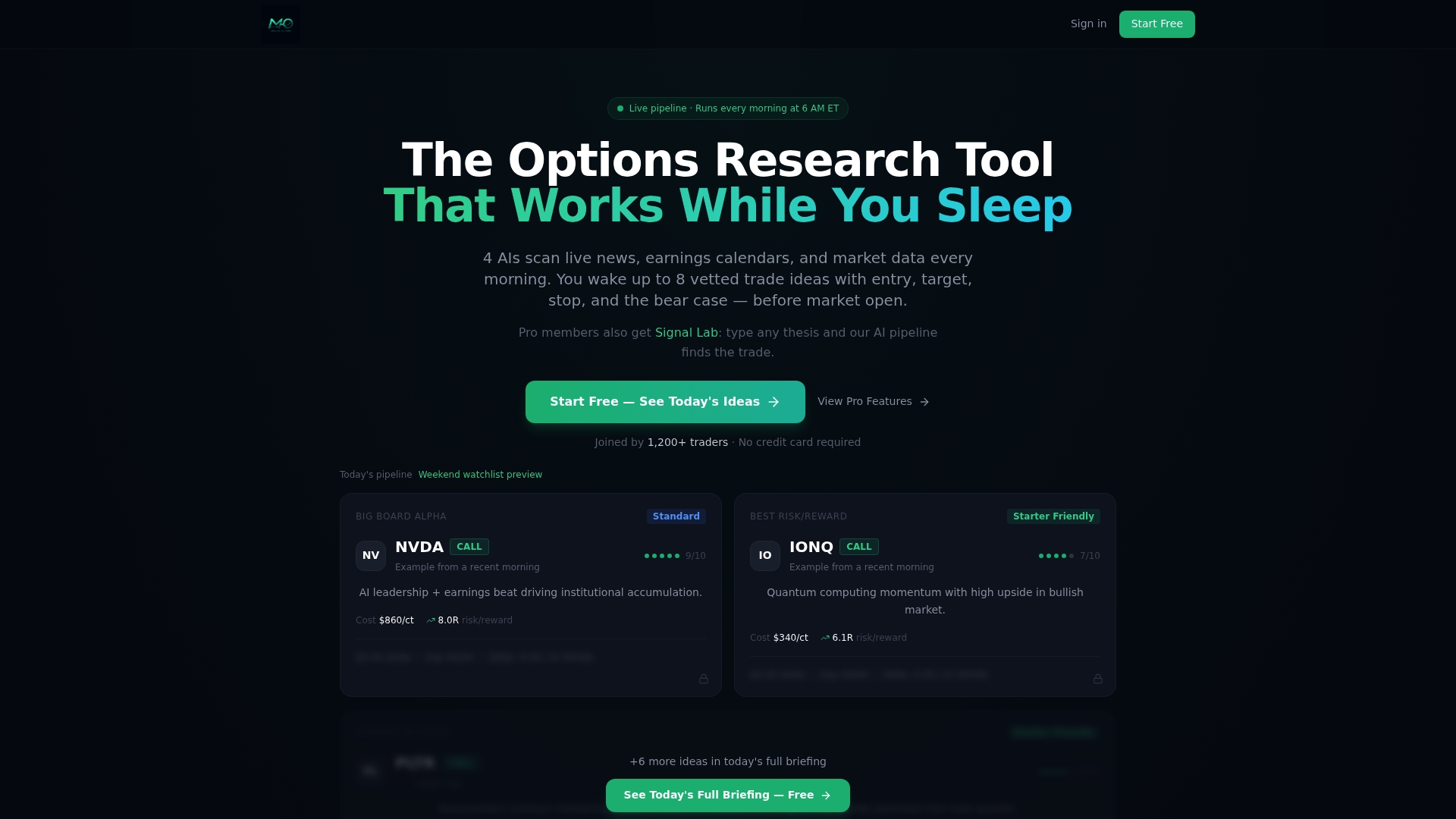
Morningoptions delivers AI-powered daily briefings with ranked, specific contract ideas, entry levels, and bear-case analysis, not vague market commentary. The five-stage AI pipeline vets and scores each idea before it reaches you. The Pro tier ($89/month) adds the lunchtime scanner and Signal Lab, an on-demand AI chat tool for researching any ticker in real time. Free daily briefings are available without a subscription.
Morningoptions is a research and education tool, not investment advice. Options trading involves substantial risk of loss and is not appropriate for all investors. Understand the risks fully before trading.
Start with a free daily briefing at Morningoptions and see the format before committing to Pro.
Sources
- Financial literacy | Capital One
- Investing Basics | FINRA
- Investor
- Core Competencies Framework on Financial Literacy for Investors | IOSCO
- The Ultimate Guide to Financial Literacy for Adults | Investopedia
- Financial literacy: What it is and why is it so important? | Fidelity
- Financial literacy definition | Investopedia
- Intuit financial literacy resources
This article is general information, not a substitute for advice from a qualified financial advisor. Consult a qualified financial professional about your own circumstances before acting on anything here.