
A market order is an instruction to buy or sell a security immediately at the best available price. Use it when getting the trade done matters more than the exact price you pay. The SEC defines it as an order that prioritizes execution certainty over price certainty, and FINRA confirms that during regular US market hours (9:30 AM–4:00 PM ET), market orders generally fill at or near the current bid or ask.
The one-line rule: use a market order primarily for liquid, widely traded stocks or ETFs during regular hours. Avoid it for options, penny stocks, or trades placed outside normal session hours.
Table of Contents
- What is market order trading and how does it actually work?
- Market order vs limit order vs stop order: which one fits your trade?
- When does a market order actually make sense?
- The real risks: slippage, gaps, and thin liquidity
- Worked examples: what slippage looks like in real numbers
- How to place a market order on a US broker: a quick checklist
- Why options traders should almost never use market orders
- The bottom line on when to use a market order
- Key Takeaways
- The case for knowing your order type before you open the ticket
- Morningoptions gives you the entry level before you open the order ticket
- Useful sources for further reading
What is market order trading and how does it actually work?
When you place a buy market order, your broker routes it to the exchange, where it immediately takes the lowest available ask price. A sell market order takes the highest available bid. The difference between those two prices is the bid-ask spread, and that spread is your minimum cost of entry before any commissions.

For most retail-sized trades in large-cap stocks, this process is nearly instant and the fill price is close to what you saw on screen. The problem shows up when your order is larger than the displayed size at the best price level.
Here's what that looks like in practice. Imagine the best ask for a stock is $50.00 with only 200 shares available there. You want 500 shares. Your order takes those 200 shares at $50.00, then sweeps to the next ask level at $50.05 for another 200 shares, then $50.10 for the final 100. Your average fill price ends up at $50.04, not $50.00. Investopedia calls this "walking the book," and it's the core mechanic behind slippage.
Key terms to know:
- Bid: the highest price a buyer is willing to pay
- Ask: the lowest price a seller will accept
- Spread: the gap between bid and ask
- Slippage: the difference between your expected price and your actual fill
- Liquidity: how much volume is available at each price level
FINRA notes that market orders receive top execution priority in the order book, but large orders can fill across multiple participants at multiple prices, producing an averaged execution price that differs from the quoted price.
Market order vs limit order vs stop order: which one fits your trade?
| Order Type | Execution Certainty | Price Certainty | Best For | Main Risk |
|---|---|---|---|---|
| Market order | Guaranteed | None | Liquid stocks/ETFs, urgent exits | Slippage, gap fills |
| Limit order | Not guaranteed | High | Thinly traded stocks, options, price-sensitive entries | Order may not fill |
| Stop order | Triggered, then market | None after trigger | Loss-cutting, breakout entries | Gap through stop price |
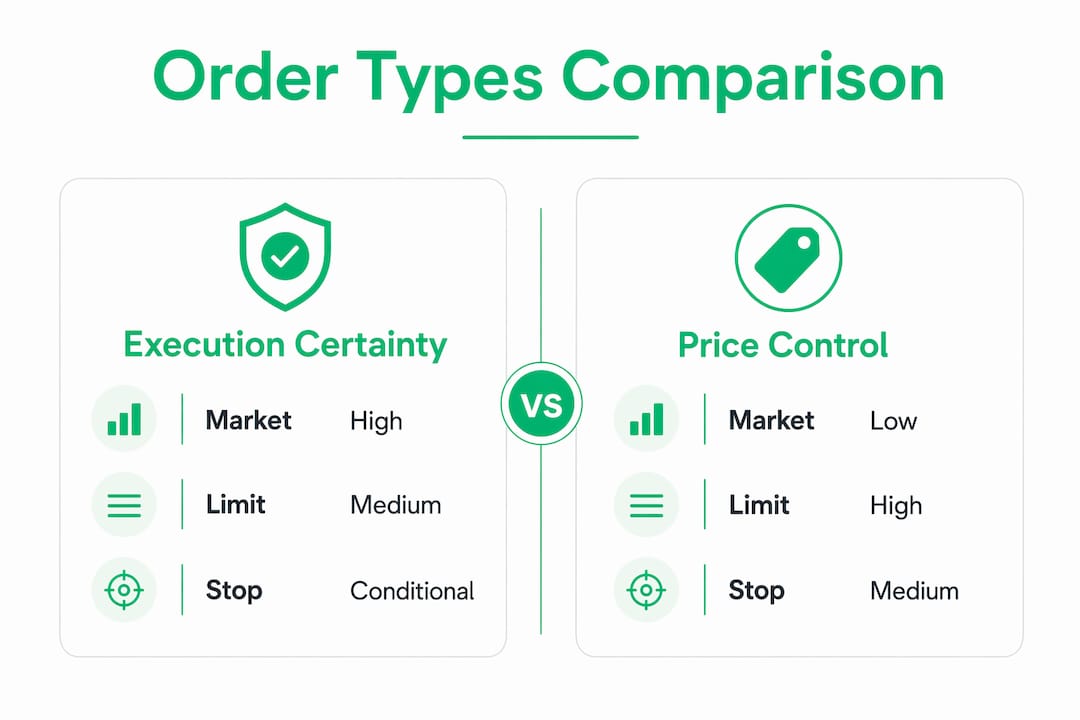
The decision comes down to one question: do you need the fill, or do you need the price?
Investor.gov confirms that a market order guarantees execution but not price, while a limit order guarantees price but not execution. For a beginner buying 100 shares of Apple or an S&P 500 ETF, a market order is fine. For a thinly traded small-cap or any options contract, a limit order is almost always the better call.
When to lean on each:
- Market order: you need out of a position fast, the stock is highly liquid, and a few cents of slippage won't change your outcome
- Limit order: you're buying a stock with a wide spread, you have a specific price target, or you're trading options
- Stop order: you want automatic loss protection or a breakout trigger, but understand the fill price isn't guaranteed once the stop is hit
When does a market order actually make sense?
Vanguard recommends market orders specifically for actively traded, liquid stocks and ETFs, calling them simple to place but lacking any price protection. That's the right framing.
Situations where a market order is the right tool:
- Entering or exiting a large-cap stock or broad ETF (SPY, QQQ, AAPL, MSFT) during regular hours, where spreads are typically a penny or two
- Urgent exits to cut a loss when getting out is more important than the exact exit price
- Quick portfolio rebalancing where missing the trade entirely costs more than a few cents of slippage
- Filling a small position in a stock with heavy daily volume
Situations where you should stop and use a limit order instead:
- Penny stocks or OTC-listed securities with wide spreads and thin volume
- Any trade placed during premarket or after-hours sessions, where liquidity drops sharply
- Options contracts of any kind
- Stocks that just had a major news event and are moving fast
The session timing point deserves emphasis. Vanguard explicitly warns that opening prices can gap sharply from the prior close, so a market order placed after hours executes at the next session's open, not at the price you saw when you submitted it.
The real risks: slippage, gaps, and thin liquidity
Slippage is the gap between the price you expected and the price you actually received. It's not a broker error. It's a structural feature of how market orders work, and it gets worse in three conditions: high volatility, low liquidity, and trading outside regular hours.
FINRA flags price gaps and volatile sessions as primary hazards. If news breaks between sessions, the opening price can be far from the prior close, and a queued market order fills at whatever that opening price turns out to be.
Practical ways to reduce the damage:
- Only use market orders in securities with tight bid-ask spreads (a penny or two for large caps)
- Check the displayed size at the best ask before submitting, especially for larger orders
- Avoid market orders in options entirely; use limit or marketable limit orders instead
- Never queue a market order overnight or into a weekend if you can help it
- For large positions, consider splitting into smaller tranches rather than one big sweep
Pro Tip: If you want near-certain execution but still want some price control, a marketable limit order is a solid middle ground. Set the limit a few cents above the current ask on a buy (or below the bid on a sell). You get execution priority close to a market order, but with a ceiling on how bad the fill can be.
Experienced traders typically reserve market orders for urgent entries and exits, relying on limit or marketable-limit approaches to retain price control, especially for options and thinly traded names.
Worked examples: what slippage looks like in real numbers
Example 1: Buying 500 shares of a liquid large-cap (e.g., a stock with very high daily trading volume)
With deep liquidity, 500 shares fills almost entirely at the best ask with minimal slippage.
Example 2: Buying 500 shares of a thinly traded stock (with only small size displayed at the best ask, then walking the book)
| Expected | Actual | |
|---|---|---|
| Price per share | $12.00 | $12.09 (averaged) |
| Total cost (500 shares) | $6,000.00 | $6,045.00 |
| Slippage | — | $45 |
Here, the order sweeps through three price levels: 200 shares at $12.00, 200 at $12.10, and 100 at $12.20. The average fill is $12.09, and the extra $45 is pure slippage. On a $6,045 trade, that's 0.75% lost before you've done anything.
The difference between these two scenarios is entirely about liquidity. The stock in Example 1 has thousands of shares stacked at each price level. The stock in Example 2 has thin size at each level, so your order moves the market against you.
How to place a market order on a US broker: a quick checklist
Most US brokers (TD Ameritrade/Schwab, Fidelity, E*TRADE, Robinhood) use similar interfaces. The steps are consistent:
- Confirm the ticker symbol — double-check you have the right stock, not a similar-looking one
- Enter the share quantity — know your total estimated cost before you submit
- Set order type to "Market" — it may default to limit on some platforms; verify
- Check the session — confirm you're trading during regular hours (9:30 AM–4:00 PM ET) unless you specifically intend extended-hours execution
- Review the bid-ask spread — if the spread is more than a few cents on a stock under $50, reconsider using a limit order
- Submit and watch the fill — your order confirmation will show the actual execution price, which may differ slightly from the quote
A few caveats worth knowing:
- Market orders are typically Good for Day (GFD) by default, meaning they expire at the close if not filled
- Charles Schwab warns that once a market order is being executed, cancellation is nearly impossible — don't submit until you're certain
- Market orders are usually the lowest-cost order type; some brokers charge extra for special handling on limit orders, though commission-free trading has made this less common
For faster execution on active platforms, reducing execution lag matters more than most beginners realize, especially when you're trying to hit a specific price window.
Why options traders should almost never use market orders
Options are a different animal. The bid-ask spread on an options contract can be $0.50 wide or more, even on a popular underlying stock. A market order on an option with a $1.00 bid and a $1.50 ask means you might pay $1.50 for something you could have bought at $1.10 with a limit order. That's a 40-cent loss before the trade even starts.
Vanguard's guidance on options is direct: contracts often have wider spreads and much smaller displayed size than the underlying stocks, so market orders can fill at far worse prices. Most professionals use marketable limit orders or carefully sized limit orders instead.
Key cautions for options traders:
- Always check the bid-ask spread on the specific contract before placing any order
- Use a limit order set at or near the midpoint of the spread as a starting point
- Size conservatively — thin options markets can move against you just from your own order
- Understand market conditions for options before entering, since volatility widens spreads further
Pro Tip: Morningoptions provides specific entry levels with each trade idea, not just a ticker and a direction. That means you know what price to target before you open the order ticket, which removes the temptation to just hit "market" and hope for a fair fill.
Morningoptions' Signal Lab lets you scan for options setups on demand and review liquidity conditions before committing. That kind of pre-trade research is exactly what separates a thoughtful entry from a blind market order in a thin contract.
The bottom line on when to use a market order
Three rules cover most situations:
- Use it for liquid large-cap stocks and broad ETFs during regular trading hours (9:30 AM–4:00 PM ET) when execution speed matters more than saving a few cents
- Avoid it for options, thinly traded stocks, penny stocks, or OTC securities where the spread is wide and liquidity is thin
- Check the spread and displayed size before submitting any market order, even in a stock you think is liquid
One more reminder: a market order placed outside regular hours doesn't execute at the price you see. It waits for the next session's open, and that opening price can gap significantly from where the stock closed. If you're not sure about session timing, a limit order is always the safer default.
This article is general information, not investment advice. Confirm current rules and order-type behavior with your broker or a qualified financial professional before trading.
Key Takeaways
A market order guarantees execution but never price, making liquidity and session timing the two factors that determine whether it's the right tool for your trade.
| Point | Details |
|---|---|
| Market order definition | An instruction to buy or sell immediately at the best available price, with no price guarantee. |
| Main benefit | Guaranteed execution, top order-book priority, and typically the lowest-cost order type. |
| Main risk | Slippage from walking the book, and gap fills when placed outside regular trading hours. |
| When to use it | Liquid large-cap stocks and ETFs during regular hours (9:30 AM–4:00 PM ET) only. |
| Morningoptions advantage | Provides specific entry levels with each trade idea so you can use limit orders confidently instead of relying on blind market orders. |
The case for knowing your order type before you open the ticket
Most beginner mistakes with market orders aren't about the order type itself. They're about using it in the wrong situation: a thinly traded stock, an options contract with a wide spread, or a position placed after hours without thinking about where the open might be.
The honest truth is that for a retail trader buying 100 shares of a major ETF, a market order is perfectly fine and probably the right call. The risk comes when traders treat market orders as the default for everything, including options, because they're fast and easy. Fast and easy in a thin market means paying the ask, sometimes well above it, with no recourse.
The smarter habit is to check the spread first, always. If it's tight, a market order is probably fine. If it's wide, a limit order at the midpoint costs you nothing but a few seconds and could save you real money. That one habit, applied consistently, closes most of the gap between a sloppy fill and a clean entry.
Morningoptions gives you the entry level before you open the order ticket
Most options research tells you what to buy. Morningoptions tells you what to pay for it. Every daily briefing includes ranked trade ideas with specific contract details and entry levels, so you're not guessing at a fair price when you open the order ticket.
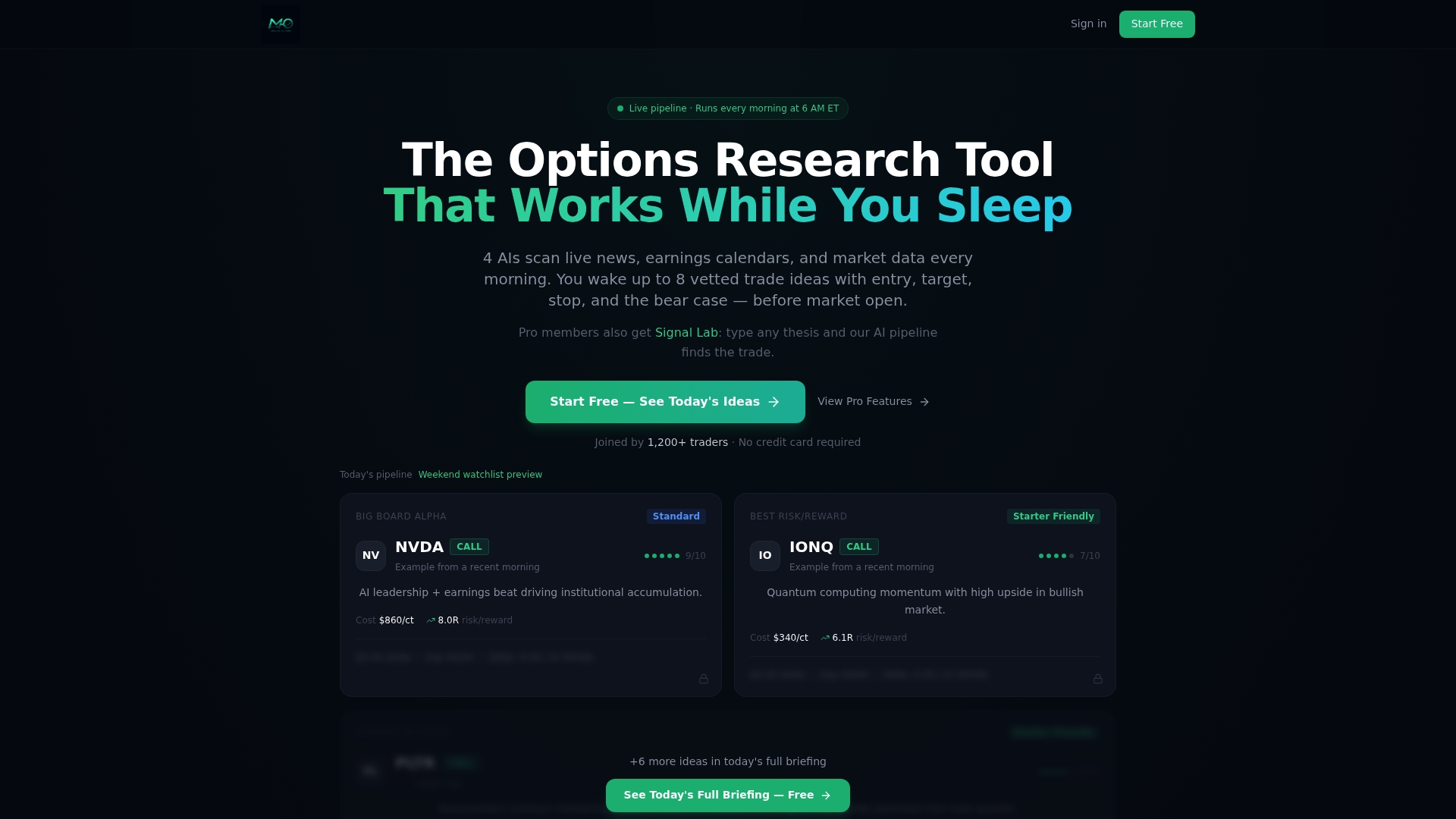
That matters for market order discipline. When you already know your target entry price, you don't need to hit "market" and accept whatever the spread gives you. You can place a limit order with confidence, knowing the level came from a five-stage AI pipeline that vetted and scored the idea before it reached you. The free plan gives you access to daily briefings. The Pro tier ($89/mo) adds the lunchtime scanner and Signal Lab, an AI chat tool for researching specific tickers on demand. Morningoptions is a research and idea platform, not an order placement service, but it's the step that makes your order placement smarter. Start with the free plan and see what a pre-vetted entry level feels like before the open.
Useful sources for further reading
These are the primary sources used in this article. All are US-specific and authoritative:
- Investor.gov — Market Order definition: The SEC's plain-language definition; the best starting point for any beginner
- Investor.gov — Types of Orders: Covers market, limit, and stop orders side by side with clear trade-off language
- FINRA — Order Types: Explains execution priority, session timing, and gap risk; the most detailed regulatory source
- Vanguard — Stock & ETF Order Types: Practical broker-level guidance on when to use each order type, including options cautions
- Charles Schwab — Mastering Market Orders: Retail-focused explainer with clear warnings about cancellation and unexpected fills
- Investopedia — Market Order: Good for understanding sweep-to-fill mechanics and worked examples of walking the book