
Wealth transfer planning is the deliberate process of moving assets to your chosen beneficiaries while managing taxes, timing, and family dynamics along the way. It happens in two primary ways: gifting assets during your lifetime, or transferring them at death through wills, trusts, and beneficiary designations. The core tools you'll encounter include:
- Wills — the foundational legal document directing asset distribution
- Revocable and irrevocable trusts — flexible or locked-in structures for control and tax efficiency
- Beneficiary designations — direct transfers on retirement accounts and life insurance that bypass probate
- Annual and lifetime gifts — tax-advantaged transfers made while you're alive
- Life insurance — often held inside an irrevocable life insurance trust (ILIT) to provide estate liquidity
- Business succession vehicles — buy-sell agreements, family limited partnerships, and gradual gifting strategies
The step-up in basis rule is one of the most powerful tax advantages in the entire system: when heirs inherit appreciated assets, the cost basis resets to the market value at the date of death, potentially wiping out decades of embedded capital gains. That single rule shapes a large portion of the strategic decisions covered in this guide.
Key Takeaways
Wealth transfer planning works best when legal structure, tax strategy, and family governance are built together rather than treated as separate projects.
| Point | Details |
|---|---|
| Step-up in basis is powerful | Inherited appreciated assets reset to market value at death, potentially eliminating decades of capital gains for heirs. |
| Beneficiary designations override wills | Retirement accounts and life insurance pass by contract; update them first before any other document. |
| Tax exposure drives strategy complexity | Estates below federal and state exemptions need solid documents; estates above them need active tax strategies. |
| Governance determines long-term success | Family meetings, staged inheritance, and heir education materially improve the odds wealth survives multiple generations. |
| Start with inventory and goals | Before drafting documents, list every asset, how it's titled, and what you want each beneficiary to receive. |
Table of Contents
- What does wealth transfer planning actually cover?
- What legal documents and vehicles actually move wealth?
- How do U.S. tax rules affect what your heirs actually receive?
- Which tax-efficient strategies are most commonly used?
- How does wealth transfer planning work in practice?
- What risks and pitfalls can derail a wealth transfer plan?
- How long does wealth transfer planning take, and what does it cost?
- How do you involve your family and prepare heirs for inherited wealth?
- How do you start a wealth transfer plan right now?
- Why governance matters as much as legal structure
- A direct take on what actually matters first
- Sources
What does wealth transfer planning actually cover?
The goals of a wealth transfer plan vary by family, but most plans address some combination of these objectives:
- Protecting a surviving spouse's financial security
- Providing for children or grandchildren, including minors or those with special needs
- Minimizing estate, gift, and income taxes for heirs
- Transferring a family business without forcing a fire sale
- Directing charitable gifts in a tax-efficient way
- Establishing governance rules so inherited wealth isn't squandered
There's an important distinction between an estate plan and a wealth transfer plan. An estate plan is document-level: a will, a trust, powers of attorney, and health care directives. Wealth transfer planning is strategy-level. It layers tax timing decisions, gifting programs, business valuation discounts, charitable vehicles, and family governance on top of those documents. You can have an estate plan without a wealth transfer plan, but you can't have an effective wealth transfer plan without both.
Typical beneficiaries include spouses, children, grandchildren, charities, and business partners. Special scenarios require extra attention: blended families where step-children and biological children have competing interests, minor children who need a trustee to manage assets until adulthood, and business co-owners who need buy-sell agreements funded by life insurance to avoid a forced liquidation.
Pro Tip: Before you draft a single document, write down your liquidity needs first. Estate taxes, if owed, are generally due nine months after death. If your estate is illiquid — tied up in real estate or a private business — your heirs may need to sell assets quickly to pay the bill. Knowing that upfront changes the entire planning strategy.
What legal documents and vehicles actually move wealth?
Every wealth transfer plan is built from a set of legal containers. Here's what each one does and when it's typically used:
- Will — directs distribution of probate assets; names an executor and, critically, a guardian for minor children. Assets with beneficiary designations or held in trust pass outside the will entirely.
- Revocable living trust — avoids probate, allows you to maintain control during your lifetime, and can include detailed distribution instructions. Does not reduce estate taxes on its own.
- Irrevocable trust — once funded, assets generally leave your taxable estate. Used for tax reduction, creditor protection, and Medicaid planning. You give up control in exchange for those benefits.
- Payable-on-death (POD) / transfer-on-death (TOD) designations — the fastest, cheapest way to pass bank accounts, brokerage accounts, and retirement accounts directly to named beneficiaries without probate. Retirement account beneficiary rules have specific tax implications for heirs and require separate attention from your will.
- Durable power of attorney — authorizes someone to manage your financial affairs if you're incapacitated. Without one, a court appoints a guardian.
- Health care directive / living will — specifies medical wishes and names a health care proxy. Not a wealth transfer tool, but a critical gap in most plans.
Beyond the basics, several specialized vehicles do the heavy lifting in larger estates:
- Irrevocable life insurance trust (ILIT) — holds a life insurance policy outside your estate so the death benefit passes to heirs free of estate tax, while providing liquidity to pay estate costs.
- Grantor retained annuity trust (GRAT) — you transfer assets into the trust, receive annuity payments for a fixed term, and any appreciation above the IRS hurdle rate passes to heirs gift-tax free.
- Dynasty trust — designed to hold assets for multiple generations, often in states like South Dakota or Nevada with no rule against perpetuities. Keeps wealth in trust and out of each generation's taxable estate.
- Family limited partnership (FLP) or family LLC — consolidates family assets under one entity, allows valuation discounts for lack of marketability and control, and facilitates gradual gifting of partnership interests.
- 529 college savings plan — contributions grow tax-free for education expenses; a special five-year election lets you front-load five years of annual exclusion gifts in a single year.
- Donor-advised fund (DAF) — take an immediate charitable deduction, then recommend grants to charities over time. Useful for bunching deductions in a high-income year.
Integrated planning across tax, charitable, and business succession domains consistently produces better outcomes than relying on any single document or vehicle.
How do U.S. tax rules affect what your heirs actually receive?
Three separate federal taxes govern wealth transfers, and each works differently.
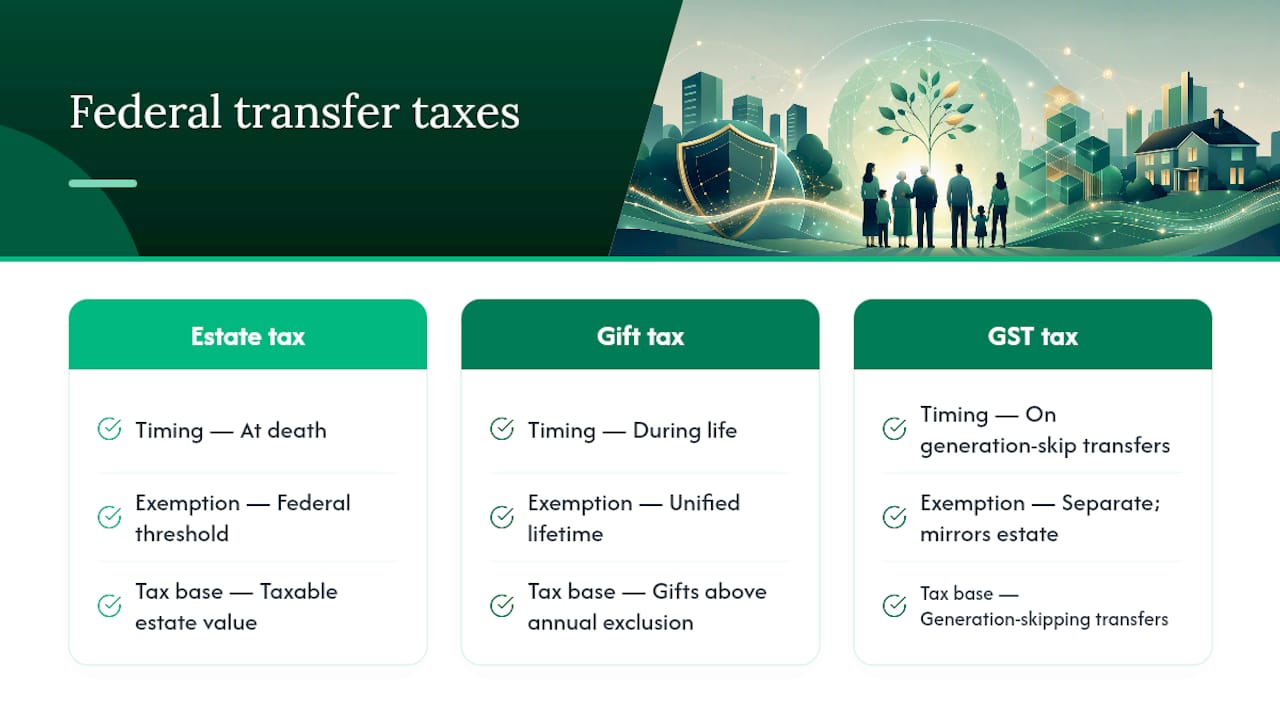
Estate tax applies to the total value of your taxable estate at death above the federal exemption threshold. The exemption is set by law and has changed significantly over time; consult a tax advisor or the IRS estate and gift tax guidance for the current threshold, since it is scheduled to change after 2025 under current law.
Gift tax applies to transfers made during your lifetime above the annual exclusion. The IRS gift tax FAQ explains the mechanics clearly: you can give any individual up to the annual exclusion amount each year without filing a gift tax return. Gifts above that amount in a given year reduce your lifetime exemption dollar-for-dollar. The estate and gift tax share a unified lifetime exemption, so every dollar of exemption used for lifetime gifts is unavailable at death.
It has its own exemption, which generally mirrors the estate tax exemption. Dynasty trusts are specifically designed to use the GST exemption efficiently.
Step-up in basis: the rule that changes everything
When a beneficiary inherits an appreciated asset, the cost basis resets to the fair market value on the date of death. If your parent bought stock for $10,000 that grew to $500,000, and you inherit it, your basis is $500,000. Sell it the next day and you owe zero capital gains tax on that $490,000 of appreciation. That's the step-up in basis, and it's one of the strongest arguments for holding highly appreciated assets until death rather than gifting them during your lifetime.
Gifting appreciated assets while alive transfers your original low basis to the recipient. They sell and pay capital gains on the full appreciation. Holding until death eliminates that tax entirely for the heir.
State-level variation adds another layer. Seventeen states plus the District of Columbia impose their own estate or inheritance tax, often with exemptions far below the federal threshold. Oregon and Massachusetts, for example, have historically taxed estates above $1 million. Some states tax the recipient (inheritance tax) rather than the estate. If you own real estate in multiple states, each state's rules apply to that property.
Which tax-efficient strategies are most commonly used?
Most families use some combination of these approaches, depending on estate size, asset type, and family goals.
- Annual exclusion gifts — the simplest strategy. Give up to the annual exclusion amount to any number of recipients each year. No gift tax return required, no lifetime exemption used. A couple can combine their exclusions to double the annual gift to each recipient.
- Direct tuition and medical payments — payments made directly to an educational institution or medical provider on someone else's behalf are completely excluded from gift tax, with no dollar limit. This is separate from and in addition to the annual exclusion.
- Irrevocable trusts — shift assets and their future appreciation out of your estate. The trade-off is real: you lose control. Once assets are in an irrevocable trust, you generally cannot take them back.
- ILITs — remove life insurance death benefits from your taxable estate while still providing liquidity to your heirs or estate. The trust owns the policy; you make annual gifts to the trust to cover premiums.
- GRATs — work best when interest rates are low and the assets inside the trust are expected to appreciate significantly. If the assets underperform the IRS hurdle rate (the Section 7520 rate), the strategy produces no tax benefit but also no harm.
- Dynasty trusts — useful for families with significant wealth who want to keep assets in trust across multiple generations, protected from estate taxes, creditors, and divorce settlements at each generation.
- Family limited partnerships — allow valuation discounts of 15–35% on transferred interests, which effectively lets you move more wealth using less lifetime exemption. The IRS scrutinizes these closely; they need to have legitimate business purposes and be properly operated.
- Charitable remainder trusts (CRTs) and charitable lead trusts (CLTs) — split-interest trusts that benefit both heirs and charity. A CRT pays income to you or your heirs for a term, then passes the remainder to charity. A CLT does the reverse.
- 529 plans — straightforward and underused. Front-loading five years of annual exclusion gifts into a 529 removes a meaningful sum from your estate immediately, with no gift tax return complexity beyond the election.
One specific pitfall worth knowing: upstream gifting, where you transfer appreciated assets to an older relative to capture a step-up in basis when they die, carries a timing risk. If the recipient doesn't survive the required holding period, the intended tax result can be negated. Advisors flag this as a drafting and timing detail that requires careful counsel.
Pro Tip: A rough rule of thumb: if your estate is below the federal exemption and your state has no estate tax, focus on beneficiary designations, step-up in basis planning, and 529s. If your estate exceeds the exemption, or if you own a business or concentrated stock position, bring in an estate attorney and CPA before year-end — the strategies that matter most at that level require lead time.
How does wealth transfer planning work in practice?
Abstract strategies are easier to evaluate with concrete examples.
-
Inherited stock with step-up in basis. A parent holds $800,000 in a single stock purchased decades ago for $50,000. If they sell, they owe capital gains tax on $750,000 of gain. Instead, they hold the stock until death. The heir inherits it with a $800,000 basis, sells immediately, and owes nothing. The $750,000 gain disappears permanently. This is why holding concentrated, highly appreciated positions until death is often the right call, even when it feels counterintuitive from a diversification standpoint.
-
ILIT funding scenario. A business owner has a $10 million estate, mostly illiquid. Without planning, heirs may owe estate tax and have no cash to pay it. An ILIT is established; the trust purchases a $3 million life insurance policy on the owner's life. The owner makes annual gifts to the trust to cover premiums (using the annual exclusion). At death, the $3 million death benefit is paid to the trust, outside the taxable estate, giving heirs the liquidity to pay estate taxes without selling the business.
-
Business succession via gradual gifting. A family business owner begins gifting minority interests in a family LLC to adult children each year, using the annual exclusion and, over time, portions of the lifetime exemption. Valuation discounts for lack of control and marketability reduce the taxable value of each gift. Over a decade, a significant portion of the business transfers to the next generation at a fraction of its full fair market value.
-
Dynasty trust for multi-generational goals. A grandparent funds a dynasty trust in a favorable state with $5 million, using GST exemption to shelter it from generation-skipping tax. The trust grows, distributes income and principal to children and grandchildren per the trustee's discretion, and is never included in any beneficiary's taxable estate. Assets compound inside the trust for generations, protected from creditors and divorce.
Pro Tip: The most common surprise heirs face is a retirement account with a named beneficiary that conflicts with the will. An IRA payable to an ex-spouse overrides any instruction in a will. Check every account's beneficiary designation before assuming your documents control the outcome.
What risks and pitfalls can derail a wealth transfer plan?
Legal and tax structures are only as good as their execution. These are the failure modes that show up most often:
- Lack of liquidity for estate taxes — if your estate is illiquid and taxes are owed, heirs may be forced to sell assets at distressed prices within nine months of death.
- Outdated or missing beneficiary designations — accounts with no named beneficiary go through probate; accounts with a deceased or wrong beneficiary create legal disputes.
- Failure to fund trusts — a revocable trust that was never retitled with assets in it accomplishes nothing. The assets still go through probate.
- Improper trustee selection — choosing a family member as trustee without considering the administrative burden, family dynamics, or legal liability can create conflict and mismanagement.
- Medicaid lookback exposure — transferring assets within five years of applying for Medicaid long-term care benefits can trigger a penalty period. This requires specific planning well in advance of need; consult an elder law attorney for state-specific rules.
- Creditor exposure — assets in a revocable trust remain reachable by creditors. Only properly structured irrevocable trusts provide meaningful creditor protection, and the rules vary by state.
- Family conflict over unequal distributions — leaving unequal shares without explanation, or leaving a business to one child while others receive cash equivalents, generates disputes that can take years and significant legal fees to resolve.
Wealth advisors consistently identify "the price of silence" as one of the most destructive forces in estate planning: plans kept secret from heirs often create confusion, resentment, and poor stewardship when the transfer finally happens. Transparency, even partial, dramatically reduces conflict.
Upstream gifting carries its own operational risk: if the intermediary recipient doesn't survive the required period, the intended tax results can be negated entirely. This is a timing and drafting detail that requires careful legal counsel before executing.
How long does wealth transfer planning take, and what does it cost?
Planning unfolds in stages, not all at once.
- Discovery and goal-setting (2–6 weeks) — inventory assets, clarify goals, estimate estate tax exposure, and identify gaps in existing documents.
- Document drafting and review (4–12 weeks) — attorney drafts wills, trusts, powers of attorney, and related documents; you review, revise, and execute.
- Funding and account updates (4–12 weeks) — retitle assets into trusts, update beneficiary designations on all accounts, transfer business interests if applicable.
- Ongoing reviews (annually or after major life events) — births, deaths, divorces, business changes, and tax law changes all require plan updates.
Professional fees vary significantly by complexity and geography:
On timing: gift tax returns (Form 709) are due April 15 of the year following the gift. Estate tax returns (Form 706) are generally due nine months after the date of death, with a six-month extension available. Estate taxes owed are also due at the nine-month mark, not at the extension deadline. That liquidity gap is why planning for it in advance matters.
How do you involve your family and prepare heirs for inherited wealth?
The legal structure is only half the job. Families that successfully transfer wealth across generations treat governance and communication as seriously as the documents themselves.
Practical governance tools include:
- Family council — a regular meeting structure (annual or semi-annual) where family members discuss shared financial goals, philanthropic priorities, and the purpose of family wealth.
- Family charter or mission statement — a written document that articulates shared values, decision-making processes, and expectations for beneficiaries. Not legally binding, but powerful as a reference point.
- Ethical will or letter of instruction — a personal document from the wealth creator explaining the "why" behind their decisions, the values they hope to pass on, and their wishes for how wealth is used.
- Staged inheritance — rather than distributing a lump sum at a fixed age, trusts can distribute in tranches (a third at 25, a third at 30, a third at 35) or tie distributions to milestones like completing education or maintaining employment.
- Financial education — heirs who understand basic investing, tax concepts, and trust mechanics make better decisions as beneficiaries. Formal programs, family advisors, and even structured reading lists help.
- Trustee advisory committees — including a mix of family members and independent advisors in trust oversight reduces the risk of any single trustee making poor decisions unchecked.
Families that start governance conversations early and use a family charter or council are more likely to preserve wealth across generations. The research on this is consistent: structure and communication together outperform either one alone.
Pro Tip: If family conversations about money feel charged, bring in a neutral facilitator — a family wealth advisor, a mediator, or a trusted attorney — for the first few meetings. Having a professional run the agenda removes the dynamic where one family member feels like they're being lectured by another.

How do you start a wealth transfer plan right now?
The first steps don't require a complex trust or a large estate. They require clarity and a few phone calls.
- Take a complete asset inventory. List every account, property, business interest, and insurance policy. Note how each is titled and who the named beneficiaries are.
- Review every beneficiary designation. Check IRAs, Roth IRAs, 401(k)s, life insurance policies, and any POD/TOD accounts. These designations override your will.
- Estimate your estate tax exposure. Add up your assets, subtract debts, and compare to the current federal exemption and your state's threshold. If you're near or above either, tax planning is urgent.
- Define your goals and timeline. Who do you want to protect? What assets do you want to keep in the family? Do you have charitable goals? Is there a business to transfer?
- Assemble your advisor team. You need an estate attorney for documents, a CPA for tax planning, and ideally a financial advisor who coordinates both. These three roles are distinct; one person rarely covers all three well.
- Begin family conversations. Even a brief conversation about your intentions reduces conflict later. You don't need to share every detail, but heirs who know a plan exists are better prepared.
- Schedule a review date. Set a calendar reminder to revisit the plan every one to two years, or immediately after any major life event.
Practical planning steps recommended across multiple practitioner guides consistently start here: inventory, designations, goals, and advisors. The complexity comes later, after the foundation is solid.
Key actions to take before your first advisor meeting:
- Gather account statements and property deeds
- Pull existing wills, trusts, and powers of attorney
- List all life insurance policies and their current beneficiaries
- Note any business ownership interests and existing agreements
- Write down your top three goals for the transfer
Why governance matters as much as legal structure
The legal mechanics of wealth transfer are well-documented. The governance side is where most plans quietly fail.
Cerulli Associates research, cited by family wealth practitioners, finds that regular family meetings and proactive communication are identified by a large majority of high-net-worth advisory practices as among the most effective strategies for successful intergenerational transfer. Without shared purpose, wealth is frequently dissipated within two to three generations.
That finding has a direct practical implication: a dynasty trust with no family education program is a legal structure waiting to be mismanaged. A GRAT with no conversation about what the transferred assets represent is a tax strategy that creates confusion rather than continuity.
Wealth advisors recommend pairing technical trust structures with clear operational rules and trustee education to avoid unintended control loss and family disputes. The most durable plans treat the family charter, the trustee selection process, and the heir education program as deliverables with the same weight as the trust document itself.
One concrete practice families can adopt immediately: hold a single structured family meeting before any documents are signed. Bring the estate attorney or a facilitator. Let heirs ask questions. The conversation that happens in that room almost always surfaces assumptions, misunderstandings, or conflicts that would otherwise surface in a probate court years later.
Pro Tip: Document the outcomes of every family meeting in writing, even informally. A simple email summary sent to all participants creates a record of what was discussed and agreed. Over time, that record becomes the foundation of your family charter.
A direct take on what actually matters first
Most people approach wealth transfer planning backwards. They start by asking which trust structure is most tax-efficient, when the first question should be: what happens to my heirs if I die tomorrow with no plan at all?
The answer to that question almost always reveals the same two urgent gaps: beneficiary designations that haven't been touched in years, and no liquidity plan for estate costs. Fix those two things first. They cost almost nothing to address and they prevent the most common disasters.
After that, the tax strategies matter. But they matter in proportion to your estate size and asset type. A family with a $3 million estate in a state with no estate tax needs a solid will, updated beneficiaries, and a conversation with a CPA about step-up in basis planning. A family with a $20 million estate that includes a private business needs an ILIT, a buy-sell agreement, a valuation strategy, and probably a dynasty trust. The complexity should match the exposure.
One thing worth saying plainly: the tax law governing estate and gift transfers is scheduled to change after 2025. The current elevated exemption may drop significantly. If your estate is in a range where that change matters, the window to act under current rules is narrowing. That's not a reason to panic, but it is a reason to schedule that advisor meeting now rather than next year.
Coordinate legal and tax advice before implementing any complex strategy. An estate attorney who doesn't know your tax situation and a CPA who hasn't read your trust documents are each working with half the picture.
Sources
These authoritative resources cover the technical rules, filing requirements, and planning frameworks referenced throughout this guide. Verify state-specific rules and consult a tax attorney or CPA before implementing any strategy.
- The Biggest Wealth Shift in History Could Transform Your Financial Future — Investopedia
- Irs
- The Great Wealth Transfer: How to Prepare Your Family for Lasting Wealth — Carter Wealth
- Mastering generational wealth transfer — Creative Planning
- What is wealth transfer and how to plan for it — Midland National
This article provides general information about U.S. wealth transfer and estate planning concepts. It is not legal, tax, or financial advice. Consult a licensed estate attorney and CPA for guidance specific to your situation and current applicable law.
This article is general information, not a substitute for advice from a qualified financial advisor. Consult a qualified financial professional about your own circumstances before acting on anything here.