
The most tax-efficient options strategies, ranked by impact

For active traders, the single highest-leverage tax move is choosing which instrument you trade, not when you trade it. Section 1256 contracts like SPX, NDX, and RUT options receive automatic 60/40 tax treatment regardless of holding period. That means even a zero-DTE SPX trade gets 60% of its profit taxed at long-term capital gains rates. SPY options get none of that.
Here are the core options strategies tax efficiency examples every active trader should know:
- SPX over SPY: The 60/40 blended rate on Section 1256 contracts produces a maximum effective rate of ~26.8% versus 37% for short-term equity options gains.
- Collar overlays on concentrated stock: Selling covered calls funds a portion of the tax liability when you eventually trim a large position.
- Tax-loss harvesting with product substitution: Closing a losing position and rotating into a correlated but non-identical underlying preserves market exposure while realizing the loss.
- High-turnover strategies inside a Roth IRA: All those short-term premiums compound tax-free.
- LEAPS held past one year: Converts what would be ordinary-income-rate gains into long-term capital gains at 15–20%.
A top-bracket trader generating substantial annual options profits can save a meaningful amount annually by trading SPX instead of SPY. That is not a rounding error. Over a decade, it is a six-figure difference from one instrument choice.
Table of Contents
- How US tax rules actually treat options: Section 1256 vs equity options
- Concrete examples of tax-efficient options strategies in action
- Advanced tax tools active options traders often overlook
- How to build tax efficiency into your daily trading workflow
- Morningoptions delivers tax-aware trade ideas every morning
- Key Takeaways
How US tax rules actually treat options: Section 1256 vs equity options
The tax code splits options into two buckets, and the difference between them is enormous.
Section 1256 contracts cover broad-based index options (SPX, NDX, RUT, VIX), futures, and options on futures. They receive the 60/40 rule automatically: 60% of gains taxed at long-term capital gains rates, 40% at short-term rates. Holding period is irrelevant. They are also marked to market at year-end and reported on Form 6781, not Schedule D. Critically, they are exempt from the wash sale rule entirely.
Standard equity options (individual stocks, SPY, QQQ) follow the same rules as stocks. Hold for one year or less and every gain is short-term, taxed at ordinary income rates up to 37%. Premiums collected from written options are always short-term capital gains when the option expires or closes, regardless of how long you held the position.
- Wash sale rule (IRC §1091): If you close an equity option at a loss and reopen a substantially identical position within 30 days before or after, the loss is disallowed and added to the new position's cost basis.
- Covered call holding period trap: Writing a deep in-the-money or short-dated call against stock you have held less than a year can suspend or reset the holding period clock on the underlying, converting potential long-term gains into short-term.
- LEAPS: Buying a long-dated equity option and holding it past the one-year mark qualifies the gain for long-term treatment. A trader bullish on a stock for 18 months can buy a LEAPS call, hold 13 months, and pay 15–20% instead of 37%.
- Form 6781: Section 1256 gains and losses go here, not on Schedule D. Misreporting them as equity options is a common and costly filing error.
Pro Tip: Before you place an index-exposure trade, confirm whether the instrument qualifies as a Section 1256 contract. SPX qualifies. SPY does not. XSP (the mini-SPX) does. QQQ does not. NDX does. This one check, done in 10 seconds, can change your effective tax rate by 10 percentage points.
Concrete examples of tax-efficient options strategies in action
SPX vs SPY: the tax math side by side
Assume a trader in a typical federal tax bracket generates a set amount in profit from index options.
| Tax treatment | Calculation | Tax owed | After-tax profit |
|---|---|---|---|
| Short-term (SPY options) | $10,000 × 26.8% | — | — |
| 60/40 (SPX options) | ($6,000 × 15%) + ($4,000 × 26.8%) | — | — |
Over $1,000 more per every $10,000 of profit from one instrument swap. Scaling up increases annual savings significantly.
Collar strategy on a concentrated stock position
An investor holds a large concentrated stock position with a near-zero cost basis. Selling outright triggers a significant capital gains bill. Instead:
- Sell monthly covered calls at a strike price above current price, collecting consistent premiums each month.
- Use a portion of that premium to buy 3-month protective puts at the $95 strike.
- The result is a collar: a $95 floor, a $105 ceiling, and monthly premium income building a tax-offset pool to fund taxes when shares are eventually sold.
The call premium effectively pre-funds part of the capital gains tax liability. If the call expires worthless, the premium is a short-term gain. If the call is exercised, the premium adds to sale proceeds. Either way, the investor is better positioned after tax than if they had simply held.
Tax-loss harvesting without triggering wash sale
A trader holds shares of AAPL purchased at a higher price. By December, the price has declined, creating an unrealized loss. Three approaches:
- Wait 31 days: Sell AAPL, wait, repurchase. Clean, but 31 days of missed exposure.
- LEAPS substitute: Sell AAPL, buy a deep in-the-money AAPL LEAPS call. Generally treated as substantially identical, triggering wash sale. Loss disallowed.
- Product substitution: Sell AAPL, immediately buy MSFT or NVDA as a tech-sector proxy. Not substantially identical. Loss is allowed. After 31 days, rotate back to AAPL if desired.
Harvested losses against current-year gains can save a significant amount in federal tax. Multiply that across multiple positions in a high-turnover year and the aggregate benefit is meaningful.
Advanced tax tools active options traders often overlook
Section 475(f) trader tax status converts gains and losses to ordinary income treatment and allows unlimited loss deductions against ordinary income, bypassing the $3,000 annual capital loss cap. The catch: the election is irrevocable once made, must be filed by the tax deadline of the prior year, and eliminates preferential long-term capital gains rates on any position. Experts consistently warn that this election requires a CPA experienced with trader tax status before you touch it. Getting it wrong has permanent consequences.
Roth IRA for high-turnover strategies is the cleanest shelter available to retail traders. Every dollar of options premium, every closed spread, every assigned put inside a Roth compounds completely tax-free. No 1099-B, no wash sale tracking, no quarterly estimated payments on those gains. Most brokers allow Level 2 to Level 3 options trading in IRAs, covering covered calls, cash-secured puts, and basic spreads. Running a wheel strategy inside a Roth while trading index options in a taxable account is a practical two-account structure that captures both advantages.
- Automatic mark-to-market on Section 1256 contracts means year-end losses are recognized without any action required, enabling flexible loss recognition that equity options traders cannot access.
- Switching to correlated non-identical underlyings (e.g., rotating from XLE to VDE after a loss) maintains sector exposure while avoiding wash sale penalties under IRC §1091.
- 3-year carryback for Section 1256 losses: A net loss on Section 1256 contracts can be carried back up to three years to offset prior-year Section 1256 gains, a provision unavailable for equity options.
- Capital gains tax calculators can model the SPX vs SPY tax delta before you commit to a strategy. Tools that compare Section 1256 vs equity options side by side are worth running before scaling any index strategy.
Pro Tip: Find a CPA who specifically works with active traders before April, not during it. Section 475(f), wash sale adjustments, and Form 6781 reporting are not areas where a generalist tax preparer adds value. The cost of specialized advice is almost always less than the cost of a filing error.
How to build tax efficiency into your daily trading workflow
Tax efficiency is not a year-end project. It is a daily decision embedded in instrument selection, timing, and documentation.
- Track every trade at execution, not at tax time. Logging the underlying, strike, expiration, premium, and open/close date in real time makes wash sale analysis tractable. A spreadsheet or dedicated trade tracking system prevents the scramble in April.
- Choose instruments with tax treatment in mind. Before placing an index-exposure trade, confirm Section 1256 eligibility. SPX, NDX, RUT, and XSP qualify. SPY, QQQ, and IWM do not.
- Time loss harvesting to November, not December 31. Realizing losses more than 30 days before year-end gives you room to re-enter positions in January without triggering a cross-year wash sale.
- Use collars and overlays on concentrated positions rather than outright sales when a large unrealized gain makes immediate liquidation tax-prohibitive.
- Run high-turnover income strategies inside a Roth IRA whenever contribution limits allow. The same wheel trade that generates a 30% tax bill in a taxable account generates zero in a Roth.
- Set aside 30–35% of every closed-trade profit into a separate account for quarterly estimated taxes. The IRS expects payments roughly April 15, June 15, September 15, and January 15.
- Use AI-powered trade selection tools to identify tax-efficient trade ideas before the open, so instrument choice is deliberate rather than reactive.
For traders running options strategies in volatile markets, tax efficiency compounds with position management: the same collar that limits downside also manages the tax timing of a concentrated exit.
Morningoptions delivers tax-aware trade ideas every morning
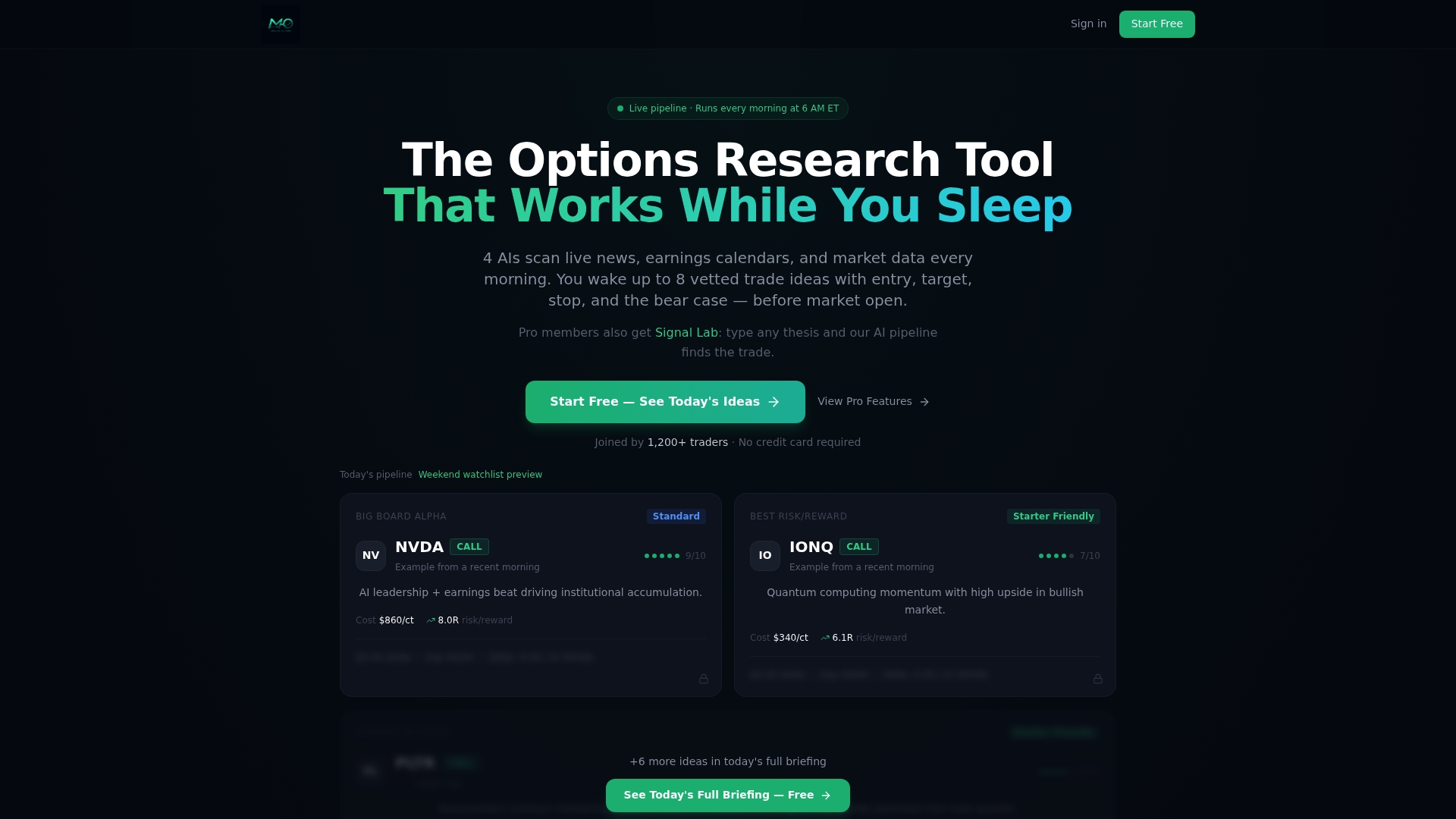
Morningoptions runs every potential trade through a five-stage AI pipeline that vets, scores, and explains each idea before the market opens. You get ranked, specific contract ideas with entry levels, not vague commentary. The free daily briefing covers the morning setups. The Pro tier ($89/mo) adds a lunchtime scanner and an on-demand AI chat scanner for researching any ticker in real time.
When instrument selection is the difference between a 26.8% and a 37% tax rate, getting the right trade idea in front of you before the open matters. Start with Morningoptions and see what the scanner surfaces today.
Key Takeaways
Section 1256 index options (SPX, NDX, RUT) deliver the largest single tax advantage available to retail options traders, saving a top-bracket trader roughly $10,200 annually versus equivalent SPY trades. For example, on $100,000 in annual profit, a trader can save this amount by choosing SPX over SPY, thanks to the 60/40 tax treatment.
| Point | Details |
|---|---|
| Section 1256 advantage | SPX options' 60/40 tax treatment cuts the effective rate to ~26.8% vs 37% for short-term equity options gains. |
| Collar strategy | Selling covered calls on concentrated stock builds a premium pool that partially funds the eventual capital gains tax bill. |
| Wash sale avoidance | Rotating to a correlated but non-identical underlying after a loss preserves market exposure and keeps the loss deductible. |
| Roth IRA for high turnover | Options premiums and spread income inside a Roth IRA compound completely tax-free with no wash sale tracking required. |
| Daily workflow discipline | Tracking trades at execution, timing harvests to November, and selecting Section 1256 instruments by default are the habits that compound tax savings year over year. |