
Options trading around business cash flow is defined as the practice of using options income strategies, specifically cash-secured puts, covered calls, and the wheel strategy, to generate predictable premium income that supplements or stabilizes a company's operating cash position. The industry term for this approach is "options overlay," and it sits at the intersection of active trading and corporate treasury management. Business owners and finance professionals who deploy these strategies correctly can collect recurring premiums, set target entry prices on stocks they want to own, and build a repeatable income cycle that runs parallel to core business revenues. The key constraint is discipline: options income is not guaranteed, and losses can occur when markets move against open positions.
Which options strategies work best to optimize business cash flow?
Three strategies dominate the options income space for business cash flow purposes: cash-secured puts, covered calls, and the wheel strategy. Each generates premium income in a different phase of a market cycle, and each carries a distinct risk profile.
Cash-secured puts
A cash-secured put involves selling a put option on a stock you are willing to own, while holding enough cash to buy 100 shares per contract if assigned. Selling one put contract requires cash equal to the strike price multiplied by 100, reserved in the account. The premium collected hits your account immediately and reduces the effective cost basis if you are assigned shares. The trade works best when you are neutral to bullish on the underlying stock and want to enter a position at a discount.

Covered calls
A covered call requires owning 100 shares of stock and selling a call option against that position. The premium collected is yours to keep regardless of outcome. If the stock rises above the strike price at expiration, shares get called away at the agreed price. If the stock stays flat or falls, you keep the premium and retain the shares, then sell another call the following cycle.
The wheel strategy
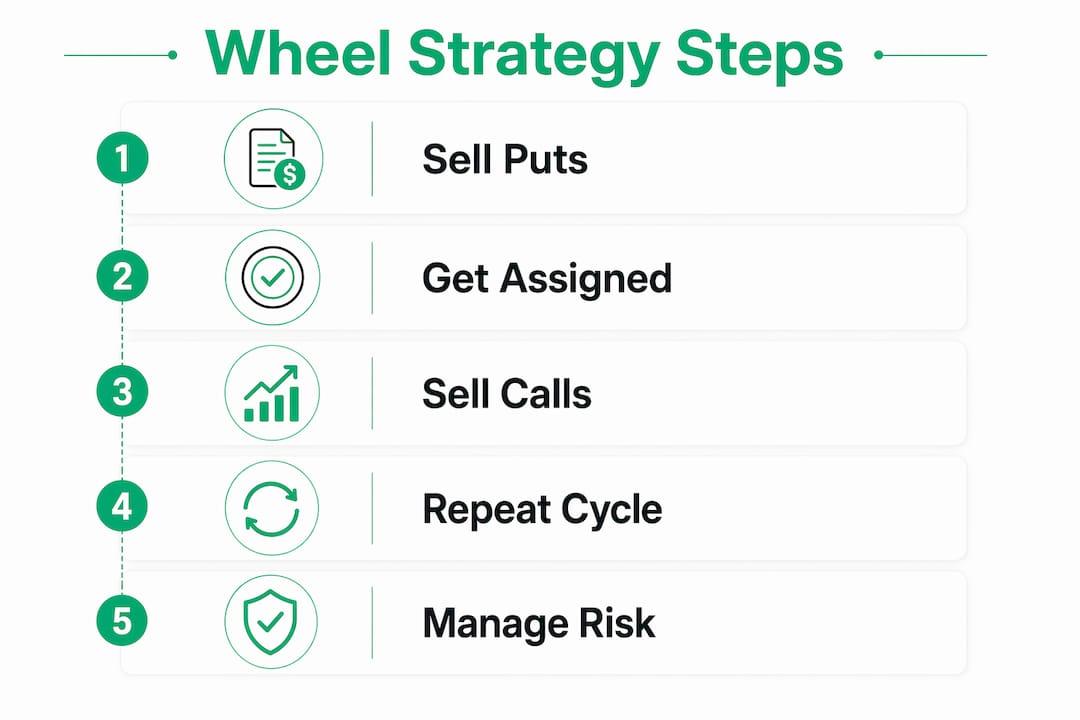
The wheel combines both approaches into a continuous income engine. You sell cash-secured puts until assigned shares, then sell covered calls against those shares until they are called away, then repeat. The wheel produces three income sources: premiums from put sales, premiums from call sales, and potential capital gains on assigned shares. That triple-income structure makes it the most popular strategy among business owners who want systematic, repeatable cash flow from a defined pool of capital.
Pro Tip: Target stocks with implied volatility in the 30th to 50th percentile range. High implied volatility inflates premiums, but it also signals elevated risk. Moderate volatility gives you a better balance between income and assignment probability.
Implied volatility directly controls premium size. Earnings season boosts premiums significantly, but downside risk grows if a stock drops below the strike after a disappointing report. Treat earnings-period premium spikes as a double-edged tool, not free money.
What prerequisites and resources do you need to start?
Before deploying any options strategy for business cash flow, you need the right capital base, account structure, and analytical tools. Skipping any of these steps creates execution problems that compound quickly.
| Prerequisite | Requirement | Why It Matters |
|---|---|---|
| Capital reserve | Strike price × 100 per put contract | Secures the position and prevents margin calls |
| Options-approved account | Level 2 or higher options privileges | Required to sell puts and covered calls |
| Liquid underlying assets | Large-cap stocks or ETFs like SPY and QQQ | Tight bid-ask spreads reduce slippage costs |
| Screening tools | Options scanner with IV rank and delta filters | Identifies high-probability setups efficiently |
| Trade tracking system | Spreadsheet or dedicated trade journal | Documents rationale and monitors P&L by cycle |
Liquid underlying assets like S&P 500 components and major ETFs reduce bid-ask spreads and make position management far easier. Illiquid options chains punish sellers with wide spreads that eat directly into premium income. Stick to names where open interest exceeds 1,000 contracts at your target strike.
Account structure matters for business entities. A business trading account with options privileges at a major broker requires entity documentation and may carry different margin rules than a personal account. Consult your accountant before opening the account, because options premium income has specific tax treatment that affects quarterly estimated payments.
Morningoptions provides a daily AI-powered scanner that vets and scores trade ideas each morning before the open. For business owners who cannot spend hours screening, that pre-filtered list of ranked contract ideas cuts setup time significantly.
How do you execute options trades around business financial cycles?
Execution follows a repeatable process. Consistency in that process is what separates traders who generate reliable cash flow from those who produce erratic results.
-
Select the underlying asset. Choose a stock or ETF you are comfortable owning at the strike price. Confirm it has adequate liquidity by checking open interest and bid-ask spread at your target strike.
-
Choose strike and expiration. For cash-secured puts, target a delta between 0.20 and 0.35. That range gives you a high probability of expiring worthless while still collecting meaningful premium. Use the 30 to 45 day expiration window, because theta decay accelerates most sharply in the final 30–45 days before expiration.
-
Confirm your cash reserve. Before placing the trade, verify the required cash is set aside and not earmarked for operating expenses. Mixing trading capital with working capital creates a liquidity problem if assignment occurs at an inconvenient time.
-
Place the trade and document it. Record the underlying, strike, expiration, premium collected, and your rationale. Systematic trade tracking correlates strongly with consistent cash flow results. Without documentation, you cannot identify what is working or why.
-
Monitor and manage the position. Set price alerts at 50% of maximum profit. When the option loses half its value, consider closing early and redeploying capital into a new position. This "50% rule" captures most of the available premium while freeing capital faster.
-
Handle assignment or expiration. If the option expires worthless, collect the full premium and repeat the cycle. If assigned, begin selling covered calls against the shares immediately. Address tax implications with your accountant each quarter, because premium income flows through differently than capital gains.
Pro Tip: Avoid selling puts through earnings announcements unless you have a specific, documented thesis for the trade. Assignment around earnings can lock up capital unexpectedly and create working capital constraints at the worst possible time.
Rolling a position means closing the current option and opening a new one at a later expiration or different strike. Roll when the underlying moves against you and you want to avoid assignment, or when you can collect additional premium by extending time. Rolling is a management tool, not a rescue plan. Use it proactively, not reactively.
How can business owners manage risks and avoid common pitfalls?
Options income strategies carry real downside. Option overlay strategies cap upside and create assignment risk without defined-loss measures. Understanding those risks before you trade is what keeps business cash flow intact.
The most common pitfalls include:
- Overleveraging capital. Selling too many contracts relative to your cash reserve ties up working capital and leaves no buffer for business operations. Limit options positions to capital you can afford to have locked up for 30–45 days.
- Ignoring liquidity. Thinly traded options have wide bid-ask spreads. Entering and exiting these positions costs more than the premium justifies.
- Skipping a written plan. Trading without documented rules leads to emotional decisions. Write down your strike selection criteria, maximum position size, and exit rules before placing a single trade.
- Misreading premium as profit. Premium income compensates for equity risk, not risk-free yield. A stock that falls 20% below your strike wipes out many months of collected premiums.
- Ignoring earnings dates. Implied volatility spikes before earnings inflate premiums but create gap risk. A stock can open 15% lower after a bad report, leaving you assigned at a price far above market value.
For business owners who want defined risk, credit spreads cap the maximum loss on a trade. A bull put spread, for example, sells a put at one strike and buys a lower-strike put as protection. The net premium is smaller, but the maximum loss is fixed and known before entry.
"Option overlay strategies can shift return drivers from capital gains to cash flow, but they require disciplined risk management to mitigate downside risks. Capped upside and assignment risk are real without defined-loss measures." — BlackRock
Position sizing is the most underrated risk control in options income trading. No single position should represent more than 5% of your total trading capital. That rule alone prevents one bad trade from derailing months of consistent premium collection.
Key Takeaways
The most effective approach to options trading around business cash flow combines cash-secured puts, covered calls, and the wheel strategy within a disciplined, documented risk framework.
| Point | Details |
|---|---|
| Start with cash-secured puts | Reserve strike price × 100 in cash per contract before selling any put. |
| Use the wheel for recurring income | Cycle between put sales and covered calls to generate premiums continuously. |
| Target 30–45 day expirations | Theta decay accelerates in this window, maximizing premium erosion in your favor. |
| Define risk before every trade | Use credit spreads or strict position sizing to cap maximum loss per position. |
| Track every trade systematically | Document strike, expiration, premium, and rationale to identify what works over time. |
What I've learned from treating options as a cash flow tool
Most business owners approach options trading the wrong way. They see premium income as a bonus on top of their portfolio, something to collect when conditions feel right. That mindset produces inconsistent results. The traders who generate reliable cash flow treat options selling like a business process: repeatable, documented, and governed by written rules.
The biggest mistake I see is mixing trading capital with operating reserves. When a business owner sells a cash-secured put using money that also covers payroll, assignment creates a genuine crisis. The fix is simple but non-negotiable: ring-fence your options capital completely. Treat it as a separate line item in your treasury, with its own floor and ceiling.
Continuous education matters more than most people admit. Options pricing, implied volatility, and assignment mechanics are not intuitive. The business owners who perform best spend time studying high-probability trade selection and reviewing their trade logs monthly. They treat losing trades as data, not failures.
The wheel strategy is genuinely powerful for business cash flow, but only when the underlying stock is one you would hold long-term anyway. Selling puts on a stock you do not want to own is speculation dressed up as income trading. Own the thesis before you sell the option.
— Customer
How Morningoptions supports your options income strategy
Business owners and finance professionals need trade ideas that are specific, ranked, and ready before the market opens. Vague commentary wastes time that most operators do not have.

Morningoptions delivers AI-powered daily briefings with ranked contract ideas, entry levels, and scored trade setups every market morning. The platform's five-AI pipeline vets each idea before it reaches you, so you are not sifting through noise. The Pro tier at $89/month adds a lunchtime scanner and an on-demand AI chat scanner for researching specific tickers. For business owners building a systematic options income program, that combination of pre-market signals and real-time research removes the biggest friction point: knowing where to look and when to act.
FAQ
What is options trading around business cash flow?
Options trading around business cash flow is the practice of selling cash-secured puts and covered calls to generate recurring premium income that supplements a company's operating cash position. The goal is predictable income from a defined pool of capital, not speculative gains.
How much capital do I need to start selling cash-secured puts?
You need cash equal to the strike price multiplied by 100 for each put contract you sell. For example, selling one put at a $50 strike requires $5,000 in reserved cash per contract.
What is the wheel strategy in options trading?
The wheel strategy cycles between selling cash-secured puts and covered calls to generate income continuously. It produces premiums from put sales, premiums from call sales, and potential capital gains on assigned shares.
How does implied volatility affect my premium income?
Higher implied volatility produces larger premiums, but it also signals greater risk of a large price move against your position. Earnings season typically spikes implied volatility, which inflates premiums but raises assignment risk significantly.
How do I reduce assignment risk in options income trading?
Use defined-risk structures like bull put spreads to cap maximum loss, avoid selling puts through earnings announcements, and select strikes with a delta of 0.20 to 0.35 to keep assignment probability manageable.