
Run five checks before every trade: account risk gates (cash, buying power, margin), contract liquidity (spread, volume, open interest), a written entry rule, a written exit rule, and a logged outcome. Skip any one of them and you're gambling with business capital, not trading it. Some pre-market tools can compress the research step, but the checklist itself has to run every single day, no exceptions.
TL;DR:
- Account risk checks must be performed daily, including cash, margin, and Greeks, before selecting any trade to prevent reckless exposure.
- Trade ideas should be based on underlying catalysts with high volume and clear technical setups, not on impulsive chart patterns alone.
- Position sizing and daily loss limits must strictly cap each trade at 1-3% of the account and stop trading after losses reach 3-5% of total capital.
- Use limit orders, confirm liquidity, and set alerts immediately after entry to ensure proper execution and effective position management.
- Business cash flow should determine trading activity, with at least 60 to 90 days of fixed costs covered before risking additional capital.
Table of Contents
- Pre-Trade Checks: Confirm Your Account and Market Gates First
- Trade Selection: Pick the Underlying, Strategy, and a Liquid Contract
- Risk and Sizing Rules That Actually Protect Your Business Capital
- Entry and Execution: What to Confirm Before You Send the Order
- Managing Open Positions: Profit Targets, Stops, and Time-Based Exits
- Your Daily Routine: A 30-Minute Pre-Market Checklist and Post-Session Log
- Check Your Business Cash Flow Before You Fund a Trading Account
- Match Your Investing Goals to Your Actual Business Financial Plan
- What Business Investment Income Means for Your Taxes
- Due Diligence: Vetting a Trade Idea Before You Risk Business Capital
- Risk Assessment That's Different for Business Owners Than for Full-Time Traders
- Diversify Across Your Business and Personal Portfolio, Not Just Within Options
- Adapting the Checklist to a Busy Business-Owner Schedule
- How MorningOptions Fits Into This Checklist Every Morning
- Sources
Pre-Trade Checks: Confirm Your Account and Market Gates First
Before you scan a single ticker, confirm you're actually allowed to trade today. This is the gate that keeps a bad morning from becoming a bad month.
Start with an account snapshot: cash on hand, buying power, current open profit and loss, and margin utilization. Business owners in particular need to separate trading capital from operating capital mentally and, ideally, in a separate account, so a rough trading week never touches payroll.
Next, roll up your portfolio Greeks. Net delta tells you your directional exposure across everything you're holding; net vega tells you how exposed you are to a volatility crush or spike. Set fixed limits for both (more on numbers below) and check today's totals against them before adding anything new.
Then read the market context in under five minutes: where is the VIX sitting, what's the expected move on your usual underlyings, and is anything major on the calendar (Fed meetings, CPI, an earnings cluster in your sector)? Pre-market routines that prioritize market context and an underlying-first approach consistently produce cleaner, less reactive trades than jumping straight to chart-scanning.
Finally, apply a binary go/no-go rule. Trigger a no-trade day if:
- Your account has exceeded your usual daily drawdown limit
- Margin utilization exceeds your cap, which is often around half to a bit over half
- A major macro event lands before the close and you don't have a plan for it
- You're outside your normal trading hours because of business obligations and can't monitor the position
Trade Selection: Pick the Underlying, Strategy, and a Liquid Contract
Pick the underlying before you touch an option chain. The option is the vehicle for an idea you already have, not the source of the idea itself, and routines that start with the underlying rather than the option chain cut down on impulsive, low-conviction entries.
- Screen the underlying first. Look for a real catalyst (earnings, news, sector move), volume above its average, and a technical setup you can actually describe in one sentence. If you can't explain why the stock moves from here, skip it.
- Run a direction-by-volatility filter. Bullish and low implied volatility often points toward a debit spread or long call; bullish and high IV favors a credit spread. Bearish and high IV often favors a put credit spread over an outright short put. This shortlist should give you one to three viable structures, not ten.
- Apply contract-quality gates. Reject anything with a bid-ask spread wider than roughly 10% of the option's price, open interest below 100 contracts, or quote size too thin to fill your intended size without moving the market. Illiquid contracts and wide spreads create immediate execution friction that erodes edge before the trade even gets going.
- Match expiration and strike to the strategy. Shorter-dated trades (7 to 21 days to expiration) suit defined directional bets; 30 to 45 DTE is a common default for credit spreads and iron condors, often around the 16 to 30 delta strikes depending on your risk tolerance.
Risk and Sizing Rules That Actually Protect Your Business Capital
This is the section most business owners skip, and it's the one that ends careers. Position sizing and portfolio-level controls are the fundamental risk-management rules for options traders, full stop.
Pro Tip: If you can't state your max dollar loss on a trade before you enter it, you haven't finished the checklist yet. Say the number out loud. If it makes you uncomfortable, size down.
- Per-trade risk: cap each individual trade at 1 to 3% of total account value. A $100,000 account trading at 2% risks $2,000 per position, no matter how confident the setup looks.
- Daily loss limit: stop trading for the day once losses hit roughly 3 to 5% of account value. This is a circuit breaker, not a suggestion.
- Drawdown circuit breaker: if the account is down 10% from its recent high, cut position size in half until it recovers. Down 15 to 20%, stop opening new trades entirely and review the plan.
- Portfolio caps: set a hard ceiling on net delta relative to account size, a total vega cap, a max margin utilization (commonly 50 to 60%), and a max number of concurrent positions (often 5 to 8 for a part-time trader).
Defined-risk structures let you calculate maximum loss at entry, which is exactly why they're the backbone of a business owner's options book. A $5 wide iron condor sold for $1.50 has a known max loss of $350 per contract. Divide your per-trade dollar risk by that number and you have your contract quantity, no guessing involved. A quick primer on position sizing methods for deciding how much to risk per trade is worth bookmarking if you want the math spelled out further.
Entry and Execution: What to Confirm Before You Send the Order
Getting the idea right doesn't matter if the fill wrecks the trade. Run this sequence every time.
- Confirm entry conditions. The underlying is at or near your target price level, you're inside your normal trading window, and implied volatility sits where your strategy needs it (low for debit trades, elevated for credit trades).
- Use limit orders, not market orders. For spreads, place the order at or near the mid price and work it in small increments if it doesn't fill immediately. Market orders on multi-leg option spreads routinely give away edge to the market maker.
- Run the pre-flight checklist. Liquidity confirmed, max loss confirmed in dollars, no conflicting earnings or macro event before your planned exit. Any single fail means don't send the order.
- Set your alerts immediately after the fill. A GTC profit-take order at your target, a mental or hard stop at your defense level, and a calendar reminder for DTE-specific checkpoints like 21 days to expiration.
Pro Tip: Set your exit alerts the same minute you get filled, not "later today." Later today is when a business call eats your afternoon and the position runs unmanaged.
Managing Open Positions: Profit Targets, Stops, and Time-Based Exits
Time-based exits matter just as much: many traders close or roll short premium at 21 days to expiration regardless of profit and loss, because gamma risk accelerates fast in the final three weeks.
- Roll a position when the underlying has moved against you but the thesis is intact and you can improve your strike or credit.
- Hedge with a protective option or offsetting position when a specific event (earnings, a Fed decision) threatens a gap move you didn't originally underwrite.
- Close outright when the thesis is simply wrong, not just moving against you temporarily.
Mental stops work for traders who are watching screens; business owners who step away for meetings need hard, automated alerts instead. Set the 21-DTE reminder in your calendar app, not just your brain, because your brain will be thinking about a client call.
Your Daily Routine: A 30-Minute Pre-Market Checklist and Post-Session Log
A short, repeatable routine beats an exhaustive one you'll abandon after two weeks, because consistency in a written trading plan matters more than completeness for busy traders.
- Pre-market (30 to 60 minutes): check futures direction, VIX level, expected move on your core watchlist, and confirm your top two or three trade candidates against yesterday's screen.
- Post-session log: record entry price, exit price, realized profit and loss, whether you followed the plan, and one lesson from the day. Keep it to a few lines.
- Score each trade 0 to 100 against your checklist criteria before you enter, using a pre-flight scorecard that converts judgment into pass/fail criteria. Anything scoring below your threshold gets rejected, not "watched."
- Review weekly and monthly. Look specifically at rejected setups and failed checklist items; patterns there usually reveal the rule you keep bending.
Check Your Business Cash Flow Before You Fund a Trading Account
Trading capital and operating capital are not the same pool, even when they sit in the same bank. Before adding a dollar to your options account, confirm your business can cover 60 to 90 days of fixed costs (payroll, rent, inventory purchases) without touching what you've allocated to trading.
Run a simple liquidity check quarterly: current cash plus receivables due within 30 days, divided by upcoming fixed obligations over the same period. If that ratio drops below roughly 1.5, pause new contributions to the trading account until cash flow stabilizes. A practical guide to assessing business cash flow walks through the specific line items worth tracking if you haven't formalized this yet.
Seasonal businesses need an extra layer here. A landscaping company or a tax-prep firm has predictable slow months, and trading capital pulled from a high season needs to survive the low one untouched. The mistake isn't trading during a slow season, it's sizing trades as if revenue were flat all year. A deeper look at aligning options trading activity with business cash-flow cycles covers how to build that buffer into your sizing rules directly.
The rule of thumb worth repeating to yourself: if a trading loss would force you to delay a supplier payment or miss payroll, the position was too large from the start, not unlucky.
Match Your Investing Goals to Your Actual Business Financial Plan
Trading income and business growth capital usually need to serve different jobs, and mixing them up leads to bad decisions on both fronts.
Ask what the trading account is actually for. Supplemental income to smooth a lumpy revenue year? A separate savings vehicle outside the business? Capital you're deliberately growing to eventually reinvest in equipment or hiring? Each answer changes your risk tolerance. A trader funding near-term equipment purchases should be running smaller, more defined-risk structures than one growing a long-term personal reserve with a multi-year horizon.
Write this down as a one-line policy: "Trading profits above $X per quarter get swept to [business reinvestment / personal savings / debt paydown]." Without that rule, gains from a good month quietly become working capital, and the account never compounds the way it could. Equally, without a clear boundary, a rough month invites the temptation to "just borrow a bit from the business account to get back to even," which is exactly the kind of decision that turns a trading loss into a business problem.
Revisit this alignment twice a year, alongside your regular business planning cycle, not on some arbitrary trading calendar. Your fiscal year, tax deadlines, and seasonal cash needs should drive when you reassess, not a random Tuesday when a trade went well.
What Business Investment Income Means for Your Taxes
Options income doesn't get taxed like ordinary business revenue, and treating it that way at filing time creates real problems. Short-term options gains, which cover most active trading, are typically taxed as short-term capital gains at your ordinary income rate in the United States, not at the lower long-term capital gains rate reserved for positions held over a year.
Wash sale rules apply to options just as they do to stock, which matters if you're closing a losing position and reopening a similar one within 30 days across the same or a substantially identical security. Keep a running log of closed positions with dates, because reconstructing this at tax time from memory is a losing game.
If you're actively trading through a business entity rather than a personal brokerage account, the tax treatment shifts again, and the line between "trader tax status" and simply being an active retail trader carries real consequences for what expenses you can deduct. This is genuinely an area where a qualified tax professional earns their fee, since the rules differ based on entity structure, trading frequency, and whether the account sits inside or outside the business. A closer look at tax efficiency considerations for different options strategies is a useful starting point before that conversation, not a replacement for it.
Due Diligence: Vetting a Trade Idea Before You Risk Business Capital
Every trade idea deserves the same skepticism you'd apply to a business investment, because that's exactly what it is.
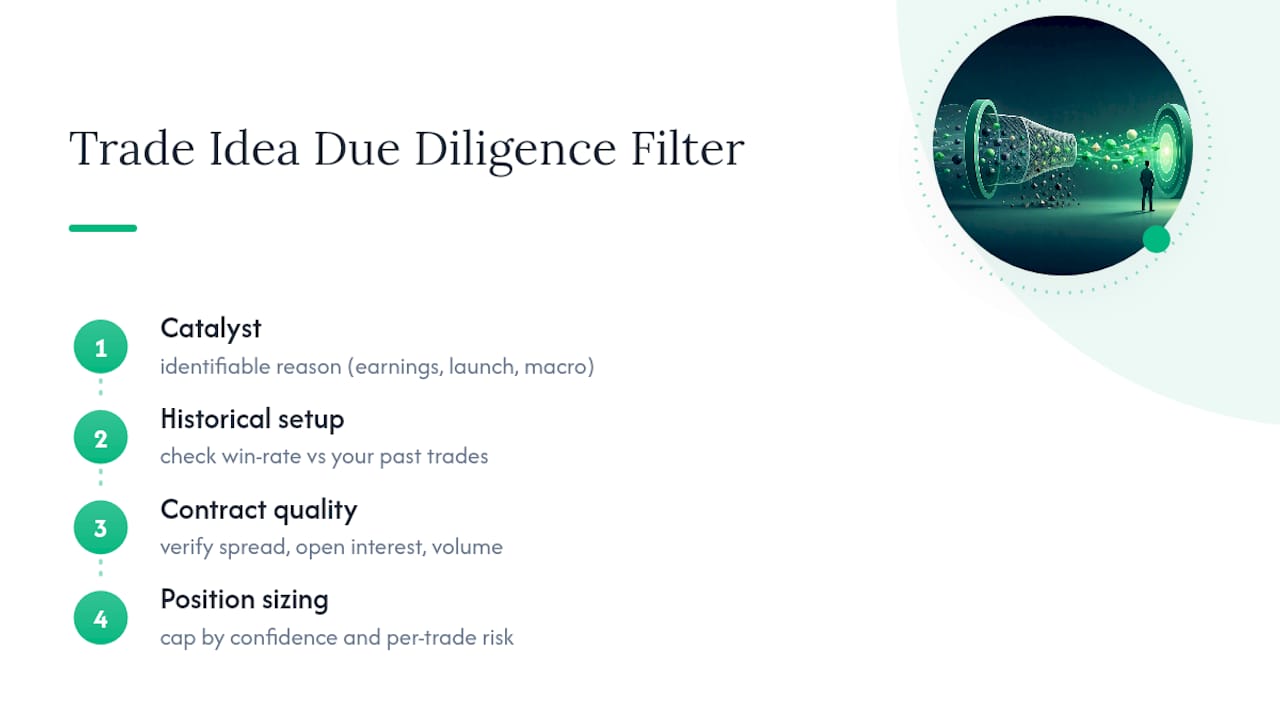
Start with the catalyst. Is there a real, identifiable reason the underlying should move (earnings, a product launch, a sector rotation, a macro shift), or are you reacting to a chart pattern with no story behind it? Trades built on a story you can explain in one sentence tend to outperform trades built on "it looks like it's about to break out."
Check the setup against your own historical data, not just gut feel. If your post-session log shows credit spreads on high-IV tech names have a worse win rate than the same structure on lower-volatility index ETFs, that's due diligence you already own and should be using. Confirm the contract-quality gates one more time (spread, open interest, volume) since a great idea on an illiquid contract is still a bad trade.
Finally, size the position against the confidence level, not against how much capital happens to be sitting idle. A high-conviction setup still gets capped at your per-trade risk limit. A moderate-conviction idea gets sized down further, even if the checklist technically passes. Due diligence isn't a single gate, it's a filter that runs at every step from idea to fill.
Risk Assessment That's Different for Business Owners Than for Full-Time Traders
A full-time trader's biggest risk is usually psychological: overtrading, revenge trading, ignoring stops. A business owner carries an additional layer most retail trading content ignores entirely: attention risk.
You cannot watch a screen all day, which means every open position needs to survive hours of inattention without blowing through your risk limits. This alone should push you toward defined-risk structures, wider stops that don't get triggered by normal intraday noise, and fewer concurrent positions than a full-time trader might run. Five open positions you can genuinely track between meetings beats twelve you're checking once at lunch.
There's also correlation risk between your business and your trading account that full-time traders don't face. If you run a construction business and load up on homebuilder calls, a downturn in housing hits your paycheck and your trading account at the same time. Deliberately trading sectors uncorrelated with your business's revenue is a form of risk management specific to owner-traders, and it's worth building into your underlying-selection rule alongside the technical criteria.

Finally, account for the cost of a bad trading day on your business judgment the next day. A rough loss that rattles you emotionally on Monday can bleed into a bad pricing decision or a snapped reply to a client on Tuesday. That's a real cost, even if it never shows up in your trading log.
Diversify Across Your Business and Personal Portfolio, Not Just Within Options
Concentration risk in a small business is already high by default, since most of an owner's net worth sits in one illiquid asset: the company itself. Options trading capital should not compound that concentration further.
Treat your trading account as one slice of a broader allocation that also includes personal retirement accounts, any real estate, and the equity value of the business itself. If the business already carries heavy exposure to interest rates (real estate, construction, equipment financing), running a trading book stacked with rate-sensitive names doubles down on a risk you're already carrying. A hedging approach aimed at offsetting business-level risk with options can occasionally work in the opposite direction, using the trading account to partially offset a risk the business already faces, though this is an advanced technique and not where a new business owner-trader should start.
Within the trading account itself, diversify across underlyings and sectors, not just across strategies. Ten iron condors on ten different tech tickers is not diversification if a single Nasdaq selloff takes all ten down together. Spread positions across sectors with genuinely different drivers, and cap total exposure to any one sector at a fixed percentage of the trading account, the same way you'd cap exposure to any single position.
Adapting the Checklist to a Busy Business-Owner Schedule
The full checklist is non-negotiable, but its execution can flex. On heavy business weeks, shrink position size and lean on defined-risk, set-and-forget structures like iron condors that don't need minute-by-minute attention. A pre-market brief, whether from MorningOptions or your own scan, compresses the research step without skipping the contract-quality gates that actually protect capital. Journaling can shrink to three lines a day. What can't shrink is consistency: a checklist you run four days a week beats a perfect one you run once a month.
— Customer
How MorningOptions Fits Into This Checklist Every Morning
Most of this checklist takes time precisely at the moment you have the least of it, right before the market opens and right when your business day is starting too. MorningOptions delivers AI-powered options briefings every market morning, built specifically to speed the parts of this routine that eat the most time: reading market context, screening underlyings, and filtering for contract quality.

Daily briefs can provide ranked, specific contract ideas with entry levels worked out, replacing the underlying-first scan in the trade selection step. Some services also offer a paid tier adding a lunchtime scanner for a second read on the day and an AI chat scanner for researching a specific ticker on demand, useful when a client meeting runs long and you need a fast answer on one name rather than a full market scan. None of it replaces your own risk rules, position sizing, or exit discipline, but it does compress the research half of the morning routine into minutes instead of an hour. Start with the free daily briefing and see how it slots into your own pre-market checklist before deciding whether the Pro tier earns a spot in your routine.