
Cash flow protection investing, in the options trader's sense, means running covered calls, cash-secured puts, protective puts, and collars together as a system: you collect steady premium income while defining a hard floor under your downside. It is not dividend investing or rental real estate. It is a deliberate options-based approach that reshapes your risk/return profile on positions you already own or want to own.
The four core building blocks:
- Covered call: sell a call against shares you hold to collect premium and reduce cost basis
- Cash-secured put: sell a put with cash reserved to buy shares at the strike if assigned
- Protective put: buy a put to cap your maximum loss on a long stock position
- Collar: combine a long put and a short call on the same stock to create a floor and a ceiling simultaneously
Fidelity's institutional options guidance frames this well: options strategies reshape risk/return rather than simply "produce income" or "provide protection" in isolation. Define the portfolio outcome first, then pick the structure. The CBOE BuyWrite Index (BXM), which tracks a systematic covered-call strategy on the S&P 500, delivered 11.77% annualized returns with lower volatility over an 18-year study period. Morningoptions builds its daily trade briefings around exactly this framework: ranked, specific contract ideas with entry and exit levels, not vague commentary.
Key Takeaways
Cash flow protection investing combines premium income from short options with defined downside floors, giving active traders a repeatable system that works across market regimes.
| Point | Details |
|---|---|
| Core definition | Covered calls, cash-secured puts, protective puts, and collars generate income while limiting downside. |
| Delta and DTE targets | Use 0.25–0.35 delta for short calls, 0.20–0.30 for short puts, at 30–45 DTE for income legs. |
| Strategy selection | Match the strategy to your outlook: covered calls for neutral/bullish, collars for concentrated winners, protective puts for near-term hedges. |
| Monitoring rule | Close short legs at 75% of max profit; set delta alerts at 0.50 and check ex-dividend dates before entry. |
| Execution trigger | Only sell premium when IV rank is above 50; buy protective puts when IV rank is below 30. |
Table of Contents
- When do income-protection option strategies make sense?
- What are the mechanics and payoff profiles of each core strategy?
- How do you implement these trades step by step?
- How do implied volatility and the Greeks affect your trade economics?
- Worked numeric examples: P/L at expiration
- How do you manage positions: rolling, closing, and handling assignment?
- Which strategy fits your account and goal?
- How Morningoptions helps you run these trades
- The system matters more than any single trade
- Sources
When do income-protection option strategies make sense?
Strategy selection should match your market outlook and portfolio situation. Fidelity and options practitioners are explicit: covered calls suit neutral-to-bullish views; protective puts suit downside hedging. Here is how that maps in practice:
- Neutral to mildly bullish: covered calls or cash-secured puts. You are comfortable capping upside in exchange for premium income.
- Bullish long-term but nervous short-term: protective put. You want to hold the position through a rough patch without a catastrophic loss.
- Concentrated winner or approaching a financial goal: collar. You lock in a floor without selling the shares and triggering a taxable event.
- Waiting for a better entry price: cash-secured put. You get paid to wait, and if assigned, your effective purchase price is below the current market.
The honest trade-offs: income strategies cap your upside, and hedge strategies cost premium. A collar can be structured at zero net cost by using call premium to offset put cost, but you sacrifice the rally above your short call strike. None of these strategies are free. The question is whether the trade-off fits your goal right now.
What are the mechanics and payoff profiles of each core strategy?
Covered call
You own 100 shares and sell one call option. Maximum profit equals the strike price minus your stock cost basis plus the premium collected. Maximum loss equals your stock cost minus the premium. Practitioners target a short call delta of 0.25–0.35 and 30–45 days to expiration (DTE) to balance income against assignment probability.
Cash-secured put
You sell a put and hold enough cash to buy 100 shares at the strike if assigned. Effective purchase price equals the strike minus the premium collected. Target put delta in a moderate range. Capital required equals strike price × 100.
Protective put
You hold 100 shares and buy one put. The put premium is your insurance cost. A protective put limits losses while preserving full upside above the strike. Maximum loss equals stock cost minus put strike plus premium paid. Best used when you are bullish long-term but expect near-term turbulence.
Collar
You hold stock, buy a put, and sell a call. The short call premium offsets some or all of the put cost. A zero-cost collar is possible when call and put premiums match. Upside is capped at the call strike; downside is floored at the put strike. Watch for early assignment risk around ex-dividend dates and potential holding-period tax effects on qualified dividends. LegalClarity's hedging analysis flags collars as best suited for concentrated positions, not as a permanent overlay on a growth portfolio.
| Dimension | Covered Call | Cash-Secured Put | Protective Put | Collar |
|---|---|---|---|---|
| Income potential | Premium collected | Premium collected | None (cost) | Net credit or low debit |
| Downside protection | Partial (premium only) | Partial (premium only) | Full below put strike | Full below put strike |
| Net cost/credit | Credit | Credit | Debit | Near zero to small debit |
| Upside cap | Yes (call strike) | Yes (strike = entry) | No | Yes (call strike) |
| Complexity | Low | Low | Low | Moderate |
| Best outlook | Neutral/bullish | Neutral/bullish | Bullish + near-term hedge | Neutral/protect gains |
| Assignment risk | Moderate | Moderate | None | Moderate (short call) |
| Margin/cash needed | Shares required | Full cash reserved | Shares required | Shares required |
| Tax notes | May affect dividends | Short-term gain on premium | Premium is cost basis | Holding-period effects |
How do you implement these trades step by step?
A disciplined checklist prevents the most common execution mistakes:
- Pick your underlying. Choose a stock you want to own (for puts) or already own (for calls/collars). Liquidity matters: tight bid/ask spreads and open interest above 500 contracts per strike.
- Set your DTE. Use 30–45 DTE for income legs (covered calls, short puts). Use 3–6 months for protective puts when buying insurance.
- Select delta targets. Short calls: 0.25–0.35. Short puts: 0.20–0.30. Long puts for protection: 0.30–0.40 depending on how close you want the floor.
- Size the position. Cap any single position at a defined percentage of your account to manage risk; many traders use modest limits per underlying.
- Reserve cash. For cash-secured puts, hold the full strike × 100 in cash or a money market equivalent.
- Enter with limit orders. Never use market orders on multi-leg trades. Submit paired spread orders when your broker supports it to avoid leg risk.
- Record your breakeven and premium. Before you submit, write down: premium collected, breakeven price, and your planned exit trigger.
Pro Tip: Use IV rank to time your entries. Sell premium when IV rank is above 50 to capture inflated premiums. When IV rank is low, avoid selling calls or puts and instead focus on buying protective puts at a lower cost.
For options strategies in volatile conditions, the options strategies for volatile markets guide covers how skew and IV spikes change the math on each leg.
How do implied volatility and the Greeks affect your trade economics?
Options income strategies require active management of Greeks, path dependency, and margin to keep income and protection in balance. Here is what each Greek actually does to your position:
- Theta: time decay works in your favor on short legs. The 30–45 DTE window captures a significant part of the theta curve, where time decay accelerates as expiration approaches. Shorter DTE (under 21 days) increases gamma risk faster than theta benefit on most underlyings.
- Delta: treat it as a probability proxy. A 0.30-delta short call has roughly a 30% chance of expiring in the money. That is your assignment probability, not just a directional measure.
- Vega: long puts gain value when IV rises (good for your hedge), but short calls also gain value against you. Net vega on a collar is near zero, which is why collars hold up in volatility spikes better than naked short calls.
- Skew: in equity options, puts typically trade richer than calls at equivalent deltas. That means your protective put costs more than the call premium you collect at the same delta distance. A collar partially corrects this by selling the call to fund the put.
Pro Tip: Avoid selling premium when IV rank is below 30. Instead, use that low-IV window to buy longer-dated protective puts cheaply, then fund them with call premium when IV normalizes.
Worked numeric examples: P/L at expiration
Setup for all examples: Stock XYZ at $100, position size = 100 shares.
Covered call
Sell the $105 call, 35 DTE, for $2.00 premium. Net cost basis: $100 − $2 = $98.
Breakeven: $98. Max profit: $700. Max loss: $9,800 (stock to zero).
Cash-secured put
Sell the $95 put, 35 DTE, for $1.50. Cash reserved: $9,500. Effective purchase price if assigned: $93.50.
Protective put
Buy the $95 put for $2.00. Total cost basis: $102. A protective put preserves full upside while capping max loss.
Breakeven: $102. Max loss: $700 (stock falls to $95, lose $5 on stock + $2 premium). Upside: unlimited above $102.
Collar
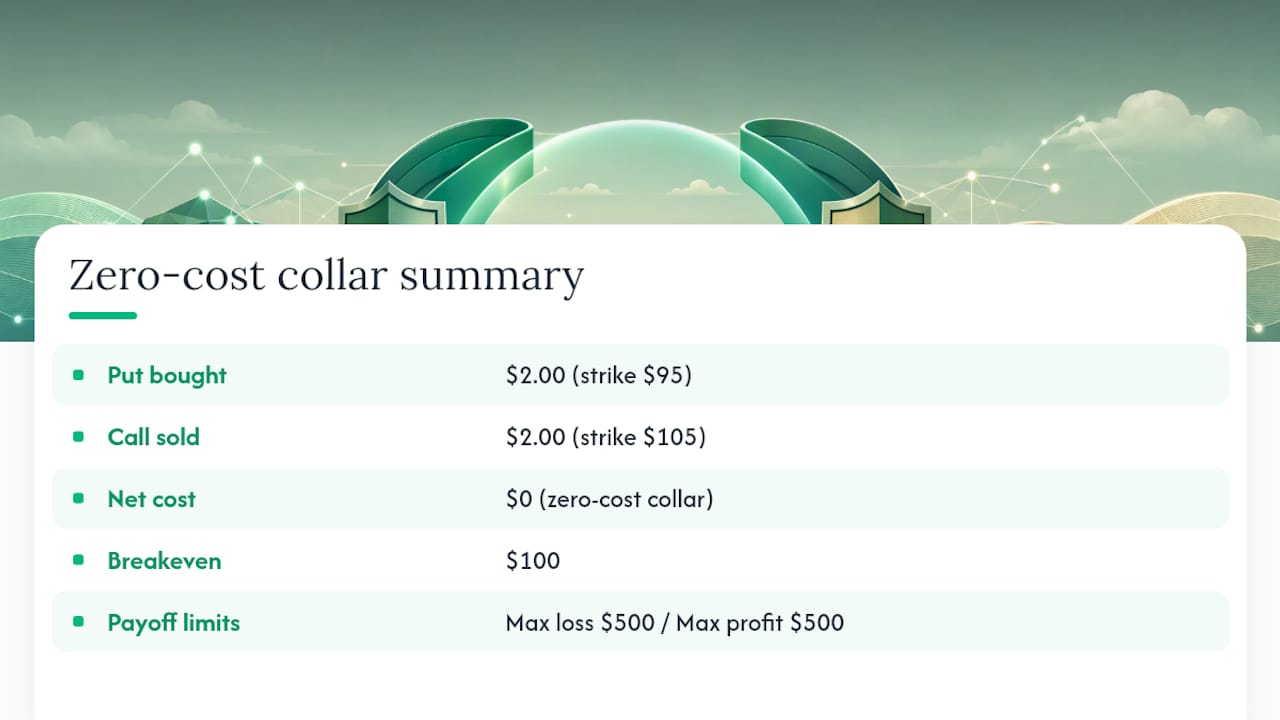
Buy the $95 put for $2.00, sell the $105 call for $2.00. Net cost: $0 (zero-cost collar). The collar creates a defined floor and ceiling with no net premium outlay.
Breakeven: $100. Max loss: $500 (stock to $95). Max profit: $500 (stock at or above $105).
For more defined-risk trade examples that extend these setups, the Morningoptions blog has eight worked cases.
How do you manage positions: rolling, closing, and handling assignment?
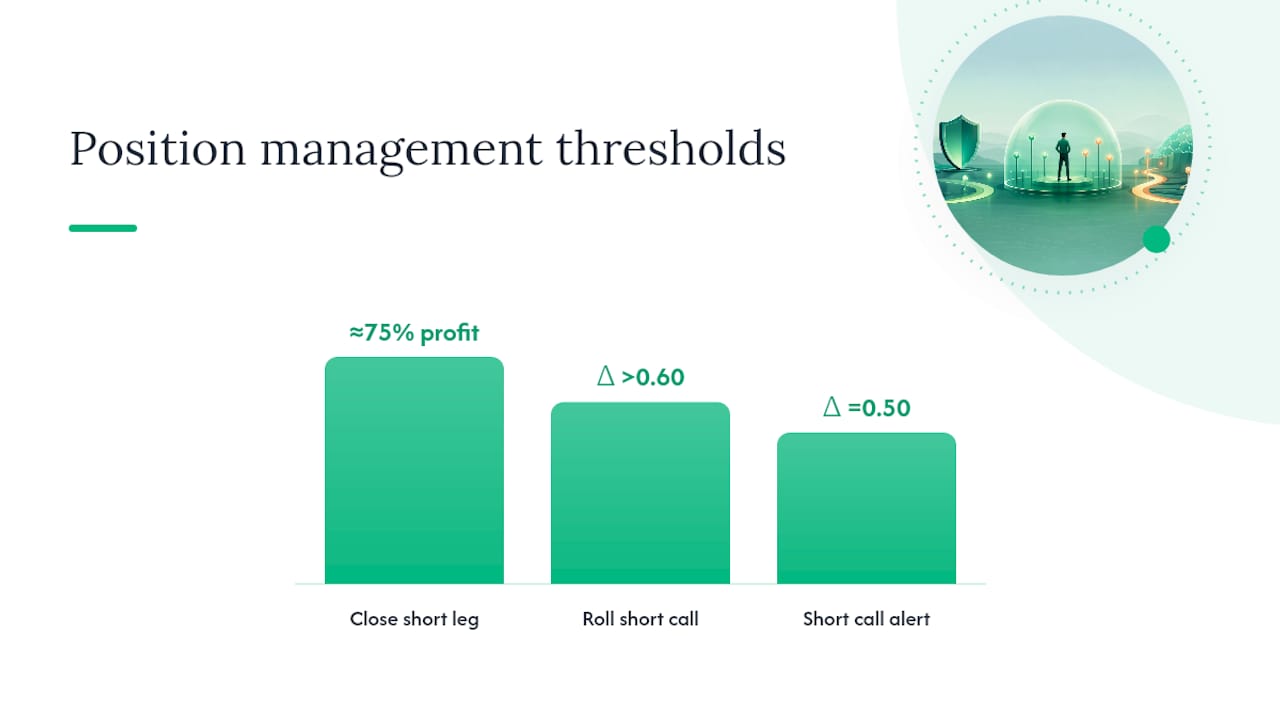
Close short legs at approximately 75% of maximum profit. On a $2.00 premium collected, buy it back at $0.50. Holding to expiration for the last $0.50 adds gamma risk that rarely justifies the reward.
Rolling rules: roll for a net credit when possible. If the short call is tested (delta above 0.60), roll up and out to a higher strike and later expiration. If you cannot collect a credit, evaluate closing the entire position instead of rolling for a debit.
Assignment handling: early assignment on short calls is most likely around ex-dividend dates when the call is deep in the money with little time value remaining. Check ex-dividend dates before entering any covered call or collar. If assigned early, you can repurchase shares and re-enter the position, or accept the sale and redeploy capital.
Emergency checklist:
- Short call deep ITM before ex-dividend: buy it back immediately or roll out
- Stock gaps down through put strike: let the put work or sell it to realize the hedge value
- Position size too large after a move: close one leg to reduce exposure before adjusting the other
- Tax event approaching: consult a tax professional before closing a collar that may reset your holding period
Pro Tip: Set price alerts at your short call delta = 0.50 and at your long put strike. Document your exit rules in your trade journal before you enter the position. Decisions made under pressure are almost always worse than ones made in advance.
For a full treatment of options assignment mechanics, including automatic exercise at expiration when a contract is $0.01 in the money, the Morningoptions assignment guide covers every scenario.
Which strategy fits your account and goal?
Match your inputs to the right structure before you trade. A three-pillar portfolio approach sequences income first, hedges second, and volatility plays third, which prevents protection costs from becoming a drag on returns.
Key inputs to assess:
- Account size and concentration in any single name
- Target monthly yield (1–2% is realistic for covered calls at 0.30 delta)
- Willingness to be assigned (sell shares or buy shares)
- Tax situation (long-term gains at risk, qualified dividends affected)
Action mapping:
- Want 1–2% monthly income and comfortable capping upside → covered calls or the wheel (covered call into cash-secured put cycle)
- Limited cash but want a lower entry price → cash-secured put
- Want a hard floor on a position you cannot sell → protective put
- Concentrated winner, tax-sensitive, need protection now → collar, structured near zero cost
- New to multi-leg trades → start with covered calls or cash-secured puts, add the hedge leg once you are comfortable with assignment
Pre-trade checklist (copy to your journal):
- Underlying selected and liquidity confirmed (open interest > 500)
- DTE set: 30–45 for income legs, 90–180 for protective puts
- Delta targets confirmed: short call 0.25–0.35, short/long put 0.20–0.30
- IV rank checked: above 50 to sell, below 30 to buy protection
- Position size within account limit (max 5% per name)
- Cash reserved for put assignment
- Exit trigger written down before entry
For traders who want a simpler starting point, the options strategy selection guide maps strategy to experience level and account size.
How Morningoptions helps you run these trades

Morningoptions delivers AI-powered options briefings every market morning: ranked contract ideas with specific entry levels, exit targets, and bear case analysis, not generic market commentary. The platform's five-stage AI pipeline vets and scores each idea before it reaches you.
For cash flow protection trades specifically:
- Daily briefings surface covered call and cash-secured put setups pre-filtered by delta, DTE, and IV rank, aligned with the 30–45 DTE income workflow
- Signal Lab lets you run on-demand scans for any ticker, pulling full options chain data and trade-ready suggestions on your schedule
- Pre-market intelligence flags earnings and dividend dates before the open, so you catch ex-dividend assignment risk before it catches you
- Options education covers everything from basic covered calls to collar construction, built into the same platform
The Pro tier ($89/month) unlocks the midday scanner and AI chat for researching tickers on demand. The free plan gives you daily briefings to start. Try Morningoptions and see the morning briefing before your next trade.
The system matters more than any single trade
Most traders treat covered calls as an income trade and protective puts as a separate hedge. The traders who do this consistently well run them as one system: income legs fund the hedge cost, and the hedge makes the income leg sustainable through drawdowns.
The discipline is the edge. A collar on a concentrated winner is not exciting. Neither is closing a covered call at 75% of max profit with two weeks left on the clock. But those rules, applied consistently, are what separate a repeatable cash flow protection approach from a series of disconnected bets.
Pro Tip: Never size a hedge position larger than the income it takes to fund it over a rolling 90-day window. If your covered call income cannot cover your put costs, you are over-hedging and eroding returns. Fund protection from premium, not from capital.
Sources
- Liquid alternatives: the power of equity options-based strategies
- Protective put
- Covered calls and cash-secured puts
- How a protective collar options strategy works
- Options income strategies (chapter)
- How to Build an Options Trading Portfolio: The 3-Pillar Blueprint | Days to Expiry
- Hedging with Options: Strategies, Costs and Tax Rules - LegalClarity
This article is general information, not a substitute for advice from a qualified financial advisor. Consult a qualified financial professional about your own circumstances before acting on anything here.