
A debit spread costs you money to open because you're paying more for the option you buy than you collect for the option you sell. A credit spread does the opposite: it pays you money upfront because you're collecting more than you spend. The quick rule of thumb: reach for a debit spread when you have real directional conviction and implied volatility is cheap, and lean on a credit spread when you expect a stock to sit still, chop sideways, or when implied volatility is rich enough to sell into.
TL;DR:
- Use a debit spread when you have strong directional conviction and implied volatility is low, aiming for a roughly even risk-to-reward profile.
- Opt for a credit spread when expecting sideways movement or rich implied volatility, as it provides upfront income with defined risk.
- Be aware that credit spreads benefit from time decay and negative vega, while debit spreads gain from volatility increases and tend to lose value over time.
- Most retail traders should match their spread choice to market conditions, with position sizing discipline being more critical than the spread type.
- Regularly monitor implied volatility levels, not just once, to avoid misjudging the strategy's payoff potential and risk profile.
Table of Contents
- Debit vs Credit Spread: The Core Mechanics and Examples
- Max Profit, Max Loss, and Breakeven: The Payoff Math
- How Theta and Vega Push Debit and Credit Spreads in Opposite Directions
- Margin, Assignment, and Broker Approval: What Retail Traders Actually Deal With
- A Pre-Trade Checklist: Debit or Credit Spread?
- Getting the Trade Right: Entries, Exits, and Position Sizing
- Where Morningoptions Fits Into This Decision
- Where to Learn More
- A Straight Take on Debit vs Credit Spreads
- Sources
Debit vs Credit Spread: The Core Mechanics and Examples
Every vertical spread, debit or credit, uses the same option type (all calls or all puts), the same expiration date, and two different strike prices. One leg is bought, one is sold. What separates a debit spread strategy from a credit spread strategy is simply which leg costs more.
In a debit spread, you buy the more expensive option and sell a cheaper one against it to offset some of the cost. You pay net premium out of pocket, which is why it shows up as a debit on your account. In a credit spread strategy, you sell the more expensive option and buy a cheaper one to cap your risk, so you collect net premium and it posts as a credit.
The canonical examples every retail trader should recognize:
- Bull call spread (debit): buy a lower strike call, sell a higher strike call. You want the stock to rise.
- Bear put spread (debit): buy a higher strike put, sell a lower strike put. You want the stock to fall.
- Bull put spread (credit): sell a higher strike put, buy a lower strike put for protection. You want the stock to stay flat or rise.
- Bear call spread (credit): sell a lower strike call, buy a higher strike call for protection. You want the stock to stay flat or fall.
That's the entire universe of standard vertical spreads. The Investopedia breakdown of credit versus debit spreads frames it the same way: credit spreads bring in premium at initiation, debit spreads require you to pay it out. If you ever forget which is which mid trade, check your account activity. Money left your account? Debit spread. Money landed in it? Credit spread. That single detail tells you everything about how the position behaves for the rest of its life, and the Wealthsimple guide to debit and credit spreads lays out the same four structures if you want a second reference point while you're memorizing them.
Max Profit, Max Loss, and Breakeven: The Payoff Math
The formulas are fixed and mechanical once you know the strikes and the premium. There's no guessing involved, which is part of why verticals are so popular with traders who want defined risk from the first tick.
For a debit spread:
- Max loss = net premium paid
- Max profit = strike width minus net premium paid
- Breakeven = long strike plus net debit (for calls) or long strike minus net debit (for puts)
For a credit spread:
- Max profit = net premium received
- Max loss = strike width minus net premium received
- Breakeven = short strike minus net credit (for puts) or short strike plus net credit (for calls)
The Fidelity options strategy reference confirms this relationship: a debit spread's max loss is always capped at what you paid, while a credit spread's max loss is the strike width minus whatever credit you banked at the open.
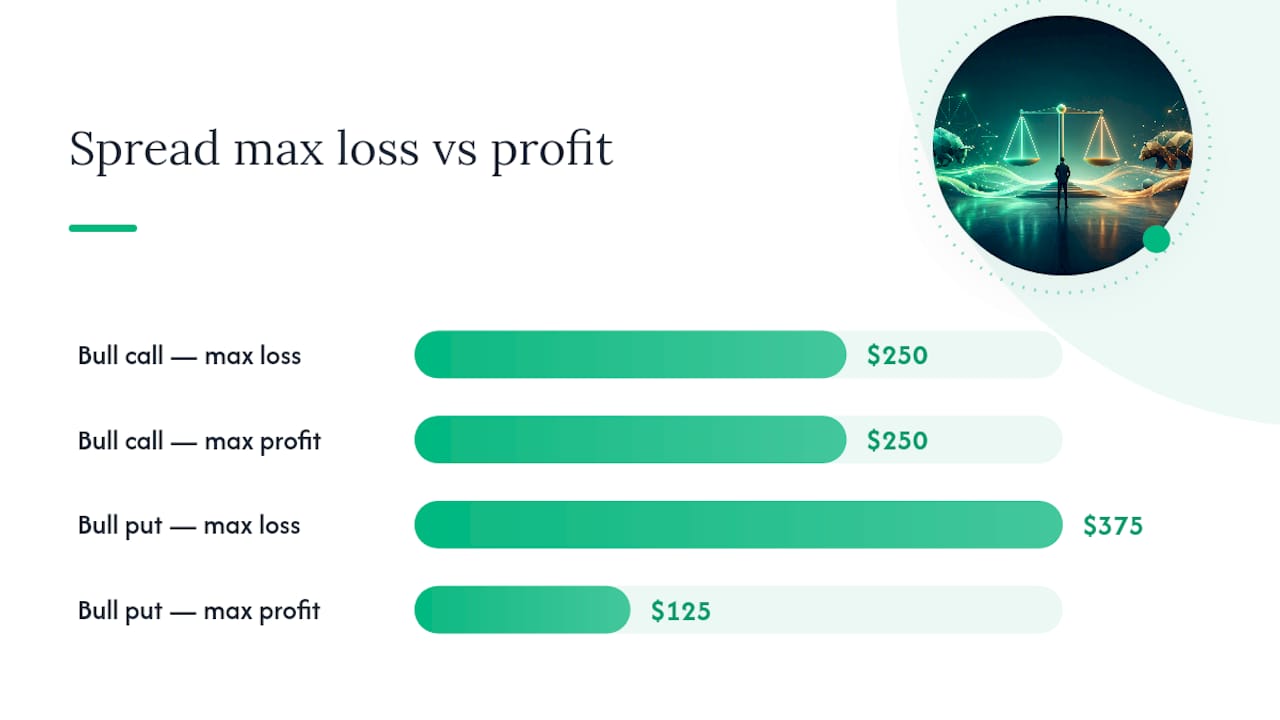
Worked example, bull call debit spread: A stock trades at $100. You buy the $100 call for $4.00 and sell the $105 call for $1.50. Net debit: $2.50, or $250 per contract. Max loss is that $250. Max profit is the $5 strike width minus the $2.50 debit, which is $2.50, or $250 per contract. Breakeven sits at $102.50.
Worked example, bull put credit spread: Same stock at $100. You sell the $95 put for $2.00 and buy the $90 put for $0.75. Net credit: $1.25, or $125 per contract. Max profit is that $125. Max loss is the $5 strike width minus the $1.25 credit, which is $3.75, or $375 per contract. Breakeven is calculated as short strike minus net credit for puts or short strike plus net credit for calls.
Notice the asymmetry: the debit trade risks $250 to make $250 (a roughly even bet), while the credit trade risks $375 to make $125. Payoff diagrams for both trades are flat lines that kink at each strike; the formulas above are just the numeric version of those kinks.
How Theta and Vega Push Debit and Credit Spreads in Opposite Directions
Time and volatility hit these two structures like mirror images of each other. Understanding this is the difference between a trader who picks the right structure and one who fights their own position for weeks.
Theta (time decay):
- Credit spreads generally benefit from time decay. Every day that passes with the stock away from your short strike, the options you sold lose value faster than the ones you bought, and that erosion works in your favor.
- Debit spreads generally lose value from time decay, because the long option you paid for is bleeding premium every day, and the short leg only partially offsets it.
Vega (implied volatility sensitivity):
- Debit spreads typically carry positive vega. A jump in implied volatility inflates the value of your long option more than your short one, so rising IV helps you.
- Credit spreads typically carry negative vega. A spike in IV can hurt you even if the stock hasn't moved, because it richens the option you're short.
This dynamic tracks closely with what Longbridge's comparison of credit and debit spreads lays out: debit spreads want IV expansion, credit spreads want IV contraction or at least stability.
Delta and gamma round out the picture. A debit spread's directional exposure is usually stronger near the long strike and fades as the stock moves past the short strike, which is exactly the payoff you want if you're right about direction. A credit spread's delta is smaller at the open but grows uncomfortably fast if the stock drifts toward your short strike, which is why credit spread positions often need earlier attention when they start going against you.
Pro Tip: Watch vega before you watch theta. A lot of traders open a credit spread right before an event that could spike implied volatility, then get confused when the position loses money even though the stock barely moved. Check the IV term structure, not just the stock chart.
Margin, Assignment, and Broker Approval: What Retail Traders Actually Deal With
The paperwork side of debit versus credit spreads matters as much as the strategy side, especially the first time you try to open one and your broker says no.
- Credit spreads usually require a higher options approval tier and margin, because you're carrying a short option position even though the long leg caps your risk. Brokers still want to see you understand assignment risk before they'll let you sell premium.
- Debit spreads often clear at a lower approval level and, in many cases, don't require margin at all, since your maximum loss is prepaid the moment you enter the trade. The Investopedia entry on debit spreads notes this exact distinction in how brokers size up the two structures.
- Early assignment is a real risk on the short leg of any spread that uses American-style options, particularly around dividend dates or when your short option goes deep in the money. Getting assigned early on one leg while the other stays open can leave you holding shares you didn't plan for. Our guide to options assignment mechanics walks through what happens step by step and how to unwind it cleanly.
- Worst-case outcomes look different for each structure. On a credit spread, the worst case is the full strike-width loss minus the credit you collected, which can happen fast if the stock gaps through both strikes overnight. On a debit spread, the worst case is simply losing the net premium you paid, no more.
Both scenarios demand active monitoring. A defined-risk trade is not a "set it and forget it" trade; it's a trade where you know your ceiling and floor in advance, which is different from not having to watch it at all.
A Pre-Trade Checklist: Debit or Credit Spread?
Run through this before you click the order ticket. Most bad spread trades come from skipping one of these steps, not from picking the wrong strategy on merit.
- Check IV percentile first. A common heuristic: above roughly 50% IV percentile, favor selling premium with a credit spread; below that, favor buying premium with a debit spread, since options are relatively cheap.
- Rate your directional conviction. Strong, specific conviction about where a stock is going favors a debit spread, because you're paying for leveraged exposure to that move. Weak or neutral conviction favors a credit spread, since you're getting paid to be roughly right instead of exactly right.
- Match time to expiration with your thesis. Debit spreads generally want more time for the move to play out; credit spreads often work best in the 30 to 45 day range where theta decay accelerates.
- Weigh probability against payout. Credit spreads tend to have a higher probability of a small win; debit spreads tend to have a lower probability of a larger win. Decide which trade off fits your account.
- Check portfolio correlation. Don't stack five bullish credit spreads on five different tech names if they all move together, because that's one concentrated bet wearing five different tickers.
- Watch for red flags. Earnings dates inside your expiration window, thin open interest, and wide bid-ask spreads all erode the edge that made the trade attractive in the first place. Reviewing how corporations disclose information around earnings and catalysts is worth doing before you hold any spread through an event date.
Pro Tip: *Size every spread as a percentage of account risk capital, not as a fixed dollar amount.
Getting the Trade Right: Entries, Exits, and Position Sizing
How you place and manage a spread often matters more than which structure you picked. A great trade idea executed badly is still a losing trade.
- Use combo orders, not individual legs. Placing both legs as a single spread order with a net limit price protects you from the market moving between fills. Legging in manually on a fast moving stock is how traders end up with a worse debit or a smaller credit than they planned.
- Set a limit price near the mid, not the wide bid-ask. Wide spreads on thinly traded names can quietly eat 5 to 10% of your edge before the trade even starts.
- Have an exit rule before you enter. Common approaches include closing a credit spread once it's captured 50 to 75% of the max profit, or closing a debit spread once it's captured a similar percentage of its max gain rather than holding for the last dollar.
- Decide in advance whether you'll roll or close. Rolling a credit spread out in time can salvage a position that's gone against you, but it also extends your risk window. Closing for a loss and moving on is often the better discipline for retail-size accounts.
- Cap concurrent positions. Running eight overlapping spreads on correlated names is functionally one oversized trade. Most active traders do fine holding somewhere between three and six open spreads at a time, sized so no single loser wrecks the week.
Our internal breakdown of how to calculate profit and loss on options positions is a useful reference the first few times you run these numbers by hand, before it becomes second nature.
Where Morningoptions Fits Into This Decision
Picking between a debit spread and a credit spread on your own, before the market opens, means checking IV percentile, scanning strike spacing, and sizing the trade all in the few minutes you actually have free. That's the exact workflow Morningoptions builds around every trading day.
The daily briefing ranks specific contract ideas with entry levels attached, so you're not starting from a blank options chain just before market open. Signal Lab lets you run your own on-demand scans when a ticker catches your eye mid-session, filtering for the IV and strike conditions this article just walked through. Combined with the education content built into the platform, it's designed to shorten the gap between "I know the theory" and "I have a trade I can actually place" before the opening bell.
Where to Learn More
- The Options Education Program covers option pricing and the Greeks in formal detail if you want to go deeper on the mechanics behind theta and vega.
- FINRA BrokerCheck lets you verify your broker's registration and background before you apply for spread trading approval or margin.
- Investopedia and similar reference sites remain solid starting points for formal definitions of terms like strike width, breakeven, and assignment.
A Straight Take on Debit vs Credit Spreads
Most retail traders overcomplicate this decision. They read ten articles about theta and vega and still freeze up at the trade ticket because they're trying to find the "better" strategy. There isn't one. A debit spread and a credit spread are tools built for opposite jobs, and the trader who does well with verticals isn't the one who picked a favorite. It's the one who matches the tool to the setup in front of them.
Here's what gets underweighted in most guides: position sizing discipline matters more than which spread you choose. High probability of a small win does not mean low risk. It means the loss is rarer but larger relative to the gain, and plenty of accounts have been quietly drained by a string of small credit-spread wins followed by one strike-width loss that erased three months of gains.
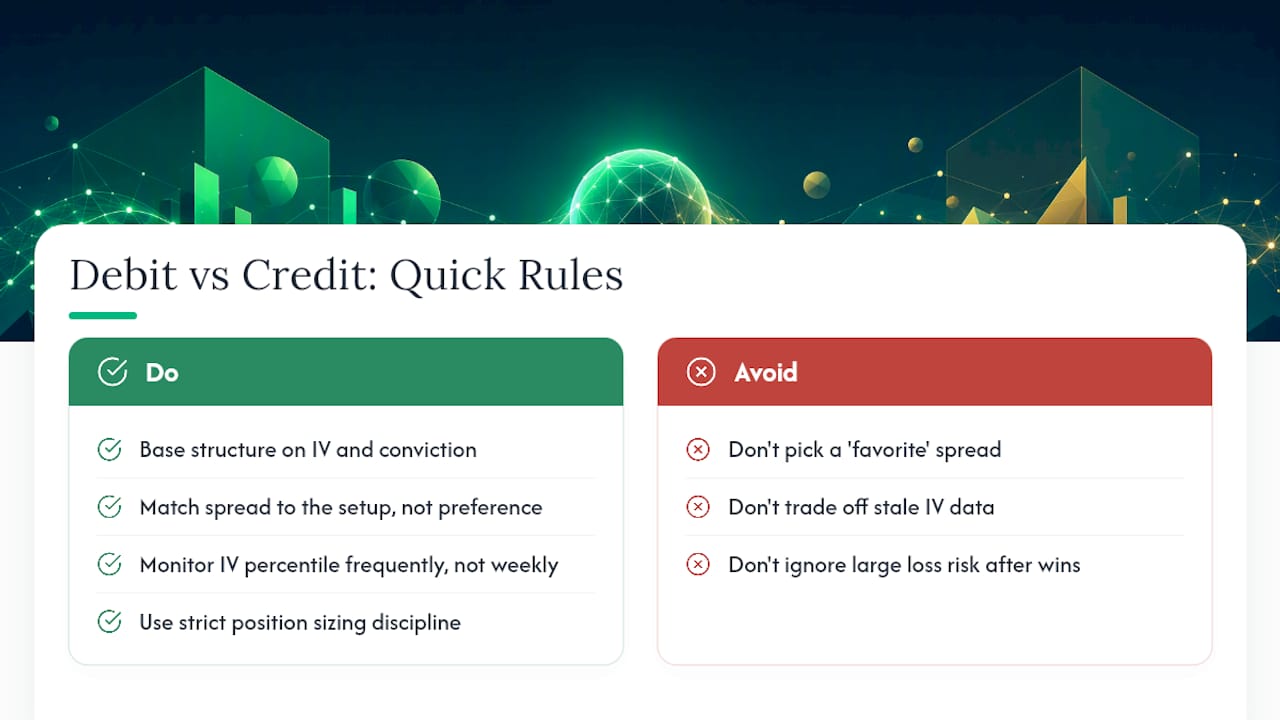
The other overlooked point: IV percentile is not a static number you check once. It moves. A stock sitting at the 30th percentile heading into an earnings date can spike past the 80th percentile within days, which flips the math on whether a debit or credit spread makes sense. Traders who check this once a week and trade off stale data are working with a compass that's already pointed the wrong way.
If there's one habit worth building, it's this: decide your structure based on IV and conviction, not on which one felt better in your last trade.
— Customer
Sources
- Mastering Credit and Debit Spreads in Options Trading — Investopedia
- Options spreads guide: Debit & credit strategies explained — Wealthsimple
- Option strategy reference: debit and credit verticals — Fidelity