
News catalyst trading means buying or selling a stock or its options around a specific event, an earnings beat, an FDA decision, a Fed statement, that forces a repricing. The single best rule: trade the market's reaction, not the headline itself, and filter every setup through a tier ranking plus an IV Rank gate before you size a position. Skip that filter and you're just gambling on speed against machines that will always beat you to the first tick.
TL;DR:
- Traders should focus on reacting to market movements rather than headlines, using tier classifications and IV Rank filters to size positions effectively.
- Classifying catalysts into four tiers helps determine trading approach, with Tier 1 events requiring tighter stops and smaller sizes due to higher unpredictability.
- Waiting for the first 15-minute candle to close before acting improves success, particularly in gap-and-go, fade, or reversal setups after a catalyst today.
- When IV Rank is below 30, buying premium makes sense, while selling spreads is better above 60, aligning options strategy with volatility levels.
- Using premarket scans, AI-powered briefings, and strict risk controls, like limiting single trades to 1-2% of capital, enhances discipline and reduces emotional errors.
Table of Contents
- What Is News Catalyst Trading and How Do You Find Catalysts Early?
- How Do You Classify Catalysts Into Tiers?
- What's the Right Way to Trade the First Hour After a Catalyst?
- How Does IV Rank Decide Whether You Buy or Sell Options Premium?
- What Tools Belong in a Premarket Catalyst Workflow?
- What Risk Rules Are Specific to Catalyst Trading?
- How MorningOptions Runs This Workflow at Scale
- Why Do Traders Keep Making the Same Catalyst Mistakes?
- What Can Past Catalyst Trades Teach You?
- What Are the Legal Lines Around Trading News Catalysts?
- A Trader's View on Why Catalyst Discipline Outlasts Speed
- Get Ranked Catalyst Ideas Before the Bell Instead of Building Your Own Scanner
- Sources
What Is News Catalyst Trading and How Do You Find Catalysts Early?
A catalyst is any piece of information that forces the market to reprice a stock. Scheduled catalysts, earnings dates, FDA decision deadlines (PDUFA dates), Fed meetings are known weeks in advance. Sudden catalysts, an activist investor filing, a surprise guidance cut, a data breach, hit with zero warning. Both move price, but they demand different prep.
Your premarket routine should run through three layers before the opening bell:
- Overnight filings: Scan SEC EDGAR for material 8-K filings, since these are primary-source documents that frequently get picked up by financial media two to six hours later, giving disciplined scanners a genuine head start.
- Scheduled events: Cross-reference a catalyst calendar for earnings, IPO lockup expirations, and macro releases so you're never blindsided by something that was on the schedule all along.
- Real-time clues: Watch for unusual options flow, large block trades in out-of-the-money contracts placed hours before a public announcement often signal institutional positioning, though you should always confirm with volume and price action rather than trading the flow blind.
Prioritize tickers by float size, relative volume, and how the options market's implied move compares to the stock's historical average move on similar events. A filing-based edge on a small-cap name can persist one to three days; a well-covered large-cap earnings reaction is usually priced in within minutes.
How Do You Classify Catalysts Into Tiers?
Not every headline deserves the same reaction. A four-tier framework keeps you from treating a routine broker upgrade like an FDA approval.
Tier 1 covers binary, material events: earnings surprises against consensus, M&A announcements, major regulatory rulings, and Fed policy shocks. These routinely produce intraday ranges of 5% to 20% or more, and biotech binary events can gap even further.
Tier 2 includes significant but non-binary news: guidance revisions, major contract wins, executive departures.
Tier 3 covers moderate catalysts: analyst upgrades or downgrades from major firms, sector-wide news, minor product announcements. Moves are usually small and short-lived.
Tier 4 is noise: routine broker notes, minor insider transactions, recycled news. Best left alone.
Tier should dictate both your timing and your size. Tier 1 setups justify tighter stops and smaller position sizes because the range is wider and unpredictable; Tier 3 and 4 rarely justify a trade at all once you account for slippage and commissions.
What's the Right Way to Trade the First Hour After a Catalyst?
The single costliest mistake in catalyst trading is acting in the first five minutes. High-frequency systems have already digested the headline and moved price before you've finished reading it, one analysis found the initial five-minute reaction wins only around 45% of the time, while trades taken after the dust settles on the second move win closer to 67%. Wait for the first 15-minute candle to close. That single discipline filters out most of the algorithmic noise.
Once that candle closes, three setups cover most scenarios:
- Gap-and-go: Price gaps on strong volume and holds above the premarket high through the first 15 minutes. Enter on a break of that high, stop below the 15-minute candle's low, target a measured move equal to the gap size.
- Gap fade: Price gaps sharply but stalls or reverses inside the first 15 minutes on declining volume. Enter short (or long, if fading a gap down) once price breaks back through the opening print, with a tight stop at the gap extreme.
- Post-news reversal: The initial move overshoots, then volume dries up and price reclaims a key level. Wait for confirmation, a higher low on rising volume, before entering.
Before the open, run this checklist: build your watchlist from overnight filings and calendar events, set a directional bias based on tier and premarket volume, define your invalidation level in advance, and size the position before you place the order, not after.
Pro Tip: Set a hard alarm for 15 minutes past the open. If you catch yourself clicking "buy" before it goes off, close the platform and walk away for five minutes. That single habit prevents more losses than any indicator ever will.
How Does IV Rank Decide Whether You Buy or Sell Options Premium?
IV Rank tells you where current implied volatility sits relative to its own 52-week range, and it should decide your entire options structure before you look at strikes. When IV Rank sits below roughly 30, premium is cheap relative to its own history, so buying calls, puts, or debit spreads makes sense. When IV Rank climbs above 60, usually right before earnings or an FDA decision, premium is expensive, and selling spreads or iron condors captures that inflated volatility instead of paying for it.
Contract duration should match your catalyst horizon. For same-day or overnight binary events, contracts expiring within zero to seven days concentrate your risk into the event window but expose you fully to time decay if the move doesn't materialize on schedule. For catalysts with a wider expected window, an activist stake building or a slow-developing legal case, one to three week expirations give the thesis room to play out without bleeding theta as fast.
Size binary-event trades smaller than your standard position, since a single earnings miss or rejected drug trial can wipe out an entire premium in minutes. If you're holding into multiple stacked catalysts on the same ticker, cut size further. Defined-risk structures, vertical spreads instead of naked long options, blunt the damage from IV crush, the sharp volatility collapse that happens the moment uncertainty resolves, regardless of which way the stock moves.
What Tools Belong in a Premarket Catalyst Workflow?
Four tool categories cover the job: catalyst calendars for scheduled events, EDGAR-based scanners for overnight filings, options-flow monitors for early positioning clues, and AI-driven premarket briefings that synthesize all three into a ranked list.
A workable five-step morning routine looks like this:
- Run an overnight filings scan for material 8-Ks and press releases.
- Check options flow for unusual block activity in your sector.
- Cross-reference both against your catalyst calendar and score each name by tier.
- Narrow the list to three to five tickers with the clearest setups.
- Set price and volume alerts so you're not staring at charts for two hours straight.
Services like Morningoptions build exactly this kind of ranked premarket briefing, cutting the manual scanning down to a few minutes of reading.
What Risk Rules Are Specific to Catalyst Trading?
Cap any single catalyst trade at a small, fixed percentage of your account, most disciplined traders use 1% to 2% of total capital regardless of how confident the setup looks. Defined-risk options structures make this easier to enforce than naked stock positions.
Tie your stop to the setup itself: the opposite side of the 15-minute candle for gap-and-go trades, or the gap extreme for a fade. Never widen a stop mid-trade because you "still believe" the thesis. Cap total exposure across stacked catalysts on correlated names; three biotech binary events in one sector on the same day is concentration risk dressed up as diversification. Reviewing risk management fundamentals before catalyst season starts is worth the hour it takes.
Behaviorally: don't chase a move you missed in the first five minutes, don't average into a losing catalyst trade hoping for a reversal, and sit out entirely when volume looks thin, illiquid options on a catalyst day are a fast way to get stuck holding a wide bid-ask spread.
How MorningOptions Runs This Workflow at Scale
MorningOptions applies a five-AI pipeline to vet and rank trade ideas every trading morning, scoring each setup, tier, IV Rank, and expected move, before publishing it. Subscribers get ranked tickers with the catalyst, suggested option structure, and entry and stop levels laid out before the open. The free daily briefing covers the basics; the Pro tier adds a lunchtime scanner and an on-demand AI chat scanner for researching any ticker mid-session. See a live example of the format.
Why Do Traders Keep Making the Same Catalyst Mistakes?
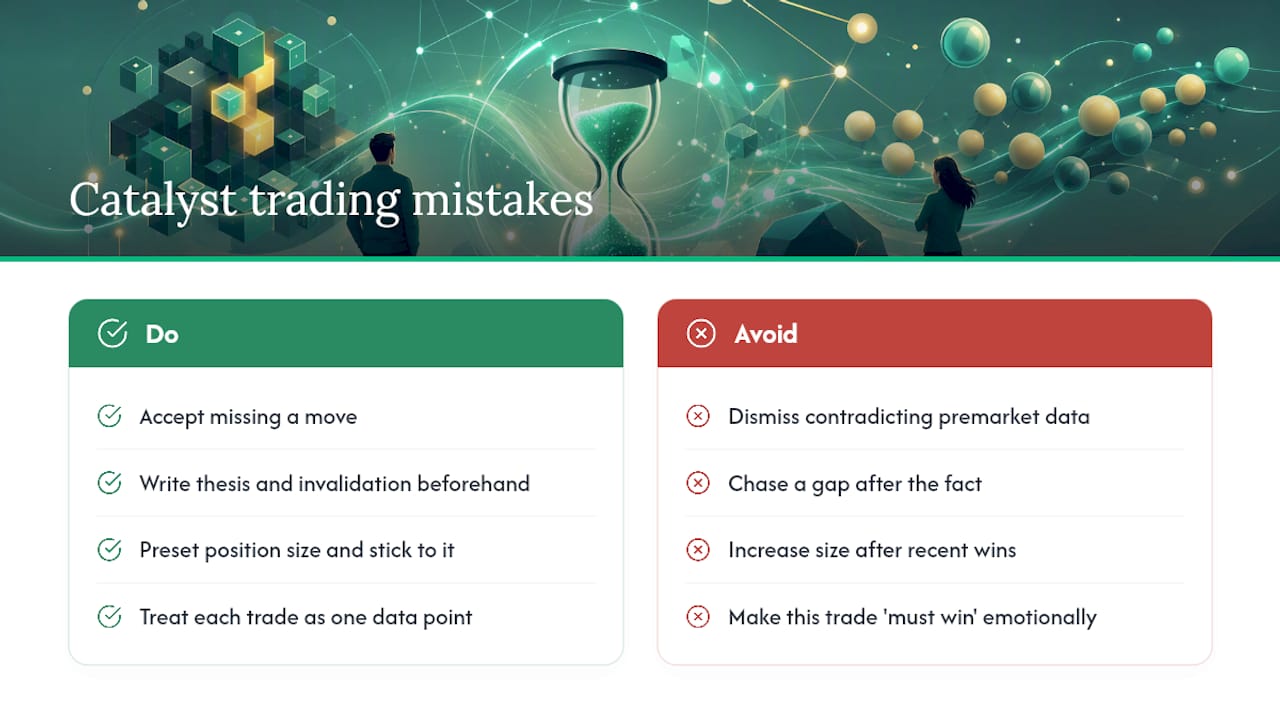
Confirmation bias is the quiet killer in catalyst trading. You build a bullish thesis on a stock overnight, then the premarket action contradicts it, and instead of updating your view, you find reasons to dismiss the contradicting data. That's how a well-researched trade turns into a stubborn hold that costs three times what the original plan called for.
FOMO shows up differently here than in normal trading. When a stock gaps 12% on an acquisition rumor and you weren't watching, the urge to jump in five minutes later, after the easy move is gone, is almost universal. That's exactly the "chase" behavior that turns a good research process into a bad execution habit. The traders who do well with catalysts tend to accept that missing a move is cheaper than chasing one.
Overconfidence after a string of wins is just as dangerous. A trader who correctly called three earnings reactions in a row starts sizing the fourth one like it's guaranteed, right as their edge (careful tier classification, patient entries) gets replaced by pattern matching and adrenaline. The fix isn't a mindset trick; it's mechanical. Write your thesis and invalidation level before the event, not after you've seen the reaction, and hold yourself to the size you planned regardless of how the first candle looks.
Emotional control in catalyst trading mostly comes down to distance from the outcome. The traders who treat each trade as one data point in a hundred behave rationally. The ones who need this specific trade to work, because they're chasing a loss or proving a point, are the ones who override their own stops.
What Can Past Catalyst Trades Teach You?
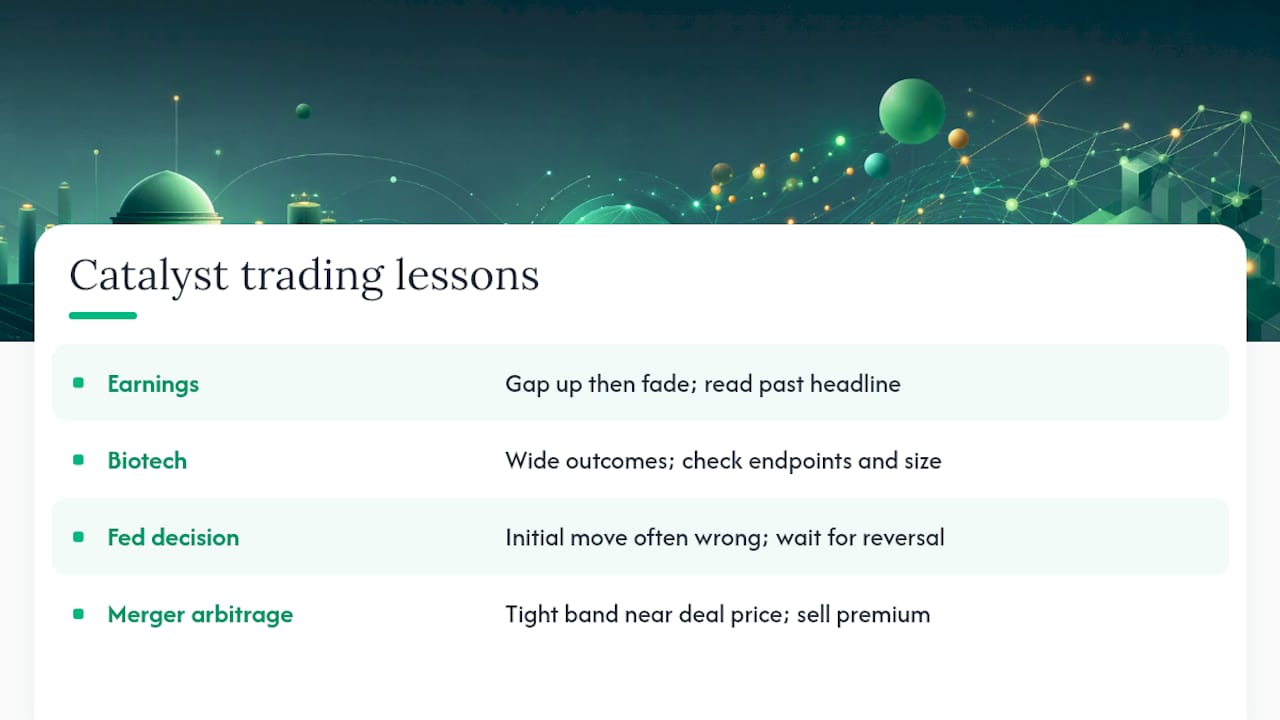
Earnings season offers the cleanest recurring dataset for studying catalyst behavior, since the same event type repeats quarterly across thousands of tickers. A stock that beats on both revenue and earnings per share but guides next quarter below consensus will often gap up at the open, then fade hard once the market digests the guidance cut buried on page four of the release, a textbook gap-fade setup for anyone who read past the headline number.
Biotech binary events show the widest range of outcomes and the clearest lesson in reading primary documents. A drug trial hitting its primary endpoint sounds unambiguously positive, but if the magnitude of benefit is modest or the safety table shows an elevated adverse-event rate, the stock can still drop on "good" news once analysts model the commercial ceiling. Traders who only read the press release headline get caught flat-footed; traders who checked the actual endpoint data and sample size going in weren't surprised.
Fed decision days illustrate the reaction-versus-headline principle in its purest form. The market's first move after a rate statement is often the wrong direction, driven by algorithms parsing keywords, before reversing once traders digest the full statement and press conference tone. Waiting for that second move has historically been the more reliable trade than reacting to the release itself.
Merger arbitrage situations show the other side: some catalysts create a defined, narrow range rather than a wide one. Once a deal is announced with regulatory approval as the main uncertainty, the stock often trades in a tight band near the deal price until the approval date, a low-volatility environment where selling premium, not buying it, tends to be the better structure.
What Are the Legal Lines Around Trading News Catalysts?
Trading on information that is publicly available, a press release, an earnings call, an SEC filing, is legal and is the entire premise of catalyst trading. Trading on material nonpublic information, knowledge of an unannounced merger from a friend at the target company, for example, is insider trading and carries serious federal penalties regardless of how the information reached you.
The line gets blurry around expert networks, unofficial "channel checks," and social media rumors claiming inside knowledge. If a tip's value depends on it not being public yet, treat it as a legal risk, not an edge. Stick to primary sources: EDGAR filings, official press releases, transcribed earnings calls, and licensed data feeds. If you're ever uncertain whether information is properly public, the safer move is to wait for the SEC filing or press release, not act on the rumor.
Front-running your own research is fine. Front-running someone else's confidential disclosure is not. When in doubt, consult a securities attorney rather than a trading forum.
A Trader's View on Why Catalyst Discipline Outlasts Speed
You will never out-speed a co-located algorithm reading the same headline. That race is over before you've opened your trading app. What you can build instead is a repeatable process: tier the event, check IV Rank, wait for the 15-minute candle, size accordingly. Log every trade, win or loss, and review what actually happened against your thesis, not what you wish had happened. Pair that discipline with account-level risk controls, because no single catalyst trade should ever threaten your overall capital. Speed is not the edge here. Process is.
— Customer
Get Ranked Catalyst Ideas Before the Bell Instead of Building Your Own Scanner
Running the full premarket workflow, EDGAR scans, options flow, calendar cross-referencing, tier scoring, by hand every morning is a part-time job on top of your actual trading. Morningoptions runs that exact pipeline through five AI models before the market opens, then hands you a ranked list of specific contract ideas with entry levels, not vague commentary about "watching this space."
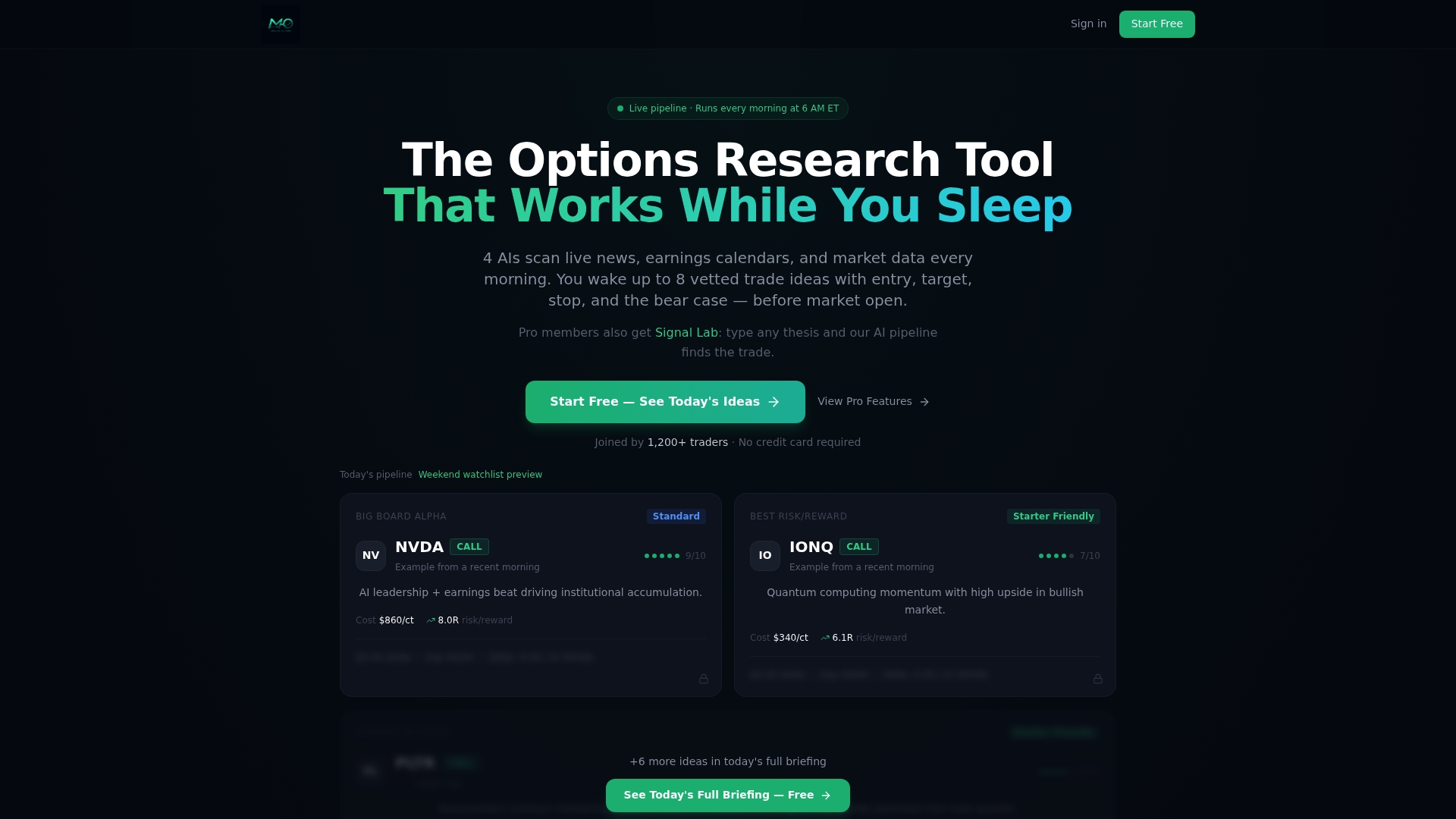
The free daily briefing gets you the ranked catalyst ideas every trading morning. The Pro tier, at $89 a month, adds a lunchtime scanner for afternoon setups and an AI chat scanner where you can research any ticker on demand instead of waiting for tomorrow's brief. If you've read this far because you want the workflow without building it yourself, check today's briefing and see what a ranked, catalyst-scored watchlist actually looks like before your next open.
Sources
- News Catalyst Trading: How to Trade Earnings, Fed Decisions, and Market Events — DXP Analytics
- Momentum Catalysts: The Complete Options Trader's Playbook — Oyamori
- Stock Catalyst Calendar — Catacal