
A trade vetting process is an objective, repeatable pipeline that screens, scores, and approves or rejects options trade ideas before you enter a position. For active retail options traders running pre-market briefings, it is the difference between a disciplined, EV-focused decision and an emotional, rushed entry that bleeds slippage from the first fill. Platforms like Morningoptions operationalize this pipeline using AI, while regulatory frameworks like FINRA Rule 2360 and the Options Clearing Corporation's disclosure standards set the legal perimeter every retail account operates within.
Key Takeaways
A trade vetting process is a repeatable, objective pipeline that screens options ideas against liquidity, EV, and regulatory constraints before entry, reducing emotional urgency and slippage on every trade.
| Point | Details |
|---|---|
| Run the liquidity gate first | Reject any contract where bid-ask exceeds your threshold or OI falls below your minimum. |
| Model POP and EV before sizing | Compute probability of profit and expected value to confirm statistical edge, not just max payout. |
| Match strategy to approval level | FINRA Rule 2360 and broker tiers determine which strategies your account can legally trade. |
| Journal every pass and fail | Track win rate by confidence grade and realized vs. modeled POP monthly to tune thresholds. |
| Morningoptions automates the pipeline | The 5-step AI pipeline delivers ranked, scored trade ideas with entry/exit levels before market open daily. |
Table of Contents
- Why a vetting routine is non-negotiable for active options traders
- Core inputs and metrics in an options trade vetting pipeline
- A 90–180 second pre-market checklist you can run on every AI-ranked idea
- How to execute vetted ideas to minimize slippage and control position risk
- Regulatory and broker-approval context active traders must understand
- How to validate and iterate your vetting process with journaling and KPIs
- What a 5-step AI-powered vetting pipeline looks like
- A two-minute walkthrough: vetting a pre-market AI-ranked trade idea
- The part most traders skip
- Morningoptions delivers the vetting pipeline, ranked and ready before the open
- Primary sources and further reading
- Sources
Why a vetting routine is non-negotiable for active options traders
Skipping a vetting routine does not save time. It transfers decision-making from a structured process to your emotional state at 9:25 AM, which is the worst possible moment to be improvising.
The harms a consistent trade vetting procedure prevents:
- Emotional urgency: A checklist forces you to answer objective questions before you size a position, breaking the impulse to chase a moving ticker.
- Execution slippage: Contracts with wide bid-ask spreads punish market orders. Vetting catches these before entry, not after.
- Poor contract selection: A strong chart setup on the underlying does not justify a thin, illiquid contract. Vetting separates the two decisions.
- Assignment risk: Short options carry assignment exposure that can blow past defined max-loss assumptions. A proper vetting routine includes an assignment risk check as a hard gate.
A structured options routine that ties market prep, contract quality, and post-session review into a repeatable loop is what separates traders who improve from those who repeat the same mistakes.
Pro Tip: Set one hard gate that causes an automatic pass regardless of how good the thesis looks: if the bid-ask spread exceeds your threshold or open interest falls below your minimum, the trade does not happen. No exceptions.
Core inputs and metrics in an options trade vetting pipeline
Every vetting pipeline, whether manual or AI-driven, runs on the same set of inputs. Here is what each one measures and why it belongs in the process:
- Catalyst: The specific event or setup driving the trade thesis (earnings, macro data, technical breakout). No nameable catalyst means no edge.
- Implied Volatility / IVR: Current IV relative to its 52-week range. High IVR favors premium-selling strategies; low IVR favors debit structures.
- Days to Expiry (DTE): Determines theta decay rate and how much time the thesis has to play out.
- Bid-ask spread: The immediate performance tax on every entry and exit. Wide spreads compound into significant equity drag over time.
- Open Interest (OI): Total outstanding contracts at a strike. Low OI signals thin markets and poor fill quality.
- Volume: Same-day activity at a strike. High volume relative to OI confirms active participation.
- Probability of Profit (POP): The model-derived likelihood the trade expires profitable. Compute POP and EV before every entry to confirm statistical edge.
- Expected Value (EV): Probability-weighted outcome across all scenarios. An EV calculator reveals whether a trade is statistically favorable, not just whether it has a large max payout.
- Greeks (Delta, Theta, Vega, Gamma): Directional exposure, time decay, volatility sensitivity, and convexity risk.
- Assignment risk: For short options, the probability and financial impact of early assignment before expiration.
Scoring outputs translate these inputs into a decision framework:
| Metric | Practitioner threshold | Red flag |
|---|---|---|
| Bid-ask spread | Within a low threshold for liquid names | Excessively wide spreads on standard contracts |
| Open interest | A meaningful number of contracts at strike | Very low open interest at the strike |
| IVR | 30–70 for balanced strategies | Under 15 (too cheap to sell) |
| POP | 60%+ for defined-risk trades | Under 50% with no edge offset |
| Confidence score | A relatively high score on a 0–100 scale indicating strong confidence | Lower scores that typically suggest reducing position size |
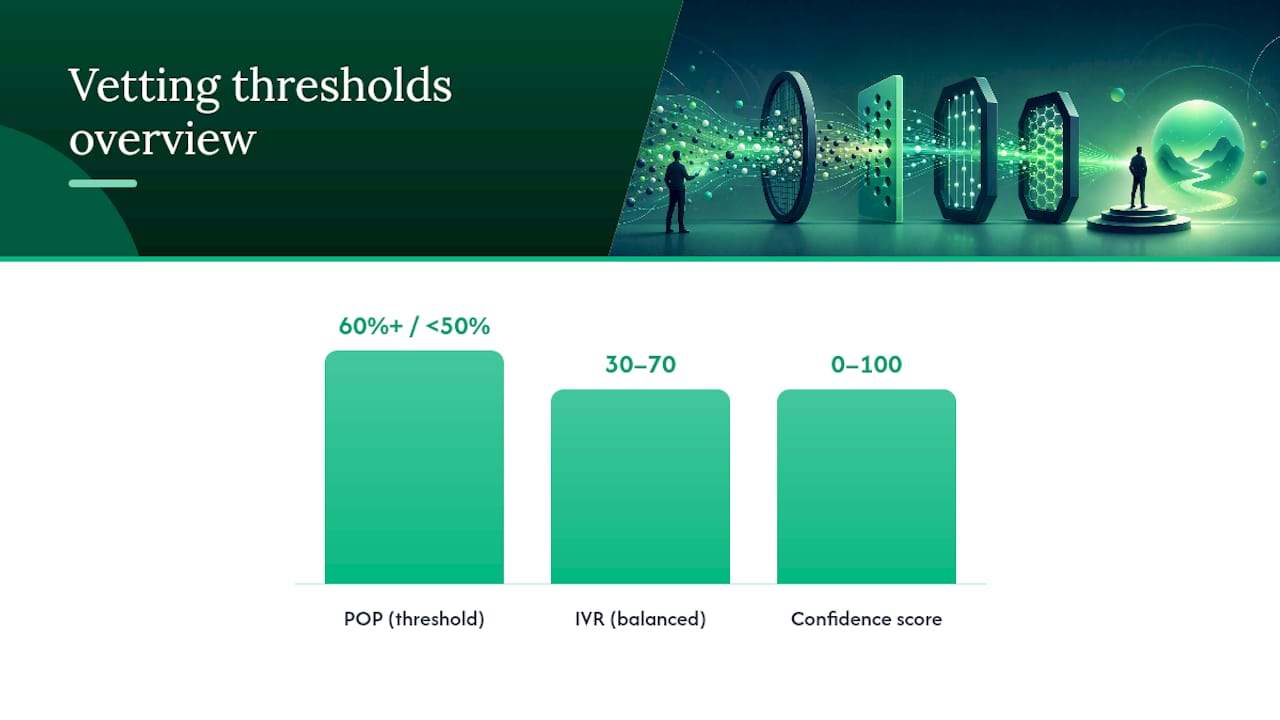
Options scoring models that apply a 0–100 grading matrix with hard floors give you the repeatability needed to evaluate strategy performance statistically over time.
A 90–180 second pre-market checklist you can run on every AI-ranked idea
This checklist is designed to run in 90–180 seconds on any ranked idea before market open. Speed matters, but every step is a gate, not a suggestion.
- Market context: Check SPY trend and VIX level. A VIX increase beyond a moderate level can influence sizing assumptions for many strategies.
- Catalyst check: Name the specific catalyst driving the idea. If you cannot state it in one sentence, pass.
- Contract liquidity gate: Confirm bid-ask spread and OI meet your minimums. Fail either one, and the trade does not happen.
- IV fit: Match the strategy type to the IVR reading. Selling premium into low IVR destroys edge before you start.
- Expected-move comparison: Compare the options-implied move to your profit target. If the target is inside the expected move, the risk/reward does not justify the trade.
- Sizing limit: Calculate max dollar risk using your account equity and risk percentage. Never override this number.
- Portfolio alignment: Check existing delta, vega, and sector exposure. Adding a correlated position concentrates risk you may not see.
- Go/no-go decision: If any hard gate fails (liquidity, edge, sizing), the answer is NO TRADE. Log the reject and move on.
For a faster evaluation of options trade ideas, run the liquidity gate first. It eliminates the most common bad trades in under 10 seconds.
Pro Tip: Convert an AI confidence score directly into a position-size multiplier. A score of 80+ gets full size; 70–79 gets half size; below 70 is a pass or paper-trade only. This removes discretion from the sizing decision entirely.
How to execute vetted ideas to minimize slippage and control position risk
A vetted idea still needs execution rules to realize its expected value. Sloppy fills on a well-scored trade can erase the edge the vetting process identified.
- Use limit orders at mid or better. Never send a market order on an options contract. Start at the mid-price and work toward the ask only if the market moves in your favor.
- Stagger entries on larger positions. Break a full-size position into two or three child orders. This reduces market impact and gives you a better average fill.
- Prefer high-liquidity expirations and strikes. Weekly expirations on major indices and large-cap names carry tighter spreads than monthlies on mid-cap stocks.
- Watch spreads at the open. The first 5–10 minutes after 9:30 AM EST often show wider spreads than the rest of the session. Waiting 10 minutes costs little and saves meaningful slippage.
- Pre-build order templates. For recurring strategy types (iron condors, vertical spreads), save order templates in your platform the night before. Execution speed at open matters.
Sizing formula: risk_per_trade = account_equity × risk_pct / trade_max_loss. For a $50,000 account with a 1% risk rule and a $200 max loss per spread, that is 2.5 contracts, rounded down to 2. Defined-risk structures make this calculation clean because max loss is fixed at entry.
Pro Tip: Pair your position-size calculator with a profit and EV model before every trade. Size and edge are the same decision.
Regulatory and broker-approval context active traders must understand
Broker approvals and FINRA rules set a legal perimeter for what retail accounts may trade. Vetting a trade idea that your account is not approved for wastes time and creates compliance exposure.
FINRA Rule 2360 requires broker-dealers to specifically approve each customer for options trading, collect financial and experience data, and conduct ongoing supervisory reviews. This is not a formality. Brokers who skip due diligence face regulatory action, and traders who misrepresent their experience during onboarding can lose account privileges.
FINRA Notice 21-15 reminds broker-dealers: "Members must exercise due diligence to ascertain the essential facts relative to every customer, including their financial situation, investment objectives, and options trading experience, before approving the account for options trading." Supervisory review must be ongoing, not just at account opening.
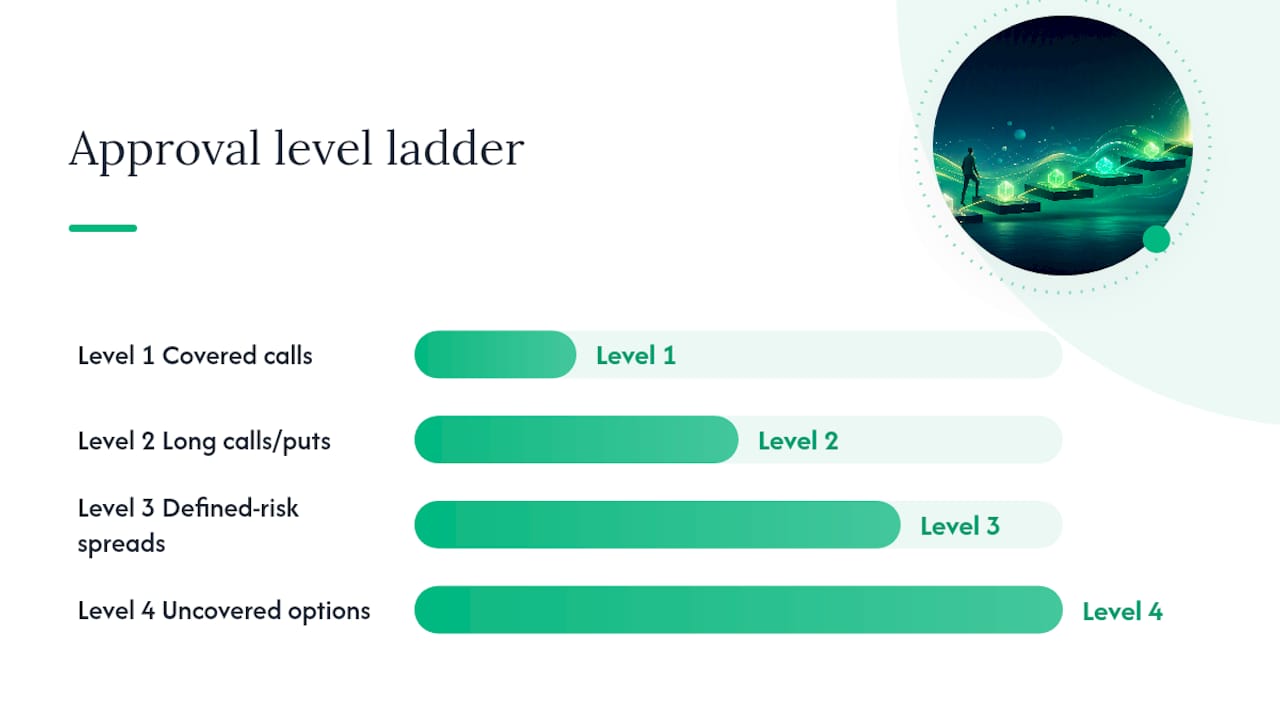
The approval level ladder at most U.S. brokers follows this structure:
- Level 1: Covered calls and cash-secured puts (lowest risk, most accounts qualify)
- Level 2: Long calls and puts, debit spreads
- Level 3: Defined-risk spreads, iron condors, butterflies
- Level 4: Uncovered (naked) short options (highest tier, strictest requirements)
Interactive Brokers and E*TRADE use similar ladders with different naming conventions and margin requirements. Series 4 guidance expects the options principal to match approval levels to documented experience and financial capacity, not to optimism.
Before trading any strategy, verify: your current approval level, margin requirements for the specific structure, and whether the broker's platform supports the order type you plan to use.
How to validate and iterate your vetting process with journaling and KPIs
Measurement drives improvement. A vetting checklist you never audit is just a ritual.
Record these items for every trade, pass or fail:
- Idea source and one-line thesis
- All input metrics at the time of vetting (IV, OI, spread, POP, EV, confidence score)
- Checklist pass/fail flag (binary: did it clear every gate?)
- Execution fills vs. mid-price at entry
- Exit reason and P&L
- Post-trade notes on what the model got right or wrong
KPIs worth tracking monthly:
- Win rate by grade: A-grade ideas (80+ confidence) should outperform B and C grades over 20+ trades.
- Average EV vs. realized P&L: If realized P&L consistently trails modeled EV, slippage or sizing is the culprit.
- Realized POP vs. modeled POP: A persistent gap signals model miscalibration or strategy-market mismatch.
- Slippage per contract: Track average fill vs. mid. Over $0.05 per contract on liquid names is a red flag.
Paper-trade any threshold change for at least two weeks before applying it to live positions. Changing a liquidity gate or confidence floor based on one bad week is how traders destroy a working system.
What a 5-step AI-powered vetting pipeline looks like
An AI pipeline operationalizes vetting inputs into scores and ranked outputs using deterministic gates combined with learned models. Here is how the five steps map to the components covered above:
- Data ingestion: Pull options chains, news feeds, earnings calendars, and macro indicators in real time. This is the raw material for every downstream signal.
- Signal generation: Apply technical and volatility models to identify setups with a nameable catalyst and directional or volatility edge.
- Contract filter: Run hard liquidity gates (bid-ask, OI, volume) and eliminate contracts that fail. No model output survives a bad contract.
- Scoring and modeling: Compute EV, POP, confidence score, and risk/reward for each surviving idea. Grade and rank the output.
- Delivery: Produce a ranked pre-market brief with specific contracts, entry and exit levels, confidence scores, and sizing notes.
Morningoptions runs exactly this pipeline every market morning. Subscribers receive ranked trade ideas with entry levels, bear case analysis, and strategy context before the open. The Pro tier ($89/mo) adds Signal Lab for on-demand ticker scans and a midday scanner for ideas that develop after the open.
A two-minute walkthrough: vetting a pre-market AI-ranked trade idea
Signal from Morningoptions: Bullish call spread on a large-cap tech name ahead of a product launch catalyst. Confidence score: 78. Suggested strike: 10-point wide debit spread, 21 DTE.
Checklist run:
- SPY trending above 20-day MA; VIX at 17. Market context: green.
- Catalyst named with a specific event, such as a product launch, confirming presence of a catalyst.
- Bid-ask spread is narrow and open interest at both strikes is strong, passing the liquidity gate.
- IVR at a moderate level, making the debit spread appropriate for the current volatility environment.
- Implied move: 4.2%. Profit target requires a move less than the expected implied move, supporting favorable risk/reward. Risk/reward: acceptable.
- Account equity $40,000, 1% risk rule, max loss $150. Contracts: 2.
- No existing tech exposure above 15% of portfolio. Portfolio alignment: pass.
- Decision: EXECUTE. 2 contracts, limit at mid.
Red-flag scenario: Same setup, but OI at the short strike is 85 contracts and the bid-ask is $0.31 wide. Liquidity gate fails on both counts. Confidence score drops to 61 after the contract filter. Decision: NO TRADE. Log the reject with the specific gate failures noted.
Regardless of outcome, log the trade metadata immediately. The journal entry takes 60 seconds and is the only way to know whether your vetting thresholds are working.
The part most traders skip
The vetting framework described here is not theoretical. Running Morningoptions means watching traders receive a ranked, scored brief every morning and still override the sizing rules when a position feels right. Over-sizing and ignoring wide spreads are the two most common ways a well-vetted idea turns into a losing trade.
No model eliminates market risk. Vetting reduces the frequency of negative-EV entries and limits the damage when the market moves against a well-structured position, but drawdowns happen. The traders who improve are the ones who journal every gate failure and paper-trade threshold changes before going live with them. The ones who do not improve are the ones who treat the checklist as optional when conviction is high.
Morningoptions delivers the vetting pipeline, ranked and ready before the open
Every morning brief from Morningoptions maps directly to the five pipeline steps: data ingestion, signal generation, contract filtering, scoring, and delivery. You receive ranked trade ideas with specific contracts, entry and exit levels, confidence scores, EV estimates, and bear case analysis before the market opens.
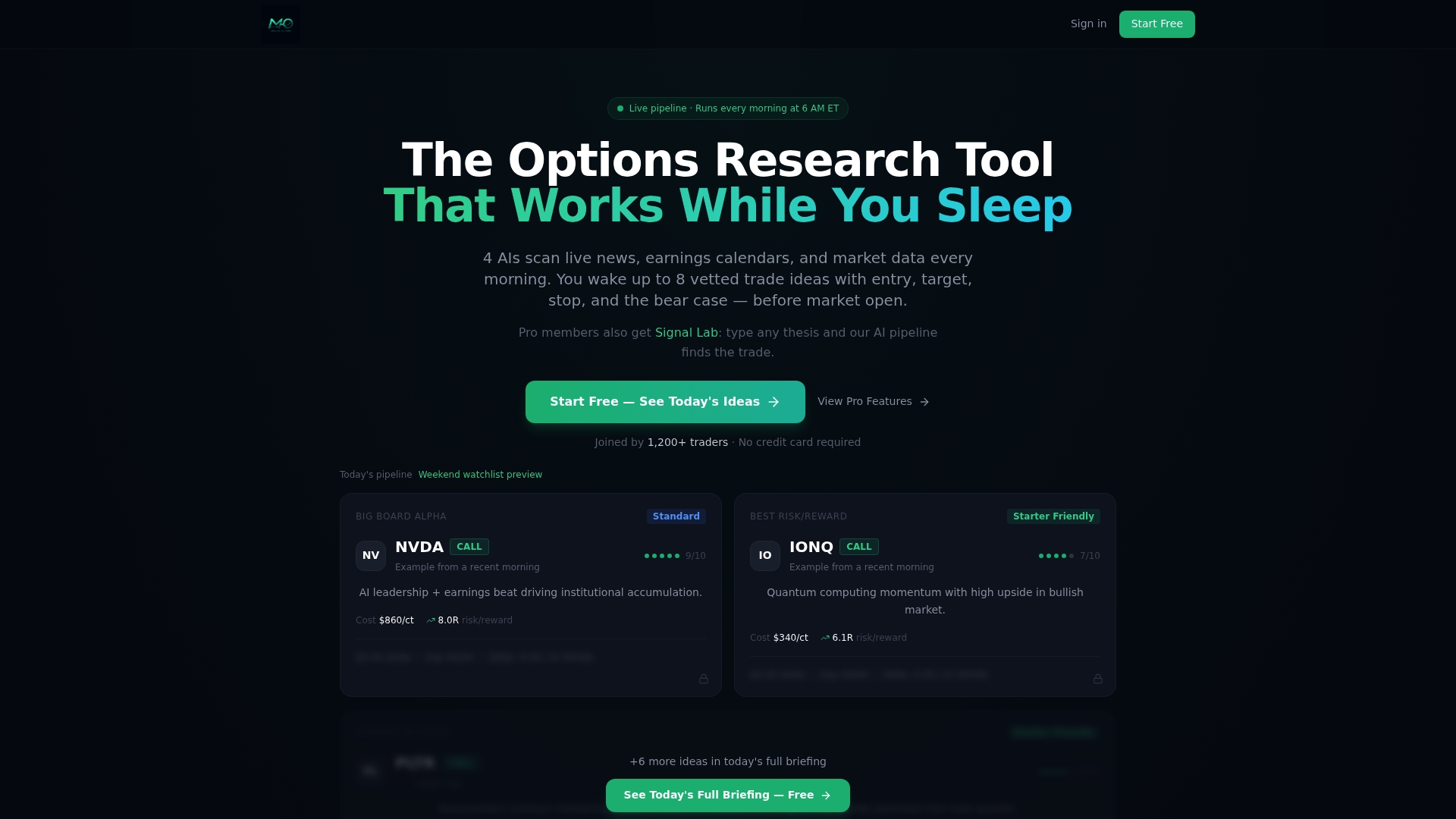
The free plan delivers daily briefings with a limited set of ranked ideas. The Pro tier at $89/mo unlocks full briefings, Signal Lab for on-demand ticker research, and the midday scanner for setups that develop after the open. If you have been running a manual checklist and want a faster, AI-scored starting point each morning, the free briefing is the lowest-friction way to see the pipeline in action. Start at Morningoptions.
Primary sources and further reading
- FINRA Notice 21-15: The regulatory basis for options account approval, due diligence requirements, and supervisory review obligations under Rule 2360.
- Series 4: Risk levels and account approval standards (SecuritiesMastery): How options principals evaluate customer profiles and authorize approval levels; useful for understanding the gatekeeping logic behind broker tiers.
- Options approval levels guide (CoveredCallCalculator): Practical breakdown of the approval level ladder and broker-specific naming conventions.
- Options Profit Calculator guide (TradeAlgo): How to model POP, EV, and volatility scenarios before entry; pair with a position-size calculator.
- OptionEV Expected Value Calculator: Tool for computing probability-weighted EV using implied volatility; confirms whether a trade has a real statistical edge.
- Trade-quality scorecard (Harsha Zampi): A 0–100 grading matrix with hard floors and grade-to-size policy for repeatable trade evaluation.
Consult your broker's current documentation for precise approval-level requirements and margin rules, which vary by platform and are updated periodically.
This article is general information, not a substitute for advice from a qualified financial advisor. Consult a qualified financial professional about your own circumstances before acting on anything here.
Sources
- FINRA Notice 21-15
- Series 4: Risk levels and account approval standards - SecuritiesMastery
- Options approval levels guide - CoveredCallCalculator
- Options Profit Calculator: How to Model Any Trade | TradeAlgo
- Options Expected Value Calculator – Measure Edge & Risk | OptionEV