
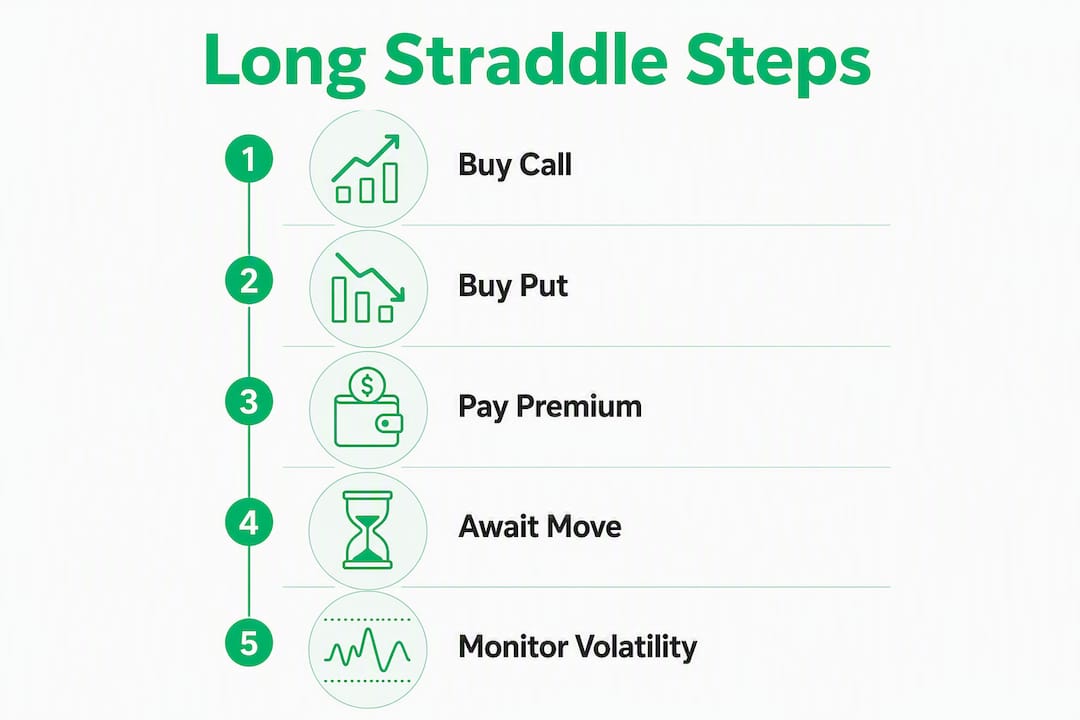
A long straddle buys one call and one put on the same underlying, at the same strike price and expiration date. Use it when you expect a large move but have no conviction on direction — earnings surprises, FDA decisions, major macro prints. The breakeven math is simple: upper breakeven equals the strike plus total premium paid; lower breakeven equals the strike minus total premium paid.
Table of Contents
- What is a straddle strategy and how does it work?
- A step-by-step numeric example of a long straddle
- When should you actually use a long straddle?
- Why long straddles lose money: the real failure modes
- Short straddle vs long straddle: opposite bets, opposite risks
- Pre-trade checklist before you open a straddle
- Key Takeaways
- Straddles are a precision tool, not a lottery ticket
- How Morningoptions helps you find and size straddle setups
- Useful sources and further reading
What is a straddle strategy and how does it work?
A long straddle is a pure volatility bet and should be used as part of a broader wealth accumulation strategy when considering personal finance goals. You're not predicting up or down — you're predicting movement. Buy both legs simultaneously, and the position profits if the underlying moves far enough in either direction to exceed what you paid for both contracts.

The payoff shape is a V. At expiration, the position loses the most when the stock sits exactly at the strike. Move far enough above the strike and the call gains more than the put loses. Move far enough below and the put does the work. One leg always offsets the other, which is the point.
Key mechanics at a glance:
- Components: Simultaneously long one call and one put, same strike, same expiration, same underlying
- Max loss: Total premium paid (plus commissions) — this is fixed and known before you enter
- Upside: Theoretically unlimited on the call leg; large on the put leg down to zero
- Breakeven (upper): Strike + total premium paid
- Breakeven (lower): Strike − total premium paid
- Vega: Positive — the position gains value when implied volatility (IV) rises
- Theta: Negative — time decay works against you on both legs simultaneously
That last point deserves emphasis. Because you own two options, you carry twice the theta drag of a single-leg position. Every day that passes without a move costs you on both the call and the put. A rapid move shortly after entry is far easier to monetize than a slow drift toward the breakeven.
IV is the other lever. Long straddles are positive vega, meaning they gain value when IV rises. The flip side: a post-event IV drop — often called a volatility crush — can reduce contract value even when the stock moves in your favor. The stock gaps up 5%, but IV collapses 40%, and your call is worth less than you paid. That scenario catches more retail traders off guard than almost anything else in options.
A step-by-step numeric example of a long straddle
Take a stock trading at $55. You buy the $55 call for $2.50 and the $55 put for $2.50, with both contracts expiring in 30 days. Total premium paid: $5.00. Each contract covers 100 shares, so your total dollar outlay is $500 per straddle.
Breakeven calculation:
- Upper breakeven: $55 + $5.00 = $60.00
- Lower breakeven: $55 − $5.00 = $50.00
- Max loss: $5.00 per share ($500 per contract), occurring if the stock closes exactly at $55 at expiration
The Investopedia breakeven example uses exactly these figures — $2.50 call, $2.50 put, $55 strike — which makes it a clean benchmark for understanding the math.
P/L at expiration across different price points:
| Stock Price at Expiry | Call Value | Put Value | Total Value | P/L (per share) |
|---|---|---|---|---|
| $45 | $0.00 | $10.00 | $10.00 | +$5.00 |
| $50 | $0.00 | $5.00 | $5.00 | $0.00 (breakeven) |
| $55 | $0.00 | $0.00 | $0.00 | −$5.00 (max loss) |
| $60 | $5.00 | $0.00 | $5.00 | $0.00 (breakeven) |
| $65 | $10.00 | $0.00 | $10.00 | +$5.00 |

Multiply any per-share P/L by 100 to get the dollar result for one contract. Two contracts would double it, and so on.
Pro Tip: Don't wait until expiration to take profits. If the stock makes a sharp move the day after an earnings release, the call or put that's in the money may still carry significant time value. Selling the winning leg early and letting the other expire worthless often beats holding both to expiration.
Commission costs matter more than most traders expect. At $0.65 per contract (a common rate at retail brokers), a two-leg straddle costs $1.30 in commissions to open and another $1.30 to close. On a $500 position, that's roughly 0.5% of capital per round trip — small, but it shifts your effective breakeven slightly wider.
When should you actually use a long straddle?
The honest answer: only when you have a credible catalyst and a reason to believe the market has underpriced the expected move. Without that, you're paying for time you don't have.
Catalysts that typically justify a straddle:
- Earnings announcements (especially for stocks with a history of large post-earnings moves)
- FDA drug approval or clinical trial readouts
- Merger announcements or activist disclosures
- Major macro data releases (CPI, FOMC decisions, jobs reports) on index options
- Product launches or regulatory decisions with binary outcomes
Traders often buy straddles before these events because the outcome is genuinely uncertain, not just directionally unclear. The key question to ask before entering: does the options market's implied move match or exceed your own expected move? If the straddle price already implies a $10 move and you think the stock will move $8, the edge is negative. The market has already priced what you know.
IV rank and IV percentile are the practical tools here. IV rank compares current IV to its 52-week range; IV percentile shows what percentage of days had lower IV. Buying when IV is relatively low relative to expected catalysts gives you a better entry price and reduces volatility crush risk after the event.
On expiration timing: shorter-dated straddles (7–21 days to expiration) are cheaper in absolute premium but bleed theta fast. Longer-dated straddles (45–60 days out) cost more but give the underlying more time to move. For a known event like earnings, buying 1–2 weeks before the announcement and closing the day of (or the morning after) is a common approach. For volatile market conditions without a specific catalyst, longer-dated straddles make more sense.
Liquidity matters too. Check open interest and bid/ask spreads on both legs before entering. A wide spread on either leg can cost you $0.20–$0.30 per share before the trade even starts.
Why long straddles lose money: the real failure modes
Most retail traders who lose on straddles lose for one of three reasons, and they're all predictable.
Theta decay is relentless. Owning two options means theta works against you on both legs every single day. The closer you get to expiration, the faster that decay accelerates. A straddle that looks cheap at 30 days out can feel expensive at 10 days out if the stock hasn't moved. The CME Group's straddle education is direct about this: pre-event timing is critical precisely because of how quickly theta compounds.
Volatility crush is the silent killer. After a priced-in event, IV often collapses sharply. The option that would have profited from the directional move can still drop in value when IV falls. A stock moves 6% on earnings, which sounds like a win — but if IV drops from 80% to 30%, the call you bought might be worth less than you paid even with the stock above your breakeven. This is why some traders close one leg and let the other run, or use spreads to hedge IV exposure.
Execution costs add up. Commissions, bid/ask spreads, and slippage on two legs compound quickly. Each contract represents 100 shares, so a $0.10 wide spread costs $10 per contract per leg. On a $400 straddle, that's a meaningful percentage of capital before you've even started.
Probability framing: a straddle is not a high-probability trade. You need the underlying to move more than the market already expects. If the market has correctly priced the move, the straddle is a zero-edge bet before costs. Understanding high-probability trade selection helps put straddles in proper context — they're situational tools, not default strategies.
Short straddle vs long straddle: opposite bets, opposite risks
The short straddle is the mirror image. Instead of buying both legs, you sell them — collecting premium upfront and profiting when the underlying stays near the strike through expiration.
| Feature | Long Straddle | Short Straddle |
|---|---|---|
| Position | Buy call + buy put | Sell call + sell put |
| Market view | Expects large move (high volatility) | Expects stability (low volatility) |
| Max profit | Unlimited (call leg) / large (put leg) | Premium collected |
| Max loss | Total premium paid (fixed) | Theoretically unlimited |
| Vega | Positive (benefits from IV rise) | Negative (hurt by IV rise) |
| Theta | Negative (time decay hurts) | Positive (time decay helps) |
| Margin required | No (debit trade) | Yes (significant) |
The short straddle profits from time decay and stable prices, but it exposes sellers to potentially unlimited losses if the underlying makes a large move. Brokers impose large margin requirements on short straddles, and assignment risk is a real operational concern for retail accounts.
For most retail traders, the short straddle's naked exposure makes it unsuitable without significant account size and risk management infrastructure. Defined-risk alternatives — iron condors, iron butterflies — achieve a similar premium-selling objective with capped downside, and most brokers approve them for standard options accounts.
Pre-trade checklist before you open a straddle
A straddle that looks good on paper can fail at execution. Work through this before placing the order.
- Identify the catalyst. Is there a specific, dated event driving your thesis? If not, reconsider — without a catalyst, theta will grind you down.
- Check IV rank/percentile. Is current IV low relative to its 52-week range? Buying at elevated IV increases volatility crush risk after the event.
- Compare implied move to your expected move. The straddle price itself tells you what the market expects. If the market implies a $7 move and you expect $6, your edge is negative.
- Verify liquidity. Check open interest (ideally above 500 contracts per leg) and bid/ask spreads. Wide spreads on either leg widen your effective breakeven.
- Calculate your max loss in dollars. Total premium × contracts × 100. Know this number before you enter, not after.
- Size the position. Limit your worst-case dollar loss to a fixed percentage of your trading account. Keeping that figure small relative to account size is standard practice for retail risk management.
- Set exit triggers. Decide in advance: at what profit do you close? At what loss? What's your time-based exit if the stock doesn't move before the event?
Pro Tip: For earnings straddles, consider entering 5–7 days before the announcement rather than the day before. IV typically rises as earnings approach, which can inflate the cost of your straddle if you wait too long. Entering earlier, when IV is still building, often gives you a better fill.
On execution: use limit orders on both legs rather than market orders. Legging into a straddle (buying one leg first, then the other) introduces directional risk between fills. Most platforms let you enter both legs simultaneously as a multi-leg order — use that when available.
After the event, reassess quickly. If the stock moves sharply and one leg is deep in the money, consider closing the winning leg and selling the other for whatever residual value remains. Holding both legs through expiration after a big move often gives back profits to theta.
Key Takeaways
A long straddle profits when the underlying moves more than the total premium paid, making catalyst selection and IV timing the two decisions that determine whether the trade has any edge at all.
| Point | Details |
|---|---|
| Core definition | Buy one call + one put, same strike and expiry; profit from a large move in either direction. |
| Breakeven math | Upper breakeven = strike + total premium; lower breakeven = strike − total premium. |
| Three biggest risks | Theta decay on both legs, IV crush after the event, and execution costs that widen effective breakevens. |
| Position sizing | Calculate total premium × contracts × 100 for your worst-case dollar loss before entering. |
| Morningoptions edge | Morningoptions delivers pre-market catalyst data, IV context, and ranked contract ideas to help identify and size straddle setups faster. |
Straddles are a precision tool, not a lottery ticket
Most retail traders treat straddles like a coin flip with leverage — buy before earnings, hope for a big move, see what happens. That framing is why most straddle buyers lose money over time.
The traders who use straddles well treat them as a pricing problem. The question is never "will this stock move?" It's "is the market underpricing how much it will move?" That's a harder question, and it requires actual work: checking IV rank, comparing the straddle cost to historical post-event moves, and being willing to pass when the premium is too rich.
The other thing most guides skip: volatility crush is not a bug, it's a feature of how options are priced. The market knows earnings are coming. It knows the FDA decision is on Thursday. IV rises into the event precisely because sellers demand compensation for that uncertainty. When the event passes, that uncertainty resolves, and IV falls. You're not getting cheated — you're experiencing the mechanism working exactly as designed. The edge, when it exists, comes from finding events where the market has underestimated the magnitude of the move, not just events where a move is likely.
One practical caution: don't confuse a cheap straddle with a good straddle. A $2 straddle on a $20 stock sounds affordable. But if the stock historically moves $1.50 on earnings, that $2 straddle has negative expected value. Cheap in dollar terms and cheap relative to expected move are completely different things. Pair straddle thinking with a broader options strategy framework and you'll avoid a lot of expensive lessons.
How Morningoptions helps you find and size straddle setups
Identifying a straddle candidate takes real research: you need the catalyst date, current IV rank, the implied move, liquidity on both legs, and a sense of whether the premium is reasonable. Doing that manually for every earnings cycle is slow.
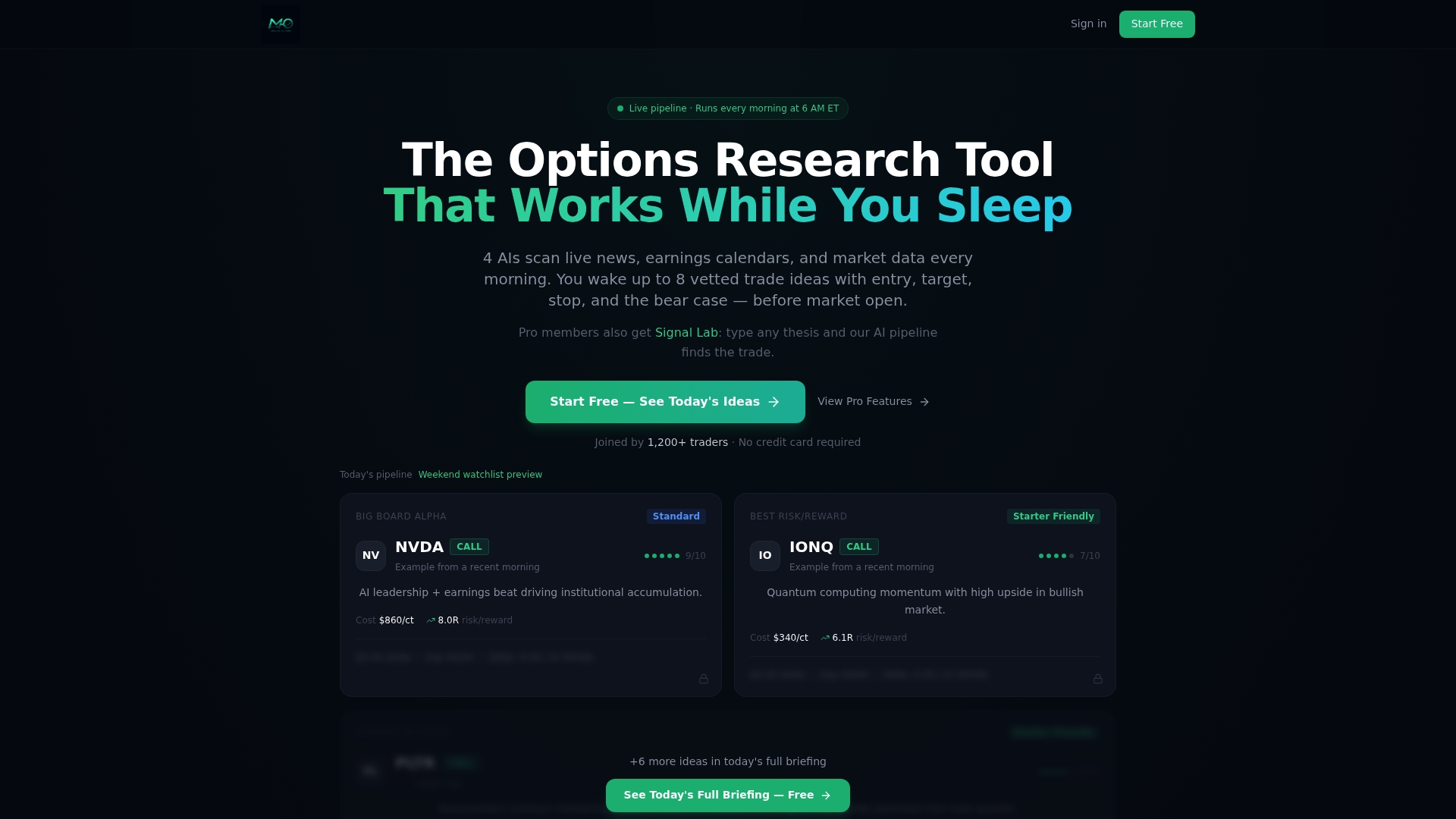
Morningoptions runs a five-stage AI pipeline every market morning that vets, scores, and delivers ranked contract ideas with specific entry levels — not vague commentary. The pre-market briefings surface earnings and catalyst dates, flag IV context, and include bear case analysis so you can see both sides of a setup before you commit capital. The Pro tier ($89/mo) adds the Signal Lab, an AI chat scanner you can use to research specific tickers on demand, including pulling up options chain data and implied move comparisons for upcoming events. That's the pre-trade checklist from this guide, automated.
If you want to stop spending an hour each morning hunting for straddle candidates and start spending that time evaluating the best ones, try the free daily briefing at Morningoptions and see what the scanner surfaces before tomorrow's open.
Useful sources and further reading
- Long Straddle Options Strategy — Fidelity: Canonical mechanics, payoff diagrams, and catalyst examples for the long straddle.
- Straddling the Market — Fidelity Viewpoints: Practical guidance on IV rank, volatility crush, and entry timing for straddle traders.
- Straddle — Investopedia: Breakeven formulas, worked examples, and short vs long straddle comparison.
- Straddles — CME Group: Exchange-level education on theta effects, margin requirements, and short straddle risk.
- Investor Bulletin: Introduction to Options — Investor.gov: SEC-backed primer on options basics and strategy complexity for retail investors.
- Options — FINRA.org: Regulatory context on multi-leg strategies, approval requirements, and assignment risk for retail accounts.
This article is general educational information, not financial or investment advice. Confirm current rules, margin requirements, and suitability with your broker or a qualified financial professional before trading options.