
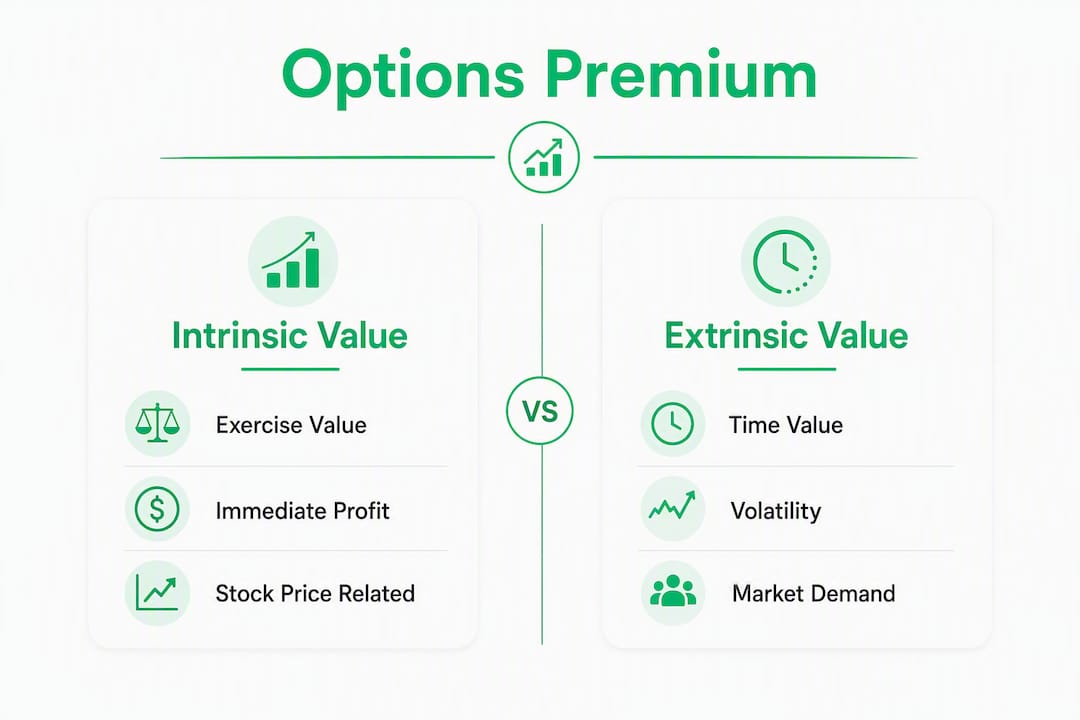
An option premium is the price a buyer pays to acquire an options contract — and the amount a seller (writer) receives and keeps upfront. Every premium splits into two parts: intrinsic value (how much the option is already worth if exercised today) and extrinsic value (everything else: time remaining, implied volatility, and market uncertainty). The biggest drivers of the total price are:
- Underlying price vs. strike (moneyness) — the closer the stock is to the strike, the more intrinsic value
- Time to expiration — more time means more extrinsic value, but that value erodes daily
- Implied volatility (IV) — higher IV inflates the extrinsic portion directly
- Interest rates and expected dividends — smaller effects, but real ones for equity options
- Liquidity — wide bid/ask spreads raise the effective cost for buyers
When a position's premium is mostly extrinsic value, it becomes highly sensitive to both time decay and volatility shifts. That threshold matters more than most beginners realize.
Table of Contents
- What is options premium in real market terms?
- How intrinsic and extrinsic value split the premium
- What factors actually move an option's premium?
- How options premiums are calculated
- A worked example: call premium, breakeven, and seller perspective
- How traders use premiums and the risks to manage
- Which pricing driver dominates as a trade ages?
- Key Takeaways
- Why premium monitoring matters more than most traders admit
- Morningoptions gives you premium intelligence before the open
- Useful sources for further research
What is options premium in real market terms?
In a live market, a premium is not a single number — it is a bid/ask quote. Buyers pay the ask; sellers receive the bid. The gap between those two prices is the spread, and it comes directly out of your P&L the moment you enter a trade.
Theoretical pricing models, most famously Black–Scholes, produce a single "fair value" for an option based on its inputs. The market premium can and does diverge from that theoretical price. Thin liquidity, sudden news, or a spike in demand for a specific strike can push the market price well above or below what any model suggests. This is why checking both the model price and the live quote matters before you execute.
The seller's position is worth understanding clearly. When you write (sell) an option, the premium lands in your account immediately. You do not need to "earn" it over time — it is yours from the moment the trade fills. What you owe is the obligation to fulfill the contract if the buyer exercises. If the option expires worthless, you keep the full premium with no further obligation.
How intrinsic and extrinsic value split the premium
Every option premium breaks into two pieces, and knowing the split tells you where your risk actually lives.
Intrinsic value: what the option is worth right now
Intrinsic value is the immediate exercise value of the option. For a call, it is the amount by which the stock price exceeds the strike: max(0, S − K). For a put, it is the reverse: max(0, K − S). An option can never have negative intrinsic value — the floor is zero.
- In-the-money (ITM): Stock at $55, call strike at $50. Intrinsic value = $5.
- At-the-money (ATM): Stock at $50, call strike at $50. Intrinsic value = $0.
- Out-of-the-money (OTM): Stock at $45, call strike at $50. Intrinsic value = $0.
Extrinsic value: time, volatility, and everything else
Extrinsic value = premium − intrinsic value. For ATM and OTM options, the entire premium is extrinsic. For an ITM option trading at $7.00 with $5.00 of intrinsic value, the extrinsic portion is $2.00. That $2.00 represents the market's compensation for time remaining and uncertainty about where the stock goes next.

Extrinsic value decays toward zero as expiration approaches. It does not decay in a straight line — the rate accelerates sharply inside the final 30 days. An OTM option with three weeks left loses extrinsic value much faster per day than the same option with three months left.
Pro Tip: Before entering any options trade, calculate the extrinsic percentage: extrinsic value ÷ total premium × 100. A high extrinsic share (above 80%) means your position is primarily a bet on time and volatility, not direction.
What factors actually move an option's premium?
Three factors dominate in practice: the underlying price relative to the strike, time to expiration, and implied volatility. The others matter, but these three are where traders spend most of their attention.
Underlying price (moneyness) moves intrinsic value directly. Delta measures this sensitivity — a 0.50 delta call gains roughly $0.50 in premium for every $1 the stock rises. Deep ITM options have deltas near 1.0 and behave almost like the stock itself. Deep OTM options have deltas near zero and barely move with the stock.
Time to expiration erodes the extrinsic portion daily. Theta is the Greek that quantifies this: a theta of -0.05 means the option loses approximately $0.05 per day, all else equal. That decay accelerates as expiration nears, which is why selling short-dated options is a common income strategy and why buying them is a race against the clock.
Implied volatility is the most unpredictable driver. IV is derived from market prices themselves — it is the market's forward-looking estimate of how much the stock will move. Vega measures how much the premium changes per 1% move in IV. During crisis periods, IV can spike sharply even when the underlying price barely moves, which inflates premiums across the board. Earnings announcements are the most common trigger: IV often surges into the event and collapses immediately after, a phenomenon traders call "IV crush."
- Interest rates affect call premiums slightly positively and put premiums slightly negatively (Rho). At normal rate levels, this is a minor factor for most retail traders.
- Expected dividends reduce call premiums and increase put premiums because a dividend payment lowers the stock's price on the ex-dividend date.
- Liquidity does not change theoretical value but absolutely changes what you pay. A wide bid/ask spread on a thinly traded option can raise execution costs noticeably per contract.
Pro Tip: Check IV rank (IVR) before entering any trade. IVR compares current IV to its 52-week range. An IVR above 50 generally means premiums are elevated — better conditions for selling. Below 30 often favors buying strategies. See options strategies for volatile markets for how this plays out across different setups.
How options premiums are calculated
The options premium calculation starts with a simple formula for intrinsic value, then adds the extrinsic component that models estimate based on five or six inputs.
The Black–Scholes model is the most widely referenced pricing framework. Its inputs are:
- Underlying price (S) — the current stock price
- Strike price (K) — the contract's exercise price
- Time to expiration (T) — expressed in years (e.g., 30 days = 0.082)
- Risk-free interest rate (r) — typically the current Treasury yield
- Implied volatility (σ) — annualized, derived from market prices
- Expected dividends — added for equity options; not in the original model
Black–Scholes assumes continuous trading, log-normal price distribution, and constant volatility. Those assumptions break down in real markets, especially around earnings, macro events, or illiquid names. The model gives a useful theoretical anchor, not a guaranteed price.
Most brokers display a theoretical value alongside the live quote on their options chains. Tools like the CBOE's options calculator let you plug in these inputs and see how the theoretical premium changes as you adjust IV or DTE. The gap between theoretical and market price is worth checking — a premium trading significantly above model value often signals elevated demand or a pending event.
A worked example: call premium, breakeven, and seller perspective
Suppose a stock trades at a certain price. You consider a call option with a strike below that price, expiring in a certain timeframe, and quoted at some premium.
Step 1: Calculate intrinsic value as the positive difference between stock price and strike price.

Step 2: Calculate extrinsic value as the premium minus intrinsic value.
Step 3: Total premium per share times contract size (commonly 100 shares) gives the total cost to the buyer.
Step 4: Breakeven for the buyer is strike plus premium paid; the stock must close above this at expiration to yield a profit.
Step 5: From the seller's view, the premium is collected upfront. If the stock closes at or below strike, the option expires worthless and the seller keeps the full premium. Above breakeven, the seller faces losses that increase with the stock price.
Put options follow similar logic, with breakeven as strike minus premium, reflecting the payoff structure for puts.
Note on rounding: brokers quote premiums to two decimal places, and contract multipliers are standardized at 100 shares for standard U.S. equity options. Always confirm the multiplier for index options or non-standard contracts, as it can differ.
How traders use premiums and the risks to manage
Premium mechanics translate directly into trading decisions. Buying vs. selling options creates fundamentally different P&L profiles, and understanding which side of the premium you are on shapes every risk management choice.
Buyers pay the premium upfront. Their maximum loss is capped at what they paid. Their challenge is that time works against them — every day that passes without a favorable move in the underlying erodes the extrinsic portion. Buyers need the stock to move enough, fast enough, to overcome both the premium paid and the ongoing decay.
Sellers collect the premium upfront and profit when the option expires worthless or loses value. Their risk is the flip side: unlimited loss on uncovered calls, or substantial loss on puts if the stock drops sharply. The income strategy only works if the premium collected is worth the risk taken.
Key risks to monitor:
- Accelerated theta inside 30 DTE: Time decay speeds up significantly in the final month. Buyers holding short-dated OTM options face rapid erosion. Sellers benefit from this acceleration but must watch for sudden moves.
- IV spikes around events: Earnings, Fed announcements, and macro data releases can double IV overnight. Buyers who enter before an event may see their premium collapse after it passes (IV crush), even if the stock moved in their direction.
- Wide bid/ask spreads: In illiquid names, the spread alone can represent 10–20% of the premium. Always check the spread before sizing a position.
A short checklist before entering any options trade:
- Check IV rank — is premium elevated or depressed relative to recent history?
- Calculate extrinsic percentage — how much of the premium is time and volatility value?
- Confirm breakeven distance — does the stock realistically reach that level before expiration?
- Size the position — never risk more than you can afford to lose on a single contract
For a fuller pre-trade framework, the options trading basics checklist covers each step in detail.
Which pricing driver dominates as a trade ages?
The answer shifts over the life of a position, and missing that shift is one of the most common mistakes in options trading.
Early in a trade's life, with 60–90 days to expiration, vega dominates for ATM options. A 1% change in IV moves the premium more than a day's worth of theta decay. This is the window where IV shocks do the most damage or provide the most opportunity. ATM options in the 60–90 DTE range carry the highest vega, making them the most sensitive to volatility changes.
As expiration approaches, theta takes over. As expiration approaches, the daily decay accelerates and directional exposure (delta) becomes the dominant concern for ITM options. Traders who entered a position for its vega exposure need to reassess once DTE drops below 30 — the position has fundamentally changed character.
The practical implication: set checkpoints. At 45 DTE and again at 21 DTE, recalculate the extrinsic percentage and check whether the dominant Greek has shifted. If a position that started as a vega play is now 85% extrinsic with 18 days left, the risk profile is now primarily theta. That may or may not match your original thesis.
Pro Tip: When extrinsic value exceeds 80% of the total premium, consider reducing position size or tightening your exit threshold. The position is now highly sensitive to both time decay and any volatility shift — a combination that can erode value quickly even if the underlying moves in your favor.
Key Takeaways
An option premium equals intrinsic value plus extrinsic value, and the dominant pricing driver shifts from vega to theta as expiration approaches — knowing which Greek controls your position at any given moment is the core skill in managing premium risk.
| Point | Details |
|---|---|
| Premium = two components | Every premium splits into intrinsic value (exercise value today) and extrinsic value (time and volatility). |
| Extrinsic decays to zero | Time value erodes daily and accelerates sharply inside the final 30 days before expiration. |
| Three main drivers | Underlying price (moneyness), time to expiration, and implied volatility move premiums most in practice. |
| The 80% extrinsic threshold | When extrinsic value exceeds 80% of total premium, reduce size or tighten stops — theta and vega risk dominate. |
| Morningoptions for daily monitoring | Morningoptions scans IV rank and flags premium signals each morning, giving traders ranked contract ideas before the open. |
Why premium monitoring matters more than most traders admit
Most beginners focus on direction. They pick a stock, decide it will go up or down, and buy a call or put. What they underestimate is that being right about direction is not enough — you also need to be right about timing and volatility. A call buyer who is correct that a stock will rise 5% can still lose money if IV collapses after an earnings event, or if the move takes three weeks longer than the option's remaining life.
The practical lesson is not to avoid buying options. It is to price them honestly before you enter. Check what percentage of the premium is extrinsic. Check whether IV is elevated or compressed. Check whether the breakeven is realistic given the stock's typical daily range. These are not advanced techniques — they are the minimum due diligence that separates a considered trade from a lottery ticket.
Sellers face the mirror image. Collecting premium feels like free money until a position moves sharply against you. The premium collected is compensation for real risk, and the quality of that compensation depends on IV rank, the distance to the strike, and the time remaining. A premium that looks generous at 40 IVR looks very different at 15 IVR on the same strike.
Morningoptions gives you premium intelligence before the open
Every morning before the market opens, Morningoptions runs a five-stage AI pipeline that vets, scores, and ranks specific options contract ideas — not general market commentary, but named tickers with entry levels, bear case analysis, and strategy context. For traders who want to know whether a premium is worth paying or collecting before the bell rings, that pre-market read cuts hours of manual scanning to minutes.
The Pro tier ($89/mo) adds the lunchtime scanner and Signal Lab, an AI chat tool that lets you research any ticker on demand and check IV rank, extrinsic share, and premium quality in real time. Free daily briefings are available at signup with no credit card required.
Start your free briefing at morningoptions.live and see ranked trade ideas with premium context before tomorrow's open.
Useful sources for further research
These are the most reliable places to verify model outputs, run your own calculations, and go deeper on options pricing mechanics.
- FINRA — the Financial Industry Regulatory Authority; use it to verify broker registration and access investor education on options basics
- NFA (National Futures Association) — regulatory body for derivatives; useful for understanding the regulatory framework around options trading
- SIPC — Securities Investor Protection Corporation; explains how your brokerage account is protected
- Investopedia: Option Premium — clear definition and component breakdown; good starting point for the core formula
- Fidelity: Understanding Options Pricing — covers the main pricing drivers with practical examples; best for quick reference on bid/ask mechanics
- Wikipedia: Valuation of Options — useful for the mathematical framework behind time decay and theta
- Morningoptions — daily AI-ranked contract ideas with IV and premium context; use it as a live reference for checking whether current premiums are elevated or compressed before you trade