
Yes, you can trade some options after the stock market closes, but far fewer than most people expect. Most equity and ETF options stop at 4:00 p.m. ET, a short list of ETF and index options run until 4:15 p.m., and a handful of index products and newly approved single-stock and ETF classes trade in early or late sessions. Below is who gets which hours, how the orders work and where the risk sits.
TL;DR
- Most equity and ETF options trade 9:30 a.m. to 4:00 p.m. ET. Certain ETF, ETN and index options run to 4:15 p.m. ET.
- Cboe index options such as SPX, VIX, XSP and RUT also have a Global Trading Hours session overnight, and NYSE American added early and late sessions for eligible equity options on October 19, 2026.
- Extended sessions bring thinner liquidity, wider spreads and bigger news-driven swings. Market orders are not allowed in NYSE American's extended sessions.
- Whether you can use any of this depends on your broker, so check its options hours page and your account permissions before you plan a trade.
Table of Contents
- Can you trade options after hours?
- Regular hours, the 4:15 p.m. close and the 3:30 p.m. cutoff
- The new early and late sessions for equity options
- Index options: the overnight session
- How orders work outside regular hours
- The risks, in plain numbers
- Do you actually need after-hours options?
- Our perspective
- Get the setups before the open
- FAQ
- Sources
Can you trade options after hours?
It depends on the contract, the exchange and your broker. "After hours" for stocks means the stretch after 4:00 p.m. ET, when you can place orders through electronic networks. Options do not work like that. Options are listed on exchanges that each set their own sessions, and most contracts simply have no session after the close.
Three groups are worth separating:
- Standard equity and ETF options. Most trade Monday to Friday, 9:30 a.m. to 4:00 p.m. ET, excluding holidays, according to Robinhood's options hours page. On half-days the close is 1:00 p.m. ET.
- Late-close options. Some underlying assets have options that trade until 4:15 p.m. ET, and the exchanges decide which. They are typically products that track major indexes, such as options on SPY, per the same page.
- Index options with extended sessions. Cboe lists a Global Trading Hours (GTH) session for SPX, VIX, XSP and RUT that runs from 8:15 p.m. ET to 9:25 a.m. ET the next day.
So the honest answer to "can I trade options after hours" is: yes for a narrow set of products, and only if your broker has turned on access to them. For the typical single-stock call you were eyeing after earnings, the answer is still no.
Regular hours, the 4:15 p.m. close and the 3:30 p.m. cutoff
The 4:15 p.m. rule trips up many traders. NYSE American's regular hours are 9:30 a.m. to 4:00 p.m. or 4:15 p.m. ET, depending on the product, and certain eligible ETF and ETN options trade until 4:15 p.m. Cboe's C1, BZX, C2 and EDGX options have regular or core sessions that run 9:30 a.m. to 4:15 p.m. ET.
That 15 minutes is not an "after hours" session in the strict sense. It is the tail of the regular day for those products. Cboe separates it for equity options as the Curb session, 4:00 p.m. to 4:15 p.m. ET, which it keeps distinct from regular trading hours.

Why you may be cut off at 3:30 p.m.
A common question is whether you can buy options after 3:30 p.m. Your broker, not the exchange, usually sets this. With Robinhood, for example, if you have expiration-date trading enabled, you generally have until 3:30 p.m. ET to open positions in same-day expiring stock and ETF options, and late-close options may allow positions until 3:45 p.m. ET. Other brokers set their own cutoffs. If your platform greys out the buy button at 3:30 p.m., that is a broker risk control, not the market closing.
Expiration timing has its own traps, since the exchange's last trading time and your broker's exercise deadline are different things. We cover that in our guide to options expiration rules and why 5:30 PM may not be your cutoff.
The new early and late sessions for equity options
The biggest change in years is that the exchanges are now widening the day for single stocks and ETFs. Effective Monday, October 19, 2026, NYSE American extended trading hours for certain eligible equity options with two new sessions:
| Session | Hours (ET) | Applies to |
|---|---|---|
| Early Trading Session | 7:30 a.m. to 9:25 a.m. | Eligible equity options designated by the exchange |
| Core session | 9:30 a.m. to 4:00 p.m. (4:15 p.m. for certain products) | All listed options on the exchange |
| Late Trading Session | 4:00 p.m. to 4:15 p.m. | Eligible equity options designated by the exchange |
CNBC reported that NYSE is the second major exchange to announce extended-hours options for heavily traded ETFs and single stocks, after Cboe's plan covering 25 single stocks and five ETFs.
Three points matter for you:
- Only designated classes qualify. The exchange picks eligible option classes, and they must meet its criteria. A new session does not mean every ticker trades in it.
- Core rules still apply. NYSE Regulation told the SEC that the rules governing the core session, including listing and conduct rules, remain applicable where relevant during extended sessions.
- Your broker must opt in. An exchange session is only useful if your broker routes orders to it. Nasdaq MRX, for instance, requires Early ETH Session orders to be entered as Do-Not-Route orders, which is the kind of detail your broker has to build around.
Because exchange schedules and eligible lists change, treat the table as the pattern and check each exchange's page for current designated classes.
Index options: the overnight session
Index options are the one place where something close to true overnight trading exists. Cboe's GTH session for SPX, VIX, XSP and RUT starts at 8:15 p.m. ET and ends at 9:25 a.m. ET the following day. At least one large retail broker says some SPX, VIX, XSP and RUT options can trade until 5 p.m. ET, so the late window is also available there.
A few features of these products shape how you use them:
- Cash settlement and European style. SPX options are cash-settled and European-style, which removes early assignment risk for writers, a real difference from American-style equity options.
- Separate sessions by design. Cboe says the split between GTH, regular hours and Curb sessions exists to give participants a choice, especially those who do not want exposure in extended or overnight periods.
- Not counted for highs and lows. Trades in the GTH and Curb sessions are not last-trade eligible and do not count toward the daily high or low for reporting. Do not be surprised when a chart's daily range does not show the overnight prints.
The cutoff at the other end matters too. The overnight session stops at 9:25 a.m., five minutes before the opening bell. We break down how to plan around that in our premarket options strategy for SPX and VIX.
How orders work outside regular hours
Extended sessions are not just the regular day with different clocks. Expect restrictions:
- No market orders on NYSE American. Market orders are not permitted in its extended sessions for equity options, to protect investors in a potentially illiquid, volatile market. Use limit orders.
- Routing limits. As above, orders in some early sessions must be do-not-route, meaning they rest on that exchange and do not hunt for a better price elsewhere.
- Broker-specific rules. Eligible tickers, order types, whether you can open or only close, and which account level you need all vary by broker.
A quick way to check your broker
- Open your broker's options trading hours or help page and find the section on late-close and extended sessions.
- Look for the list of eligible symbols, and confirm whether it covers index options, ETF options, single stocks or only some.
- Check which order types are allowed, and whether opening trades are permitted or only closing ones.
- Read the extended-hours risk disclosure. Under NYSE American Rule 901.2NY(f), members must give customers written disclosure of the material risks, including lower liquidity, higher volatility, wider spreads and news-related price changes.
- Place a small limit order in a liquid contract first, and see how it routes and fills before you size up.
The risks, in plain numbers
The known risks are lower liquidity, higher volatility, wider spreads and uncertain pricing, as Robinhood lists them. Options magnify each of these, because an option's price depends on the underlying, implied volatility and the quoted spread all at once.
A worked example, with made-up numbers for illustration only: a contract quoted 1.80 bid and 1.90 ask in the middle of the day is a 10 cent spread, about 5% of the price. In a thin extended session the same contract might show 1.60 bid and 2.05 ask. That is a 45 cent spread, about 24% of the mid price. You start the trade down by roughly a quarter of the premium before the stock moves at all.
Other things to hold in mind:
- News effects are exaggerated. An earnings release hits a market with few participants, so prices can overshoot and then reverse at the open. NYSE American's own rule filing requires disclosure of exaggerated news effects and changing prices.
- Single stocks carry more risk than ETFs and indexes. Cboe says it keeps separate sessions for those products because of significant differences in their risk profiles, so brokers can manage adverse customer experiences.
- Short-dated contracts compound it. A same-day expiring option has no time to wait out a bad fill. If you trade these, size them to the loss you can accept, as we describe in sizing 0DTE trades to max loss, not credit.
- Early assignment on short American-style options. If you write equity options, dividends and exercise timing still matter. See our four checks to avoid assignment on ex-dividend options.
If you are a beginner, or you hold a defined-risk spread, the simplest rule is that you rarely need to act in a thin session. Orders you place at 4:10 p.m. can usually wait until the next morning's liquid open.
Do you actually need after-hours options?
Many working people ask this because they cannot watch the screen from 9:30 to 4:00. That is a fair reason, but extended sessions are a poor fix for a busy schedule. Thin books cost you more than a rushed lunch break does.
Better options for people with day jobs:
- Do the research the night before or before the open. Build a short list, note entry levels and decide your maximum loss in advance. Our five-step premarket options watchlist walks through presets and alerts.
- Trade when liquidity is deepest. For many active retail traders that is the first hour or so after the open. We explain why in our piece on 10 to 11 AM ET as the best time to trade options.
- Skip the midday dead zone. If you check positions at lunch, our midday options playbook on avoiding 11:30 to 2:00 PM buys covers what to do and what to leave alone.
- Mind account rules. The pattern day trader rules changed in 2026, which affects how often a smaller account can day trade. Our note on the replaced pattern day trader rule lays out what to do.
Our perspective
We built Morning Options for people who trade around a job, a trade business or a company they run. When we talk to that kind of trader, the question behind "can I trade options after hours" is rarely about the clock. It is: how do I act on what I learned today without being glued to a screen?
Our view is that the extended sessions are a tool for specific, liquid products and for traders who already know their exit. They are not a place to look for ideas. A contract that looks cheap at 4:12 p.m. may just be a wide spread. Our pipeline vets each idea with live market data, catalyst analysis and a bear case before the open, so you walk into the regular session with an entry level and a risk limit already set, rather than improvising on thin quotes.
We would rather you take one well-defined trade in the liquid part of the day than three reactive ones in the thin part. That is the discipline we try to build into every briefing.
— Customer
Get the setups before the open
If you want a clear read on the day before the bell, the free Morning Options plan gives you limited daily trade ideas at $0 per month. Pro is $89 per month, or $742 per year, and adds the full briefings, the lunchtime scanner, Signal Lab for custom on-demand scans and the AI chat scanner for researching tickers. Each idea comes with entry and exit levels and a bear case, so you can decide quickly. See the free and Pro plans.
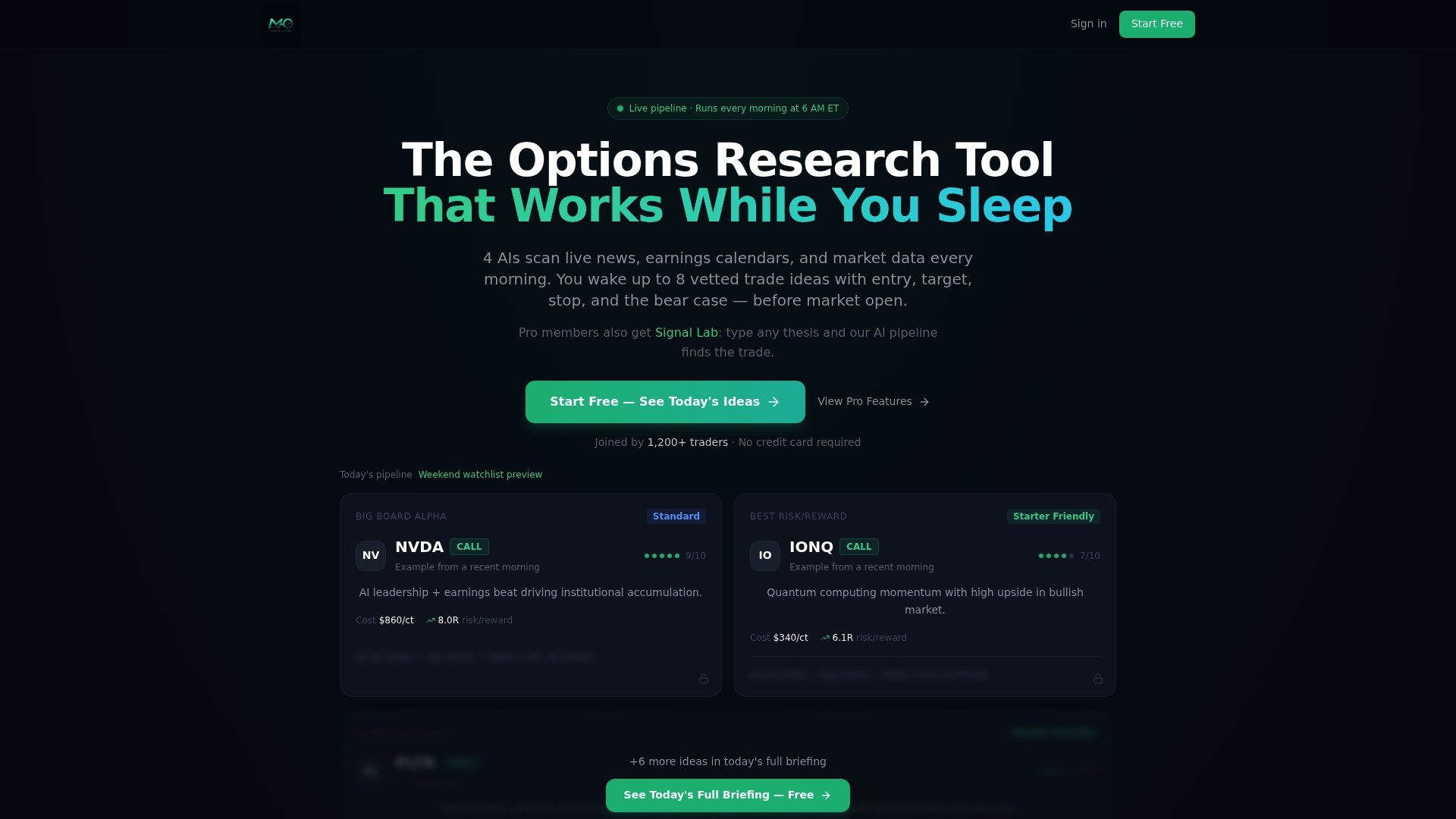
It suits traders who want ranked, specific contract ideas without watching the market all day. If you only want to read headlines, the free tier will do. If you trade actively and want on-demand scans, Pro is the plan built for you.
FAQ
Can you trade options after hours?
Only some of them. Most equity and ETF options stop at 4:00 p.m. ET, certain ETF, ETN and index options run to 4:15 p.m., and some index options like SPX have extended sessions. Whether you can place the order depends on your broker.
Can I buy options after 3:30 p.m.?
Often yes, but your broker may block new positions in same-day expiring contracts at a set time. One large broker uses 3:30 p.m. ET for stock and ETF options with expiration-date trading enabled, and 3:45 p.m. ET for late-close options. Check your own broker's rule, because it varies.
Can you trade options in premarket?
Sometimes. NYSE American has an Early Trading Session from 7:30 a.m. to 9:25 a.m. ET for certain eligible equity options, and Cboe's index options have an overnight session that ends at 9:25 a.m. ET. Single stock options not on an eligible list still wait for the 9:30 a.m. open.
What order types work in extended options sessions?
Limit orders are the safe choice. NYSE American does not permit market orders in its extended sessions for equity options, and some sessions require do-not-route orders. Your broker may add more limits.
Are extended-hours options riskier?
Yes. Liquidity is lower, spreads are wider and news can move prices sharply. Use small size, limit orders and defined-risk positions, and talk to a licensed financial professional if you are unsure whether these trades fit your situation.
Sources
- Options trading hours | Robinhood
- NYSE American regulatory memo on extended hours trading for options
- Hours & Holidays | Cboe
- Equity Options Extended Trading Hours FAQ | Cboe
- SPX Index Options fact sheet | Cboe
- NYSE Regulation comment letter, SR-NYSEAMER-2026-34 | SEC
- Nasdaq MRX rule release 34-106033 | SEC
- NYSE extends options trading hours | CNBC