
The broken wing butterfly is an asymmetric options spread that collects a small net credit at entry while keeping risk defined on one side and deliberately larger on the other. Use it when you have a mild directional bias, implied volatility is low to moderate, and you want time decay working for you without paying a debit. The single risk to control: gap risk on the "broken" wing, where the underlying can blow through your further long strike and hand you a loss that dwarfs the credit you collected.
Three things to know before you go further:
- What it is: A 1-2-1 options spread with one wing wider than the other, converting a standard symmetric butterfly from a debit into a zero-cost or net-credit entry.
- When it works best: Low to moderate CBOE VIX environments, mild directional lean, and a skew structure that finances the broken wing without requiring a large debit.
- The key risk: The broken side carries asymmetric max loss. Without predefined delta thresholds and a monitoring routine, a small credit can become a material loss fast.
Quick note on terminology: "broken wing butterfly" is the trader's shorthand. The recognized industry term is broken wing butterfly spread, sometimes abbreviated BWB. Both refer to the same structure throughout this guide. And yes, if you searched for a butterfly with damaged wings in the literal sense, the options strategy is what dominates this keyword. For actual butterfly rehabilitation, Birds & Blooms covers wing repair in detail.
Key Takeaways
The broken wing butterfly is a credit-entry asymmetric spread that works in low-to-moderate IV environments with a mild directional bias, but it demands predefined delta triggers and hard stops to prevent the broken wing's gap risk from turning a small credit into a large loss.
| Point | Details |
|---|---|
| Size to max loss, not credit | Max loss on the broken side can be 20+ times the credit received; size positions accordingly. |
| Entry conditions matter | IV percentile below 50, favorable skew, and no binary events within the DTE window are the core filters. |
| Exit at 30–50% of credit | Close winning BWBs before expiration; don't hold for the last dollar of credit. |
| Delta triggers are non-negotiable | When short-leg delta crosses 0.40, evaluate immediately; above 0.50, adjust or close. |
| Morningoptions pre-scores setups | The daily AI briefing surfaces ranked BWB ideas with entry levels, IV context, and exit triggers built in. |
Table of Contents
- What is a broken wing butterfly and how does it differ from a standard butterfly?
- Common BWB variants and how wing width changes the payoff
- How to set up a broken wing butterfly step by step
- Breakeven formulas, max profit, and how to read the payoff
- Worked numeric example: a put BWB on a generic index ETF
- How the Greeks behave in a broken wing butterfly
- What market conditions favor a broken wing butterfly?
- Broken wing butterfly vs. standard butterfly vs. iron condor
- Active management: monitoring rules, adjustment recipes, and hard stops
- A practical pre-trade checklist and monitoring template
- Tax implications of broken wing butterfly trading
- The BWB in a daily trading workflow: a Morningoptions perspective
- Morningoptions scans and scores BWB setups daily
- Sources
What is a broken wing butterfly and how does it differ from a standard butterfly?
A standard symmetric butterfly uses three strikes equidistant from each other: one long lower strike, two short middle strikes, and one long upper strike. The wings are equal width. You pay a debit, your max profit sits at the short strikes at expiration, and your max loss is capped symmetrically on both sides.
A broken wing butterfly breaks that symmetry deliberately. One wing is wider than the other. That extra width generates additional premium, which can offset the cost of the spread entirely and flip it into a net credit. The trade-off: the wider wing now carries a larger potential loss if the underlying moves hard in that direction.
Core components of a BWB:
- Long lower strike (farther OTM on the broken side, wider than standard)
- Two short middle strikes (the body, same as a standard butterfly)
- Long upper strike (the intact wing, standard width from the body)
Call vs. put BWBs and directional lean:
- A put BWB places the broken wing below the market. You collect a credit if the stock stays flat or rises. The risk is a sharp drop. This is the bullish/neutral version.
- A call BWB places the broken wing above the market. You profit if the stock stays flat or falls. The risk is a sharp rally. This is the bearish/neutral version.
Compared to a standard butterfly, the BWB typically enters at zero cost or a small credit rather than a debit, shifts one breakeven point, and accepts a larger max loss on the broken side in exchange for that credit. The Interactive Brokers Traders' Insight piece on BWBs frames it well: the structure is a credit vehicle, not a passive income trade, and it demands active monitoring because of that asymmetric exposure.
Common BWB variants and how wing width changes the payoff
The most common variants active traders run:
- Put BWB (bullish/neutral): Broken wing is the lower put. Most popular for retail traders who want upside credit in a rising or sideways market.
- Call BWB (bearish/neutral): Broken wing is the upper call. Used when you expect the underlying to drift lower or stay range-bound.
- Skip-strike BWB: Instead of moving the long strike one increment farther, you skip an entire strike, creating a larger gap and typically a larger credit but also a wider gap risk zone.
- Ratio variations: Some traders run a 1-3-2 or 1-2-1 with unequal leg sizes to tune the credit and delta exposure, though the 1-2-1 is the cleanest structure for most setups.
How wing width affects the trade in practice:
| Wing Width (Broken Side) | Typical Effect on Credit | Max Loss (Broken Side) | Breakeven Shift |
|---|---|---|---|
| Standard + 1 strike | Small credit or near zero | Moderate increase | Minor shift outward |
| Standard + 2 strikes (skip) | Larger credit | Significant increase | Larger shift outward |
| Standard + 3 strikes | Largest credit | Largest potential loss | Substantial shift |
The wider you break the wing, the more credit you collect, but the gap risk zone expands proportionally. Most practitioners keep the broken wing to one or two strikes beyond the intact wing. Going wider than that often means the credit doesn't justify the tail risk, especially in low-liquidity underlyings.
How to set up a broken wing butterfly step by step
Step 1: Choose your underlying and check liquidity. Use underlyings with tight bid-ask spreads on all three strikes. Wide spreads on any leg eat into the credit and make fills unpredictable.
Step 2: Select your DTE. The most common range is 21–45 days to expiration. Shorter DTE accelerates theta but compresses your adjustment window. Longer DTE gives more time but slows decay.
Step 3: Pick the body (short strikes). Place the two short strikes near the price you expect the underlying to be at expiration. For a put BWB, that's typically at or slightly above the current price. Delta on the short strikes commonly runs 0.25–0.40 at entry.
Step 4: Set the intact wing. Place the long strike on the intact side one standard increment from the short strikes (e.g., 5 points on SPY, 10 points on SPX).
Step 5: Break the other wing. Move the long strike on the broken side one or two increments farther than the intact wing. This is what generates the credit.
Step 6: Calculate net credit and max loss before placing the order. Never enter without knowing both numbers. Size the position to the max loss on the broken side, not to the credit received. The SEC's margin borrowing guidance is worth reviewing here: multi-leg spreads carry margin and assignment implications that vary by account type and broker.
Step 7: Place as a single strategy order. Use a limit order on the net credit. Legging in separately exposes you to leg risk and often results in a worse fill.
Sizing to the credit (which might be $50) instead of the max loss is the most common mistake retail traders make with this structure.
Breakeven formulas, max profit, and how to read the payoff
For a put BWB entered at a net credit, the math works as follows. Define:
- A = lower long put strike (broken side)
- B = short put strikes (body, two contracts)
- C = upper long put strike (intact side)
- Credit = net premium received
Breakeven points:
- Upper breakeven: C minus Credit (the stock must stay above this for you to keep the credit)
- Lower breakeven: A plus (width of broken wing minus Credit)
Max profit: Occurs when the underlying closes exactly at B at expiration. Max profit = (C minus B) times 100 plus Credit times 100.
Max loss (broken side): (B minus A) minus (C minus B) minus Credit, times 100. This is the gap risk zone. If the underlying falls below A at expiration, you lose this amount per spread.
Max loss (intact side): Limited to the credit received. If the underlying rallies above C, you simply keep nothing and lose the credit.
The three payoff zones at expiration:
- Credit-kept zone (above upper breakeven): Underlying stays above C. You keep the full credit. This is the "nothing happens" scenario.
- Max profit zone (near the body strikes): Underlying closes near B. You collect the credit plus the spread value. Best-case outcome.
- Gap risk zone (below lower breakeven): Underlying falls through A. Max loss is realized. This is the scenario that requires hard stops.
The Strike confirm this structure: the credit shifts the lower breakeven outward, giving you a small buffer, but the gap loss on the broken side is real and can be multiples of the credit.
Worked numeric example: a put BWB on a generic index ETF
Assume an index ETF trading at $450. You construct a 30-DTE put BWB:
| Leg | Strike | Action | Premium |
|---|---|---|---|
| Long put (broken side) | $430 | Buy 1 | $1.20 |
| Short puts (body) | $445 | Sell 2 | $2.10 each |
| Long put (intact side) | $450 | Buy 1 | $3.55 |
Net credit calculation:
- Collected: (2 × $2.10) = $4.20
- Paid: $1.20 + $3.55 = $4.75
- Net: $4.20 minus $4.75 = -$0.55 debit (this example is a small debit; widening the broken wing one more strike typically flips it to a credit of roughly $0.30–$0.55 per the optionstrading.org worked example)
Adjusting the broken wing to $425 instead of $430 would generate a net credit of approximately $0.55. Using that credit version:
Max profit: ($450 minus $445) × 100 + $0.55 × 100 = $500 + $55 = $555 per spread
Max loss (broken side): ($445 minus $425) minus ($450 minus $445) minus $0.55 = $20 minus $5 minus $0.55 = $14.45 × 100 = $1,445 per spread
Upper breakeven: $450 minus $0.55 = $449.45
Lower breakeven: $425 + ($14.45) = $439.45 (approximately)
Scenario P&L at expiration:
| Underlying at Expiration | P&L per Spread |
|---|---|
| Above $450 | +$55 (keep credit) |
| At $445 (body) | +$555 (max profit) |
| At $439.45 (lower BE) | $0 |
| At $425 (broken long) | -$1,445 (max loss) |
| Below $425 | -$1,445 (capped) |
The ratio of max loss to max credit kept is roughly 26:1 in this example. That ratio is why sizing to the max loss, not the credit, is non-negotiable.
How the Greeks behave in a broken wing butterfly
Delta at entry is typically small and positive for a put BWB (you benefit slightly from upward price movement). As the underlying drifts toward the short strikes, delta increases. If the underlying falls toward the broken wing, delta turns sharply negative and the position starts behaving like a short put. That shift is the warning signal.
Theta works in your favor when the underlying is near the body strikes. Time decay erodes the value of the short puts faster than the longs, which is the core income mechanism. Theta flips negative if the underlying moves far from the body.
Vega is typically negative at entry for a credit BWB. Falling implied volatility after entry helps the position. Rising IV hurts, because it inflates the value of the options you're short and can push the position into a loss even if the underlying hasn't moved much. Tracking IV percentile at entry is therefore not optional; it's the primary environmental filter.
Pro Tip: Set a delta alert on your short strikes. When the short-leg delta crosses 0.30–0.40 (from its entry level of 0.25–0.35), that's your signal to evaluate adjustment or exit. Waiting for a larger delta move typically means the gap risk zone is already close.

The asymmetric risk profile means the position doesn't behave symmetrically as price moves. The intact side has limited loss (the credit). The broken side has a loss that can be 10–30 times the credit. Greeks help you see the move coming; they don't prevent it. Predefined triggers do.
What market conditions favor a broken wing butterfly?
The BWB performs best in a specific set of conditions. Outside those conditions, other structures fit better.
Ideal environment:
- IV percentile in the 20th–50th percentile range. Low enough that you're not selling cheap premium, high enough that the broken wing generates a meaningful credit.
- A skew structure where OTM puts carry elevated implied volatility relative to ATM options. That skew helps finance the broken wing on a put BWB.
- A mildly directional or range-bound underlying. The strategy doesn't need the stock to move; it needs it not to move hard against the broken side.
- Liquid options chain with tight bid-ask spreads across all three strikes.
When to avoid it:
- Before earnings, Fed announcements, or other binary events. A gap through the broken wing on an event is the worst-case scenario, and it happens fast.
- When IV percentile is above 60–70. High IV means the credit looks attractive but the underlying is already pricing in large moves. The Interactive Brokers analysis specifically flags high-IV expansion environments as unfavorable for BWBs used as credit vehicles.
- When the underlying is in a strong trending move against your broken side. A put BWB in a stock already breaking down is not a neutral trade; it's a leveraged short position with a credit attached.
Quick IV checklist before entry:
- IV percentile below 50? Check.
- Skew favorable for the broken wing? Check.
- No binary event within DTE window? Check.
- Bid-ask spread under $0.10 on all legs? Check.
If any of these fail, consider a standard butterfly, an iron condor, or waiting for a better setup. For high-IV environments specifically, options strategies for volatile markets covers the alternatives in detail.
Broken wing butterfly vs. standard butterfly vs. iron condor
BWB vs. standard butterfly:
- Entry cost: BWB enters at zero cost or a credit; standard butterfly requires a debit.
- Max loss: BWB has asymmetric max loss (larger on broken side); standard butterfly has symmetric, smaller max loss on both sides.
- Directional tilt: BWB has a mild directional lean; standard butterfly is neutral.
- Best use: BWB when you have a directional view and want credit entry; standard butterfly when you want pure neutral exposure and symmetric risk.
BWB vs. iron condor:
- Structure: Iron condor sells premium on both sides; BWB concentrates risk on one side.
- Probability of profit: Iron condor typically has higher POP because it profits over a wider range; BWB has a narrower profit zone but a credit-kept zone on the intact side.
- Capital efficiency: BWB can require less capital than an iron condor in some account types, but the asymmetric max loss is larger.
| Structure | Entry Cost | Asymmetric Risk | Best Market Regime |
|---|---|---|---|
| Standard butterfly | Debit | No | Neutral, low IV |
| Broken wing butterfly | Credit or zero | Yes (one side) | Mild directional, low-mod IV |
| Iron condor | Credit | No | Range-bound, moderate IV |
Pick the BWB when you have a directional lean, want a credit entry, and are willing to manage the broken side actively. Pick the iron condor when you want symmetric, wider profit zones and less active management. For a broader look at defined-risk trade structures, the comparison extends to other spread types.
Active management: monitoring rules, adjustment recipes, and hard stops
The BWB is not a set-and-forget trade. Experienced practitioners exit credit BWBs at roughly 30–60% of initial credit when the trade is working, and use delta-based triggers to exit or adjust when it isn't.
Monitoring cadence:
- Pre-market: Check overnight moves, IV changes, and any news on the underlying.
- At open: Verify fills, confirm position Greeks match expectations.
- Midday: Check IV drift and price relative to short strikes.
- One hour before close: Re-evaluate exit plan if the underlying is near the body or broken wing.
Adjustment sequence (execute in order if the broken side is threatened):
- Buy back one of the two short contracts to reduce short exposure and flatten delta.
- If justified by the new IV and price level, resell a replacement short further OTM.
- If the underlying continues moving toward the broken wing, add an extra long put below the broken long to cap the gap loss.
Hard stop rules:
- Dollar loss: If the position reaches a loss equal to 2–3 times the initial credit, close the entire spread.
- Delta trigger: If the short-leg delta crosses 0.40, evaluate immediately. Above 0.50, close or adjust without waiting.
- Technical break: If the underlying closes below a key support level that puts the broken wing in play, exit the next morning.
Pro Tip: Set price alerts on your broker platform the moment you enter the trade. Alert levels: short strike price, lower breakeven, and the broken long strike. Predefined alerts prevent the emotional "let me see if it bounces" hold-through that turns a small loss into a max loss.
A practical pre-trade checklist and monitoring template
Use this as a copy-paste template for your trade journal.
Pre-entry checklist:
- Underlying: liquid, tight spreads, no binary events within DTE window.
- IV percentile: below 50th percentile at entry.
- Skew: favorable for the broken wing (elevated OTM IV on broken side).
- DTE: 21–45 days.
- Leg widths: intact wing width, broken wing width (note the difference).
- Net credit: confirmed positive or zero before placing order.
- Max loss (broken side): calculated and recorded.
- Position size: sized to max loss, not to credit.
- Stop triggers: dollar loss threshold and delta threshold written down.
- Exit target: 30–50% of credit collected.
Monitoring schedule:
- Pre-market (8:00–9:30 AM ET): IV change, overnight gap, news check.
- Open (9:30–10:00 AM ET): Verify fills, check position Greeks.
- Midday (12:00–1:00 PM ET): IV drift, price relative to short strikes.
- Pre-close (3:00–3:30 PM ET): Re-evaluate exit if near body or broken wing.
Trade journal entry fields:
- Entry date and expiration date
- Strikes (all three) and wing widths
- DTE at entry
- IV percentile at entry
- Net credit received
- Max loss (broken side)
- Delta of short strikes at entry
- Stop trigger (dollar and delta)
- Actual exit date and P&L
- Notes on what triggered exit
Recording DTE, IV percentile, and predefined exit triggers across many trades materially improves outcomes over time by preventing emotional hold-through decisions, as the optionstrading.org BWB guide emphasizes in its journaling guidance.
Tax implications of broken wing butterfly trading
Multi-leg options spreads like BWBs carry specific tax considerations under U.S. tax law that differ from single-leg trades. This is general information, not tax advice. Consult a qualified tax professional for your specific situation.
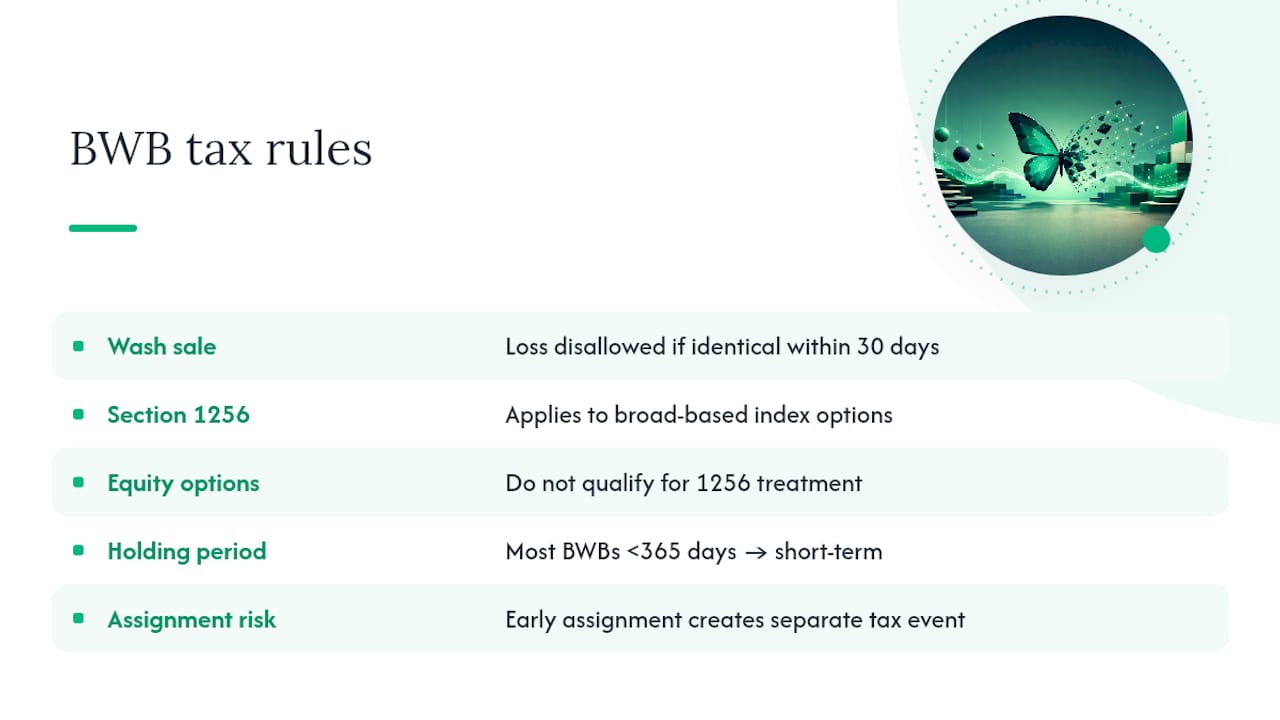
Wash sale rules: Options are subject to wash sale rules. If you close a BWB at a loss and open a substantially identical position within 30 days before or after, the loss may be disallowed. With BWBs, "substantially identical" can be ambiguous when you adjust strikes or DTE, so document every adjustment clearly.
Section 1256 contracts: Broad-based index options (SPX, NDX, RUT) are treated as Section 1256 contracts under the IRS code. This is a meaningful tax advantage for active traders running BWBs on index products. Equity options (SPY, QQQ, individual stocks) do not qualify for Section 1256 treatment.
Short-term vs. long-term: Most BWBs are held for fewer than 365 days, so gains and losses are typically short-term capital gains or losses for non-Section 1256 products.
Credit received at entry: A net credit received when opening a BWB is not taxable income at entry. It becomes part of the cost basis calculation when the position closes.
Assignment risk and tax events: Early assignment on a short leg creates a separate tax event. If one of your short puts is assigned, you may be forced to buy shares at the short strike, creating a stock position with its own holding period and tax treatment. Options assignment mechanics are worth reviewing before running BWBs in a taxable account. For a broader look at tax efficiency across options strategies, including multi-leg spreads, that resource covers the key distinctions.
The BWB in a daily trading workflow: a Morningoptions perspective
The broken wing butterfly is one of the most misused structures in retail options trading, and the misuse almost always comes down to two things: sizing to the credit and ignoring the IV regime.
Traders see a $55 credit on a spread and think their risk is $55. It isn't. The risk is $1,445. That cognitive gap, between the credit you see and the loss you can take, is where accounts get damaged. The structure is genuinely useful when IV is low, skew is favorable, and you have a directional lean. Outside those conditions, it's a trap dressed up as a free lunch.
The other pitfall is treating the BWB as passive. It isn't. The broken wing creates a one-sided exposure that can accelerate quickly. Delta-based triggers and predefined exits aren't optional risk management; they're the only thing separating a managed loss from a max loss. The Interactive Brokers guidance on active monitoring makes this point directly, and it's worth taking seriously.
Where BWBs fit well in an AI-assisted workflow: use a scanner to identify underlyings where IV percentile is in the 20th–50th range, skew is elevated on the broken side, and there's no binary event within the DTE window. That filters the universe down to setups where the credit is real and the gap risk is manageable. Morningoptions's Signal Lab does exactly this kind of pre-scored filtering, surfacing ranked setups with entry levels rather than leaving traders to scan manually.
Morningoptions scans and scores BWB setups daily
Every morning before the open, Morningoptions runs a five-stage AI pipeline that vets, scores, and ranks options trade ideas, including broken wing butterfly setups, with specific contract details, entry levels, and exit triggers. You get ranked ideas with the IV percentile, skew context, and delta profile already calculated, not a list of tickers to research yourself.

The Pro tier ($89/month) adds the lunchtime scanner and an AI chat interface where you can query specific tickers for BWB suitability on demand. That means you can check whether a setup meets the IV, skew, and DTE criteria from this guide in under a minute, rather than pulling up three separate tools. Free daily briefings are available at Morningoptions. If you're running BWBs actively, the pre-scored setups and built-in exit trigger guidance are worth the subscription cost on a single avoided max-loss trade.
This content is educational and does not constitute financial advice. Options trading involves substantial risk of loss. Always consult a qualified financial professional before trading.
Sources
- The Broken‑Wing Butterfly: A Hidden Gem in Options Trading
- Broken Wing Butterfly Options Strategy: Setup, Risks, and Examples
- Butterfly Spreads
- Sec
This article is general information, not a substitute for advice from a qualified financial advisor. Consult a qualified financial professional about your own circumstances before acting on anything here.