
If implied volatility is sitting above the 70th percentile going into an earnings report, sell premium with iron condors or short strangles. If it's below the 30th percentile and you expect a real surprise, buy a straddle or strangle instead. Anywhere in between, a calendar spread splits the difference. In every case, cut your normal position size by half or more and set your exit before you place the trade.
TL;DR:
- Selling premium with iron condors or short strangles is most effective when implied volatility is above the 70th percentile, especially if liquidity is strong.
- Buying straddles or strangles offers potential gains when implied volatility is below the 30th percentile and a significant surprise is expected with ample time before expiry.
- Adjust position sizes down by at least 50 percent and set exit points before placing any earnings trade to manage the high risk of IV crush.
- Liquidity, narrow bid-ask spreads, and careful expiration selection are critical to avoid trading costs eroding profits on multi-leg strategies.
- Pre-screening tools like Morningoptions can save time by automatically ranking setups based on IV percentile, liquidity, and expected move.
Table of Contents
- Earnings Options Strategies and the IV Crush Problem
- Long Straddles and Strangles: How to Buy Volatility Before Earnings
- Selling Premium: Iron Condors, Short Strangles, and Credit Spreads
- Calendar and Diagonal Spreads: The Middle Ground
- How to Choose the Right Earnings Options Strategy
- Execution Details That Separate Winners From Losers
- What the Research Actually Shows About Earnings Trades
- How Morningoptions Fits Into an Earnings Trading Routine
- Tax Implications of Earnings Options Strategies
- How Earnings Surprises Move Option Prices in Real Time
- Real Trade Examples: How Earnings Setups Actually Played Out
- How I Size and Manage My Own Earnings Trades
- Try Morningoptions Before Your Next Earnings Week
- Sources
- FAQ
Earnings Options Strategies and the IV Crush Problem
Every earnings options strategies decision starts with one number: implied volatility. IV measures the market's expectation of how far a stock will move, and around earnings, it inflates for a simple reason. Nobody knows what the company will report, so option sellers demand more premium to take on that uncertainty. Traders call this IV crush, and it's the single biggest reason naive earnings trades lose money even when the direction call was right.
The magnitude is bigger than most new traders expect. IV commonly runs 30% to 50% higher in the days before a report than it does in a normal trading week, then falls 50% to 80% within a day or two after the release, according to practical trading guidance from Ticker Daily. That collapse hits the options pricing model through vega, the Greek that measures sensitivity to volatility changes. A long option can lose value from vega even while gaining from a favorable stock move through delta, and if the crush is severe enough, vega wins.
IV percentile is the fastest screening tool for this problem. It ranks current IV against the stock's own IV range over the past year, so a reading of 80 means IV is higher than it's been 80% of the time. That one number tells you which family of strategies has better odds.
- IV percentile above 70: option premium is rich, favoring strategies that sell it.
- IV percentile below 30: premium is cheap relative to its own history, favoring long volatility.
- IV percentile 30 to 70: no strong edge either way, so structure matters more than direction.
Liquidity matters just as much as IV. Wide bid-ask spreads on thin option chains can eat a bigger chunk of your edge than the IV crush itself, especially on multi-leg trades where you're paying that spread on every leg.
Long Straddles and Strangles: How to Buy Volatility Before Earnings
Buying a straddle or strangle is a bet that the stock's actual move will exceed what the options market has priced in. It only works when the expected move, calculated from the front-month straddle price, understates what's about to happen.
1. Timing the entry. Enter at least five to seven days before the report rather than the day before. Premium is already elevated a week out, but it hasn't reached its peak, and you avoid paying the very last spike in IV that shows up in the final 24 to 48 hours.
2. Picking the expiration. Choose an expiration with a minimum of two to three weeks of life remaining past the earnings date, per Investopedia's straddle and strangle guide. Weekly options that expire the same day as earnings carry so much theta decay and IV crush risk that even a correct directional call can lose money.
3. Selecting strikes. At-the-money strikes maximize gamma and give the cleanest break-even math for a straddle. A strangle with strikes 5% to 10% out-of-the-money costs less upfront but needs a bigger move to pay off.
4. Doing the break-even math. If you pay $6.00 total premium for an at-the-money straddle on a $100 stock, your break-evens sit at $94 and $106. Anything short of that range, even a "good" earnings beat, can still lose money once IV crush eats the residual premium.
5. Setting the exit before you enter. Decide in advance whether you're selling into the IV peak right before the announcement, holding through the report for a directional bet, or exiting at a fixed profit or loss target the next morning.
Pro Tip: Size these trades at two to three times smaller than your normal position, since a single earnings gap can wipe out a full position's gain in one session.
Selling Premium: Iron Condors, Short Strangles, and Credit Spreads
Selling volatility works when IV percentile sits above roughly 70 and the options market has priced in a bigger move than the stock is likely to make. You're collecting inflated premium and betting the IV crush plus time decay outpaces any adverse move.
A typical iron condor sells a call spread and a put spread simultaneously, often placing short strikes around the edges of the expected move (roughly one standard deviation, which most broker platforms display directly on the option chain). A short strangle does the same without buying protective wings, collecting more premium but carrying undefined risk on both sides. A tighter wingspan on a condor caps risk further but shrinks the credit collected.
Delta targeting keeps the setup consistent trade to trade. Selling strikes near the 15 to 20 delta on each side gives a rough 70% to 85% theoretical probability of expiring outside the short strikes, though earnings reports break normal probability assumptions more often than routine weekly trades do.
Sizing discipline here matters more than in almost any other options trade, because a surprise beat or miss can gap the stock through both sides of a condor overnight, with no chance to adjust intraday.
- Cap max loss per trade at 1% to 2% of account value, not per contract, but per full trade.
- Define exact max loss before entry using the wingspan, never leave a short strangle naked without a mental stop.
- Close or roll the trade if the stock approaches your short strike before earnings, don't wait for the report to force a decision.
- Watch assignment risk on the call side heading into earnings, particularly with dividend-paying stocks near ex-dividend dates. Morningoptions covers the mechanics of early assignment risk in more detail.
Margin requirements on undefined-risk short strangles run substantially higher than defined-risk condors, which is often the deciding factor for smaller accounts choosing between the two structures.
Calendar and Diagonal Spreads: The Middle Ground
A calendar spread sells a near-term option and buys a longer-dated option at the same strike, collecting the front month's inflated earnings-driven premium while keeping exposure alive through the back-month leg. A diagonal does the same thing with different strikes on each leg, adding a directional tilt to the position.
This structure fits the IV percentile range where neither straddle-buying nor naked-selling looks compelling, roughly the 30 to 70 band, or any situation where you want defined risk without giving up all your upside if the stock makes a real move.
1. Enter 14 to 35 days before the report. This window lets you buy the back-month leg before its own IV rises much, while the front-month leg still has time to benefit from the pre-earnings volatility run-up.
2. Let the front leg expire or close it right after earnings. The near-term option you sold usually loses most of its value from IV crush within a day of the report, which is exactly the profit driver of the trade.
3. Manage the back-month leg on its own merits. Once the front leg is gone, you're holding a straightforward long option that behaves like any other directional or volatility position.
The payoff shape caps your maximum loss at the net debit paid, a meaningful advantage over a naked short strangle, and it costs less than an outright long straddle since the front-month sale offsets part of the purchase price. The tradeoff is a capped profit zone: a massive surprise move can actually hurt a calendar spread if it pushes the stock far past the strike before the front leg expires.
How to Choose the Right Earnings Options Strategy
Run through this checklist a few days before any earnings report, not the morning of.
- Check IV percentile first. Above 70 leans toward selling premium (condors, strangles), below 30 leans toward buying it (straddles, strangles), and the middle band favors calendars or diagonals.
- Look at the stock's last four to six earnings moves. A stock that has averaged 3% moves against an expected move of 8% is a strong premium-selling candidate; the reverse favors buying volatility.
- Confirm liquidity before committing capital. Open interest above a few hundred contracts per strike and bid-ask spreads under 10% of the option's price keep transaction costs from eating your edge.
- Cap risk as a percentage of account, not contracts. Many traders using earnings options strategies limit any single earnings trade to 1% to 3% of total account value, given how binary the outcome can be.
- Flag red conditions that should stop you. Pending litigation, an unusually large short-interest squeeze, a scheduled guidance update alongside earnings, or thin open interest are all reasons to skip the trade entirely, regardless of what IV percentile suggests.
Straddle and strangle research backs up the "size down" instinct here. Individual trades in one academic sample posted mean peak returns of 27.1% for straddles and 29.9% for strangles, with 62.5% and 70.8% of trades profitable at some point, yet holding a full portfolio of these trades over a 90-day window often failed to stay profitable. Good individual trades don't automatically add up to a good long-term system.
Execution Details That Separate Winners From Losers
A perfectly reasoned earnings options strategy can still lose money to bad execution. Multi-leg trades are where this shows up most.
Always use a net debit or net credit limit order for spreads, condors, and calendars rather than legging in with separate market orders. Legging in exposes you to price movement between fills, and on a volatile pre-earnings chain, that gap can erase a meaningful chunk of your expected edge before the trade is even fully open.
Route orders through a platform that shows the full option chain and combo order book rather than guessing at fair value; understanding how options premium is built from intrinsic and time value makes it much easier to judge whether your limit price is realistic. Traders who want a deeper dive into order-flow mechanics and execution terminology can also check TradeDupe's trading glossary for definitions that come up constantly in multi-leg fills.
Commissions and slippage matter more on earnings trades than on routine ones, because most earnings strategies are built with two, three, or four legs.
- A four-leg iron condor at $0.65 per contract in commissions plus a few cents of slippage per leg can add up to $0.15 to $0.30 per share in total friction.
- Fold that estimate directly into your break-even math before entry, not after you're already in the trade.
- Wider bid-ask spreads right before earnings make market orders especially costly; a limit order a few cents inside the spread usually fills within seconds on liquid names.
For exits, most short-volatility positions should close within one to two trading days after the report once IV crush has done its work. Long-volatility trades held through the announcement should have a same-day or next-morning decision point, since theta and vega work against you the longer you wait.
What the Research Actually Shows About Earnings Trades
The straddle and strangle results are the clearest data point in this space, and they cut both ways. Individual trades looked genuinely attractive, with strong peak returns and win rates well above a coin flip. But when researchers modeled those same trades as a continuous portfolio strategy held over 90 days, the strategy failed to produce sustained profitability. The gap between "this trade worked" and "this system works" is exactly where most retail traders get burned by overconfidence.

A separate line of research looked at whether the language in earnings press releases itself carries predictive value. Text-based models pulling soft signals from press releases explained about as much of the announcement-day return as the earnings surprise number itself did. Combined models reached roughly 56% predictive accuracy for top-performing stocks, but strategies that entered trades after the market open captured no excess return, according to research published on arXiv.
The practical takeaways:
- Treat any single winning trade as a data point, not proof of a repeatable edge.
- Whatever edge exists in earnings text and surprise data gets priced in fast. Waiting until after the open to act usually means you're trading against a market that already knows what you know, which is why premarket screening matters more than midday analysis.
- Build position sizing and exit rules assuming any given trade could be the loser, since the research shows plenty of them are.
How Morningoptions Fits Into an Earnings Trading Routine
Running the IV percentile, liquidity, and sizing checklist manually across a full earnings calendar takes real time, which is exactly the gap Morningoptions is built to close. Its five-AI pipeline scans the day's setups before the market opens and scores each idea, so you're not starting your screening from a blank options chain.
Every morning briefing delivers ranked trade ideas with specific entry and exit levels attached, not general commentary about "watching volatility." For traders who want a live look at a ticker outside the morning window, the Signal Lab and AI chat scanner let you research a specific name on demand, pulling in the same IV and liquidity read the morning pipeline uses.
That workflow maps directly onto the checklist in this article: check IV percentile, confirm liquidity, size the position, and set exits before earnings, with Morningoptions doing the initial screening work so you can spend your limited time on trade selection and risk decisions instead of manual scanning.
Tax Implications of Earnings Options Strategies
Most retail earnings options trades fall under standard short-term capital gains treatment, since the holding period around an earnings report is almost always under a year and frequently under a month. Short-term gains get taxed as ordinary income, which for many active traders is a meaningfully higher rate than the long-term capital gains brackets.
A few structural details matter more for earnings-specific strategies than for routine trading. Multi-leg trades like iron condors involve several separate opening and closing transactions, and each leg is its own taxable event when closed, whether it closes at a profit or a loss. That means a condor with two winning legs and two losing legs generates four separate entries on your tax records, not one net figure.
The wash sale rule deserves particular attention for traders who repeatedly buy straddles on the same underlying stock across multiple earnings cycles. If you close a losing position and open a substantially identical one within 30 days, the loss can be disallowed for tax purposes in that period and added to the cost basis of the new position instead.
Assignment adds another wrinkle. If a short strangle or condor leg gets assigned, the resulting stock position carries its own cost basis and holding period calculation, separate from the option premium you originally collected.
None of this is tax advice, and the rules shift depending on account type, trading frequency, and whether the IRS considers you a trader for tax purposes. A CPA familiar with active options trading is worth the fee once your earnings trade volume picks up, since the recordkeeping gets complicated fast with multi-leg positions.
How Earnings Surprises Move Option Prices in Real Time
The moment an earnings report hits, two forces move option prices simultaneously, and untangling them is the difference between understanding your P&L and being confused by it. The stock price itself moves based on whether results beat or missed expectations. At the same time, implied volatility collapses because the uncertainty that inflated it is now resolved, regardless of which way the number came in.
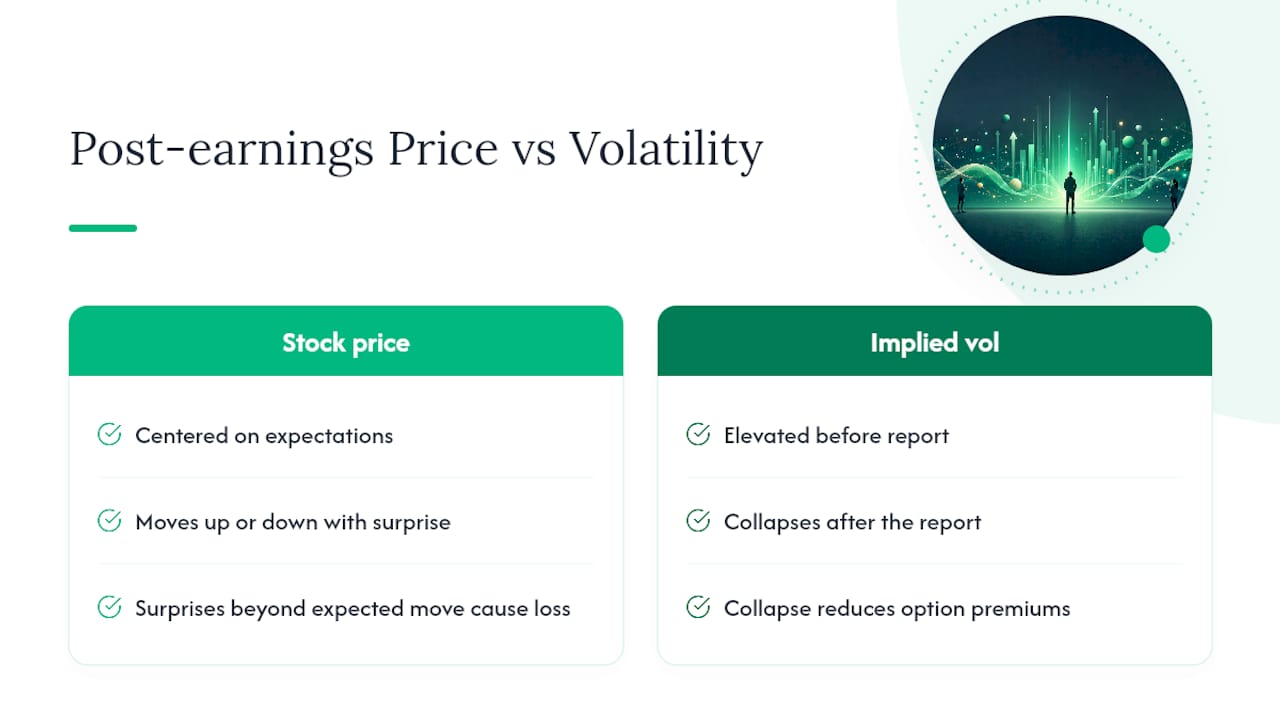
This is the single most common source of confusion for traders new to earnings options strategies: getting the direction right and still losing money on the trade.
For short-premium positions, a surprise in either direction beyond the priced-in expected move is the scenario that actually causes damage.
Adjustment options after a surprise are limited but real. Rolling a losing short spread out in time can buy room for the stock to recover, though it usually locks in a wider loss if done reactively rather than as a planned rule. Closing immediately at a predetermined stop, rather than hoping for a reversal, tends to preserve capital better than any rolling strategy executed under stress.
Real Trade Examples: How Earnings Setups Actually Played Out
A pre-earnings iron condor on a large-cap tech stock. With IV percentile at 78 heading into a quarterly report, a trader sold a condor with short strikes set near the edges of the expected move, roughly one standard deviation out on each side, five trading days before the announcement. The stock moved less than half the priced-in expected move after reporting in line with estimates. IV crush collapsed the premium on both short legs within a day, and the position was closed for most of its maximum profit within 48 hours of the report, consistent with the pre-earnings selling window many professional traders favor.
A long strangle on a smaller-cap biotech ahead of a data readout tied to earnings. IV percentile sat below 25, unusually low given the binary nature of the catalyst.
A calendar spread on a mid-cap retailer heading into a mixed-signal quarter. Entered 21 days before the report at the same strike near the money, the front-month leg lost most of its value to IV crush the day after earnings while the back-month leg retained enough value to keep the trade near break-even, illustrating the defined-risk tradeoff calendars offer over naked short volatility.
How I Size and Manage My Own Earnings Trades
My default is selling premium, condors mostly, when IV percentile clears 70 and the stock's recent moves have run smaller than what's priced in. I avoid naked strangles on anything with a history of double-digit gaps.
I write down my exit level before I enter, both a profit target and a hard stop, and I close on that number regardless of how the position feels in the moment. Earnings season creates a temptation to trade every ticker on the calendar. Discipline about which setups actually clear the checklist matters more than trade volume.
— Customer
Try Morningoptions Before Your Next Earnings Week
Screening IV percentile, liquidity, and expected move across dozens of tickers by hand is exactly the kind of grind that eats a trading morning. Morningoptions runs that scan through a five-AI pipeline before the open and hands you ranked ideas with specific entry and exit levels already attached, not a vague list of "stocks to watch."

The free daily briefing covers the morning's top ranked ideas at no cost. A paid subscription plan adds the lunchtime scanner for a second read on setups as the trading day develops, plus an AI chat scanner for researching any ticker on demand, useful for pulling up a specific earnings name the morning briefing didn't cover. These offerings map directly onto the checklist in this article: IV context, liquidity, and sizing, delivered as a ranked list instead of a spreadsheet you build yourself. Head to the Morningoptions product page to see today's briefing and decide which tier fits your trading pace.
Sources
The straddle and strangle return data referenced throughout this article comes from an honors thesis examining options-based earnings strategies, useful for anyone who wants the full portfolio-level breakdown behind the individual-trade numbers. The predictive-accuracy figures on press-release text come from arXiv research on earnings announcement returns. For broker due diligence before funding any options account, FINRA BrokerCheck and SIPC are worth bookmarking.
- Investing Around Earnings Announcements: An Options-based Trading Strategy (Honors thesis)
- Extracting the Structure of Press Releases for Predicting Earnings Announcement Returns (arXiv)
- How to Trade Options Around Earnings (Ticker Daily)
- Long straddle/strangle earnings guide (Investopedia)
FAQ
What is Warren Buffett's favorite option strategy?
Buffett has spoken favorably about selling cash-secured puts on stocks he'd be willing to own anyway, collecting premium while setting a target buy price below the current market. It's a long-term income approach rather than an earnings-specific tactic.
What is the 3-5-7 rule in options trading?
Definitions vary by source, but the core idea, capping concentration, applies directly to earnings trades given their binary risk.
Why do 90% of options traders lose money?
Most losses trace back to oversized positions, no defined exit plan, and trading through binary events like earnings without adjusting size for the added risk. The straddle and strangle research above shows even statistically favorable setups can fail as a portfolio without strict sizing and exit discipline.
What is the most profitable options strategy for earnings?
There's no single best strategy since profitability depends entirely on IV percentile and the stock's actual move relative to what was priced in. Selling premium tends to outperform when IV is elevated and the historical move is smaller than the expected move; buying volatility tends to outperform in the opposite condition.