
A gamma squeeze happens when a surge of call buying forces dealers to hedge by purchasing the underlying stock, and that hedging pushes the price up even further, feeding more call buying. It's fast, mechanical, and self-limiting. Watch for concentrated call open interest near the current price, short-dated expirations, and a thin float. Size positions like you're betting on a tail event, not a trend.
TL;DR:
- Gamma squeezes mainly occur around near-the-money options with short expiration dates and a small float, especially when call open interest is concentrated at those strikes.
- Elevated short interest combined with heavy call buying increases the risk of a gamma squeeze, but traders must treat signals as probabilistic due to the invisibility of dealer positions.
- Positions should be sized conservatively, with defined risk and clear exit triggers, because gamma-driven moves can reverse quickly and transaction costs can erode potential gains for retail traders.
- Strategies like long straddles or vertical spreads are better suited for high-gamma environments than naked short calls, which carry unlimited downside risk if a squeeze occurs unexpectedly.
- Past episodes like GameStop and AMC show that rapid buildup and unwind of gamma-driven moves happen over days, emphasizing the importance of early detection and precise position sizing.
Table of Contents
- How Gamma Squeeze Options Mechanics Actually Work
- Gamma Squeeze vs Short Squeeze: What's the Difference?
- What Signals Point to a Gamma Squeeze Forming?
- How Should You Size Positions Around a Gamma Squeeze Setup?
- Which Options Strategies Fit a High-Gamma Environment?
- What GME and AMC Taught Traders About Gamma Squeezes
- How Morningoptions Approaches High-Gamma Setups
- Get Ranked Trade Ideas Before the Next Gamma Setup Forms
- Sources
- FAQ
How Gamma Squeeze Options Mechanics Actually Work
Delta tells you how much an option's price moves when the stock moves a dollar. Gamma tells you how fast that delta changes. An option with 0.50 delta and high gamma might jump to 0.70 delta after a two-dollar rally, meaning the dealer who sold that call now needs to hold a lot more stock to stay hedged.
Gamma peaks for at-the-money contracts as expiration nears, and it's typically highest when delta sits in the 0.40 to 0.60 range. Deep in-the-money or far out-of-the-money options barely move the needle. That's why gamma squeezes cluster around strikes close to the current stock price with weeks, not months, left on the clock.
Here's the mechanical chain, step by step:
- Retail or institutional traders buy a wave of short-dated, near-the-money calls.
- Market makers who sold those calls are now short gamma and need to hedge their delta exposure.
- To hedge, they buy shares of the underlying stock, since gamma measures how sensitive that delta hedge needs to be to price changes.
- That buying pushes the stock price higher.
- Higher prices push more calls into the money, raising delta further and forcing dealers to buy even more stock.
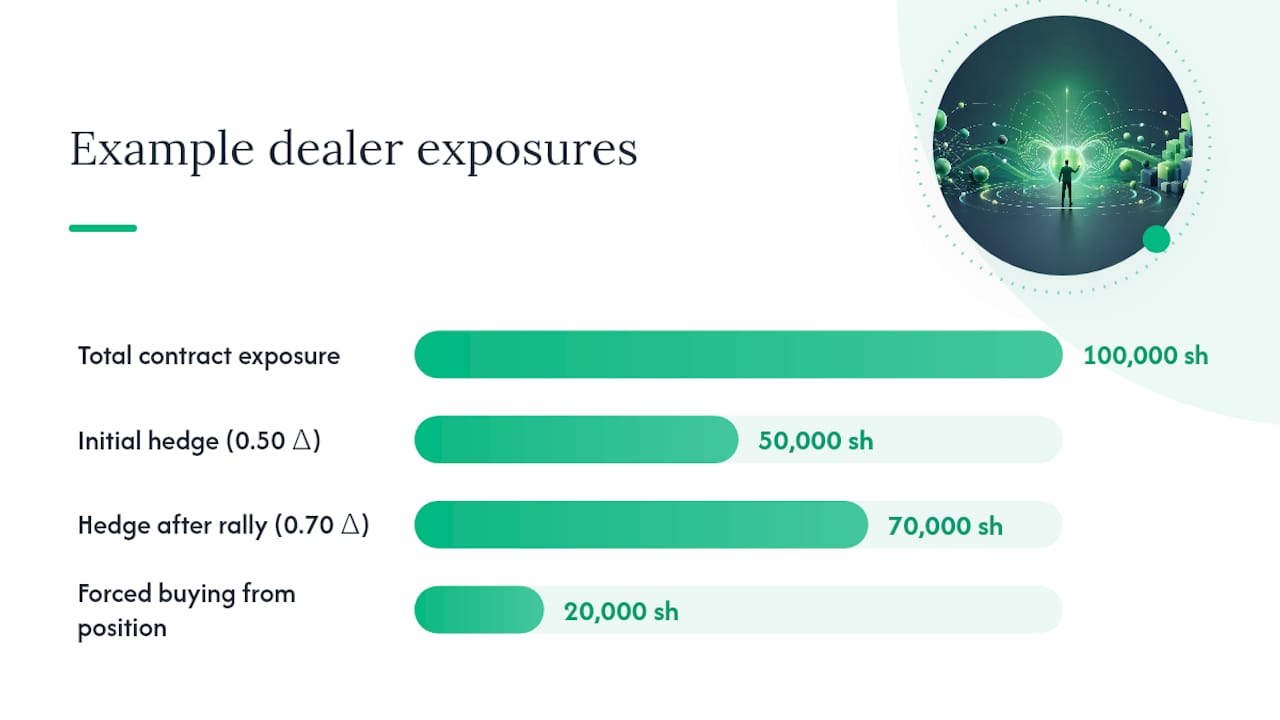
Quick math: say a market maker is short 1,000 call contracts (100,000 shares of exposure) with a 0.50 delta. They're hedging 50,000 shares. If the stock rallies and delta jumps to 0.70, the hedge requirement climbs to 70,000 shares. That's 20,000 shares of forced buying from one options position alone, and multiply that across every dealer holding similar exposure.
Short expirations matter because theta decay and gamma both accelerate as the clock runs out. A three-week option's gamma behaves very differently than a six-month one at the same strike.
Gamma Squeeze vs Short Squeeze: What's the Difference?
The two get lumped together constantly, but they're driven by completely different mechanics. A short squeeze happens when traders who bet against a stock (by borrowing and selling shares) get forced to buy back those shares as the price rises, usually because of margin calls or expiring borrow agreements. A gamma squeeze happens because options dealers are hedging delta exposure, not covering a short position.
The signals you'd track are different too:
- Short squeeze indicators: short interest as a percentage of float, days-to-cover ratio, borrow fees spiking on hard-to-borrow lists.
- Gamma squeeze indicators: call open interest concentration at near-the-money strikes, dealer gamma exposure (GEX) trending negative, short-dated expirations piling up.
- Overlap risk: a heavily shorted stock that also sees a flood of call buying can get hit by both mechanisms at once, and that combination is what produced the most extreme moves in early 2021.
When you see elevated short interest and rising call open interest on the same ticker, treat it as a higher-volatility setup than either force alone. The two feed off each other because short covering pushes the price toward strikes that trigger more dealer hedging.
What Signals Point to a Gamma Squeeze Forming?
You can measure some of this, with prediction-market and order-flow research that helps explain limitations of observable signals and how market microstructure can amplify flows (Assymetrix). You cannot measure all of it, and that gap matters more than most traders admit.
Here's what's actually observable:
- Call open interest concentration at strikes close to the current stock price, especially when a huge share of that OI expires within one or two weeks.
- Float size and average daily volume. A stock with a small float sees larger percentage price swings from the same dollar amount of hedging flow.
- Short interest layered on top of call buying, which amplifies the setup if both are elevated at once.
- Dealer gamma exposure (GEX) estimates, which model whether dealers are likely net long or net short gamma. Net short-dealer gamma tends to amplify price moves because dealers buy into strength and sell into weakness to stay hedged. Tools that track gamma exposure can help you spot when GEX is flipping negative before a move accelerates.
The catch: GEX is an estimate built from public options data, not a direct read of dealer books. Nobody outside a market maker's own desk knows their exact net position. A true gamma squeeze requires four conditions lining up at once: concentrated near-the-money call OI, dealers net short those calls, a thin enough float, and short expirations. Since the dealer side stays invisible, treat every signal as probabilistic. Size your position for "this might not happen" rather than "this is confirmed."
How Should You Size Positions Around a Gamma Squeeze Setup?
There's no free lunch here. Long options give you positive gamma, but you pay for it with negative theta every single day the trade sits open. If the squeeze doesn't materialize before your options expire, decay eats the position alive regardless of how right your thesis was on direction.
A few sizing rules worth adopting:
- Cap gamma-squeeze plays at a small percentage of your total options allocation. Treat them as tail bets, not core positions.
- Use defined risk. Know your maximum loss before you enter, since these setups can reverse inside a single session.
- Set a hard exit trigger tied to observable data: a drop in call volume, a stall in the stock's momentum, or the approach of expiration without follow-through.
- Watch for liquidity changes. Wide bid-ask spreads on the options chain are often the first sign a squeeze is losing steam.
Gamma scalping, buying options and trading the underlying against them to harvest realized volatility, sounds appealing on paper. In practice, transaction costs and slippage eat most of the edge for retail traders. It works better for market makers with near-zero execution costs than for someone paying retail commissions and spreads.
Pro Tip: Write down your exit trigger before you enter the trade, not after the position starts moving against you. Gamma squeezes punish traders who improvise exits in real time.
Which Options Strategies Fit a High-Gamma Environment?
Not every strategy behaves the same way when gamma spikes. Matching the structure to your actual objective, betting on the move versus protecting against it, changes everything about the payoff.
- Long straddles and strangles profit from a big move in either direction and carry positive gamma. The tradeoff is steep negative theta, so these positions need to move fast or they bleed value daily.
- Defined-risk vertical spreads cost less upfront than buying naked calls and cap your downside, though they also cap your upside if the squeeze runs further than expected.
- Ratio spreads can reduce net cost by selling more contracts than you buy, but that flips part of your position short gamma, which is exactly the exposure that can blow up if the underlying keeps ripping.
- Short-gamma income strategies, like selling naked calls into a rising stock, collect premium and theta in calm markets but face outsized, asymmetric losses if a squeeze catches the position wrong-footed.
For most retail traders watching a potential squeeze from the outside, a defined-risk spread or a modest long straddle beats a naked short call every time. The naked short position has open-ended risk exactly when volatility is least predictable. Reviewing strategies built for volatile markets before entering helps clarify which structure matches your actual risk tolerance rather than your hope for a quick win.
What GME and AMC Taught Traders About Gamma Squeezes
The GameStop and AMC episodes of early 2021 remain the clearest live case study in how these mechanics play out. Retail traders piled into short-dated, near-the-money calls in enormous volume. Market makers on the other side of those trades had to buy stock to stay hedged, and because both stocks also carried heavy short interest, short covering layered on top of the gamma-driven buying.
Three takeaways still apply:
- The move happened fast because call buying was concentrated in strikes expiring within days, maximizing gamma exposure.
- The unwind happened just as fast. Once new call buying dried up and dealers no longer needed incremental hedges, the stocks gave back gains in a matter of sessions.
- Traders who bought into the move late, chasing the headline price action, absorbed the sharpest losses when the reversal hit.
The lesson isn't that gamma squeezes are unprofitable. It's that the window to enter safely closes long before most people notice the move has started.
How Morningoptions Approaches High-Gamma Setups
Spotting a gamma squeeze forming means reading call open interest, expiration clustering, and dealer positioning together, not in isolation. A five-AI pipeline can vet and score trade ideas every market morning, flagging when gamma exposure looks stretched and explaining the setup in plain terms. A trader can scan the daily briefing before the open, check which tickers show elevated gamma risk, and decide whether that fits their own risk tolerance before the session starts.
— Customer
Get Ranked Trade Ideas Before the Next Gamma Setup Forms
Spotting a gamma squeeze after it's already ripping is the expensive way to learn this lesson. Ranked, specific contract ideas with entry levels can be sent every market morning, so traders may see vetted setups before the crowd piles in, not after. The free daily briefing covers the basics; paid tiers may add a lunchtime scanner and an AI chat scanner for researching tickers on demand, including checking gamma exposure on names being watched.

If you trade options actively and want a faster read on where gamma risk is building before the opening bell, check out the daily briefing at Morningoptions and see whether the Pro tier's scanner fits your morning routine.
Sources
- Gamma — Options Education Program
- Gamma Definition — Investopedia
- Gamma — Options Analysis Suite
- Gamma Squeeze Explained: Mechanics and Limits | Curved Trading
This article is general information, not a substitute for advice from a qualified financial advisor. Consult a qualified financial professional about your own circumstances before acting on anything here.
FAQ
Is Gamma Scalping Profitable?
It can be for market makers and high-frequency desks with near-zero execution costs, but for retail traders, transaction costs and slippage typically erode most of the expected edge, making it a poor fit for most individual accounts.
What Counts as High Gamma for an Option?
Gamma is generally considered high when an option's delta falls in the 0.40 to 0.60 range, which usually corresponds to at-the-money contracts close to expiration.
How Can You Predict a Gamma Squeeze Before It Happens?
You can't predict one with certainty, since dealer positioning is unobservable. You can watch for concentrated near-the-money call open interest, short-dated expirations, a thin float, and negative dealer gamma exposure, then treat those signals as a probability input for position sizing rather than a guarantee.
How Much Gamma Is Good for Option Buying?
Higher gamma benefits option buyers seeking a big directional move, since it means delta accelerates faster as the stock moves in their favor, but that same gamma pairs with faster theta decay, so the position needs to move quickly to pay for the time premium spent holding it.