
Before you enter an options trade, write four exit rules: profit target, maximum loss, time stop, and a thesis check. Pair each one with an execution action, not a vague intention. A trade with a number in your head is a wish; a trade with an order queued or an alert armed is a plan. That single habit removes most of the emotional decision-making that wrecks otherwise good setups.
TL;DR:
- Setting specific, order-armed exit rules before entering a trade ensures automatic action and reduces emotional decisions.
- Strike and expiration choices influence exit strategies, with in-the-money, at-the-money, and out-of-the-money options each requiring different handling.
- Market conditions like wide bid-ask spreads and low volume can prevent orders from executing at expected prices and must be checked beforehand.
- Managing long, short, and spread positions involves tailored exits, including scaling out, using stop-loss orders, or closing entire structures at once.
- Using predefined order types and templates for profit, loss, and time limits helps maintain discipline and consistency in trade management.
Table of Contents
- Nailing Your Options Entry Exit Checklist
- How Do Strike and Expiration Choices Shape Your Exit?
- Why Do Exit Rules Fail at the Order Level?
- Exit Tactics for Different Position Types
- What Order Types Actually Execute Your Exit Rules?
- Two Copy-Ready Exit Templates
- Why We Push Written Exit Rules So Hard
- Get Entry and Exit Levels Before the Market Opens
- Sources
- FAQ
Nailing Your Options Entry Exit Checklist
The four triggers below aren't abstract advice. Each one needs an observable level and a specific order attached to it before you click "buy." That pairing, a written trigger tied to a concrete closing action, is what separates a real options entry exit plan from a hope.
- Profit target: Close at a defined gain, such as capturing a significant portion of the premium paid or collected. Action: send a sell-to-close limit at your target price, or a GTC buy-to-close if you're short.
- Maximum loss: Cap the damage before it compounds. Action: GTC stop or mental alert at a substantial loss level on debit trades, or a defined multiple of credit received on short premium.
- Time stop: Exit or reassess by a specific date, regardless of price. Action: calendar reminder tied to days-to-expiration, not "whenever I remember."
- Thesis check: If the reason you entered no longer holds (earnings miss, broken support, sector rotation), exit even at breakeven.
For premium sellers, capturing a substantial portion of profit before exit is a commonly referenced heuristic, and for good reason. For premium buyers, the math is blunter: you can lose the entire premium, so your loss trigger deserves as much attention as your profit target.
Pro Tip: Write your exit rules on the trade ticket itself, in the notes field if your platform allows it. If you can't articulate the exact order you'll send, you don't have a rule yet.
How Do Strike and Expiration Choices Shape Your Exit?
Your exit options are decided the moment you pick a strike and expiration, not when you're staring at a loss three weeks later. Strike and expiration selection are the key entry decisions that strongly influence how a position behaves and how you manage the exit., and traders who skip this step end up writing exit rules that don't match the trade they actually own.
- In-the-money (ITM): Higher delta, more expensive, moves closely with the stock, but gives you room to exit early without waiting on extrinsic value to decay.
- At-the-money (ATM): Balanced delta and theta, the most common choice for defined-risk plays, but the fastest gamma acceleration near expiry.
- Out-of-the-money (OTM): Cheap, high leverage, but most of the premium is extrinsic and decays fast if the move doesn't happen quickly.
Expiration choice effectively sets your time horizon for the trade and exit. An expiration giving ample time for theta decay matches most swing setups; shorter expirations approaching the final weeks invite sharper gamma risk, which is why so many traders use that window as a hard checkpoint to close or roll rather than ride into expiration week. Match your profit target to the stock's expected move, not to a round number that sounds satisfying.
Why Do Exit Rules Fail at the Order Level?
A written rule is not the same thing as an order sitting in the market. This is where most options entry exit plans break down: the trader has a number in mind, but never turns it into a mechanism the broker can execute while they're at work or asleep.
Stop orders on options elect off the contract's own quote or last print, not the underlying stock, which means a stop can trigger on a stale or lopsided quote in a thinly traded series and fill you far worse than expected. That's a mechanical trap, not bad luck.
- GTC limit order: Best for defined profit targets on liquid, high open-interest contracts where you're comfortable waiting for your price.
- Alert plus manual limit: Better for illiquid strikes where an automatic stop could trigger on a bad print; you confirm the quote, then act.
- Conditional order: Useful for spreads, since it can trigger off the net debit or credit of the whole structure instead of one leg.
- Letting it expire: Sometimes the right move. When remaining extrinsic value sits in the low cents and the bid-ask spread would eat most of it, closing can cost more than it saves.
Wide bid-ask spreads and thin daily volume turn a perfectly good exit rule into an unfillable order. Check the spread and volume on a contract before you build a rule around it, not after you're stuck holding it.
Options with wide spreads relative to mid price routinely see fills worse than the quoted mid price by several cents, according to Trader Central's analysis of profit-taking mechanics on thinly traded series.
Exit Tactics for Different Position Types
Your exit posture changes depending on whether you're long, short, or running a multi-leg structure. Treat these as starting heuristics, then adjust for the specific contract's liquidity and your own risk tolerance.
- Long calls and puts. Scale out in pieces rather than closing everything at once, define both profit and loss levels before entry, and never let a long option ride unmanaged into expiration week unless you've deliberately decided you want exercise or assignment.
- Short premium (naked or covered). The 50% profit rule and 21 DTE checkpoint are the two most common anchors. Add a stop-loss around 2x to 3x the credit received, and recognize that inside a few days to expiry, holding worthless-adjacent premium can beat paying the spread to close it.
- Spreads and combos. Close the whole structure with a single combo order when you can, since legging out one side at a time exposes you to price movement between fills. Use a conditional order tied to net debit or credit whenever your platform supports it.
- Covered calls and cash-secured puts. Decide in advance whether you want assignment or want to avoid it. Roll the short leg out in time or up/down in strike when the stock approaches your strike with weeks of time value still on the table, and accept assignment when rolling only delays an outcome you're fine with anyway.
What Order Types Actually Execute Your Exit Rules?
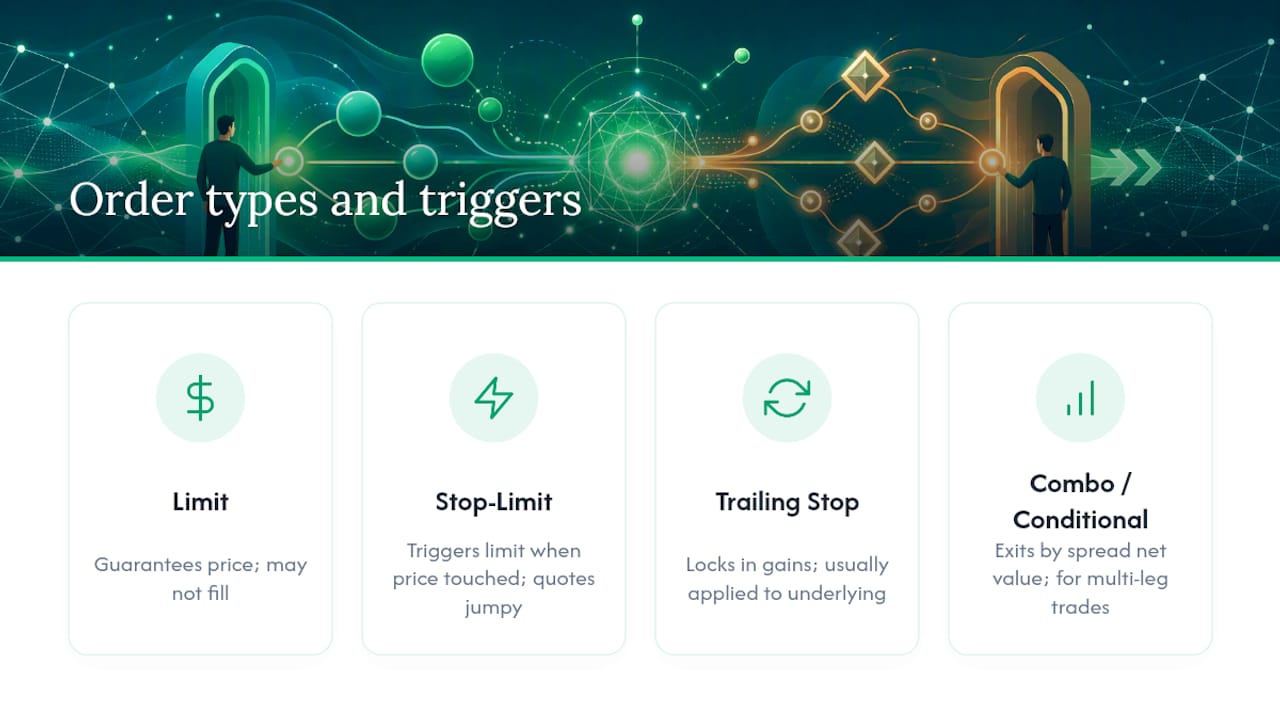
Four order types cover almost every options entry exit scenario you'll face. A limit order guarantees price but not fill, useful for profit targets where you're willing to wait. A stop-limit order triggers a limit once a price is touched, but remember it's reading the option's own quote, which can be jumpy. A trailing stop locks in gains as a position moves favorably, though it's rarely used on options directly since most platforms apply it to the underlying instead. A conditional or combo order lets you set exits based on a spread's net value, which matters more for multi-leg trades than any single-leg mechanism.
Pro Tip: *Set your closing GTC order the same minute you open the position, not after the market moves.
A practical workflow: draft your four exit rules before entry, place whatever closing orders your platform allows immediately, set alerts for anything that can't be automated, and review the full plan again before the next market open. Traders exploring more advanced conditional-order logic for spread execution can find useful parallels in quant-style order flow strategies built around similar trigger-based thinking.
Two Copy-Ready Exit Templates
Templates beat memory. Write these into your trade journal before you place the order.
- Profit template: "Close at [X]% gain: send sell-to-close limit at mid price or better." Example: long call bought for $3.00, close at $6.00 (100% profit) with a limit order at the ask.
- Loss template: "Close at [X]% loss: GTC buy-to-close at [price]." Example: same $3.00 call, exit at $1.50 (50% loss) via a standing GTC order.
- Time/thesis template: "By [DTE or date], reassess regardless of price; exit if [thesis condition] fails."
| Example | Entry | Profit exit | Loss/time exit |
|---|---|---|---|
| Long call | Bought for $3.00 | Close at $6.00 (100%) via limit | Close at $1.50 (50%) via GTC |
| Short put spread | Sold for credit | GTC buy-back at $0.50 (50%) | Buy back at $2.00 (2x stop) or at 21 DTE |
Why We Push Written Exit Rules So Hard
Most losing trades don't die from a bad thesis. They die from a trader who never wrote down what "good enough" or "too far gone" looked like, then froze when the moment arrived. Some daily briefings are built around specific entry and exit levels for exactly that reason: a number you can act on beats a feeling you have to interpret. Try the four-trigger checklist on your next single trade before you decide it's overkill.
— Customer
Get Entry and Exit Levels Before the Market Opens
Some services exist because writing four exit rules from scratch, every morning, for every ticker you're watching, is exactly the kind of repetitive work that eats a trader's edge. Such services deliver ranked contract ideas with entry levels, bear case analysis, and exit guidance before the open.

The free plan sends daily briefings with a handful of vetted trade ideas every trading morning, no strings attached. The Pro plan, at $89 a month or $742 a year, adds the lunchtime scanner for midday setups and an AI chat scanner so you can research a specific ticker's options chain on demand instead of waiting for tomorrow's briefing. If today's article convinced you that written, execution-paired rules are worth having, the fastest way to see them in practice is to open Morningoptions and read tomorrow morning's briefing before the bell.
Sources
- Optionstrading
- When to Close a Winning Options Trade: Profit-Taking Rules for Premium Sellers — Trader Central
- Entry and Exit Strategy: What you need to consider — Fidelity transcript
FAQ
What Is Warren Buffett's Favorite Option Strategy?
Buffett is best known for selling long-dated cash-secured puts on companies he'd be happy to own at a lower price, collecting premium while waiting for a better entry point rather than chasing short-term trades.
Why Do Most Options Traders Lose Money?
Most losses trace back to missing or unenforced exit rules rather than bad entries. Traders without a written profit target, loss limit, time stop, and thesis check tend to hold losers too long and cut winners too early.
When Should You Exit an Options Trade?
Exit when any of your four preplanned triggers fires: your profit target, your max loss, your time stop (commonly 21 days to expiration for short premium), or a break in your original thesis. Some daily briefings include these levels so you're not deciding in the moment.
What Is an Exit Option in Options Trading?
An exit refers to closing a position through a buy-to-close or sell-to-close order, or letting the contract expire or get exercised. The SEC's options primer covers all four mechanisms in detail.