
The most useful covered-call variants for active retail traders are the standard buy-write, overwrite on existing shares, covered calls on ETFs, the collar, the poor man's covered call, and laddered/ratio writes. Each fits a different objective:
- Standard buy-write: Buy stock and sell a call simultaneously. Best for building a new income-generating position from scratch.
- Overwrite: Sell calls on shares you already own. Best for squeezing yield from a long-term holding without disturbing your cost basis.
- Covered calls on ETFs: Write calls against broad-market or sector ETFs. Best for diversified income with lower single-stock risk.
- Collar: Pair a covered call with a protective put. Best when you want defined downside protection alongside the premium income.
- Poor man's covered call (PMCC): Replace the 100-share requirement with a long-dated call option. Best for traders who want the income mechanic at a fraction of the capital.
- Laddered/ratio write: Sell calls at multiple strikes or sell more calls than shares owned. Best for experienced traders targeting specific yield targets in range-bound markets.
- Rolling covered calls: Actively roll the short call forward or up as expiration approaches. Best for traders who want to manage assignment risk and compound income over time.
The selection rule is straightforward: match your market outlook and your willingness to sell the shares to the variant that fits. Neutral outlook with no desire to sell? Overwrite. Want to exit at a target price? Standard buy-write at that strike. Need downside protection? Collar.
Key Takeaways
Covered calls generate consistent income and serve as a target-exit tool, but the variant you choose must match your market outlook, capital, and willingness to sell the underlying.
| Point | Details |
|---|---|
| Match variant to objective | Use buy-write for new income positions, overwrite for existing holdings, collar when downside protection matters. |
| Strike and tenor defaults | Target the 0.25–0.30 delta call with 30–45 days to expiration for income-focused trades in normal IV environments. |
| Roll rules before entry | Set buyback and roll triggers before placing the trade; 80% profit on premium or stock closing above strike are common thresholds. |
| Dividend timing risk | Check ex-dividend dates before entry; in-the-money calls face elevated early assignment risk the day before ex-dividend. |
| Morningoptions daily briefing | Pre-vetted, ranked covered-call candidates with entry levels and IV checks delivered before the market open, free or Pro at $89/month. |
Table of Contents
- What are the types of covered call strategies?
- Core covered call variants: mechanics and when to use each
- How do you manage a covered call position in live trading?
- Advanced covered call techniques: collars, LEAPS, and ratio writes
- Worked example: P/L across three scenarios
- Risks and tax considerations every covered call trader should know
- How to implement a covered call: step-by-step checklist
- How a scanner workflow speeds up covered call selection
- Where covered calls actually fit in an active trader's toolkit
- Morningoptions cuts your covered call research time significantly
- Sources
What are the types of covered call strategies?
A covered call, also called a buy-write, means you own at least 100 shares of a stock and sell one call option contract against that position. The buyer of that call pays you a premium upfront. In exchange, you take on the obligation to sell your shares at the strike price if the buyer exercises. That premium is yours to keep regardless of what happens next.
The payoff has three moving parts. First, you collect the premium immediately, which lowers your effective cost basis. Second, your upside is capped at the strike price. If the stock blows past the strike, you still sell at the agreed price and miss the extra gain. Third, the premium provides only a partial cushion on the downside. If the stock drops $10 and you collected $1.50 in premium, your net loss is $8.50 per share, not zero.
The primary motivation for writing covered calls is to earn premium income that boosts returns and provides a measured downside buffer while accepting the prospect of forfeiting upside. That trade-off is the whole strategy in one sentence.
The market outlook that makes this work is neutral to mildly bullish. Covered calls suit investors who expect the stock to stay flat or rise modestly because time decay (theta) erodes the option's value in your favor when the stock doesn't move much. Implied volatility matters too: higher IV means fatter premiums, which is why many traders look for elevated IV rank before writing calls.
Covered call payoff summary
| Scenario | Stock at expiration | P/L driver |
|---|---|---|
| Flat | Near entry price | Full premium kept; stock unchanged |
| Up to strike | At or just below strike | Full premium + stock gain up to strike |
| Far above strike | Well above strike | Capped at strike gain + premium; misses excess upside |
| Down | Below entry price | Premium offsets loss partially; net loss = drop minus premium |
Breakeven = stock purchase price minus premium received. If you buy at $50 and collect $2.00, your breakeven is $48.
Core covered call variants: mechanics and when to use each
Standard buy-write
You buy 100 shares and sell one call in a single order, often executed as a net-debit combo. The advantage is price certainty: you know the combined entry cost before the trade fills. The downside is that entry slippage on both legs can eat into the premium, especially in fast markets. Strike selection typically targets a moderate delta range for income-focused traders who want a reasonable buffer before assignment.
Best for: New positions where you want income from day one and are comfortable selling at the strike.
Overwrite on existing shares
Here you already own the stock and layer a short call on top. Because your cost basis is fixed, you evaluate the trade purely on the premium relative to your target exit price. This is the most common approach for long-term holders who want to generate what is a covered call income without triggering a taxable sale. The buy/write vs. overwrite distinction matters operationally: buy/write requires accounting for purchase-date slippage; overwrite uses the existing cost basis to evaluate success differently.
Best for: Long-term holders wanting yield enhancement without selling the position.
Covered calls on ETFs
Writing calls against ETFs like SPY, QQQ, or sector funds gives you diversified exposure without single-stock event risk. The premiums are generally lower than individual stocks because ETF volatility is lower, but the consistency is higher. Covered-call ETF strategies trade steady income for some capital appreciation, which is the same trade-off you accept when you write calls manually on an ETF. The practical benefit: no earnings-surprise risk wiping out your position overnight.
Best for: Traders who want income without the concentration risk of a single stock.
Collar
A collar adds a long put below the stock price to the standard covered call setup. The call premium you collect may partially fund the put purchase. The result is a defined range: your upside is capped at the call strike, your downside is floored at the put strike. Collars make sense when you hold a large, concentrated position and want to protect gains without selling. The cost is giving up more upside than a plain covered call, since the put premium eats into your net credit.
Best for: Protecting an appreciated position while still collecting some income. For options strategies in volatile markets, collars often outperform plain covered calls because the put floor prevents catastrophic drawdowns.
Poor man's covered call (PMCC)
Instead of owning 100 shares, you buy a deep in-the-money LEAPS call (typically 12–24 months out, delta 0.70–0.80) and sell a shorter-dated call against it. The LEAPS acts as a synthetic stock position at a fraction of the capital. Capital required drops significantly compared to owning shares outright, which is the main appeal. The risk is the vega/theta mismatch: the long LEAPS loses value faster in a volatility crush, and the short call's theta decay doesn't fully offset it. Active monitoring of the long call's theta is non-negotiable with this structure.
Best for: Traders with limited capital who understand the Greeks and can monitor positions daily.
Laddered and ratio writes
A laddered write staggers short calls across multiple strikes or expiration dates. A ratio write sells more calls than the number of 100-share lots owned (e.g., 3 calls against 200 shares). Laddering smooths out assignment risk and captures premium at different price levels. Ratio writes generate more premium but create uncovered exposure on the extra contracts, which means unlimited upside risk on those legs. These are not beginner setups.
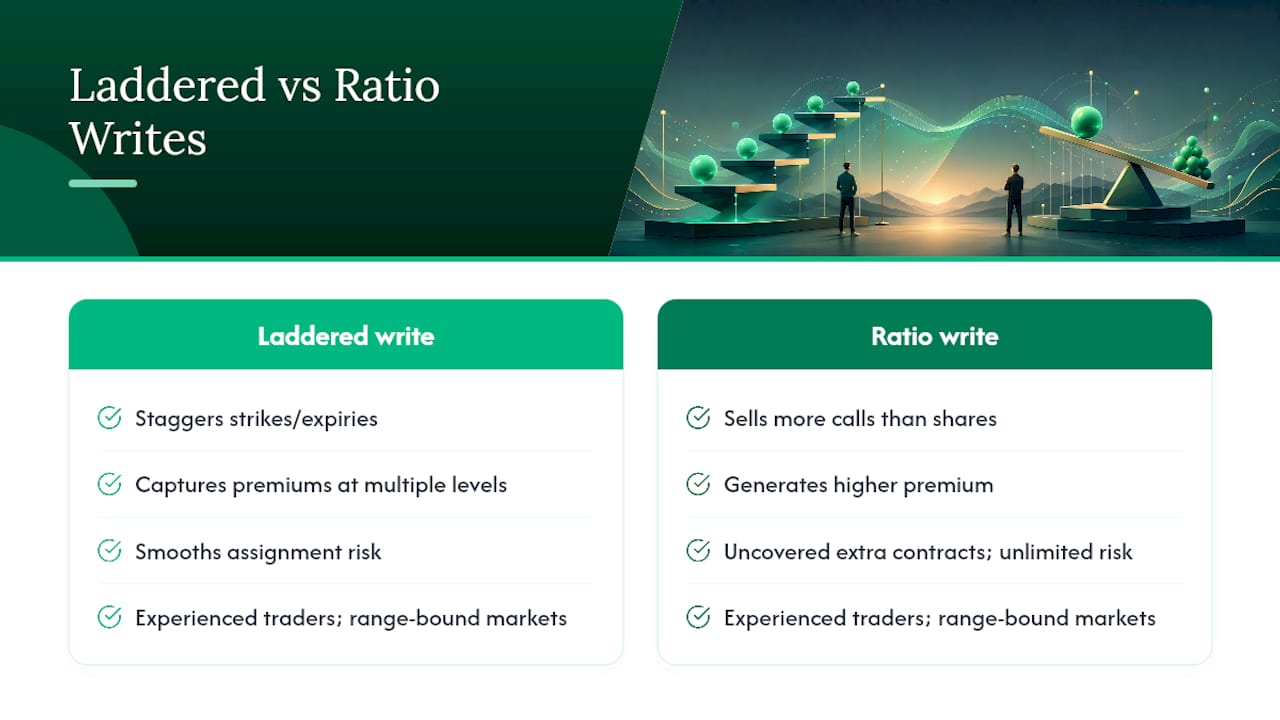
Best for: Experienced traders in range-bound markets targeting specific yield levels.
Pros/cons comparison by variant
Strike and expiry selection rules
Time decay accelerates as expiration approaches, which is why most income-focused covered-call writers target options with about one to two months to expiration. For assignment-tolerant traders using covered calls as a target-exit plan, the strike is simply the price at which they're happy to sell. For income-first traders who want to keep the shares, the strike should sit above the current price by enough that the stock would need a meaningful move to trigger assignment. IV rank above 30 generally produces better premium-to-risk ratios than low-IV environments where premiums are thin.
How do you manage a covered call position in live trading?
The highest-value management actions are pre-defined roll rules and buyback thresholds tied to assignment risk and remaining time value. Without those rules set before you enter, you'll make emotional decisions at exactly the wrong moment.
Rolling types and when to use them
Rolling covered calls comes in three forms. Roll out means buying back the current call and selling a new one at the same strike but a later expiration. You collect additional premium and buy more time, but you extend your obligation. Roll up means buying back the current call and selling a new one at a higher strike, same expiration. You give up some premium but recapture upside. Roll out-and-up combines both: later expiration and higher strike. This is the most common adjustment when a stock has rallied and you want to avoid assignment while still collecting a net credit.
The trade-off on every roll is premium collected versus additional capital at risk and extended time commitment. Rolling up near expiration captures additional upside at the cost of a new short option premium, and you must weigh that against the remaining time value you're giving up on the current position.
Early assignment and dividend risk
The OCC disclosure makes clear that options sellers carry an obligation, not a right. Assignment can happen any time the call is in-the-money, but the highest-risk window is the day before an ex-dividend date. If your short call is in-the-money before the ex-dividend date, the call holder has a financial incentive to exercise early to capture the dividend by owning the stock. Check your ex-dividend dates before entering any covered call on a dividend-paying stock.

The cost to close is small; the benefit is eliminating assignment risk and resetting the income clock.
Monitoring cadence
Weekly: review remaining time value, IV rank changes, and whether a roll makes sense given the current premium available.
Rolling discipline beats prediction every time. The traders who consistently extract income from covered calls don't predict stock moves better than anyone else. They set a buyback threshold (e.g., close the call at 80% profit or if the stock closes above the strike for two consecutive days) and execute it without hesitation. The rule removes the decision; the discipline is the edge.
Pro Tip: Combine IV rank with open interest to time buybacks. When IV rank drops sharply after a catalyst (earnings, Fed announcement), the short call's premium collapses faster than theta alone would explain. That's your signal to buy back early and wait for IV to recover before selling the next call.
Advanced covered call techniques: collars, LEAPS, and ratio writes
Ratio and laddered writes in practice
A ratio write typically involves selling 2 calls against 100 shares, or 3 against 200. The extra call generates additional premium but creates a naked short call on the uncovered portion. If the stock surges past the strike, the uncovered leg has theoretically unlimited loss potential. Laddered writes avoid this by staggering strikes: sell one call at the 30-delta strike and another at the 20-delta strike with a later expiration. You collect premium at two levels and reduce the all-or-nothing assignment dynamic.
Traders use laddering most often when they expect a stock to grind higher slowly rather than spike. The lower strike captures more premium; the higher strike gives the position room to breathe.
Collars as a hybrid structure
A collar beats a plain covered call when the downside risk of the underlying is the primary concern. The put floor converts an open-ended loss into a defined one. The practical question is whether the net credit (call premium minus put cost) is worth the additional complexity. In high-IV environments, both legs are more expensive, which can make collars attractive because the call premium more than covers the put cost. In low-IV environments, you often end up paying for the put out of pocket, which reduces or eliminates the net income.
Covered calls with LEAPS (poor man's covered call, revisited)
Using a LEAPS call as synthetic stock reduces upfront capital but introduces margin and assignment nuances. Most brokers treat the PMCC as a spread, not a covered position, for margin purposes. If the short call is assigned before the LEAPS expires, you may need to exercise the long LEAPS to deliver shares, which can trigger unexpected capital requirements. Confirm your broker's treatment of PMCC positions before trading this structure. Verify your broker's credentials and protections through FINRA BrokerCheck before enabling options trading at any level.
Red flags for retail traders in advanced variants:
- Ratio writes with uncovered legs: unlimited upside risk on the naked portion.
- PMCC positions where the long LEAPS is near expiration: time decay accelerates and the synthetic stock position loses its effectiveness.
- Collars where the put strike is too far out-of-the-money: the protection is theoretical, not practical, in a fast market.
- Laddered writes during earnings season: IV crush can collapse premiums on all legs simultaneously, reducing the benefit of staggering.
Worked example: P/L across three scenarios
Premium income improves your return in a flat or modest-gain scenario but caps your upside if the stock runs hard. Here's how the math plays out on a straightforward buy-write.
Setup: You buy 100 shares of XYZ at $50.00 and sell one 30-day call at the $53 strike for $1.50 premium. Your net cost basis is $48.50 ($50.00 minus $1.50). Understanding how options premium is priced helps you evaluate whether $1.50 is fair value for this strike and tenor.
P/L at expiration
Breakeven: $48.50. Without the covered call, your breakeven is $50.00. The premium shifts it down by $1.50, giving you a modest buffer before you're in the red.
In the far-above-strike scenario, the stock gained $10 but you captured only $4.50. That's the cost of the strategy: you traded $5.50 in upside for $1.50 in guaranteed income. Whether that trade is worth it depends entirely on your outlook and income objectives.
Tax and settlement note: If the call is assigned, the sale of shares is treated as a short-term or long-term capital gain depending on how long you held the stock, not the option. Assignment before the ex-dividend date means you won't receive the upcoming dividend. For a deeper look at how assignment timing affects your tax position, the options tax efficiency guide covers the key scenarios.
Risks and tax considerations every covered call trader should know
Covered calls do not eliminate downside risk. The premium is a partial cushion, not insurance.
Core risks:
- Capped upside: Your gain is limited to the strike price plus premium, regardless of how high the stock climbs.
- Assignment risk: Any time the call is in-the-money, you can be assigned. Early assignment is rare but happens, especially around ex-dividend dates.
- Dividend-driven early assignment: When a short call is in-the-money before the ex-dividend date, the call holder has a direct financial incentive to exercise early to capture the dividend. This is one of the most common surprises for new covered-call writers.
- IV spikes: A sudden volatility increase raises the value of the short call, creating an unrealized loss on the option leg even if the stock hasn't moved much.
- Transaction costs: Commissions and bid-ask spreads reduce net premium. On a $1.50 premium, a $0.10 spread and a $0.65 commission per contract can meaningfully reduce your effective yield.
US tax considerations
Assignment converts your stock sale into a taxable event. If you've held the stock for more than a year, the gain is long-term. But writing a call can affect your holding period: under IRS rules, writing a call that is "in the money" can suspend the long-term holding period clock while the call is open. The wash-sale rule can also apply if you buy back a call at a loss and re-enter a substantially identical position within 30 days. These rules are nuanced enough that a tax advisor review is worth the cost for active covered-call writers. For a structured overview, the options strategies tax efficiency guide walks through the most common assignment and holding-period scenarios.
Covered calls generate short-term premium income regardless of the stock's holding period. That premium is taxed as ordinary income or short-term capital gain in the year received if the option expires worthless or is bought back.
Cost considerations: Always calculate net premium after commissions and spread. For low-premium situations (under $0.50), transaction costs can consume 20–30% of the gross premium, making the trade economically questionable.
How to implement a covered call: step-by-step checklist
The most repeatable implementation follows a six-step process from screening to exit. Skipping any step, especially the roll rules, is where most traders lose discipline.
Step-by-step covered call implementation
- Screen for candidates. Filter for stocks or ETFs with: tight bid-ask spreads on the options chain (under $0.10 for liquid names), IV rank above 25–30, no earnings within the option's expiration window, and an ex-dividend date you've checked against your planned expiration.
- Select strike and expiration. For income-first trades, target the 0.25–0.30 delta call with 30–45 days to expiration. For target-exit trades, use the strike equal to your desired sell price regardless of delta. Higher IV rank justifies slightly lower delta (more out-of-the-money) since premiums are fatter.
- Place the order. Use a limit order on the net credit for a buy-write combo, or a limit order on the call premium for an overwrite. Never use market orders on options. For the buy-write, set the limit at the midpoint of the bid-ask spread and work toward the ask if unfilled after 2–3 minutes.
- Set roll and buyback rules before you walk away. Write down: the price at which you'll buy back the call (e.g., 80% profit on the premium, or if the stock closes above the strike for two consecutive days), and the roll trigger (e.g., 21 days to expiration with the call still worth more than $0.20).
- Monitor daily triggers. Each morning, check: stock price vs. strike distance, days to expiration, any ex-dividend dates within 5 trading days, and whether IV rank has shifted enough to justify an early buyback.
- Execute rolls or buybacks per your rules. Don't improvise. If your rule says buy back at 80% profit, do it. If the stock is within 1% of the strike with 10 days left, evaluate the roll-out-and-up. Use a simple options strategy selection guide to cross-check whether a different structure fits better before rolling into another covered call cycle.
Quick morning screening checklist:
- Options chain bid-ask spread under $0.10 on the target strike
- IV rank above 25 (check your broker's options analytics or a tool like thinkorswim's IV percentile)
- No earnings announcement before expiration
- Ex-dividend date confirmed and outside the expiration window
- Open interest above 500 contracts on the target strike
That's not a guarantee, but it's a consistent starting point for income-focused covered calls in normal volatility environments.*
How a scanner workflow speeds up covered call selection
An AI-powered scanner shortlists high-probability covered-call candidates by combining liquidity filters, IV rank banding, dividend timing checks, and technical trend filters simultaneously. Running those four screens manually across a watchlist of 50 names takes 30–45 minutes. A scanner does it in seconds.
Here's how a practical signal workflow runs:
Signal inputs: Liquidity filter (bid-ask spread, open interest threshold), IV rank band (e.g., 25–60 to avoid both thin premiums and event-driven spikes), dividend calendar cross-reference, and a basic trend filter (stock above its 20-day moving average for neutral-to-bullish confirmation).
Ranking rules: Candidates are scored by net premium yield (annualized), distance from current price to strike (buffer), and days to expiration alignment with the 30–45 day target window.
Entry triggers: Candidates that clear all filters appear in a ranked list with the specific contract (strike, expiration, bid-ask midpoint) and an estimated net credit after a standard commission assumption.
Watchlist and alert cadence: Active positions are monitored against the roll triggers set at entry.
Pro Tip: Use IV rank and open interest together when evaluating a strike. High IV rank with low open interest on your target strike is a warning sign: the premium looks attractive but the market for that contract is thin, which means your fill price will be worse than the midpoint suggests. Stick to strikes where open interest exceeds 500 contracts.
Practical scanner workflows prioritize liquidity (tight bid-ask), IV rank banding, and upcoming ex-dividend dates to avoid surprise early assignment. That combination catches the most common covered-call pitfalls before you're in the trade.
Where covered calls actually fit in an active trader's toolkit
Covered calls earn their place in three specific situations: as an income layer on a position you plan to hold anyway, as a target-exit mechanism when you want to sell at a specific price, and as a tactical yield boost during low-conviction periods when you're not adding new positions.
The scanner and rolling discipline described above aren't theoretical. Active traders who run covered calls consistently use pre-defined rules because the decisions are too easy to second-guess in real time. The moment a stock rallies past your strike, the temptation to roll up "just one more time" is strong. Having the rule written down before entry is the only reliable defense against that.
One category of trader should avoid covered calls entirely: anyone holding a stock primarily for its upside potential in a near-term catalyst. Writing a call against a position you're holding for a breakout trade defeats the purpose. The premium you collect won't compensate for the upside you forfeit if the catalyst fires.
Morningoptions cuts your covered call research time significantly
Every morning before the open, Morningoptions delivers a ranked list of specific covered-call candidates with entry levels, strike recommendations, and bear-case analysis already built in. You're not reading vague commentary. You're getting a contract-level idea with the IV rank, liquidity check, and dividend timing already vetted by a five-stage AI pipeline.

The free daily briefing gives you a preview of the day's top setups. The Pro tier at $89/month unlocks the full ranked list, the Signal Lab for on-demand ticker scans, a lunchtime scanner for mid-session adjustments, and the AI chat scanner so you can research any name before placing a covered call. For options strategies built around a busy schedule, the pre-market briefing format means you can review candidates, set your orders, and be done before the opening bell. Start your free daily briefing at Morningoptions and see the ranked covered-call candidates for tomorrow's session.
Sources
Authoritative references for covered-call mechanics, disclosure, and practical implementation:
- Covered Call (Buy/Write)
- Covered Calls Strategy: Generate Income and Manage Risk
- What is a covered call? | Fidelity
- Options Disclosure Document | The OCC
Cross-check broker-specific order behavior (combo order types, assignment notification timing, margin treatment of PMCC positions) directly with your broker, and confirm tax treatment with a qualified tax advisor before trading covered calls in a taxable account.
This article is general information, not a substitute for advice from a qualified financial advisor. Consult a qualified financial professional about your own circumstances before acting on anything here.