
The right way to treat unusual options activity is as a lead, not a signal. Use it to build a watchlist of tickers where big money is positioning, filter each alert for volume-to-open-interest ratio, premium size, and liquidity, then confirm with price action before risking a dollar. Skip copying the exact institutional contract; a defined-risk vertical or the underlying stock usually gets you the same thesis with far less capital at risk.
TL;DR:
- Most retail traders fail by skipping confirmation steps, buying contracts without verifying open interest growth or chart support, leading to avoidable losses.
- Repeated large-volume prints across multiple sessions with rising open interest indicate institutional accumulation, not just hedge adjustments or volatility trades.
- Use filters such as a volume-to-open-interest ratio of at least 2 to 3 times, notional premiums over $250,000, and spreads under 8% to identify credible unusual activity.
- Favor defined-risk spreads or stocks over naked options, and always confirm price action before entering a trade based on options flow signals.
- Employ a disciplined position size, set fixed exits, and avoid market orders on illiquid contracts to reduce the risk of chasing false signals.
Table of Contents
- What Counts as Unusual Options Activity?
- Why Should Traders Pay Attention to UOA?
- How Do You Find and Validate Unusual Options Alerts?
- How Do You Actually Trade Unusual Options Activity?
- Weighing the Advantages Against the Real Limitations
- How Morningoptions Applies This Same Workflow
- A Blunt Take on Chasing Unusual Options Activity
- Get Morning-Vetted Trade Ideas Before the Open
- Where to Verify These Concepts Further
- Sources
- FAQ
What Counts as Unusual Options Activity?
Unusual options activity (UOA) shows up when a contract trades far more volume than its normal pattern, often tied to a large premium outlay that suggests informed money is stepping in rather than random retail flow. It happens for a mix of reasons: leverage-seeking directional bets, capital-efficient hedges against a stock position, or institutional desks adjusting exposure ahead of a known event.
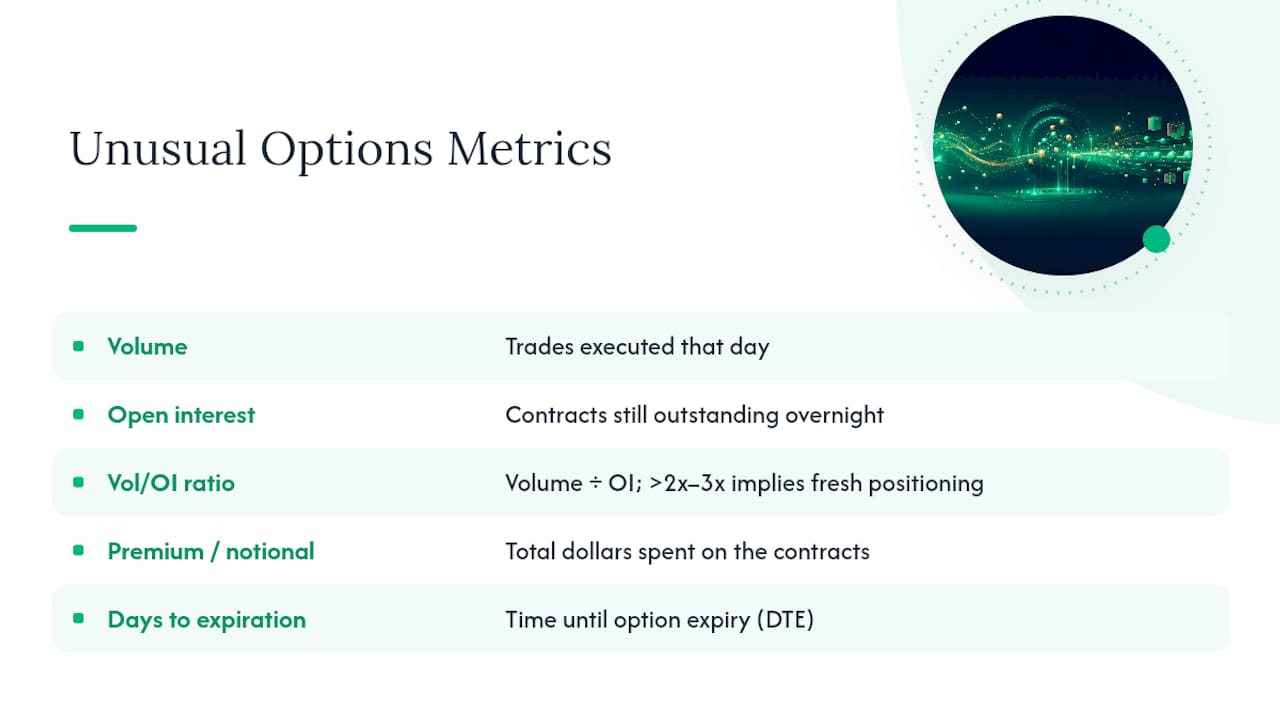
A handful of metrics tell you what you're actually looking at. Volume is trades executed that day. Open interest (OI) is contracts still outstanding overnight. The Vol/OI ratio compares the two: a ratio above 2x to 3x usually means fresh positioning rather than existing holders trading among themselves, because volume that dwarfs open interest can't just be closing out old positions, as Options Education explains.
Beyond the ratio, check the premium or notional value (total dollars spent, not just contract count), days to expiration (DTE), and moneyness (how far the strike sits from the current price). Whether the trade filled at the bid or the ask matters too.
Why Should Traders Pay Attention to UOA?
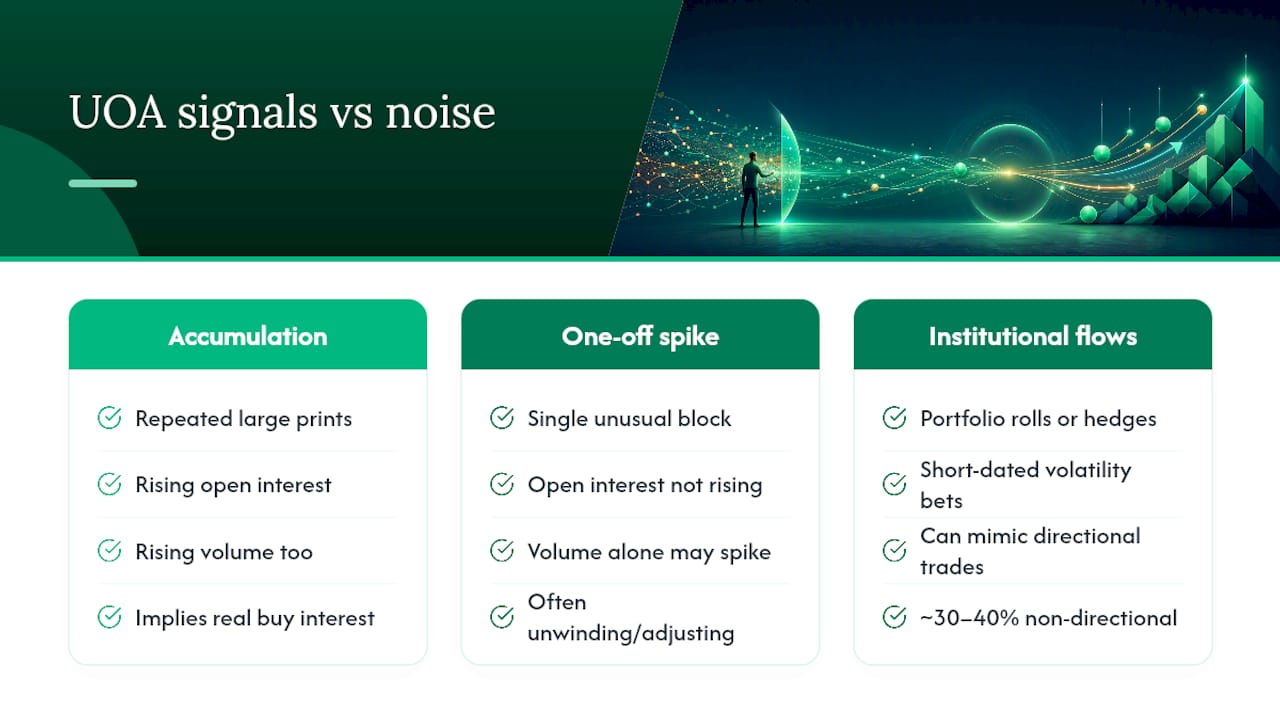
Institutional positioning sometimes precedes price movement, especially when the same strike or expiration sees repeated large prints across multiple sessions rather than a single one-off trade. A single unusual block on a Tuesday means little. The same ticker showing elevated call volume three days running, with open interest climbing alongside it, is a different story: that combination suggests real accumulation rather than a trader closing a position or adjusting a hedge.
Rising open interest paired with rising volume is the stronger tell, because it confirms new contracts are actually being created and held, not just changing hands. Volume alone can spike from someone unwinding a spread they already had on.
The limitations matter just as much as the opportunity. Institutional hedges against a large stock or bond position can look identical to a directional bet on a scanner. Portfolio rolls, where a fund closes one expiration and opens another, generate volume that has nothing to do with conviction. Short-dated options tied to earnings or a Fed decision often reflect volatility trades rather than a simple call that a stock goes up, a dynamic that showed up clearly in a widely discussed volatility bet ahead of a Fed rate decision that looked directional but wasn't. Industry estimates suggest a meaningful chunk of flagged activity, somewhere in the range of 30 to 40 percent, turns out to be non-directional once you dig into it.
How Do You Find and Validate Unusual Options Alerts?
Treat every alert as a candidate for research, not a trade ticket. A three-step filter separates the noise from the setups worth your time.
Step 1: Set your filter rules before you look at a single ticker.
- Vol/OI threshold: 2x to 3x minimum, higher for less liquid names.
- Minimum notional premium: a floor like $250,000 to $500,000 filters out retail-sized flow.
- DTE guardrails: exclude anything expiring in under five days unless you're specifically hunting event-driven volatility trades.
- Spread-quality minimum: reject anything with a bid-ask spread wider than 5% to 8% of the midpoint, since wide spreads make execution costs prohibitive even when the thesis is right.
Step 2: Identify urgency. Sweep orders, where a single large order gets split across multiple exchanges to fill immediately, and prints that hit right at the ask carry more weight than a passive fill sitting between bid and ask. A sweep signals someone wanted in now, not whenever a resting limit order got filled. Block trades negotiated off-exchange can be equally large but often reflect a pre-arranged hedge rather than urgent conviction, so treat the two differently.
Step 3: Run context checks before you act. Pull open interest the next morning to confirm the volume actually became new positions. Check nearby strikes and expirations for paired activity, since a decline in OI on one strike alongside a jump on another usually means a roll or repositioning, not fresh directional money. Note any earnings date, FDA decision, or macro catalyst sitting inside the option's window.
Keep a simple log for every alert you review: OCC symbol, bid and ask, midpoint, implied volatility, delta, notional premium, and the timestamp of the trade. You'll want that history in a week when you're trying to remember whether last Tuesday's sweep in a $150 strike was a hedge or the real thing.
Pro Tip: Build a spreadsheet column for "next-day OI confirmed" and force yourself to check it before entering any trade. Skipping this single step is the most common reason retail traders get burned copying an institutional print that turned out to be a hedge.
How Do You Actually Trade Unusual Options Activity?
Buying the exact contract an institution just bought is usually the wrong move for a retail account. That contract might carry a $2 million premium built for a fund with a book that can absorb a loss without blinking. You don't have that book. A defined-risk vertical spread, or simply buying the underlying stock in a smaller size, gets you exposure to the same thesis with a capped downside and none of the assignment risk that comes with holding a single naked option into expiration.
Here's a workable sequence once an alert clears your filters:
- Wait for chart confirmation. A breakout above resistance on rising volume, or a pullback to a support level that held before, tells you the underlying agrees with what the options flow suggested. Don't buy blind on the alert alone.
- Choose your structure. If implied volatility is already elevated (common right before earnings), a debit spread caps your cost and limits vega exposure. If IV looks reasonable, a single long call or put, or the stock itself, works fine.
- Size the position. Cap any single UOA-driven trade at a fixed percentage of your account, something like 1% to 3% of total capital at risk, and set a hard notional dollar limit regardless of how convicted you feel about the setup.
- Set your exit before you enter. Decide your stop level and a time-based exit (for example, close the trade if the thesis hasn't played out within 5 to 10 trading days) before you place the order, not after it starts moving against you.
For illiquid contracts, don't market-order your way in. Ladder your entry with limit orders at or near the midpoint, and widen your profit target on spreads to account for the extra slippage you'll eat on the way out. A trade that only works if you get filled at the exact midpoint on both legs isn't a trade worth forcing.
Pro Tip: If a flagged contract has a bid-ask spread wider than the profit you're targeting, walk away from that exact strike and look one or two strikes closer to the money. The tighter market there often makes a nearly identical trade far more tradable.
Weighing the Advantages Against the Real Limitations
UOA earns its place in a trading routine because it surfaces ideas you'd otherwise miss scrolling through a watchlist of the same 20 tickers. It can put you onto a setup before the broader market catches on, and repeated signals across sessions build a research trail that's hard to fake.
The limitations are real, though, and worth naming plainly:
- False positives from hedges and rolls inflate volume without reflecting new directional conviction.
- Liquidity problems and wide bid-ask spreads can erase any edge the signal gave you.
- Implied volatility often collapses right after the catalyst that caused the activity, crushing option value even when the direction call was right.
Three mitigations handle most of this. Require multiple confirming signals (Vol/OI, open interest follow-through, and chart action) before sizing up. Keep individual position sizes conservative regardless of how strong an alert looks. And default to defined-risk structures like vertical spreads over naked long options whenever the setup allows it.
How Morningoptions Applies This Same Workflow
A five-AI pipeline can run every morning to mirror the filter sequence above: vetting flagged contracts for volume and open-interest pressure, scoring premium and liquidity, and checking for earnings or news catalysts before a trade idea reaches subscribers. Daily briefings can include ranked contract ideas, entry levels, and a bear case, incorporating confirmation steps into the research rather than leaving them for individual pre-market review. The options flow and open interest checks covered above are the same checks the pipeline runs before a contract ever gets ranked.
A Blunt Take on Chasing Unusual Options Activity
Most retail traders who lose money on UOA aren't misreading the data. They're skipping the confirmation step because a chart with a huge volume spike triggers pure fear of missing out. The fix isn't more indicators. It's a rule: no entry without next-day open interest confirmation and a chart that agrees with the flow. Repeat prints across two or three sessions, paired with price holding a level, justify action. A single flashy sweep on a name you'd never otherwise trade does not. Log every alert you skip, and check back in a month. You'll learn more from the trades you didn't take than the ones you did.
— Customer
Get Morning-Vetted Trade Ideas Before the Open
Running the filter checklist above by hand every morning, across dozens of tickers, before the market opens, is exactly the grind Morningoptions built its pipeline to remove. Instead of scanning raw options flow yourself for Vol/OI, sweeps, and spread quality, users can receive ranked contract ideas with entry levels and a bear case prepared, along with access to a Signal Lab scanner for researching tickers on demand at higher subscription levels.

A free plan offers daily briefings at no cost, while a paid plan unlocks additional features such as a lunchtime scanner and an AI chat scanner for deeper ticker research throughout the day. If the workflow in this article is one you want to run every morning without building it yourself, sign up for a free daily briefing and see how the ranked ideas compare to what your own scanner flags this week.
Where to Verify These Concepts Further
- Options Education's open interest primer breaks down OI mechanics in more technical detail than covered here.
- SIPC explains the investor protections that apply to your brokerage account, separate from any trading strategy.
- Industry writeups from Barchart walk through additional scanner-based workflows worth comparing against your own.
Sources
- Bizarre volatility bet in the options pits is a head-scratcher ahead of Fed rate decision — CNBC
- Open interest: why it matters — Options Education
- How you can use unusual options activity to stalk big-money trades — Barchart
FAQ
What Is Warren Buffett's Favorite Option Strategy?
Buffett has spoken favorably about selling cash-secured puts on stocks he'd be willing to own anyway, collecting premium while waiting for a price he considers fair. It's a conservative, defined-entry approach, nearly the opposite of chasing high-volume speculative flow.
What Is the 3-5-7 Rule in Trading?
Applied to UOA-driven trades, it reinforces the position-sizing discipline covered earlier in this article.
Why Do 90% of Options Traders Lose Money?
Undersized risk controls, chasing signals without confirmation, and holding short-dated options through implied-volatility collapse are the most common causes. Traders who copy a flagged institutional contract without checking liquidity or waiting for chart confirmation run into exactly these problems.
Can I Make $1,000 a Day Day Trading?
It's possible on a good day with a large enough account and the right setup, but it isn't a repeatable outcome, and most traders who try to hit a fixed daily dollar target end up oversizing trades to chase it. A more durable goal is a consistent, rules-based process, filtering unusual options activity, confirming with price action, sizing conservatively, that compounds over months rather than one lucky session.
How Much Does Morningoptions Cost?
Morningoptions offers a Free plan with daily briefings at no cost, and a Pro plan at $89 per month or $742 per year that adds the lunchtime scanner and the on-demand Signal Lab tool.