
An options contract gives its buyer the right, but not the obligation, to buy or sell a specific stock at a set price, called the strike price, on or before a set expiration date. Here's the number that makes it real: if a call option is quoted at $2.20, that's the price per share, and one standard equity contract usually represents 100 shares, so the total cost is the quoted premium multiplied by contract size. Investor defines options this way in its own investor glossary, and it's the cleanest starting point for anyone new to the market.
The premium is the only thing a buyer can lose. Pay $220 for that call, and no matter what happens to the stock, your downside stops at $220. That asymmetry, capped risk for the buyer, open-ended obligation for the seller, is the single idea that everything else in this guide builds on.
Table of Contents
- How Does an Options Contract Actually Work?
- What Are the Two Types of Options Contracts?
- What Terms Define Every Options Contract?
- What Determines an Option's Price?
- Why Do People Trade Options?
- What Are the Real Risks and Benefits?
- How Do Payoffs Actually Work? A Simple Example
- How Do Experienced Traders Actually Use Options?
- Where Pre-Vetted Trade Ideas Fit Once You Know the Basics
- Frequently Asked Questions
- Sources
How Does an Options Contract Actually Work?
Every options contract has two sides, and they don't carry the same risk. The holder (buyer) pays a premium for the right to act. The writer (seller) collects that premium and takes on an obligation if the buyer decides to exercise. FINRA puts it plainly: options are derivatives that grant the purchaser a right, while the seller accepts the duty to deliver or accept shares if assigned.
Once you own or sell a contract, there are exactly three ways it can end.
- Exercise: the holder invokes the right to buy (call) or sell (put) shares at the strike price.
- Close: the holder sells the contract back into the market, or the writer buys it back, before expiration, locking in a gain or loss without ever touching the underlying shares.
- Expire worthless: if the option isn't profitable to exercise, it simply lapses, and the buyer loses the full premium.
In practice, most retail traders never exercise. They close their position days or even hours before expiration, according to guidance from Investor.gov's investor bulletin on options. Exercising ties up more capital and adds logistical steps, closing is faster and keeps the trade purely about price.
Writers face something buyers don't: assignment risk. If you sold a call and the stock rallies past your strike, you can be assigned at any point before expiration (for American-style contracts) and forced to deliver shares you may not own. That's the trade-off for collecting the premium up front.
What Are the Two Types of Options Contracts?
Every options contract falls into one of two buckets: calls or puts. Penn State's EBF301 course materials frame it simply, calls give the right to buy, puts give the right to sell, and in both cases the buyer pays a nonrefundable premium while the seller takes on the obligation if assigned.
A call option gives the buyer the right to buy 100 shares at the strike price. Say a stock trades at $48 and you buy a call with a $50 strike for $1.50 ($150 total). If the stock climbs to $55 before expiration, your right to buy at $50 is now worth real money, you're sitting on $5 of intrinsic value per share, well above what you paid.

A put option gives the buyer the right to sell 100 shares at the strike price. Buy a put with a $50 strike for $1.80 on a stock trading at $48, and if the stock drops to $40, your right to sell at $50 is worth money above the premium paid.
Traders typically use calls when they expect a stock to rise and want leveraged upside without buying shares outright. Puts serve two very different jobs: speculating on a decline, or protecting shares you already own against a drop. Selling either one, instead of buying, flips the trade into an income strategy, which we'll get to shortly.
What Terms Define Every Options Contract?
Before you place a trade, you need to be able to read a quote. Every options contract is defined by the same handful of variables, and an options quote will always identify the underlying stock, the expiration date, the strike price, and the premium in that order.
| Term | What It Means |
|---|---|
| Underlying | The stock or asset the contract is based on (e.g., a company's shares) |
| Strike price | The fixed price at which the holder can buy or sell the underlying |
| Expiration date | The last date the contract is valid; often the third Friday of the month, though weekly expirations are now common |
| Premium | The market price of the contract, quoted per share (a $2.20 premium = $220 per 100-share contract) |
| Contract size | Standard equity contracts usually represent 100 shares of the underlying |
| Settlement method | Physical (shares change hands) or cash (a dollar difference is paid) |
| Exercise style | American (exercisable any time before expiration) or European (exercisable only at expiration) |
Those specifications aren't arbitrary. SIFMA's options primer notes that standardized terms, strike, expiration, contract size, are exactly what make options exchange-tradable and liquid rather than one-off private agreements.
The American versus European distinction matters more than beginners expect. Most individual equity options trade American-style, meaning the holder can exercise on any business day up to expiration. Many index options trade European-style, exercisable only on the expiration date itself. That difference shapes assignment timing for sellers: an American-style call writer can be assigned weeks early if the stock moves sharply in the buyer's favor, while a European-style writer knows assignment, if it happens, lands on one specific date.
Corporate actions can also rewrite a contract mid-life. A stock split adjusts the strike price and contract size proportionally. A merger can convert the underlying into cash or a different security entirely. Dividends don't change the contract terms directly, but they do affect pricing, since the stock typically drops by roughly the dividend amount on the ex-dividend date, which can make in-the-money calls more likely to be exercised early for the dividend.
What Determines an Option's Price?
An option's premium breaks into two pieces: intrinsic value and extrinsic value. Intrinsic value is the amount by which the option is already profitable, a $50 strike call is worth at least $5 of intrinsic value when the stock trades at $55. Extrinsic value is everything else, the market's bet on how much the option might gain in value before expiration.
CME Group's education materials break down premium exactly this way, and note that extrinsic value depends on two things above all: time remaining until expiration and volatility.
- Underlying price vs. strike: the closer the stock price sits above a call's strike (or below a put's strike), the more intrinsic value the option carries.
- Implied volatility (IV): higher expected volatility means a wider range of possible outcomes, so options get more expensive when IV rises, even if the stock hasn't moved.
- Time decay (theta): extrinsic value erodes every day as expiration approaches, which is exactly why option sellers can profit from a stock that goes nowhere.
- Quotes are per share: always multiply the quoted premium by 100 (the standard contract size) to get your actual dollar cost or credit.
This is also where the "Greeks" come in. Professionals track Delta, Gamma, Theta, Vega, and Rho daily to measure how sensitive a position is to price moves, time, and volatility shifts. Beginners tend to fixate only on where the stock is headed and ignore theta entirely, which is a mistake, since time decay accelerates in the final weeks before expiration regardless of what the stock does. For a full breakdown of how these pieces combine into the number you see on your screen, MorningOptions' premium explainer walks through the math step by step.
Why Do People Trade Options?
Options solve different problems for different traders, and the four basic building blocks, buying calls, selling calls, buying puts, and selling puts, cover nearly every strategy you'll encounter, as Chase's own options primer lays out.
- Hedging: buying a put against shares you own acts like an insurance policy, capping your downside if the stock drops while letting you keep the shares.
- Speculation: buying calls or puts lets you bet on direction with a fraction of the capital it would take to buy or short the stock outright.
- Income generation: selling calls against stock you own (covered calls) or selling cash-secured puts collects premium up front in exchange for taking on an obligation.
- Leverage: controlling 100 shares' worth of exposure for a few hundred dollars in premium magnifies both percentage gains and percentage losses compared to owning the stock directly.
The insurance analogy for puts is worth sitting with. If you own 100 shares of a stock at $60 and buy a put with a $55 strike, you've guaranteed you can sell at $55 no matter how far the stock falls, for the cost of the premium. That's a real trade-off: you're paying for protection, and if the stock never drops, that premium is gone, the same way a home insurance premium doesn't come back if your house never burns down.
Selling premium works the opposite way. You collect cash now, but you've accepted an obligation that can turn against you if the stock moves sharply. Investor.gov's bulletin on options frames the whole category as a tool for hedging, speculating, or generating income, but every one of those uses comes with a corresponding trade-off in flexibility or risk. For business owners managing exposure to input costs or currency swings, options-based hedging applies the same logic at a company level.
What Are the Real Risks and Benefits?
Options give retail traders access to strategies that used to be reserved for institutions, but that access cuts both ways.
Benefits:
- Limited, known-in-advance cost for buyers, you can never lose more than the premium paid.
- Ability to hedge existing stock positions against downside moves.
- Leverage that lets smaller accounts control larger positions.
- Income potential through selling covered calls or cash-secured puts.
Risks:
- Buyers can lose 100% of the premium if the trade doesn't work out in time.
- Uncovered ("naked") sellers face losses that are theoretically unlimited on calls and substantial on puts.
- Assignment can happen unexpectedly for American-style contracts, forcing a sudden stock purchase or sale.
- Selling options typically requires margin, and a fast move against the position can trigger a margin call demanding more collateral almost immediately.
FINRA is direct about this asymmetry: buyers' losses are capped at the premium, but sellers can face obligations far larger than what they collected. That single sentence is worth rereading before placing your first trade.
Pro Tip: Before you sell your first option, check your broker's margin requirement for that specific trade. A cash-secured put on a $50 stock ties up roughly $5,000 in collateral, not just the premium you collect, and that capital sits locked until the position closes.
A quick red-flag checklist for anyone starting out: trading without getting approved for the right options level at your brokerage, ignoring how fast time decay accelerates near expiration, not knowing your assignment risk on a short position, and sizing trades as if premium loss doesn't count as real money lost. Each one of those has ended more beginner accounts than a bad stock pick ever did.

How Do Payoffs Actually Work? A Simple Example
Numbers make this concrete faster than any explanation. Here's a call and a put, both using round figures and a standard 100-share contract.
Call example: You buy one call, $50 strike, for a $2.00 premium. Total cost: $200.
- If the stock is at $55 at expiration: intrinsic value is $5/share ($55 minus $50 strike), so the contract is worth $500. Profit: $500 minus your $200 cost = $300.
- If the stock is at $48 at expiration: the call has no intrinsic value, it expires worthless. Loss: the full $200 premium.
- Break-even: strike ($50) plus premium ($2.00) = $52. Below that, you lose money; above it, you profit dollar-for-dollar.
Put example: You buy one put, $50 strike, for a $2.50 premium. Total cost: $250.
- If the stock is at $44 at expiration: intrinsic value is $6/share ($50 strike minus $44), worth $600. Profit: $600 minus $250 = $350.
- If the stock is at $53 at expiration: the put has no intrinsic value and expires worthless. Loss: the full $250 premium.
- Break-even: strike ($50) minus premium ($2.50) = $47.50. Below that, the put profits; above it, you lose the premium.
Notice how the same $2 to $2.50 difference in premium changes your break-even and your total dollar risk once you multiply by the 100-share contract size. That multiplier is the detail beginners underestimate most.
How Do Experienced Traders Actually Use Options?
Knowing the definitions is one thing. Trading with discipline is another. Before placing any options trade, experienced traders run through a short mental checklist.
- Confirm your brokerage approval level actually permits the strategy you're about to place.
- Size the position based on premium at risk, not share count, a $200 premium on a $50,000 account is a very different bet than the same premium on a $5,000 account.
- Check at least the delta and theta on the position before entering, not just the stock's recent price chart.
- Set an exit rule in advance, a target profit or a stop, rather than deciding in the moment.
- Know your assignment plan if you're selling contracts: are you comfortable owning or delivering the shares if assigned?
Pro Tip: Most retail traders close their positions well before expiration rather than exercising, partly because time decay accelerates fastest in the final two weeks. Holding into the last few days for a small remaining gain often isn't worth the added risk of a sudden move against you.
This guide draws on publicly available regulatory sources and reflects how MorningOptions, which delivers daily AI-generated options trade briefings, frames the basics for its own subscriber base. For a structured walk-through before your first trade, the options trading basics checklist covers the approval and sizing steps in more depth.
A Personal Note on Learning This Market
Options felt genuinely confusing the first time I sat with a real quote screen, strike prices, expiration dates, bid-ask spreads on top of bid-ask spreads. What eventually made it click wasn't a formula, it was working through small examples like the call and put payoffs above until the numbers stopped feeling abstract. If you're at that stage now, the most useful next step isn't a bigger account or a riskier trade, it's running a handful of paper trades and watching how premium actually moves day to day as expiration gets closer. The strategy selection guide for beginners is a reasonable place to go once the vocabulary in this article feels familiar rather than foreign.
Where Pre-Vetted Trade Ideas Fit Once You Know the Basics
Once the definitions here feel second nature, strikes, premiums, intrinsic versus extrinsic value, the harder problem becomes finding contracts worth researching every single morning before the market opens. That's the specific gap MorningOptions is built to close.
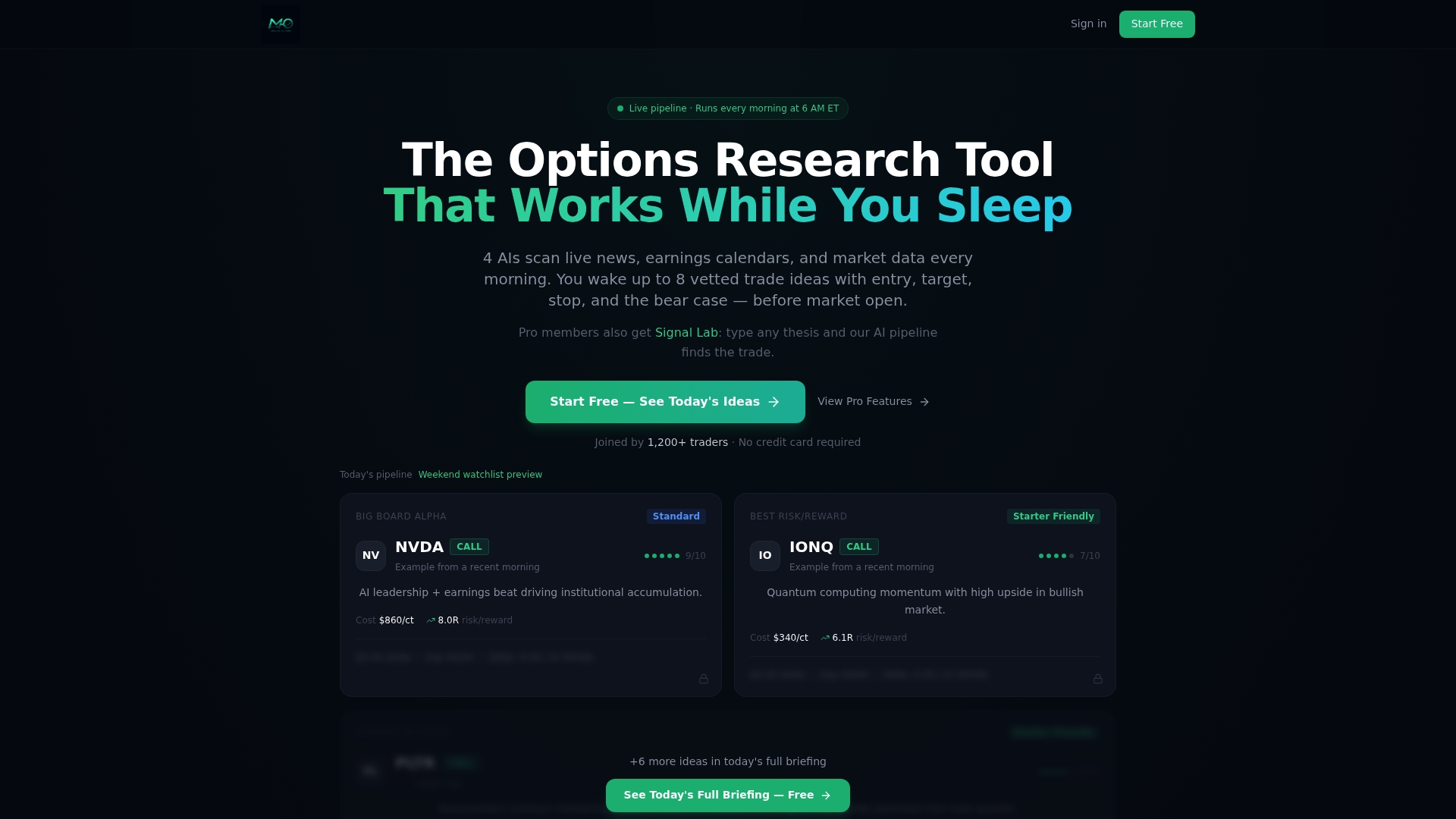
MorningOptions runs a daily scan through a five-AI pipeline that vets and scores options trade ideas before the opening bell, surfacing ranked contract ideas with entry levels and a bear case, not vague market commentary. The daily briefing is free. A Pro tier at $89/month adds a lunchtime scanner and an AI chat tool for researching any ticker on demand. If you've worked through the mechanics in this guide and want a faster read on which contracts are actually worth a closer look tomorrow morning, MorningOptions' daily briefing is worth checking before the next session opens.
Key Takeaways
An options contract gives the buyer a right, never an obligation, and that single distinction determines every risk, reward, and pricing dynamic covered above.
| Point | Details |
|---|---|
| Right, not obligation | The buyer can walk away and lose only the premium; the seller must fulfill the contract if assigned. |
| Standard contract size | One equity options contract equals 100 shares, so a $2.20 premium quote costs $220 total. |
| Premium has two parts | Intrinsic value reflects current profitability; extrinsic value reflects time and volatility, and it decays daily. |
| Three possible endings | Every position ends by exercise, closing the trade, or expiring worthless, most retail trades close early. |
| Get pre-vetted ideas | MorningOptions delivers free daily briefings with ranked contract ideas, plus a $89/month Pro tier for deeper scans. |
Where to Learn More
- Investor covers official definitions straight from the SEC's investor education arm.
- FINRA's options overview explains the buyer/seller asymmetry and regulatory context for retail traders.
- SIFMA's options primer details standardized contract specifications used across US exchanges.
- CME Group's options education course breaks down pricing mechanics in more technical depth.
- Investopedia's options contract entry offers accessible definitions worth bookmarking as a reference.
Frequently Asked Questions
What is an options contract in simple terms? It's an agreement that gives the buyer the right, but not the obligation, to buy or sell 100 shares of a stock at a fixed strike price before a set expiration date, in exchange for paying a premium.
What is a call option versus a put option? A call gives the right to buy shares at the strike price, used when you expect the stock to rise. A put gives the right to sell shares at the strike price, used when you expect a decline or want downside protection.
How much does an options contract cost? The premium is quoted per share, and standard contracts cover 100 shares, so a $2.20 premium costs $220. That's the maximum a buyer can lose on that position.
What happens if an option expires without being exercised? If it has no intrinsic value at expiration, it expires worthless and the buyer loses the entire premium paid. If it has intrinsic value, most brokers automatically exercise it on the holder's behalf.
What's the difference between American and European options? American-style options can be exercised any time before expiration. European-style options can only be exercised on the expiration date itself, which changes assignment timing for sellers.
This article is general information, not a substitute for advice from a qualified financial advisor. Consult a qualified financial professional about your own circumstances before acting on anything here.
Sources
- Investor
- FINRA — Options
- SIFMA Insights Primer: Options
- CME Group — Understanding option contract details