
Yes, gap trading options works, but only if you match the gap type to the right options structure and wait for opening-range confirmation before you commit capital. The single action to take this morning: classify the gap (common, breakaway, runaway, or exhaustion), let the first 5 to 15 minutes of trading confirm direction, then pick the options strategy mapped to that read.
Two anchors matter here. The opening-range rule tells you to wait for the first candle or two before entering, and pre-market relative volume (RVOL) tells you whether institutions actually care about this gap or whether it's noise. A service like MorningOptions can hand you both pieces, ranked, before the bell.
- Classify the gap using catalyst strength and pre-market volume.
- Wait for the opening range to confirm the move rather than guessing at the open.
- Choose a defined-risk options structure (vertical spread, collar, or protective spread) over an undefined-risk one whenever the setup allows it.
Key Takeaways
Gap trading with options works best when you classify the gap, confirm direction with the opening range, and match the setup to a defined-risk strategy rather than a one-size-fits-all trade.
| Point | Details |
|---|---|
| Classify before you trade | Common, breakaway, runaway, and exhaustion gaps each carry different odds of continuation versus fill. |
| Confirm before you enter | Wait for the opening range (roughly 5 to 15 minutes) and volume confirmation before committing capital. |
| Match strategy to setup | Use straddles for uncertain-direction catalyst gaps, verticals for gap-and-go, collars for protecting existing shares. |
| Size down on weak catalysts | Cut position size when there's no clear news behind the gap, since the fade odds are thinner than they look. |
| Use a premarket workflow tool | MorningOptions ranks gap setups by catalyst and RVOL each morning, cutting scanning time before the open. |
Table of Contents
- What Is a Gap in Trading and Why Does It Happen?
- Gap Types and a Pre-Open Classification Checklist
- Gap Fill vs. Gap-and-Go: How Do You Pick the Right Play?
- Which Options Strategy Fits Each Gap Setup?
- How Do You Size Positions and Manage Risk on Gap Trades?
- How Do You Build a Premarket Gap-Options Watchlist?
- How MorningOptions Fits the Gap-Trading Workflow
- What Are the Tax and Cost Implications of Gap Options Trading?
- An Honest Take on Gap Trading With Options
- MorningOptions: Your Morning Edge on Gap Setups
- Sources
What Is a Gap in Trading and Why Does It Happen?
A gap is the empty space on a chart between yesterday's close and today's open, where price jumps instead of trading through the levels in between. It happens because markets move overnight while your position sits still: earnings hit after the close, an FDA ruling drops at 4:15 PM, a CEO resigns, or an algorithm reacts to a headline nobody saw until the futures market opened. By 9:30 AM, the stock has already repriced.
Not every gap carries the same weight. The bigger the gap and the stronger the catalyst behind it, the more the odds shift toward continuation rather than reversal.
- Earnings and guidance changes tend to produce the largest, most durable gaps because they change the fundamental story.
- News and regulatory events (FDA decisions, litigation outcomes, M&A announcements) can produce gaps just as large, often with less predictable follow-through.
- After-hours order imbalances and algorithmic flow can create smaller gaps that have nothing to do with the company's actual value and tend to close fast.
Take two real patterns you'll see constantly.
Gap Types and a Pre-Open Classification Checklist
Every gap falls into one of four buckets, and knowing which one you're looking at changes your entire trade plan. Quantum Algo's framework breaks them down this way:
- Common gap: small, no catalyst, usually happens inside a trading range. Expect it to fill within the session or the next few days.
- Breakaway gap: appears at the start of a new trend, often on heavy volume and real news. Expect continuation, not a fill.
- Runaway (continuation) gap: shows up in the middle of an established trend, signaling the move still has legs. Expect it to extend before it fills.
- Exhaustion gap: appears near the end of a long trend, often on a final volume spike. Expect a reversal soon after.
Location in the trend and volume are the two variables that separate a breakaway from an exhaustion gap that looks similar on the chart.
Pro Tip: Pull up a six-month chart before you trade any gap. If the stock has already made a huge run, treat the gap as exhaustion until volume and price action prove otherwise.
Run this checklist before the open:
- Where is the gap relative to the last 20 trading days (range, breakout, or blow-off top)?
- Is there a specific, named catalyst, or is this unexplained order flow?
- What's the pre-market RVOL, and is volume actually confirming the move?
- Does the gap size look proportional to the news, or does it look overdone?
Gap Fill vs. Gap-and-Go: How Do You Pick the Right Play?
Favor the gap fill (fade) approach when there's no real catalyst and RVOL is unremarkable. Favor gap-and-go (momentum) when the catalyst is strong and pre-market volume is running heavy relative to the stock's average.
The numbers back this split. TradeAlgo's research puts common, no-catalyst gaps filling more than 70% of the time, while breakaway gaps tied to a strong earnings catalyst fill less than 30% of the time. That gap in probability is the whole basis for treating these as two separate trades rather than one generic "gap strategy."
Statistic to remember: a small no-catalyst gap is a fade far more often than not. A breakaway gap on a real catalyst usually keeps going. Trading both the same way is the fastest way to bleed out a decent account.
Here's the rule sequence for each:
- Wait for the opening range. StockCharts' research on gap methodology recommends letting the first 5 to 15 minutes establish a high and low before you enter either direction.
- For gap fill: enter once price fails to make a new high (or low) beyond the opening range and starts reverting toward the prior close. Stop goes just beyond the gap extreme, not at a round number. Take partial profits at the halfway point of the gap, and the rest near the prior close.
- For gap-and-go: enter on a confirmed break of the opening-range high (for gap-ups) or low (for gap-downs), ideally on a pullback rather than chasing the initial breakout candle. Stop goes below the opening-range low (or above the high for shorts). Scale out a third of the position at your first measured-move target, and trail the rest.
That's a fade candidate back toward yesterday's close. That's a gap-and-go long, not a fade, and treating it like one just because "gaps fill" will cost you.
Which Options Strategy Fits Each Gap Setup?
Once you know the gap type and have opening-range confirmation, the options structure should follow directly from the read, not from habit.
- Large implied-move gaps (earnings, FDA, M&A): a long straddle or strangle captures the move if you're unsure of direction, but implied volatility crush right after the announcement can gut the position even if the stock moves your way. Entering 15 to 30 minutes after the open, once IV has partially re-priced, often gives a better cost basis than buying pre-open.
- Gap-and-go directional setups: a shorter-dated vertical spread (bull call or bear put) or an outright long call/put lets you capture the continuation move without paying full straddle premium. Our bullish options guide covers strike selection for exactly this kind of momentum trade.
- Holding shares into an earnings gap: a protective collar (long put plus short call against existing stock) caps both downside and upside while limiting the cost of protection. This is the trade for someone who doesn't want to sell the position but doesn't want to eat a 15% overnight loss either.
- Stabilized, range-bound gap-fill situations: credit spreads or iron condors profit from the fade thesis directly, since you're betting the stock reverts into a range rather than trends. This fits low-catalyst gaps where you expect chop, not a breakout.
On strikes and expirations: for volatility plays around a big catalyst, at-the-money or slightly out-of-the-money strikes on weekly expirations keep the trade responsive without paying for time you don't need. For gap-and-go directional trades, a spread one to two weeks out gives the move room to develop past the first session. Our guide to strategies for volatile markets walks through this strike math in more detail.
Pro Tip: If you're buying a straddle into an earnings gap, check the option's implied move against the actual gap size after the open. If the stock already moved more than the option priced in, you're chasing a trade that's already played out.

How Do You Size Positions and Manage Risk on Gap Trades?
Cut your position size on any gap without a clear catalyst. If you can't name the reason a stock moved, you shouldn't be sizing it like a high-conviction trade.
Stop placement should sit beyond the gap extreme (the pre-market high or low), not at a convenient round number the whole market is watching. A hard stop executes automatically and protects you from a distracted moment, but it can get hit by a brief wick before the real move develops. A mental stop avoids getting picked off by stop-hunts, as StockCharts notes in its discussion of the Modified Trading Method, but it requires the discipline to actually pull the trigger without hesitation.
- Use limit orders on the opening print; market orders on gap opens can fill you far worse than the quote you saw seconds earlier.
- Expect wider bid-ask spreads in the first few minutes, especially on options, where liquidity often lags the underlying stock.
- Scale out in tiers: take partial profits at your first target, move your stop to breakeven, and let the remainder run with a trailing stop.
- Avoid full size on illiquid options chains. A wide spread on a single contract can eat a third of your expected profit before you even exit.
Our options basics checklist covers order types and sizing mechanics in more depth if you're still building these habits. A position size calculator can also help you translate your risk percentage into an actual share or contract count before the open, rather than eyeballing it under pressure.
How Do You Build a Premarket Gap-Options Watchlist?
- Run your scan and pull every name meeting the gap and RVOL thresholds.
- Rank by catalyst strength first (named news beats no news every time), then by RVOL within that group.
- Cut the list to 3 to 5 names by around 9:15 AM. More than that and you'll be reacting instead of executing.
- Mark four levels on each chart: prior close, pre-market high/low, the likely gap-fill level, and where you expect the opening range to form.
- Between 9:30 and 9:45 AM, watch the opening range build. Do nothing until it's set.
- From 9:45 to 10:00 AM, look for your entry trigger (breakout of the range, or failure at the range extreme) and execute according to the gap type you identified pre-open.
Our premarket trading guide covers this scanning routine in more detail if you want the full mechanics behind each filter.
How MorningOptions Fits the Gap-Trading Workflow
MorningOptions builds a version of this exact workflow into a daily briefing, so you're not running scans from scratch every morning before the bell.
- AI morning briefings rank the day's setups by catalyst and volume signal, cutting the scanning step down to a few minutes of review.
- Ranked, specific contract ideas come with entry levels attached, so you're not guessing at strikes after you've already identified the gap.
- Signal Lab and the lunchtime scanner (Pro tier) let you re-run the same catalyst and RVOL logic midday, useful when a morning gap-and-go setup develops a second leg.
For traders who want the routine described above without building the scanner themselves, the MorningOptions platform delivers the ranked version of it every trading day.
What Are the Tax and Cost Implications of Gap Options Trading?
Every gap options trade you close generates a taxable event, and the frequency of gap trading tends to push most retail traders into short-term capital gains territory. In the United States, options held one year or less before closing are taxed as short-term gains at ordinary income rates, which are higher than the long-term rate applied to positions held over a year. Gap trades, by nature, rarely last that long. You're usually in and out within a session or a few days.
Transaction costs matter more in gap trading than in slower strategies because you're trading around the open, when bid-ask spreads on options widen and per-contract commissions and regulatory fees stack up across multiple entries and exits. A strategy that nets a small edge on paper can turn negative once spread cost and fees are subtracted from every leg of a spread trade.
A few practical points worth building into your plan:
- Multi-leg strategies (spreads, collars, condors) involve two to four separate contracts, each with its own bid-ask spread and fee, so the total cost of entry is higher than that of a single-leg trade.
- Frequent gap trading can trigger wash-sale rule complications if you close a losing position and re-enter a substantially similar one within 30 days, which can defer the loss for tax purposes rather than letting you claim it immediately.
- Keep detailed trade records; short-term options activity generates a lot of line items come tax season, and your broker's 1099-B won't always capture the full complexity of multi-leg trades.
None of this is tax advice specific to your situation, and rules vary by account type and jurisdiction, so a tax professional familiar with active options trading is worth the consultation fee if you're trading gaps regularly.
An Honest Take on Gap Trading With Options
Most gap trading content treats the options layer as an afterthought, a footnote after twelve paragraphs about stock price action. That's backward. The options structure you choose is where most of the actual risk decision gets made, not the direction call.
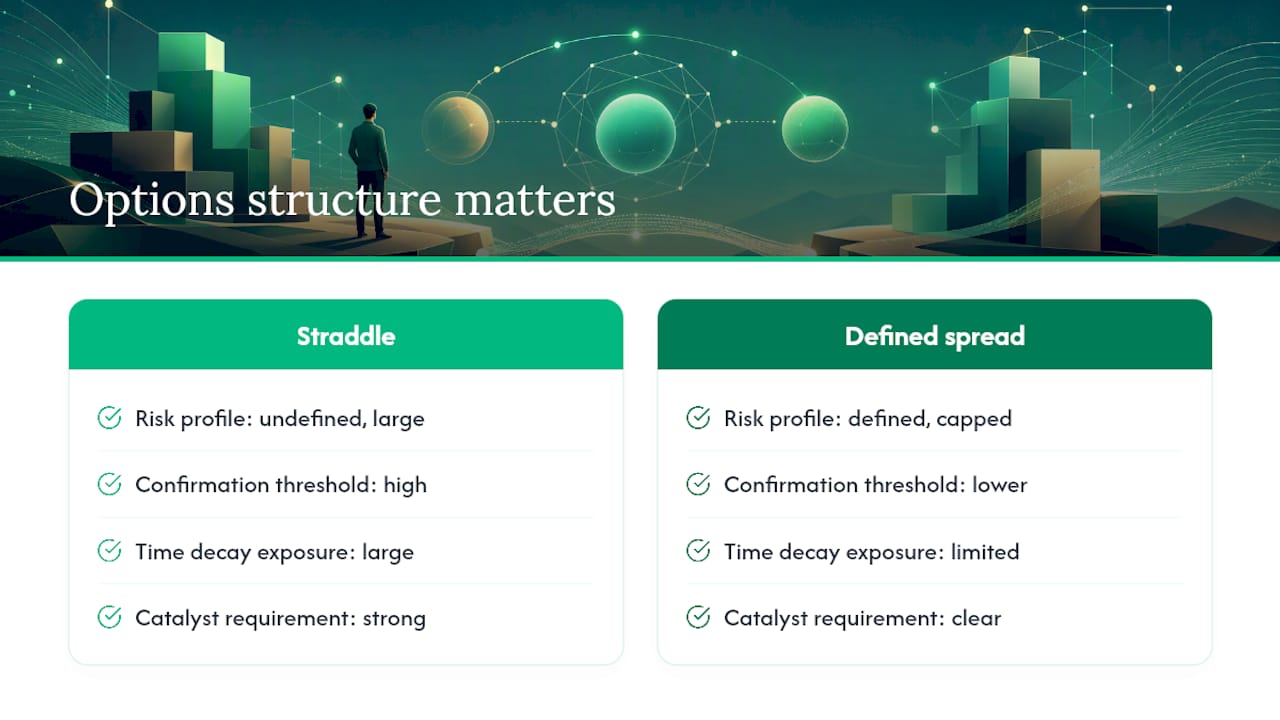
The conventional advice to "wait for confirmation" is correct but incomplete. What it skips is that confirmation means different things for a straddle than for a vertical spread. A straddle buyer needs the move to be big enough to overcome time decay and IV crush combined, a much higher bar than a spread trader needs to hit for a directional win. Treating "confirmed" as a single threshold across every options strategy is where a lot of otherwise sound gap trades lose money anyway.
If you take one thing from this: spend less time hunting for the perfect entry candle and more time matching your options structure to the actual catalyst strength behind the gap. A defined-risk spread on a real catalyst beats a straddle on a coin-flip gap almost every time.
— Customer
MorningOptions: Your Morning Edge on Gap Setups
Building the workflow above by hand, scanning, ranking, marking levels, before 9:30 AM every single trading day is a lot to ask of anyone with a job outside trading. MorningOptions exists for exactly that gap between wanting to trade catalysts and having the hours to hunt for them yourself.

The free daily briefing gives you ranked setups with the catalyst and volume context already sorted. The Pro tier, at $89 a month, adds the lunchtime scanner for names that develop a second gap leg midday, plus an AI chat scanner for researching a specific ticker the moment a gap catches your eye. If you've read this far and you're serious about trading gaps with options instead of just watching them happen, check out MorningOptions before tomorrow's open.
This article is general information, not a substitute for advice from a qualified financial advisor. Consult a qualified financial professional about your own circumstances before acting on anything here.
Sources
For deeper study, see Investopedia's gap trading guide, TradeAlgo's overnight gap strategy breakdown, and StockCharts' ChartSchool on gap methodology. For execution routines, read our posts on low-risk options trades and premarket trading mechanics.
- Gap Trading Strategies: How to Profit From Market Gaps — Investopedia
- Gap Trading Strategy: How to Trade Overnight Gaps | TradeAlgo
- Gap trading strategies — StockCharts ChartSchool