
Intrinsic value is the option's in-the-money amount. Extrinsic value is everything else in the premium. The two formulas are simple:
- Call intrinsic = max(0, underlying price − strike price)
- Put intrinsic = max(0, strike price − underlying price)
- Extrinsic value = option premium − intrinsic value
Quick example: a call option trades at a $5 premium, the underlying is $83, and the strike is $80. Intrinsic = $3, extrinsic = $2. That $2 is what time, volatility, and market demand are worth right now. The Black-Scholes model gives you a theoretical fair value for that split; the CBOE's listed premiums show you what the market actually charges. Morningoptions surfaces both in its pre-market briefings so you can see the split before you place a trade.
Table of Contents
- How does an option premium split into intrinsic and extrinsic?
- How do you calculate intrinsic value for calls and puts?
- Worked examples: call and put premium splits
- What drives extrinsic value, and how do the Greeks measure it?
- How do you calculate extrinsic value quickly?
- Theta decay and Vega: two scenarios that show extrinsic in motion
- How do intrinsic and extrinsic values affect exercise and assignment?
- How traders use intrinsic vs extrinsic to pick strikes and manage risk
- How Morningoptions helps you spot mispriced extrinsic value
- Key Takeaways
- The number that changes how you trade
- Morningoptions: daily briefings built around the premium split
- Useful sources and further reading
How does an option premium split into intrinsic and extrinsic?
Every option premium has two components: intrinsic value and extrinsic value. Understanding that split is the foundation of options pricing explained at any level.

Moneyness determines how the split looks:
| Moneyness | Intrinsic Value | Extrinsic Value | Notes |
|---|---|---|---|
| In the money (ITM) | Positive | Positive | Both components present |
| At the money (ATM) | Zero | Maximum | Entire premium is extrinsic |
| Out of the money (OTM) | Zero | Equals full premium | No intrinsic component at all |

ATM options carry the largest extrinsic component because the probability of expiring in or out of the money is most uncertain at that strike. Deep ITM options are mostly intrinsic. Deep OTM options are entirely extrinsic and expire worthless if the underlying never moves enough.
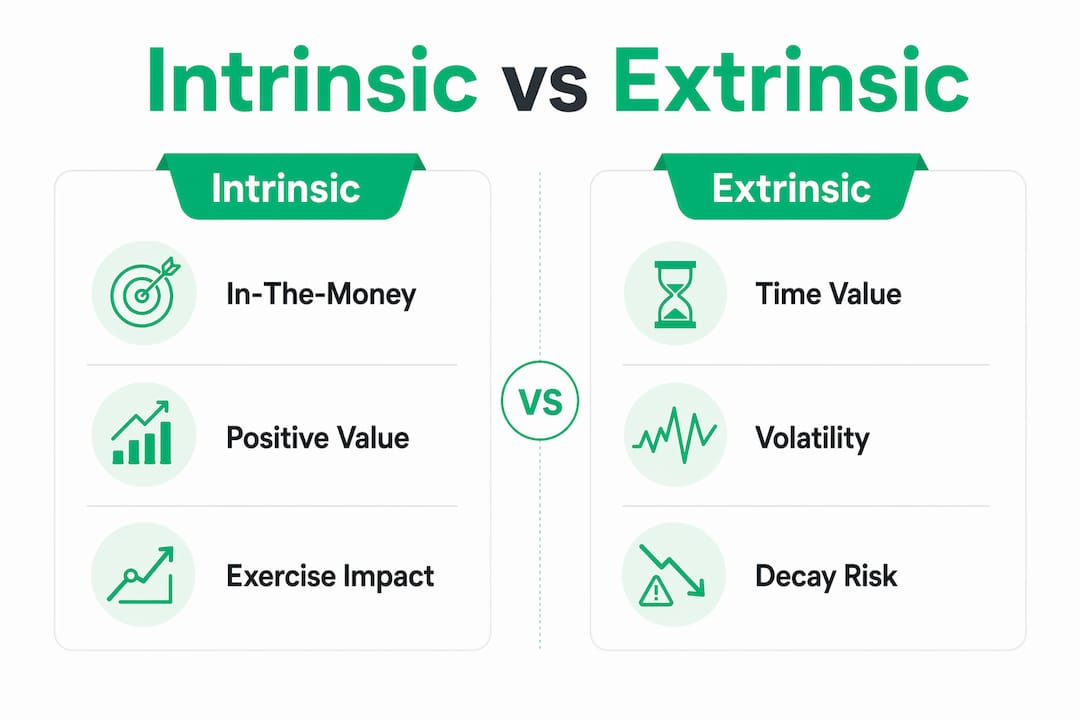
Why does the split matter in practice? Three reasons. First, exercise and assignment risk is tied to intrinsic value, not total premium. Second, time decay (Theta) erodes only the extrinsic portion, so a deep ITM option loses less to decay than an ATM one. Third, when you price a spread, you are often buying one option's intrinsic and selling another's extrinsic, and knowing which is which tells you where the real risk sits.
How do you calculate intrinsic value for calls and puts?
The formula clips at zero because an option can never have negative intrinsic value. Here is the step-by-step process for any contract:
- Find the current underlying price. Use the last trade or mid-price of the stock or ETF.
- Subtract the strike price (calls) or reverse the subtraction (puts). Call: underlying − strike. Put: strike − underlying.
- Apply the max(0, result) rule. If the result is negative, intrinsic = $0. The option is OTM or ATM.
- Subtract intrinsic from the premium to get extrinsic. Extrinsic = premium − intrinsic.
OTM clipping example: A $90 call on a stock trading at $87. Step 2 gives $87 − $90 = −$3. Step 3 clips that to $0. If the premium is $1.50, the entire $1.50 is extrinsic.
One critical distinction: intrinsic value is not the same as profit. A trade can show positive intrinsic value at exercise and still be a net loss if you paid too much extrinsic premium to get in. Your breakeven is strike + premium paid (for calls), not just the strike. Keep that number in front of you, not just the intrinsic figure.
Worked examples: call and put premium splits
These two examples use the same arithmetic structure so you can verify your own calculations.
| Call Example | Put Example | |
|---|---|---|
| Underlying price | $83 | $78 |
| Strike price | $80 | $80 |
| Option premium | $5.00 | $4.50 |
| Intrinsic value | $3.00 | $2.00 |
| Extrinsic value | $2.00 | $2.50 |
Call: Underlying $83, $80 strike. Intrinsic = $83 − $80 = $3. Extrinsic = $5 − $3 = $2.
Put: Underlying $78, $80 strike. Intrinsic = $80 − $78 = $2. Extrinsic = $4.50 − $2 = $2.50.
ATM note: If the underlying were exactly $80 in either example, intrinsic = $0 and the full premium would be extrinsic. That is the highest-extrinsic scenario for a given expiration and volatility level. Sellers love ATM options for exactly that reason; buyers pay the most "hope" at that strike.
What drives extrinsic value, and how do the Greeks measure it?
Extrinsic value exists because the future is uncertain. Higher implied volatility and longer time to expiration both increase an option's extrinsic value. Think of it as a risk premium: buyers pay it for potential upside; sellers collect it as compensation for the price risk they absorb.
Primary drivers:
- Time to expiration (Theta): Every day that passes, some extrinsic value evaporates. Theta accelerates as expiration nears; the last two to three weeks of a contract's life are where extrinsic collapses fastest. A 60-day option loses extrinsic slowly at first, then rapidly in the final stretch.
- Implied volatility (Vega): Vega measures how much an option's price changes for a one-point move in implied volatility. Earnings and scheduled news events often lift IV and therefore extrinsic value, sometimes dramatically. A stock with a $3 ATM option before earnings might show a $5 ATM option the day before the announcement, purely from IV expansion.
Secondary drivers:
- Dividends: An upcoming dividend reduces call extrinsic and increases put extrinsic slightly, because the expected stock drop on the ex-dividend date is priced in.
- Interest rates: Higher rates nudge call extrinsic up and put extrinsic down through the cost-of-carry component.
- Supply/demand and order flow: Heavy retail buying of calls can push extrinsic above what models suggest. Options sentiment and order flow are worth tracking for this reason.
Theta and Vega quantify the two biggest sources of extrinsic sensitivity. Theta tells you how much extrinsic you lose per day. Vega tells you how much extrinsic changes per volatility point. Together, they are the two numbers sellers watch most closely.
Pro Tip: Sellers harvest extrinsic as their "opportunity." Buyers pay it as the "cost of hope." Before any trade, ask which side of that equation you are on and whether the price is fair given current IV.
How do you calculate extrinsic value quickly?
The formula is straightforward: extrinsic = premium − intrinsic. Compute intrinsic first using the formulas above, then subtract.
Numeric structure:
- Premium: $4.00
- Underlying: $102, Strike: $100 (call)
- Intrinsic: $102 − $100 = $2.00
- Extrinsic: $4.00 − $2.00 = $2.00
Extrinsic here is 50% of the premium. That percentage is the quick sanity check traders use. For options strategies in volatile markets, a high extrinsic percentage signals rich premium worth selling; a low percentage signals cheap premium worth buying.
Three quick checks before entering a trade:
- Extrinsic as a % of premium: ATM options run high; deep ITM options run low. Compare across strikes to find where the market is pricing uncertainty.
- Implied volatility vs. historical: If current IV is well above the stock's historical volatility, extrinsic is elevated. Sellers have an edge; buyers are overpaying for movement that may not come.
- Days to expiration and upcoming catalysts: Short-dated options with earnings in two days carry inflated extrinsic. That can be an opportunity or a trap depending on your position.
Theta decay and Vega: two scenarios that show extrinsic in motion
Scenario A: Theta decay over time
Same ATM call, $100 strike, underlying at $100:
- Day 1 (45 days to expiration): Premium = $4.50. Intrinsic = $0. Extrinsic = $4.50.
- Day 30 (15 days to expiration): Premium = $2.20. Intrinsic = $0 (underlying unchanged). Extrinsic = $2.20.
What happened:
- Time passed; intrinsic stayed zero because the underlying did not move.
- Theta eroded the extrinsic by more than half in 30 days, and the decay rate accelerated in the final two weeks.
- A seller who opened a short position on Day 1 collected $4.50 and could close for $2.20, keeping the difference.
Scenario B: Vega spike before earnings
Same $100 strike call, 10 days to expiration:
- Before earnings announcement: IV at 25%, premium = $1.80. Extrinsic = $1.80.
- Day before earnings: IV jumps to 55%, premium = $3.60. Extrinsic = $3.60.
What happened:
- Underlying price barely moved; intrinsic stayed near zero.
- IV expansion doubled the extrinsic almost entirely through Vega.
- A buyer who entered before the IV spike saw their position gain value without the stock moving. A seller who entered after the spike collected elevated extrinsic but took on the risk of a large post-earnings move.
How do intrinsic and extrinsic values affect exercise and assignment?
For American-style options, you can exercise any time before expiration. The rule of thumb: exercise only makes sense when intrinsic value exceeds any remaining extrinsic value, or when a dividend justifies early exercise on a call.
Here is why. When you exercise, you give up the extrinsic value still embedded in the option. Selling the option in the market captures both intrinsic and extrinsic. Exercising captures only intrinsic.
At expiration: Extrinsic = $0. Any ITM option is automatically exercised by the OCC if it is $0.01 or more in the money. At that point, the only value left is intrinsic, so exercise and sale are equivalent.
Assignment risk for sellers: The higher an option's intrinsic value and the closer to expiration, the higher the probability of assignment. Deep ITM short options with little extrinsic remaining are assignment candidates at any time.
Worked example showing intrinsic ≠ profit:
- You buy a $75 call for $6.00 when the underlying is $78. Intrinsic = $3.00, extrinsic = $3.00.
- At expiration, the underlying is $80. Intrinsic = $5.00, extrinsic = $0.
- You exercise. You receive $5.00 of intrinsic value.
- Net result: $5.00 received − $6.00 paid = −$1.00 loss.
Positive intrinsic at exercise did not save the trade. The $3.00 of extrinsic paid at entry was never recovered because the stock did not move far enough. Breakeven was $81 ($75 strike + $6 premium), and the stock closed at $80.
How traders use intrinsic vs extrinsic to pick strikes and manage risk
The arithmetic translates directly into trading rules. Here is how active traders apply the split:
When to buy intrinsic (debit trades, deep ITM):
- Expected move is large and near-term.
- You want less time-decay exposure and more directional leverage.
- Deep ITM calls or puts have high intrinsic and low extrinsic, so Theta hurts less.
When to sell extrinsic (credit trades):
- IV is elevated relative to historical volatility.
- No major catalyst in the near term.
- Credit spreads, covered calls, and cash-secured puts all harvest extrinsic as the primary profit source.
Strategy examples:
- Credit spreads: Sell the higher-extrinsic strike, buy a cheaper OTM option as a hedge. Net credit = extrinsic collected minus extrinsic paid.
- Debit spreads: Buy an ITM option for intrinsic exposure, sell an OTM option to offset some extrinsic cost.
- Naked sells: Maximum extrinsic collection, maximum assignment risk. Size carefully.
Risk management checklist:
- Monitor Theta daily; know how much extrinsic you lose per day in a short position.
- Track Vega exposure; an IV spike against a short position can wipe out weeks of Theta gains.
- Set breakeven targets before entry, not after. For evaluating options trade ideas quickly, breakeven math is the first filter.
- Size positions so the maximum extrinsic risk matches your account's tolerance, not just the dollar amount.
Pro Tip: Before any trade entry, check three things: extrinsic as a percentage of premium, days to expiration, and whether a catalyst (earnings, Fed meeting, dividend) falls inside the trade window. If extrinsic is high AND a catalyst is near, you are buying or selling into a volatility event. Know which side you want to be on.
How Morningoptions helps you spot mispriced extrinsic value
Black-Scholes gives a theoretical price; real premiums shift with supply, demand, and catalysts. The gap between the two is where trade ideas live, and finding it manually across dozens of tickers takes time most traders do not have.
Morningoptions runs a five-model AI pipeline every morning to surface that gap. Here is the workflow:
- Receive the pre-market briefing. Ranked contract ideas arrive before the open, each with entry level, exit target, and bear-case analysis. The briefing flags upcoming catalysts so you know which ideas carry elevated extrinsic from IV expansion.
- Check the intrinsic/extrinsic split. For each idea, note the extrinsic percentage and compare it to the implied volatility rank. High IV rank with high extrinsic = rich premium. Low IV rank with low extrinsic = cheap premium.
- Inspect Theta and Vega. The briefing includes days to expiration and strategy type. Cross-reference with the Greeks to understand your daily decay exposure and volatility sensitivity.
- Size and plan exits. Use the entry and exit levels provided to set your breakeven and max-loss targets before placing the order.
The Signal Lab (Pro tier) lets you run on-demand scans for any ticker, pulling the same intrinsic/extrinsic data and IV rank on demand. For options strategies for busy professionals, that replaces an hour of manual chain analysis with a two-minute read.
Pro Tip: Always vet extrinsic against IV rank before buying. If IV rank is above 70 and you are buying options, you are paying elevated extrinsic into a likely IV contraction. Wait for the event to pass, or flip to a selling strategy instead.
Key Takeaways
An option's premium splits cleanly into intrinsic value (the in-the-money amount) and extrinsic value (time plus volatility), and knowing that split determines whether you are buying cheap directional exposure or overpaying for hope.
| Point | Details |
|---|---|
| Compute intrinsic first | Use max(0, underlying − strike) for calls; max(0, strike − underlying) for puts; extrinsic = premium − intrinsic. |
| ATM options carry peak extrinsic | At-the-money strikes have the highest extrinsic because outcome uncertainty is greatest at that strike. |
| Theta and Vega drive extrinsic | Theta erodes extrinsic daily (fastest in the final weeks); Vega expands or contracts it with implied volatility moves. |
| Intrinsic ≠ profit | A trade can have positive intrinsic at exercise and still lose money if extrinsic paid at entry was too high. |
| Morningoptions surfaces the split | Daily AI briefings rank contract ideas with entry/exit levels and catalyst flags, shortening the path from analysis to trade. |
The number that changes how you trade
Most traders focus on direction. The stock goes up, the call makes money. That logic is not wrong, but it is incomplete. The extrinsic percentage you pay on entry is just as important as the directional call.
A 50% extrinsic-to-premium ratio means the stock has to move significantly just to break even. A 10% ratio means you are mostly buying intrinsic and the stock barely needs to budge. Those are fundamentally different trades even if the ticker and the direction are identical.
The practical habit worth building: before you look at the chart, calculate the extrinsic percentage. If it is high, ask whether you should be selling instead of buying. If it is low, ask whether the option is cheap because the market knows something you do not. Neither answer is automatic, but asking the question puts you ahead of most retail traders who never look past the premium price.
Morningoptions: daily briefings built around the premium split
Knowing the intrinsic/extrinsic split is one thing. Finding contracts where that split creates an edge, before the open, across the whole market, is another problem entirely.

Morningoptions delivers AI-powered pre-market briefings every trading day: ranked contract ideas with specific entry levels, exit targets, and bear-case analysis. Each idea is vetted through a five-model pipeline that checks IV rank, days to expiration, upcoming catalysts, and the intrinsic/extrinsic split, so you get a clear read on whether you are buying cheap premium or selling rich premium. Free daily briefings are available at signup. The Pro tier ($89/mo) adds the lunchtime scanner and Signal Lab, an AI chat scanner for on-demand ticker research.
Start with the free briefings at Morningoptions and see how the split looks on today's top ideas.
This article is general educational information, not investment advice. Confirm current rules and suitability with a qualified financial professional before trading.
Useful sources and further reading
| Source | What it covers |
|---|---|
| Fidelity: Understanding Options Pricing | Formulas for intrinsic and extrinsic value, moneyness definitions, and IV-driven premium changes with real examples. |
| Schwab Asset Management: Intrinsic and Extrinsic Value | Worked numeric examples, ATM extrinsic explanation, and the intrinsic-vs-profit distinction. |
| Merrill Edge: Options Pricing and Valuation | Theta and Vega as extrinsic drivers; time-decay acceleration near expiration. |
| Investopedia: How Are Options Priced? | Black-Scholes overview, supply/demand effects on premiums, and catalyst impact on pricing. |
| Morningoptions: Simple Options Strategy Selection Guide | Beginner-friendly framework for matching intrinsic/extrinsic knowledge to strategy selection. |
| Galami Gold Market Insights | Real-world examples of IV-driven extrinsic moves in commodity options around macro news events. |