
Rolling means closing your current option and opening a new one, further out in time or at a different strike, in a single transaction. It only makes sense when your original thesis still holds and, ideally, when the roll brings in a net credit rather than costing you money. Everything else, from the 21 DTE trigger to the two-roll cap, flows from that one rule, and the Decision Framework: When to Roll, When to Close, and Guardrails section below turns it into numbers you can actually use.
TL;DR:
- Rolling should only be used when the original market thesis remains valid and when the move results in a net credit after fees.
- Executing a roll as a single multi-leg order avoids slippage and reduces the risk of unintended naked exposure.
- The ideal timing for rolling is around 21 days to expiration, with additional guardrails including a credit minimum and a cap of two rolls per position.
- Market conditions significantly influence the appropriate rolling strategy, with bullish trends favoring up-and-out moves and range-bound markets benefiting from rolling to extend time.
- Repeatedly rolling a losing position or during high implied volatility can turn a cautious adjustment into a costly mistake.
Table of Contents
- What Rolling Options Means and the Common Roll Types
- Why Traders Roll: Primary Goals and Trade Outcomes
- Mechanics and Execution: How to Place a Roll Order
- Decision Framework: When to Roll, When to Close, and Guardrails
- Worked Examples: Locking Profits, Extending Time, and Covered Call Rolls
- Risks, Common Mistakes, and Practical Rules Traders Must Respect
- How Morningoptions Applies Rolling Rules in Daily Research
- Tax Implications of Rolling Options and How to Report Them
- Impact of Volatility and Time Decay on Rolling Decisions
- Adjusting Rolling Strategies for Different Market Conditions
- Software Tools and Platforms That Facilitate Rolling Options
- Case Studies Comparing Outcomes of Rolling Versus Closing Positions
- Author's Perspective: Trader Rules I Follow When Deciding to Roll
- How Morningoptions Helps You Spot Roll Candidates Before the Open
- Sources
- FAQ
What Rolling Options Means and the Common Roll Types
Rolling is a single transaction with two legs: you buy to close your existing option and sell to open a new one (or the reverse if you're long) in the same order ticket. Fidelity describes it as closing an existing position and opening a substantially similar one with a later expiration, and warns that strategies involving multiple purchases and sales carry extra transaction costs compared to a single trade.
There isn't just one way to roll. The direction and shape of the new position depend on what happened to the stock and how much time you want to buy:
- Roll out: Same strike, later expiration. Used when the thesis is intact but you need more time for the move to play out.
- Roll up: Higher strike, same or later expiration. Common on covered calls after a rally, letting you capture more upside.
- Roll down: Lower strike, same or later expiration. Typical on cash-secured puts when the stock has weakened and you want a more defensible strike.
- Diagonal roll (up-and-out or down-and-out): Strike and expiration both change. This is the standard move on credit spreads and covered calls when price action forces a bigger adjustment than a simple roll out can fix.
Covered calls and cash-secured puts lean on roll up/down and out. Credit spreads more often need the diagonal version because both legs need repositioning at once.
Why Traders Roll: Primary Goals and Trade Outcomes
Traders roll for one of three reasons: to lock in a gain while keeping capital working, to buy time for a thesis that hasn't played out yet, or to sidestep an assignment they're not ready for. Britannica's breakdown of rolling frames these as locking in gains, deferring losses, or simply keeping a strategy intact, and its worked examples show how each goal changes the strike and expiration you pick.
The financial mechanics matter more than the label you put on the trade:
- A net-credit roll lowers your breakeven price, which raises your probability of finishing profitable.
- Rolling a short put instead of taking assignment keeps you in premium-selling mode rather than converting to stock ownership.
- On the wheel strategy, rolling a put that's about to go in-the-money is often how traders defer assignment by another cycle rather than accepting shares early.
Quick math: if you sold a put for $1.20 and roll it for an additional $0.45 credit, your total credit collected is $1.65, and your breakeven drops by that same $0.45 versus doing nothing.
Mechanics and Execution: How to Place a Roll Order
Execution quality is where good rolling plans fall apart. EquiCurious notes that executing the roll as a single spread order avoids slippage and eliminates the risk of getting filled on one leg while the other sits open, which is exactly the scenario that turns a planned credit roll into an accidental naked position.
Follow this sequence every time:
- Build the roll as one multi-leg ticket on your platform, buying to close the old leg and selling to open the new one simultaneously.
- Set a net-credit (or net-debit) limit on the whole spread, not on each leg individually, so either both sides fill or neither does.
- Check commissions and margin impact before submitting. Fidelity points out that multi-leg option adjustments carry extra costs versus a single trade, and those fees eat into your net credit fast on small contracts.
- Never leg into a roll manually. Closing one side and waiting on the other exposes you to price movement between fills.
Pro Tip: Roll early rather than on expiration day. Evaluating positions around 21 days to expiration, a widely cited practitioner benchmark, gives you liquidity and time value that vanish in the final week.
Decision Framework: When to Roll, When to Close, and Guardrails
The single best trigger point for evaluating a short option is around 21 days to expiration. EquiCurious's rolling framework uses 21 DTE as the checkpoint, closing winners near 50% of max profit and requiring a minimum net credit before extending any position further.
Beyond the timing trigger, a few guardrails keep rolling from becoming a way to avoid admitting a trade is wrong:
- Require a real net credit after fees, not just a nominal one. A $0.05 credit that costs $0.10 in commissions isn't a credit.
- Cap yourself at two rolls per position. If you've rolled twice and the thesis still hasn't played out, close it.
- Watch delta-to-theta balance at the portfolio level. Rolling can quietly convert theta income into directional exposure you didn't intend.
- Factor in pin risk near expiration, since the OCC's exercise and assignment rules include automatic exercise provisions that can surprise traders holding positions barely in or out of the money.
| Trigger | Action | Guardrail |
|---|---|---|
| ~21 DTE reached | Evaluate roll vs. close | Only roll for net credit |
| Position at 50% of max profit | Close, don't roll | Lock in the win |
| Two rolls already done | Close regardless of thesis | Hard cap, no exceptions |
| Delta-to-theta skewed | Reassess directional exposure | Rebalance or close |
A stop-loss template built ahead of time makes these checks mechanical instead of emotional, which matters most exactly when a position is moving against you.
Worked Examples: Locking Profits, Extending Time, and Covered Call Rolls
Numbers make the rules concrete. Here are three scenarios that show up constantly in retail options accounts.
- Locking in a gain on a short put. You sold a 30-day put for $1.50 and it's now worth $0.40 with 10 days left, the thesis still intact. Rolling out 30 more days at the same strike brings in another $0.60 credit. Total credit banked: $1.10 realized plus $0.60 new, for $1.70 combined, and your breakeven drops by $0.60 from the original trade.
- Rolling out-and-down after an adverse move. A put sold at the $50 strike is now $3.00 underwater as the stock dropped to $47. Rolling down to $47 and out 21 days brings in a $0.35 net credit, which doesn't erase the loss but lowers your effective cost basis if assigned and buys 21 more days for the stock to recover.
- Rolling a covered call up-and-out after a rally. You wrote a $100 call and the stock ran to $108. Rolling to a $110 strike, 14 days later, for a $0.20 net credit protects more upside. But if the stock keeps climbing past $110, letting assignment happen and realizing the capital gain is often the better outcome than chasing the price higher with another roll.
Risks, Common Mistakes, and Practical Rules Traders Must Respect
The most expensive mistake in rolling is turning it into a way to avoid ever taking a loss. Rolling a losing put strike after strike, month after month, is how a $200 loss quietly becomes $2,000. That's why practitioner sources consistently recommend a two-roll cap as a hard rule, not a suggestion.
A few more failure modes worth naming directly:
- Rolling for a debit compounds losses instead of managing them. If the new position costs you money upfront, you're often just delaying the inevitable.
- Slippage and commissions matter more than traders expect on small-credit rolls. A $0.05 credit can vanish entirely in fees.
- Elevated implied volatility inflates option premiums, which can make a roll look like a fat credit when it's really just IV expansion masking a weaker thesis.
Pro Tip: If you're only rolling because the position is red and you don't want to admit it, that's the trade you should close, not roll.
How Morningoptions Applies Rolling Rules in Daily Research
Morningoptions's morning briefings run every candidate through a thesis check, a net-credit test, and a timing filter before it ever reaches a subscriber. A position gets flagged as a roll candidate when the underlying thesis still holds, the roll produces a real credit after fees, and days to expiration have hit the 21 DTE window.
The metrics that matter most in that scoring: entry and exit levels, DTE, net credit, and delta-to-theta balance at the position level. A candidate that fails the credit test or breaks the delta-to-theta balance gets flagged for a close recommendation instead of a roll, which is the same discipline covered in the decision framework above, just applied at scale before the market opens.
Tax Implications of Rolling Options and How to Report Them
Rolling doesn't get special tax treatment just because it happens in one order ticket. The IRS treats the closing leg and the opening leg as two separate transactions: closing your existing option realizes a gain or loss right then, and the new option you open starts its own separate holding period and cost basis.
That means a profitable roll on a short put you've held for 25 days realizes a short-term capital gain on the closed leg, taxed at ordinary income rates, even though you immediately opened a new position with the proceeds. There's no deferral mechanism built into rolling itself. If you're consistently rolling the same underlying every few weeks, you're generating a string of short-term gains or losses, not one long continuous position for tax purposes.
Brokers report these on Form 1099-B, and most active platforms will show each closing transaction separately in your year-end statement, even when you executed the roll as a single spread order. Wash-sale rules can also apply if you close a losing option and open a substantially identical one within 30-day, which is precisely what many rolls do. That can disallow the loss on the closed leg until the new position is eventually closed for good.
This is genuinely one area where a tax professional earns their fee. The mechanics of options taxation get complicated fast once you're rolling the same position repeatedly across a calendar year, and the rules differ depending on whether you're dealing with equity options, index options, or something with Section 1256 treatment. Keep a clean log of every roll: dates, credits or debits, and strikes. It makes year-end reconciliation far less painful.
Impact of Volatility and Time Decay on Rolling Decisions
Implied volatility and time decay move rolling math in opposite directions, and mixing them up leads to bad decisions. Rising IV inflates the premium on the new option you're selling, which can make a roll look like a fat credit when it's really just volatility expansion, not a genuine improvement in your position.
Theta, the daily time decay on an option, accelerates as expiration approaches, especially inside that final 21 to 30 day window. That acceleration is exactly why 21 DTE is the standard evaluation point: waiting past it means the option you're trying to close has less time value left to work with, and the roll itself becomes less efficient because there's simply less premium left to extract.
Here's the trap: high IV environments, like right before earnings or during a broad market selloff, often produce the juiciest-looking roll credits. But that same elevated IV usually means the stock is more likely to make a large move against you before the new expiration arrives. A strategy built for volatile markets treats a big credit during an IV spike as a signal to size down or tighten strikes, not as free money.
Conversely, rolling in a low-IV environment often produces thin credits that barely cover commissions. In that case, closing the position outright and waiting for a better setup is usually the more efficient move than forcing a roll that barely clears the fee threshold.
Adjusting Rolling Strategies for Different Market Conditions
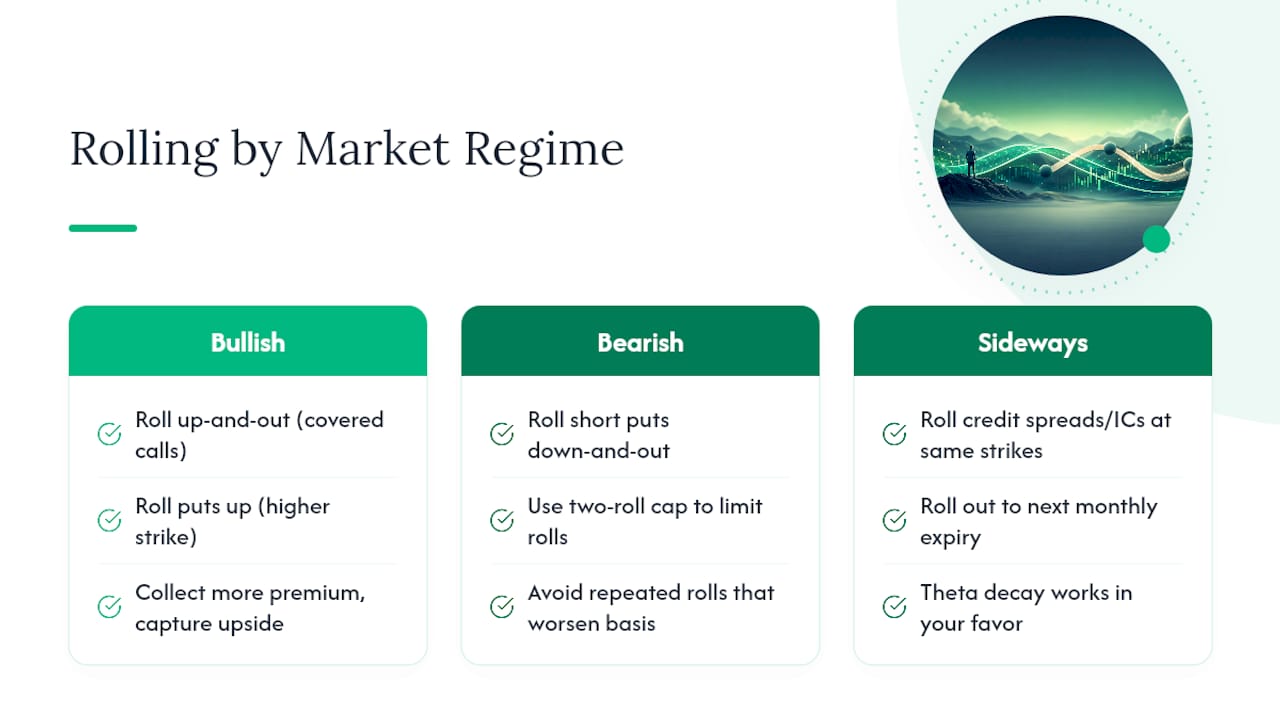
The right roll depends entirely on what the market is doing, not just what your position is doing. A roll up-and-out on a covered call makes sense during a genuine bull run, but the same roll during a choppy, range-bound market just chases a stock that's likely to fall back toward your original strike anyway.
In a bullish trend, rolling covered calls up and out captures more upside while keeping the position alive, and rolling cash-secured puts up (to a higher strike, same or later expiration) lets you collect more premium as the stock grinds higher.
In a bearish or declining market, the calculus flips. Rolling short puts down-and-out defends your position, but each roll down effectively concedes that the stock is weaker than you originally thought. This is where the two-roll cap earns its keep. A stock in a genuine downtrend will often blow through your rolled strike again, and a third roll is usually just delaying an inevitable close at a worse basis.
Sideways, range-bound markets are actually the friendliest environment for rolling credit spreads and iron condors, since theta decay works in your favor without directional risk forcing your hand. Rolling out to the next monthly expiration at the same strikes, for a small additional credit, is a routine and low-risk adjustment in this regime.
The common thread across all three conditions: rolling adjusts strike and time, but it never changes what the underlying is actually doing. If the market regime has genuinely shifted, from trending to choppy or calm to volatile, the smarter move is often reassessing the entire position rather than mechanically rolling into a market that's stopped resembling the one you built the trade for.
Software Tools and Platforms That Facilitate Rolling Options
Most major retail brokerage platforms now build rolling directly into the order ticket, letting you select an existing position and generate a pre-populated closing and opening leg in one multi-leg order. This single-ticket execution is exactly what avoids the legging risk discussed earlier, and it's become table stakes for any platform serious about active options trading.
Where platforms differ is in the analytics layered on top of that order ticket. Some show you the net credit or debit in real time as you adjust strikes and expirations before submitting. Others include probability-of-profit calculators that update as you test different roll structures, which is useful for checking whether a proposed roll actually improves your odds or just extends a losing thesis.
Beyond the broker's own tools, research platforms fill a different gap: flagging which of your positions are worth rolling in the first place, before you ever open the order ticket. That's a scoring problem, not an execution problem, and it's where a service that scans positions against thesis, DTE, and net-credit criteria each morning adds value that a bare-bones order ticket can't replicate on its own.
For traders doing their own due diligence on brokers or platforms, FINRA BrokerCheck is worth running before committing capital anywhere new, particularly if a platform advertises features that sound too good to be checked. Regulatory and exchange context on execution standards is also available through CBOE's regulatory resources, which cover how exchanges handle multi-leg order execution.
Case Studies Comparing Outcomes of Rolling Versus Closing Positions
Consider two traders holding the same short put position, both facing the identical 21 DTE checkpoint with the option worth $0.35 after being sold for $1.40.
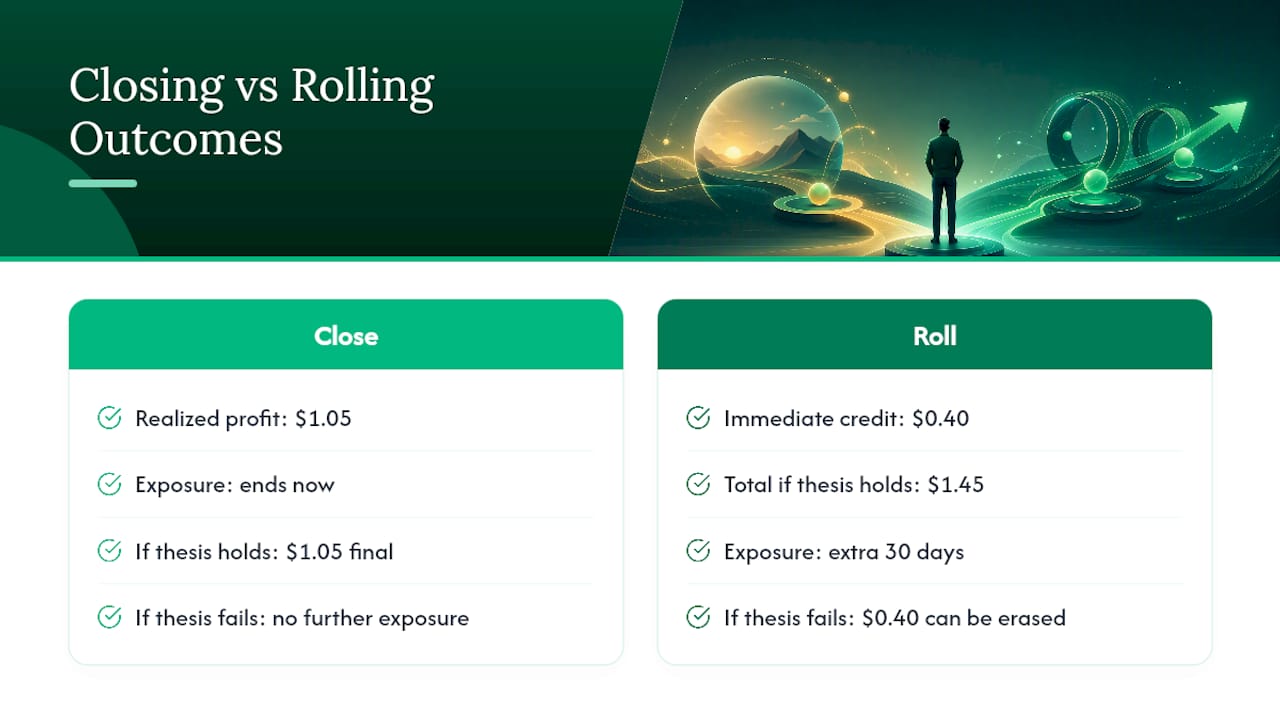
Trader A closes the position outright, banking $1.05 in realized profit, and moves on to a fresh setup elsewhere. Trader B rolls it out 30 days at the same strike for an additional $0.40 credit, betting the thesis still has room to run. If the stock cooperates and the new option also decays toward worthless, Trader B ends up with $1.45 total across both legs, beating Trader A's outcome by $0.40.
But if the stock reverses and the rolled put moves against Trader B, that extra $0.40 credit can get erased fast, and Trader B is now exposed for another 30 days on a position Trader A already closed clean. The roll wasn't wrong, but it converted a locked-in win into a new, open-ended bet.
The pattern holds across most side-by-side comparisons: rolling outperforms closing when the original thesis was correct and the stock continues cooperating. Closing outperforms rolling when the thesis was already shaky, since a fresh 30 day exposure window on a weakening setup just gives the market more time to prove the trade wrong. The decision framework's thesis check exists specifically to sort these two cases before you commit to either path.
Author's Perspective: Trader Rules I Follow When Deciding to Roll
The traders who roll well aren't smarter than the ones who blow up rolling. They just follow rules instead of feelings: verify the thesis every single time, prefer a credit, cap it at two rolls, and log every adjustment.
A rolling log sounds tedious until you're staring at your third consecutive roll on a losing position and the log makes the pattern undeniable. Discipline beats conviction here, every time.
— Customer
How Morningoptions Helps You Spot Roll Candidates Before the Open
Deciding whether to roll or close means checking thesis, DTE, and net credit on every open position, every morning, before the market moves against you. That's the exact workflow Morningoptions runs daily, flagging which positions in a subscriber's watchlist meet the criteria for a roll worth considering.

The free daily briefing gives you ranked, specific contract ideas with entry levels each market morning, no vague commentary. The Pro tier, at $89 per month or $742 per year, unlocks the lunchtime scanner and an AI chat scanner so you can research a specific ticker's roll candidacy on demand instead of waiting for tomorrow's briefing. If you're managing multiple short options and want a second set of eyes checking thesis and timing before the open, start with the free briefing at Morningoptions and see how the scoring lines up with your own checklist.
Sources
For procedural details beyond what's covered here, Fidelity's options exercise and roll guide explains broker-side mechanics, while the OCC's options disclosure document covers exercise and assignment rules directly. CBOE's regulatory resources address exchange execution standards, and Britannica's rolling explainer offers additional worked examples. Investor due diligence resources are also available through profi-forex.lt alternatives coverage.
- How to exercise, roll, and assign options | Fidelity
- Rolling Options: How It Works, Examples, & Strategies | Britannica
- Options disclosure and OCC materials
FAQ
What Is Warren Buffett's Favorite Option Strategy?
Buffett has publicly favored selling cash-secured puts on stocks he'd be happy to own anyway, collecting premium while waiting for a price he considers fair. It's a patient, income-generating approach rather than a speculative one, and it pairs naturally with rolling when the put moves close to the money but the underlying thesis hasn't changed.
Is Rolling an Option a Good Idea?
Rolling is a good idea when your original thesis is still intact and the roll brings in a net credit, since both conditions mean you're extending a trade that's still working rather than avoiding a loss. It's a poor idea when used to dodge admitting a position is wrong, which is why a two-roll cap and a documented thesis check matter.
Is It Better to Roll an Option or Let It Expire?
It depends on whether the thesis holds and whether a net credit is available; rolling extends a working trade, while letting an option expire (or closing it) locks in the current outcome. If you've already rolled twice on the same position, closing or letting it expire is usually the more disciplined choice regardless of thesis.
What Is the Most Successful Option Strategy?
There's no single strategy that outperforms across every market condition, but selling premium through covered calls and cash-secured puts, combined with disciplined rolling rules around 21 DTE and net-credit minimums, is one of the more consistently applied approaches among active retail traders. Morningoptions builds its daily scoring around exactly this kind of rules-based framework rather than one-off predictions.
How Many Times Should You Roll an Option?
Two rolls is the practical cap most experienced traders use before forcing a close, since a position that still needs adjusting after two rolls usually signals the original thesis has broken down. Rolling beyond that point tends to compound losses rather than manage them.