
Weekly options suit active traders chasing short-term income or fast directional moves, but only with a rule attached: lean on defined-risk premium selling when implied volatility is elevated, and switch to directional buying near 0.40 to 0.60 delta when it's cheap. Either way, cap risk at 1 to 2% of account equity per trade. Skip weeklies entirely if you can't watch a position through its final three days.
TL;DR:
- Weekly options experience rapid theta and gamma decay, especially in the last three days, increasing the importance of timely exits.
- Strategies should match volatility conditions, with low IV favoring directional buys and high IV suited for credit spreads and iron condors.
- Liquidity with tight bid-ask spreads and high open interest in large-cap underlyings is crucial for tradability and efficient exit.
- Position sizing, profit targets, and risk caps must be set at entry, with early hedging or closing before gamma spike days to avoid losses.
- Commissions and fees have a significant impact on returns due to high trade frequency and multi-leg strategies, requiring careful cost analysis.
Table of Contents
- What Makes Weekly Options Different From Monthly Contracts
- Five Weekly Strategies and When Each One Fits
- Picking the Right Underlying and Strike
- Position Sizing, Exits, and Assignment Risk
- Timing Your Entries and Avoiding Event Traps
- Three Trade Templates You Can Adapt This Week
- Where MorningOptions Fits Into a Weekly Trading Routine
- Tax Treatment You Need to Plan Around
- How Commissions Quietly Erode Weekly Options Returns
- What I've Learned Trading Weeklies: A Short Checklist
- Sources
What Makes Weekly Options Different From Monthly Contracts
Weekly options expire every Friday instead of on the standard monthly cycle, giving traders more expiration cycles per year than the standard monthly cycle. That frequency is why weekly options now account for a majority of total U.S. options trading volume: faster capital recycling means more chances to act on a thesis without waiting weeks for the next cycle.
The tradeoff is speed of decay. Theta and gamma both accelerate hard in a weekly's final stretch, and the mechanics differ from a monthly contract in ways that matter for entry and exit timing:
- Extrinsic value erodes fastest in the last three days before expiration, often losing the most of what's left in that window
- Gamma exposure spikes as expiration nears, meaning small stock moves cause outsized swings in the option's price
- Implied volatility can compress sharply around scheduled events, a phenomenon known as IV crush, hitting long option buyers particularly hard
That gamma acceleration is exactly why professional traders commonly close weekly positions two to three days before expiry rather than riding them to the final bell.
Five Weekly Strategies and When Each One Fits
Not every weekly setup calls for the same structure. Match the strategy to the volatility regime and your directional conviction, not the other way around.
- Long calls or puts. Best when implied volatility is low and you have a specific directional catalyst. Target 0.45 to 0.55 delta contracts so you're not paying for pure lottery-ticket odds. Risk is capped at premium paid, but IV crush after an earnings print can gut the position even if you're right on direction.
- Vertical spreads (debit or credit). A debit spread caps your directional risk cheaper than a naked long. A credit spread does the opposite: you collect premium and profit if the stock stays away from your short strike. Credit spreads are the better fit when IV percentile is elevated.
- Iron condors. Best in range-bound, high-IV environments where you expect the underlying to sit between two strikes through Friday. Max loss is defined at trade entry, which matters given how fast weekly gamma moves against you.
- Straddles and strangles. Useful only when you expect a big move but don't know direction, typically around earnings or a macro catalyst. These are the most vulnerable to IV crush after a scheduled event, so entering the day before a known catalyst is often a mistake rather than an edge. Our straddle strategy breakdown covers entry timing in more detail.
- Short premium (naked or covered). Reserved for traders with margin and risk tolerance for undefined-risk exposure, best avoided by most retail accounts trading weeklies given the gamma profile.
For credit trades, a widely used management rule is to take profits at 50% of the maximum credit collected and cap losses at a fixed percentage of account equity, commonly around 30% of max loss on debit trades.
Pro Tip: Set your profit-take and stop-loss orders the moment you enter the trade, not after you've watched the position move. Weekly gamma punishes hesitation.
Picking the Right Underlying and Strike
Liquidity determines whether a weekly strategy is tradable at all. A wide bid-ask spread eats your edge before the trade even starts, and thin open interest makes exiting early nearly impossible.
- Favor underlyings with tight bid-ask spreads and heavy open interest, which is why day traders and swing traders gravitate toward SPY, QQQ, and large-cap names for weekly expirations
- Check open interest at your specific strike, not just the underlying's overall volume; a popular stock can still have a dead strike
- Use IV percentile as your regime filter: high IV percentile favors selling premium, low IV percentile favors buying it
- Stick to the 0.40 to 0.60 delta band for directional buys, since a 0.50 delta option carries roughly a 50% probability of expiring in the money
- Sellers should target out-of-the-money short strikes with room for the stock to move against them without breaching the strike
- Avoid at-the-money naked long options close to expiration, where gamma risk is highest and theta decay is most punishing
Position Sizing, Exits, and Assignment Risk
Position sizing is the difference between a bad week and a blown account.
Exit discipline matters more with weeklies than with any other options timeframe, because there's no room to "wait it out."
- Take profits at 50% of maximum credit on short premium trades rather than holding for the full amount
- Set a hard stop at a defined maximum loss, often 30% of premium paid on long trades or a set dollar amount on spreads
- Close or roll positions by Wednesday or Thursday rather than holding into Friday's gamma spike
- Roll only when the underlying thesis is still intact and you can roll for a credit; don't roll simply to avoid taking a loss
- Watch for early assignment risk on short calls near ex-dividend dates, even on cash-secured positions
One statistic worth internalizing: professionals who exit two to three days before expiry aren't being cautious for no reason. That's the window where weekly contracts lose most of their remaining extrinsic value, and where a stock's move that would barely register on a monthly option can wipe out a weekly position entirely.
Timing Your Entries and Avoiding Event Traps
When you enter a weekly trade matters almost as much as which strike you pick, a decision that can be enhanced by using prediction markets signals alongside options catalysts and directional probability research.
- Enter positions Monday or Tuesday when possible, giving the trade room to work before gamma acceleration sets in Thursday and Friday.
- Avoid opening new weekly positions on Wednesday or later unless you have high conviction and a short holding horizon in mind.
- Skip or significantly downsize trades around earnings, Fed announcements, or major economic releases unless the trade is specifically structured to profit from the volatility event.
- Check IV percentile before and after scheduled events. Buying premium right before a catalyst, then watching IV collapse afterward, is one of the most common ways retail traders lose on weeklies even when they call the direction correctly.
- Use limit orders on every leg, keep size small enough to fill without moving the market, and re-check the position at midday for developing risk.
Three Trade Templates You Can Adapt This Week
Turning rules into templates makes them repeatable. Here are three structures built around the numbers already covered.
- Directional long call/put: Buy a 0.45 to 0.55 delta contract, target a 50 to 75% gain on premium, and set a hard stop at a 30% loss.
- Short credit spread: Sell an out-of-the-money spread sized so max loss equals roughly 1% of account equity, then close at 50% of collected credit.
- Iron condor: Structure both wings so combined max loss stays inside your 1 to 2% risk cap, and close the threatened side once it approaches 50% of its own max loss.
| Template | Delta / Strike Focus | Profit Target | Stop / Max Loss |
|---|---|---|---|
| Long call/put | 0.45–0.55 delta | 50–75% of premium | 30% of premium |
| Credit spread | OTM short strike | 50% of max credit | 1% of account equity |
| Iron condor | Both wings OTM | 50% of max credit | 1–2% of account equity |
Our options profit and loss workflow walks through the exact payoff math behind each of these templates if you want to model them before placing size.
Where MorningOptions Fits Into a Weekly Trading Routine
Some daily briefings build around this kind of decision tree: ranked trade ideas with entry levels, not vague commentary. A typical workflow looks like a pre-market scan of the day's briefing, a shortlist of two or three setups matching your delta and IV criteria, sizing at 1 to 2% risk, then a midday recheck using the lunchtime scanner before deciding whether to hold into the close.
Tax Treatment You Need to Plan Around
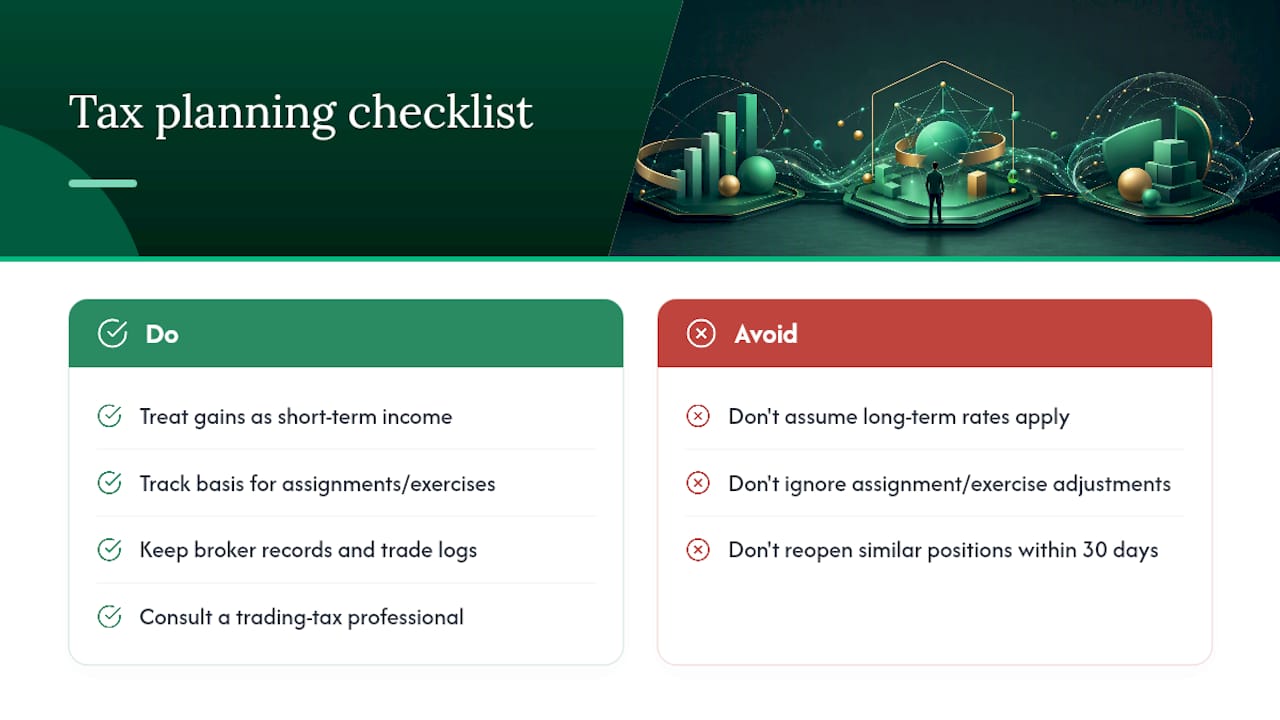
Weekly options generate short-term capital gains or losses in almost every case, since holding periods under a year (and weeklies rarely exceed seven days) don't qualify for long-term capital gains treatment. Short-term gains get taxed at ordinary income rates, which for active traders running dozens of weekly cycles a year can mean a meaningfully higher effective rate than a buy-and-hold investor pays.
Assignment adds another layer. If a short put gets assigned, the premium collected adjusts your cost basis in the resulting stock position rather than counting as an immediate gain. If a covered call gets exercised, the premium adjusts your sale proceeds. Get these wrong on your own tracking and your tax software will likely flag a mismatch against your broker's 1099-B.
Wash sale rules apply to options just as they do to stock. Closing a losing weekly position and reopening a substantially similar one within 30 days can disallow the loss for that tax year, which matters more for weekly traders than most because the short cycle length makes accidental wash sales easy to trigger without noticing.
None of this is a substitute for a conversation with a tax professional familiar with active trading, especially if your weekly volume is high enough to raise the question of trader tax status. But the baseline expectation for any retail trader running a weekly income approach should be short-term rates on nearly everything, with basis adjustments on anything that gets assigned or exercised rather than closed outright.
How Commissions Quietly Erode Weekly Options Returns
Commission structure matters more in weekly trading than in almost any other options timeframe, purely because of trade frequency. A trader running 40 weekly cycles a year on a four-leg iron condor is generating 160 option legs annually, and even a small per-contract fee compounds fast across that volume.
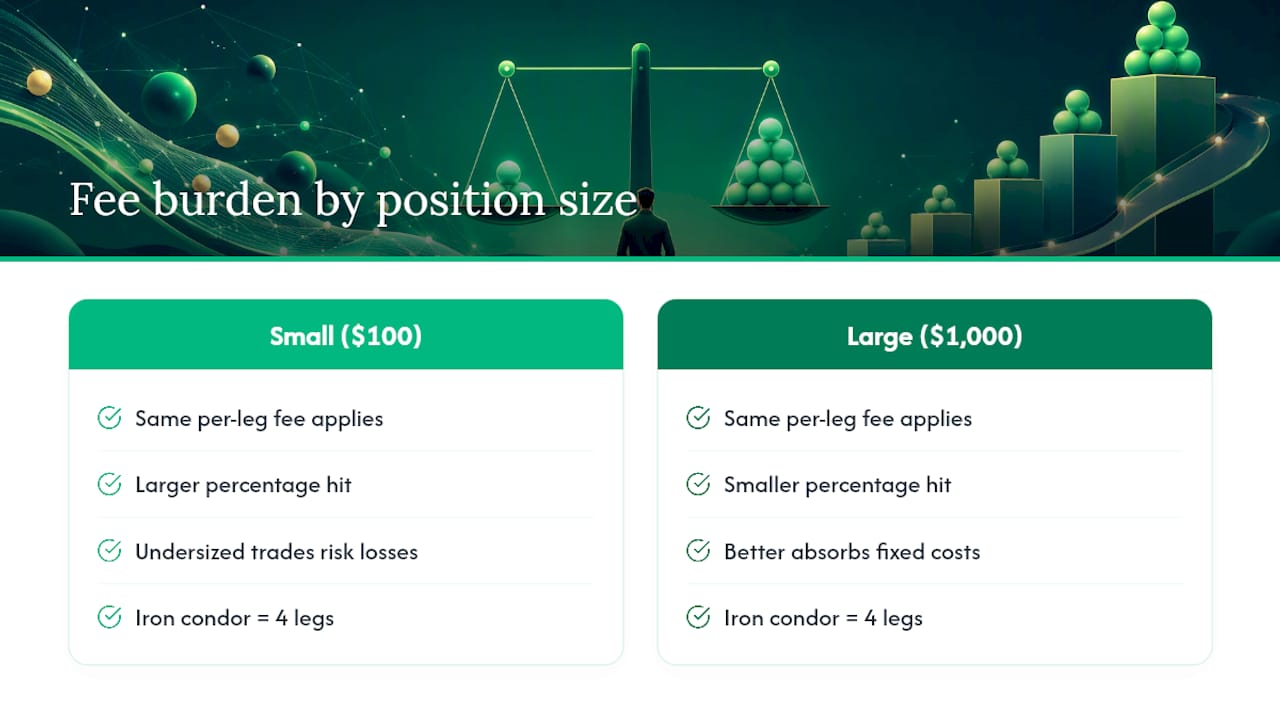
Multi-leg strategies are where this bites hardest. A single iron condor involves four separate legs, each carrying its own commission and, at many brokers, a separate options regulatory fee. If each leg costs even a modest per-contract fee, that adds up before the trade has moved a single cent in your favor. On a credit spread targeting a 50% profit-take rule, fees eat directly into that 50%, sometimes shaving several percentage points off the realized return on smaller position sizes.
The math gets worse the smaller your position size gets. A trader risking $100 on a single-contract spread absorbs a much larger percentage hit from fixed per-contract fees than a trader risking $1,000 on the same structure. This is part of why position sizing and cost structure need to be considered together rather than separately. Undersized weekly trades running through a fee structure not built for high-frequency, multi-leg trading can turn a statistically sound strategy into a losing one purely on execution cost, even when the underlying edge is real.
Before committing to a weekly income approach, run your expected trade frequency and typical leg count against your broker's actual fee schedule. It's the kind of math that's easy to skip and expensive to ignore.
What I've Learned Trading Weeklies: A Short Checklist
Three rules keep a weekly options account alive: enter Monday or Tuesday, never Friday morning on a whim. Cap risk at 1 to 2% of the account per trade, no exceptions for "high conviction." Exit or reassess by Thursday, before gamma acceleration takes the decision out of your hands. Some daily briefings work well as the shortlist step in that routine. Before every trade: check delta, check IV percentile, check the calendar for events, check position size against account equity.
— Customer
Ready to build your own weekly rotation without staring at five screens before the open? Morningoptions delivers ranked, specific weekly trade ideas every market morning, with entry levels and bear case analysis built in, plus a Pro tier that adds a lunchtime scanner and an AI chat scanner for researching any ticker on demand.
This article is general information, not a substitute for advice from a qualified financial advisor. Consult a qualified financial professional about your own circumstances before acting on anything here.
Sources
- Weekly options: how they work, advantages and disadvantages — Investopedia
- Swing trading with weekly options — Ticker Daily
- How to trade weekly options for consistent income — ClimbTheLadder
- Options strategies — CFA Institute (2026 refresher reading)