
A trading thesis is a written, evidence-based rationale that explains why you are entering a specific trade, what conditions keep it valid, and what events would force you to exit. Think of it as the written contract you make with yourself before you risk a single dollar. Without one, every trade decision defaults to gut feel, and gut feel is not a repeatable edge. Active options traders who build a clear thesis before entering a position make faster, calmer decisions when the market moves against them. The concept maps directly to what institutional investors call a "position thesis" or "investment hypothesis," and the same discipline applies at the retail level.
What is a trading thesis, and why does it matter?
A trading thesis is defined as a structured, written document that answers three questions: why does this trade exist, what would prove it right, and what would prove it wrong. Best practices in 2026 trading frameworks organize this into four core elements: a hypothesis, key assumptions, falsification criteria, and instrument mapping. That four-part structure is not arbitrary. It forces you to think through the full life cycle of a trade before capital is at risk.
The importance of a trading thesis becomes obvious the moment a position moves against you. Without a written rationale, you improvise. You rationalize holding a losing trade because the stock "feels like it should bounce." With a thesis, you already know the exact condition that kills the trade, and you act on it without debate. That is the difference between a disciplined trader and one who turns a small loss into a large one.

Institutional frameworks identify psychological errors as the primary cause of trading losses, not bad market calls. A thesis controls those errors by anchoring your decisions to logic written before emotion entered the picture.
What are the essential components of a trading thesis?
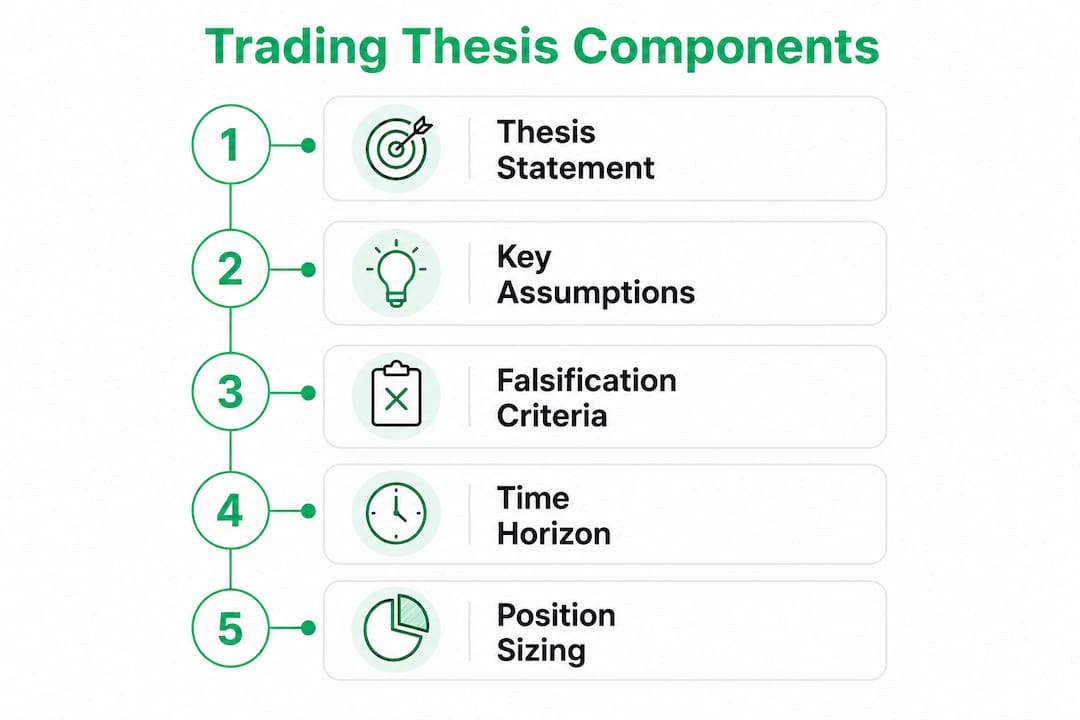
A well-built trading thesis contains five core components. Each one serves a specific function in keeping your decision-making rational.
| Component | Description |
|---|---|
| Thesis statement | One sentence stating the directional hypothesis and expected outcome |
| Key assumptions | The market conditions and data points the trade depends on |
| Falsification criteria | Specific events or price levels that invalidate the thesis |
| Time horizon | The expected duration aligned to your trade type |
| Position sizing rationale | How much capital to risk, tied to your conviction level |
The thesis statement is the anchor. It should read like a testable claim: "NVDA calls will appreciate over the next 14 days because data center demand is accelerating ahead of Q2 earnings." Every other component flows from that sentence.
Key assumptions are the conditions the trade relies on. For an options trader, these might include implied volatility staying below a certain level, a catalyst arriving on schedule, or a sector trend holding. Listing assumptions forces you to see where the trade is fragile.
Falsification criteria are the most underused component. Top institutional traders treat every position as a falsifiable hypothesis with specific kill criteria. For a retail options trader, a falsification event might be a failed earnings beat, a regulatory announcement, or a break below a key support level.
Pro Tip: Write your falsification criteria before you write your entry plan. If you cannot name two specific events that would kill the trade, you do not understand it well enough to take it.
Time horizon alignment is where many retail traders fail. A thesis built on a quarterly earnings catalyst does not justify holding a position through a two-week technical correction. The horizon defines which data matters and which noise you can ignore.
Position sizing ties conviction to capital. A thesis with three solid assumptions and a clear catalyst warrants more size than one built on a single data point. Linking size to thesis quality is one of the most direct ways to evaluate options trade ideas with discipline.
How to create a trading thesis: step-by-step for options traders
Building a thesis does not require hours of research. A focused process takes 10–20 minutes and produces a document you can reference throughout the trade's life.
-
Identify the catalyst or market driver. Start with what is actually moving the market. Policy changes, supply shocks, earnings revisions, and sector rotations all qualify. Pinpointing the driver gives your thesis a factual foundation. Options pipeline research is one structured way to surface these drivers before the open.
-
Write a one-sentence hypothesis. State the direction, the instrument, and the reason. Keep it specific enough to be falsifiable. "SPY puts will gain value over the next 5 days because CPI data will come in above consensus" is testable. "The market looks weak" is not.
-
Map the thesis to the right instrument and strike. Elite fund managers use fundamentals for conviction and technical analysis for execution. Apply the same split: use your thesis to pick direction and duration, then use technicals to select the strike and expiration that match your expected move.
-
Set entry, exit, and invalidation rules. Write the exact price level or event that triggers your entry. Write the profit target. Write the stop. These three numbers are non-negotiable before you place the order.
-
Write a pre-trade note. A brief paragraph explaining the trade in plain language. If you cannot write a coherent pre-trade note in under 3 minutes, you likely do not understand the setup well enough to trade it. This is not a test of writing skill. It is a test of trade clarity.
-
Log the thesis and review it. Store every thesis in a trading journal or spreadsheet. After the trade closes, compare what you wrote to what actually happened. That review loop is where real skill development occurs. Tracking trades systematically turns individual trades into a learning database.
Pro Tip: Feeling urgent to enter a trade before finishing your thesis is a red flag, not a green light. That urgency signals insufficient understanding of the setup. Slow down, finish the thesis, or skip the trade.
Why a trading thesis is critical for decision-making and risk management
A trading thesis does four things that no trading tool or indicator can replicate.
- It removes impulsive decisions. When you have a written rationale, you are not reacting to price action. You are comparing price action to a pre-set framework. That comparison takes seconds and removes the emotional charge from the decision.
- It defines rational exit rules. Traders who hold losing positions too long almost always lack a written invalidation condition. The thesis makes the exit rule visible before the loss starts growing.
- It scales position sizing to conviction. A thesis with strong, multi-source assumptions justifies larger size. A thin thesis with one weak assumption justifies minimal size. This is how professional risk management works at the retail level.
- It prevents thesis drift. Thesis drift happens when you start using a long-term rationale to justify holding a short-term trade past its intended horizon. Using long-term rationales to justify holding short-term trades is a common and costly error. A written thesis with a clear time horizon stops this before it starts.
"Thesis writing forces articulation of reasoning prior to risking capital, preventing ego-based bias shifts after market moves. This psychological control is a discipline highlighted by leading investors like Howard Marks."
The psychological benefit is real and measurable in behavior. Well-built theses act as psychological control tools that enforce rational trading and prevent bias shifts after price moves. When the market drops 2% and your thesis says "hold unless X happens," you hold without panic. When X happens, you exit without hesitation.
How to adapt and maintain your trading thesis over time
A trading thesis is a living document, not a one-time exercise. A position thesis requires regular review to stay aligned with evolving market conditions. The review schedule should match the trade's time horizon.
- Daily review for short-term trades. Check whether the catalyst is still intact. Confirm that implied volatility and price action match your assumptions. If a key assumption breaks, update or close the thesis.
- Weekly review for swing trades. Assess whether new fundamental data has changed the picture. Look at sector trends and macro data that affect your assumptions. Adjust position sizing if conviction has changed.
- Monthly review for longer-term positions. Evaluate whether the original thesis still holds or whether you are holding out of hope rather than logic. This is where thesis drift most often appears.
Adapting a thesis is not a sign of weakness. It is the correct response to new information. The error is changing a thesis because the price moved against you, not because the underlying logic changed. Price movement alone is not a reason to abandon a well-built thesis. New data that contradicts a key assumption is.
Pro Tip: Create a simple "thesis scorecard" for each open position. Rate each assumption as intact, weakened, or broken on a weekly basis. When two or more assumptions are broken, the thesis is dead regardless of where the price sits.
Matching the thesis time horizon to evidence-gathering frequency prevents the common mistake of applying long-term logic to short-term trades. A thesis built on a quarterly earnings catalyst should not be reviewed using daily price charts as the primary input. Use the data type that matches the thesis type.
Key Takeaways
A trading thesis is the single most effective tool for separating disciplined options trading from reactive, emotion-driven speculation.
| Point | Details |
|---|---|
| Core definition | A trading thesis is a written, evidence-based rationale covering why, when, and how to exit a trade. |
| Five components | Every thesis needs a hypothesis, assumptions, falsification criteria, a time horizon, and a position size rationale. |
| Psychological control | Writing a thesis before entry prevents ego-based bias shifts and impulsive decisions after price moves. |
| Living document | Review your thesis on a schedule that matches the trade's time horizon, daily, weekly, or monthly. |
| Urgency as a warning | Feeling pressure to enter before finishing your thesis signals insufficient trade understanding. |
The habit that changed how I trade
The most underrated part of building a trading thesis is not the framework. It is the act of writing it down before you touch the order ticket. I spent years thinking I had a thesis because I had a reason in my head. That is not a thesis. That is a feeling with a story attached to it.
The shift happened when I started writing a three-sentence pre-trade note for every position. Hypothesis, invalidation condition, time horizon. Three sentences. What I found was that roughly one in four trades I thought I understood, I could not actually write those three sentences for. That alone cut my losing trades significantly, not because I found better setups, but because I stopped taking setups I did not actually understand.
The psychological benefit is harder to quantify but just as real. When you have a written thesis, a 3% move against you is not a crisis. You check the thesis. If the invalidation condition has not triggered, you hold. If it has, you exit. The decision is already made. That calm is not a personality trait. It is a process.
For traders who struggle with impulsive entries, the fix is not more discipline in the abstract. The fix is a written thesis completed before the order is placed. Make it a rule with no exceptions. The trades you skip because you cannot finish the thesis are often the ones that would have hurt you most.
— Customer
How Morningoptions supports your trading thesis process

Building a thesis requires knowing which trades are worth analyzing in the first place. Morningoptions delivers AI-powered daily trade ideas every morning before the open, each one ranked and scored through a five-AI pipeline that vets conviction, entry levels, and strategy fit. That structured research gives you a starting point for your own thesis rather than a blank page. The free daily briefing covers the top setups of the day. The Pro tier at $89/month adds a lunchtime scanner and an on-demand AI chat scanner for researching specific tickers as your thesis evolves. If you want thesis-grade research without spending hours on it, Morningoptions is built for exactly that workflow.
FAQ
What is a trading thesis in simple terms?
A trading thesis is a written statement that explains why you are entering a trade, what would prove it right, and what would force you to exit. It replaces gut-feel decisions with a pre-set logical framework.
How long should a trading thesis be?
A trading thesis for an active options trade can be as short as three to five sentences covering the hypothesis, key assumptions, and invalidation criteria. Length matters less than clarity and specificity.
What makes a good trading thesis?
A good trading thesis is specific, falsifiable, and time-bound. It names the catalyst, states the expected outcome, and defines at least one concrete event that would invalidate the position.
How often should you update your trading thesis?
Update your thesis whenever new data challenges a key assumption, not simply because the price moved. Short-term trades warrant daily reviews, while swing trades benefit from weekly reassessment.
What is the difference between a trade setup and a trading thesis?
A trade setup describes the technical conditions that trigger an entry. A trading thesis explains the underlying rationale, expected duration, and exit logic that give the setup its meaning and context.