
In most high-IV regimes, the statistical edge favors selling premium. Defined-risk credit spreads and iron condors, run at 30–45 days to expiration with reduced size, capture inflated premium and benefit as volatility mean-reverts. Buying volatility only makes sense for narrow, binary-event setups where the expected move plausibly exceeds what's already priced in.
TL;DR:
- Selling defined-risk credit spreads and iron condors at 30–45 days to expiration is the safest way to profit from high implied volatility regimes.
- Confirm the underlying's IV rank is above 50 and ideally over 70, with good liquidity, before constructing high-IV credit strategies.
- Use smaller position sizes—around 75% of normal—and limit total risk to about 20% of your account to avoid big losses from unexpected moves.
- Buy volatility only for specific catalyst events like earnings or FDA decisions, and avoid it during general high-IV conditions due to unfavorable pricing.
- Close positions at 50% of max profit or when the short strike delta roughly doubles, with strict risk management rules to prevent account blowups.
Table of Contents
- Which High IV Strategies Options Traders Should Use First
- How Do You Set Up Iron Condors and Credit Spreads in High IV?
- When Should You Buy Volatility Instead of Selling It?
- How Do You Measure "High" IV Before You Trade It?
- How Should You Trade Options Around Earnings?
- What Risk Rules Keep High-IV Trading From Blowing Up an Account?
- How MorningOptions Screens for High-IV Trade Setups
- Tax Implications of Trading High IV Premium Strategies
- Integrating High-IV Rules Into a Trading Program
- Trade the Setups This Guide Describes, Every Market Morning
- Sources
- FAQ
Which High IV Strategies Options Traders Should Use First
If you're deciding where to start, rank your choices by risk profile and account size before you rank them by premium collected. High implied volatility inflates every options price on the chain, so the question isn't whether premium is rich. It's which structure lets you collect it without a single bad print wrecking your month.
- Defined-risk sellers (iron condors, credit spreads). These are the default for most traders. You cap your loss at entry, know your max risk before the trade fills, and can run several at once across uncorrelated tickers without blowing through margin.
- Short strangles and short straddles. These collect the fattest premium and often the highest win rate, but the risk is undefined. Selling a strangle naked demands real margin capacity and the discipline to close or adjust fast when the underlying moves against you, as Fidelity's volatility strategy guide points out this when comparing strangle structures to their defined-risk cousins.
- Long straddles and long strangles. Reserve these for event-driven bets where you have a specific thesis that realized volatility will outrun implied volatility. This is the exception, not the rule, in a high-IV tape.
- Covered calls and cash-secured puts. If you already hold the stock or want to own it at a discount, elevated IV means fatter premium on both sides. It's a lower-octane way to monetize high IV without opening a new directional bet.
Match the strategy to your account size and temperament first. A $5,000 account and a $500,000 account shouldn't be running the same structure just because IV rank says "sell."
How Do You Set Up Iron Condors and Credit Spreads in High IV?
Start with the screen, not the trade. Before you even look at strikes, confirm the underlying's IV rank sits above 50, ideally north of 70 for the richest credits. IV rank measures where current implied volatility sits relative to its own 12-month range, and practitioner guides commonly use those same thresholds to separate "elevated" from "expensive." Skip anything with wide bid/ask spreads or thin open interest. A juicy-looking credit means nothing if you can't get filled near the mid.
Here's the sequence that turns a screen into a filled trade:
- Filter for IV rank above 50 and confirm the name has decent options volume and open interest.
- Pick 30 to 45 days to expiration. This window balances theta decay against gamma risk. Shorter-dated options decay faster, but gamma risk spikes as expiration nears, meaning small stock moves swing your P&L disproportionately.
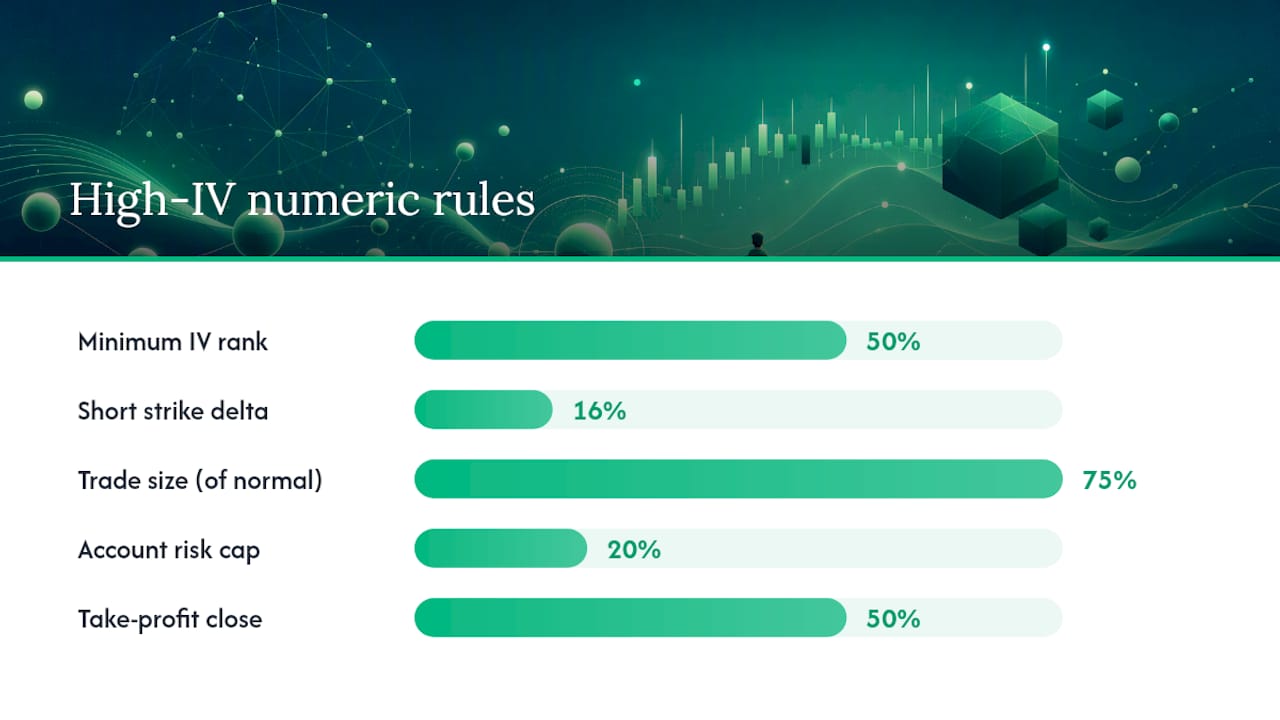
- Set short strikes around the 16 delta for iron condors, adjusting further out-of-the-money in especially high IV since inflated premium lets you widen your safety margin without giving up much credit.
- Size the trade at roughly 75% of your normal position size. High IV means bigger expected moves, and cutting size protects you if the underlying gaps against the short strike.
- Cap total exposure. Keep no more than about 20% of your account at risk across all open short-premium positions at once.
- Set the exit before you enter: close at 50% of max profit, and treat a loss equal to roughly 2x the credit received as your signal to cut, roll, or hedge.
Selling volatility works because IV tends to mean-revert, so sellers who enter at elevated IV rank benefit from both time decay and a likely contraction in the volatility component of the option's price. That's a two-way tailwind that buyers of premium simply don't get in the same environment.
Rolling makes sense when the short strike is tested but your thesis hasn't broken. Closing makes sense when the move blows through your adjustment point or IV rank has dropped so far that the remaining credit isn't worth the risk.
Pro Tip: Widen your short strikes slightly further out-of-the-money than you would at the same delta in a low-IV environment. You're still targeting 16 delta, but the absolute price move to breach that strike is larger when IV is elevated, giving you a bigger cushion for the same credit.
When Should You Buy Volatility Instead of Selling It?
Buying volatility only makes sense when you have a specific, binary catalyst and a reasoned belief that the actual price move will outpace what the option chain is already pricing in. Earnings releases, FDA rulings, merger votes, and major litigation outcomes are the classic setups. Outside of those windows, buying premium in a high-IV market usually means paying a rich price for a decay clock that's working against you.
A long straddle (buying a call and a put at the same strike) or a long strangle (buying a call and a put at different strikes) profits from a large move in either direction, and a strangle typically costs less than a straddle but needs a bigger move to break even. Before placing either, run the math on the implied move (what the option prices suggest the stock will do) against your own estimate of the likely realized move. If those numbers are close, you're paying full price for a coin flip.
A few ways to bring the cost down without abandoning the thesis:
- Use debit spreads instead of naked long options when you have a directional lean alongside the volatility bet, capping your cost and reducing the drag from time decay.
- Skew your strikes toward the direction you find more probable rather than buying a perfectly symmetrical straddle.
- Layer in a calendar-style hedge by selling a near-term option against a longer-dated one you own, though this only works cleanly when the term structure supports it.
- Predefine your exit before the event. Set a price-move target and a vega-change threshold (how much the option's value will shift per point of IV change) so you're not making decisions in the middle of a violent tape.
Calendars deserve a specific warning here: buying a long-vega structure right before a known IV spike often means selling into the post-event crush at exactly the wrong moment, since calendars lose value when IV contracts, which is precisely what happens after most binary events resolve.
How Do You Measure "High" IV Before You Trade It?
IV rank above 50 is the baseline signal that options premium is elevated relative to the stock's own history, and readings above 70 mark genuinely rich conditions where sellers can collect outsized credits relative to risk. But rank alone can mislead you if you stop there.
- Check absolute IV, not just rank. A utility stock with an IV rank of 80 might carry an absolute IV of 22%, while a small-cap biotech with the same rank could sit at 90%. Rank tells you where IV sits relative to itself; absolute IV tells you what you're actually being paid.
- Compare front-month IV to back-month IV. This term-structure check reveals whether near-term options are unusually rich (often around a known event) or whether the whole curve is elevated, which changes which expiration cycle you should target.
- Confirm liquidity before trusting the number. Thin names produce noisy, unreliable IV readings, and wide spreads eat into any theoretical edge the screen suggests.
- Cross-reference IV percentile alongside rank when a stock's IV history is skewed by one extreme event, since rank alone can overstate how "normal" high actually is for that name.
How Should You Trade Options Around Earnings?
Earnings and other binary events push IV to its yearly extremes right before the print, then collapse it almost immediately after, a pattern traders call IV crush. That crush is exactly what makes premium selling profitable around earnings, and exactly what makes it dangerous if you're on the wrong side of the actual move.
- Size down before you size up. Even a defined-risk structure can hurt if the realized move is bigger than your model expected, so cut your normal position size for any trade held through an earnings print.
- Favor defined-risk structures across the event. Naked short strangles into earnings can work, but a single surprise report can produce losses that dwarf months of collected premium.
- Build a pre-event checklist. Confirm liquidity, set intraday price alerts, decide your order types in advance, and write down your stop and take-profit levels before the report drops, not after.
- Consider a small long-vega hedge, such as VIX calls or back-month puts, if you're running a book heavy with short premium. It won't offset every loss, but it blunts the tail risk from a market-wide volatility shock hitting all your positions at once.
What Risk Rules Keep High-IV Trading From Blowing Up an Account?
The strategies matter less than the guardrails around them. High IV means bigger dollar swings on the same percentage move, and the traders who survive a volatile stretch are the ones who capped their exposure before it got tested.
- Cap total risk at roughly 20% of account value across all open short-premium positions combined, not per trade.
- Size individual high-IV trades at about 75% of what you'd risk in a calmer market, since the same delta target now sits behind a wider expected range.
- Adjust or close once delta on your short strike roughly doubles from entry, a sign the underlying has moved meaningfully against your original thesis.
- Set alerts for IV rank changes, not just price, since a sharp drop in IV can hand you your 50% profit target well before the underlying moves at all.
- Watch assignment risk closely on covered calls and cash-secured puts when IV is elevated, since early assignment becomes more likely around dividends and deep in-the-money strikes. Morningoptions's guide to assignment mechanics breaks down what actually triggers it.
Pro Tip: Treat IV rank as a second monitoring metric alongside P&L. A position can hit your profit target on an IV crush alone, even if the stock hasn't moved, and closing early on that basis locks in a win you might otherwise give back.
How MorningOptions Screens for High-IV Trade Setups
A repeatable screen beats a gut feeling every time volatility spikes. The baseline filter starts with IV rank above 50, a 30 to 45 day expiration window, and a liquidity check on bid/ask spread before any strike selection happens. From there, the standard iron condor template uses a 16-delta short strike as a starting point, widened further out-of-the-money as IV climbs.
- Screening rule: IV rank > 50, 30–45 DTE, tight spreads, 16-delta baseline for condor construction.
- Sizing formula: 75% of standard position size in elevated IV, with total short-premium exposure capped near 20% of account value.
- Exit rule: close at 50% of max profit; treat a loss near 2x the credit received as the signal to act.
- Reference material: the full breakdown of 30–45 DTE iron condor construction and the broader options strategies for volatile markets walk through the same logic in more depth. Pairing this with TradingView's risk management and alerting setup covers the monitoring side once a trade is live.
Tax Implications of Trading High IV Premium Strategies
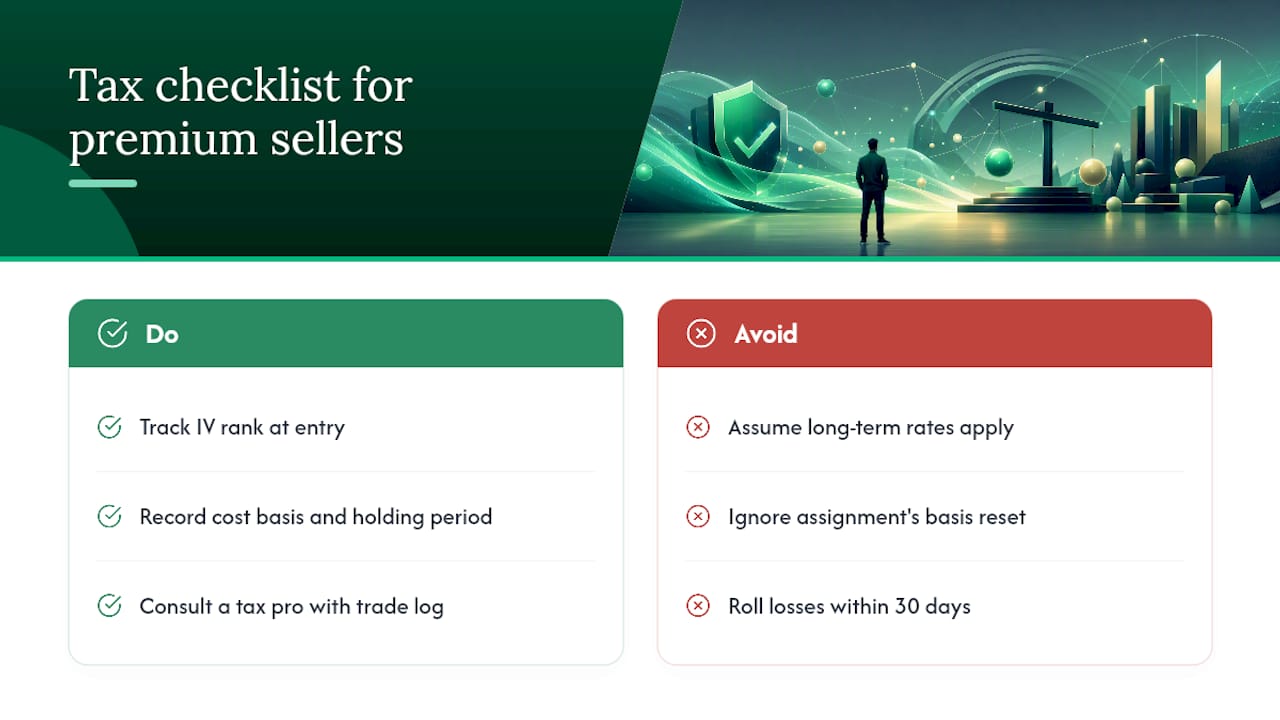
Most short-term options premium falls under short-term capital gains treatment, since positions built around 30 to 45 day expirations rarely clear the one-year holding period that qualifies for long-term rates. That means gains from iron condors, credit spreads, and short strangles are typically taxed at your ordinary income rate, not the lower long-term capital gains rate.
Assignment complicates things further. If a short put gets assigned and you end up holding shares, your cost basis adjusts to reflect the premium collected, and the clock on any future long-term holding period starts fresh from the assignment date. Covered calls carry their own wrinkle: writing a call against stock you already hold can, in some cases, affect the holding period of the underlying shares if the call is deep in-the-money, a rule the IRS treats under "qualified covered call" provisions.
Wash sale rules can also snag active premium sellers who roll losing positions repeatedly on the same underlying within a 30-day window. Rolling a credit spread to a new expiration after a loss might trigger a wash sale disallowance depending on how the new position is structured.
None of this is a substitute for a conversation with a tax professional who can look at your actual trade log, but it's worth tracking IV rank at entry alongside your cost basis and holding period for every trade. That record makes reconciling a busy year of premium selling far less painful come filing season.
Integrating High-IV Rules Into a Trading Program
The rules in this guide work best as a rotation, not a one-time checklist. When IV rank confirms an elevated regime across your watchlist, shift more of your allocation toward defined-risk selling and keep a small reserve earmarked for long-volatility hedges around known events.
Journaling matters more than most traders admit. Log the IV rank at entry, the delta you sold, and the DTE for every trade, then review that log monthly to see which parameters actually produced your best risk-adjusted results. Execution discipline, the 50% exit, the sizing caps, the pre-event checklists, does more for your account than any theoretical edge ever will. The edge only pays off if you're still in the game to collect it.
— Customer
Trade the Setups This Guide Describes, Every Market Morning
Screening for IV rank above 50, checking DTE windows, and filtering for liquidity before every trade takes time most active traders don't have before the opening bell. A multi-step AI pipeline can vet, score, and rank trade ideas daily, delivering specific contract suggestions with entry levels instead of vague commentary.

The free daily briefing gets you ranked ideas before the open at no cost. The Pro tier, $89 per month or $742 per year, adds the lunchtime scanner and an AI chat scanner for researching any ticker's IV setup on demand, the same kind of screen this article walked through manually. If you're running the 30–45 DTE, IV-rank-filtered approach described above, check today's briefing and see how the ranked ideas compare to what you'd build by hand.
Sources
For deeper reading on the mechanics covered here, the OCC's Options Disclosure Document covers formal risk disclosures every options trader should review. Fidelity's strangle strategy explainer and Investopedia's volatility trading strategies guide add further detail, and SIPC offers broker verification resources worth checking before funding any account.
This article is general information, not a substitute for advice from a qualified financial advisor. Consult a qualified financial professional about your own circumstances before acting on anything here.
- Taking advantage of volatility with options
- Trade Volatility Like a Pro: 5 Essential Options Strategies
FAQ
What Options Have the Highest IV?
Stocks facing binary catalysts, biotech names awaiting FDA decisions, companies in the middle of merger speculation, and heavily shorted stocks tend to carry the highest implied volatility. IV also spikes broadly during earnings season and market-wide stress events, pushing even normally calm large-cap names into elevated IV rank territory.
What IV Is Too High for Options?
There's no fixed number that makes IV "too high," but an IV rank above 70 signals very elevated premium where the underlying is pricing in a large expected move. At that level, sellers should size down and stick to defined-risk structures like iron condors, since a rank that high often means the market is bracing for a genuine surprise, not just routine noise.
What Is the Best Option Strategy for High Volatility?
For most traders, defined-risk credit spreads and iron condors run at 30–45 DTE with an IV rank above 50 offer the best balance of premium collected versus capped risk. Short strangles collect more premium but carry undefined risk, making them better suited to traders with more margin capacity and experience managing fast-moving positions.
What Is Warren Buffett's Favorite Option Strategy?
Buffett has publicly discussed selling cash-secured puts on stocks he'd be willing to own at a lower price, collecting premium while setting a target entry point. That approach lines up with the broader premium-selling logic in this guide: getting paid to wait, rather than paying for the chance that something dramatic happens.